
20kV Medium Voltage Reeling Cable Selection Guide: High-Output Power Delivery for Ultra-Heavy Australian Mining Machinery
Explore 20kV medium voltage reeling cables for bucket wheel excavators, draglines, and large conveyors, with key selection factors for long-distance mining power supply.
hongjing.Wang@Feichun
7/23/202612 min read
The continuous evolution of open-cut mining operations across Australia—from the expansive coal seams of Queensland’s Bowen Basin to the massive iron ore deposits of Western Australia’s Pilbara region—has driven an unprecedented increase in equipment scale. Ultra-heavy mining machines such as draglines, bucket wheel excavators, long-distance overland shiftable conveyors, and stacker reclaimers require immense electrical power to maintain continuous, high-tonnage material handling.
As machine power demands escalate into multi-megawatt thresholds, traditional low-voltage and lower-medium-voltage distribution networks (such as 3.3kV, 6.6kV, or 11kV) hit physical and operational limits. Carrying multi-megawatt loads at lower voltages requires thick, heavy copper conductors that create excessive voltage drops over long bench runs and impose unbearable weight loads on dynamic cable reeling drums.
To overcome these constraints, mine electrical architects and original equipment manufacturers (OEMs) increasingly turn to 20kV medium-voltage reeling cable systems. Operating at 20kV provides a step-change in power density, allowing continuous multi-megawatt energy delivery over extended physical distances with significantly reduced line currents, lower thermal resistive losses, and manageable overall cable dimensions.
This guide offers a deep technical analysis of the engineering logic, electrical physics, mechanical resilience factors, material construction choices, and operational criteria required when selecting and deploying 20kV medium-voltage reeling cables in Australian open-cut mining.
1. Why Choose 20kV?
The engineering justification for stepping up power distribution to a 20kV class is rooted directly in fundamental alternating current power transmission physics. In any three-phase electrical installation, the continuous active power delivered to the load is governed by the standard three-phase power equation:
$$P = \sqrt{3} \times U \times I \times \cos(\phi)$$
In this mathematical relationship:
$P$ represents active power in Watts.
$U$ represents the phase-to-phase system line voltage in Volts.
$I$ represents line current in Amperes.
$\cos(\phi)$ represents the overall operating power factor of the load.
When the power demand of a mega-machine is fixed, system line current is inversely proportional to system voltage. Elevating the supply voltage from a traditional 6kV standard to a 20kV medium-voltage class reduces the required operational line current by a factor of more than three for the exact same megawatt throughput.
Quantitative Mathematical Demonstration
Consider a large dragline or high-capacity bucket wheel excavator drawing a continuous operational load of 5000 kW (5 MW) at a typical heavy-inductance power factor of 0.85:
At a 6kV Operating Voltage: The continuous three-phase line current required to feed the machine is approximately 566 Amperes.
At a 11kV Operating Voltage: The line current drops to approximately 309 Amperes.
At a 20kV Operating Voltage: The line current drops down to approximately 170 Amperes.
Reducing continuous operating current from 566 Amperes to 170 Amperes completely alters the physical design parameters of the flexible umbilical cable. Carrying nearly 570 Amperes continuously in dynamic outdoor reeling conditions requires heavy phase conductors with cross-sections often exceeding 185 or 240 square millimetres. Such massive conductors create a thick, heavy, and rigid cable structure that is difficult to spool onto machine reels. Conversely, feeding that same 5 MW load at 20kV allows engineers to select flexible 50 or 70 square millimetre conductors, keeping overall cable mass and outer diameter well within manageable mechanical limits.
2. Lower Current, Higher Efficiency
Lowering continuous line current delivers critical thermodynamic and economic benefits for mine sites operating continuously in remote Australian pits. Electrical power loss within any conductor—manifested as heat—is governed by Joule’s Law:
$$P_{\text{loss}} = 3 \times I^2 \times R$$
Where $I$ is line current and $R$ is active AC conductor resistance at operating temperature.
Because resistive energy dissipation scales with the square of the current ($I^2$), cutting operating current by a factor of more than three reduces internal thermal dissipation by a factor of nearly ten for a given conductor size.
Operational and Thermal Advantages
This massive reduction in internal thermal losses delivers three immediate practical advantages:
First, energy efficiency increases substantially. In multi-megawatt mining infrastructure operating twenty-four hours a day, hundreds of kilowatts of energy otherwise wasted as resistive cable heat are saved, directly lowering site power generation costs or utility consumption.
Second, the cable operates significantly cooler under heavy duty cycles. Excessive internal heating accelerates chemical aging within primary insulation polymers, causing embrittlement and eventual dielectric breakdown. By keeping internal $I^2 R$ heat low, insulation integrity is preserved over years of continuous dynamic service.
Third, cooler-running conductors provide greater operational headroom during ambient heat waves. In Australian mining regions where summer shade temperatures regularly exceed 45°C, cables already running near their maximum thermal limits under load are easily pushed into thermal overload. A 20kV system operates with substantial thermal reserve, preventing thermal tripping events during peak summer operation.
3. Lower Voltage Drop Over Distance
In expansive open-cast mine pits, electrical power must travel over long physical distances—ranging from hundreds of metres from bench substations to several kilometres along pit benches or overland conveyor runs. Transmitting high current over long flexible trailing cables creates significant voltage drop across the phase conductors.
Excessive voltage drop at machine terminals leads to severe operational problems, including reduced motor torque, excessive starting current draw, chatter in heavy contactors, drive trip faults, and potential motor stalling under peak breakout loads.
Voltage drop across a three-phase AC cable run is calculated using line current, route length, AC resistance, and inductive reactance:
$$\Delta V = \sqrt{3} \times I \times L \times (R \cdot \cos(\phi) + X \cdot \sin(\phi))$$
Where $I$ is line current, $L$ is route distance in kilometres, $R$ is conductor AC resistance, $X$ is inductive reactance, and $\phi$ is phase angle.
Because line current ($I$) is reduced by over 66% when stepping up from 6kV to 20kV, total terminal voltage drop ($\Delta V$) drops proportionally over identical route lengths. Alternatively, for the same allowable voltage drop percentage, a 20kV supply system can feed heavy mobile machinery over three times the physical distance achievable with lower-voltage cables. This extended range allows mine planners to position heavy bench substations further back from active digging walls, reducing frequency of substation relocations and simplifying pit power logistics.
4. Typical Applications
The extreme power density, extended voltage-drop headroom, and mechanical handleability of 20kV medium-voltage reeling cables make them the preferred power umbilical for the largest mobile machinery deployed in open-cut mining.
Primary high-tonnage application categories include:
Bucket Wheel Excavators: Continuous extraction giants operating in soft-rock, lignite, or continuous strip-mining pits.
Walking Draglines: Massive overburden stripping machines that execute continuous swing, dump, and walk cycles under multi-megawatt load profiles.
Overland Shiftable Conveyors: Kilometer-scale continuous bulk transport systems with mobile drive stations and hopper cars.
Stacker Reclaimers: High-throughput stockpile management machinery operating on long linear rail corridors in port facilities and pit stockyards.
Across all these categories, 20kV reeling cables provide the necessary blend of dynamic flexibility, mechanical strength, and efficient medium-voltage power transmission.
5. Bucket Wheel Excavator Applications
Bucket wheel excavators are continuous extraction machines that rely on an uninterrupted power feed to drive their massive rotating cutter wheels, slewing booms, and internal discharge conveyors. Operating on long bench faces, these machines travel continuously along pit walls, requiring high-performance bucket wheel excavator cable reel systems to manage power delivery.
Key operational demands for bucket wheel excavator reeling systems include:
Continuous Dynamic Tension: As the excavator advances along the bench, machine-mounted cable reels pay out or retrieve cable under active tension control to prevent cable slack from falling under crawler tracks.
High Multi-Layer Spooling Capacity: Because bucket wheel travel distances often exceed 500 to 1000 metres, cable reel drums are frequently multi-layered. Operating at 20kV keeps total cable diameter smaller, allowing long lengths to fit onto a single drum without exceeding maximum machine reel dimensions.
Torsional Stability During Slewing: As the excavator superstructure rotates relative to its undercarriage, the trailing cable experiences continuous multi-axis bending and torsional twisting. Cables deployed in this service must feature rigid internal anti-torsional reinforcement layers to prevent internal phase core twisting and outer sheath buckling.
6. Dragline Applications
Walking draglines represent the absolute pinnacle of electrical and mechanical severity in open-cast mining. Used to clear vast volumes of overburden, draglines draw extreme cyclical peak power loads when hoisting and dragging massive buckets filled with rock.
When evaluating dragline mining power cables operating in a 20kV class, engineers must account for extreme working conditions:
Dynamic Walking Mechanical Stress: When a dragline "walks" to a new operating position, the trailing cable is subjected to severe tensile pulling forces, abrasion over rough pit rock, and sharp lateral bending.
Severe Cyclic Current Surges: Dragline motor generator sets or active front-end solid-state drives create massive, rapid load swings. The 20kV electrical architecture manages these load spikes with minimal thermal stress and stable terminal voltage retention.
Heavy-Duty Tensile Resistance: Dragline reeling and trailing cables require high-strength central load-bearing cores made from aramid yarns to absorb tensile pulling stresses without transferring strain to delicate tinned copper power conductors.
7. Conveyor System Applications
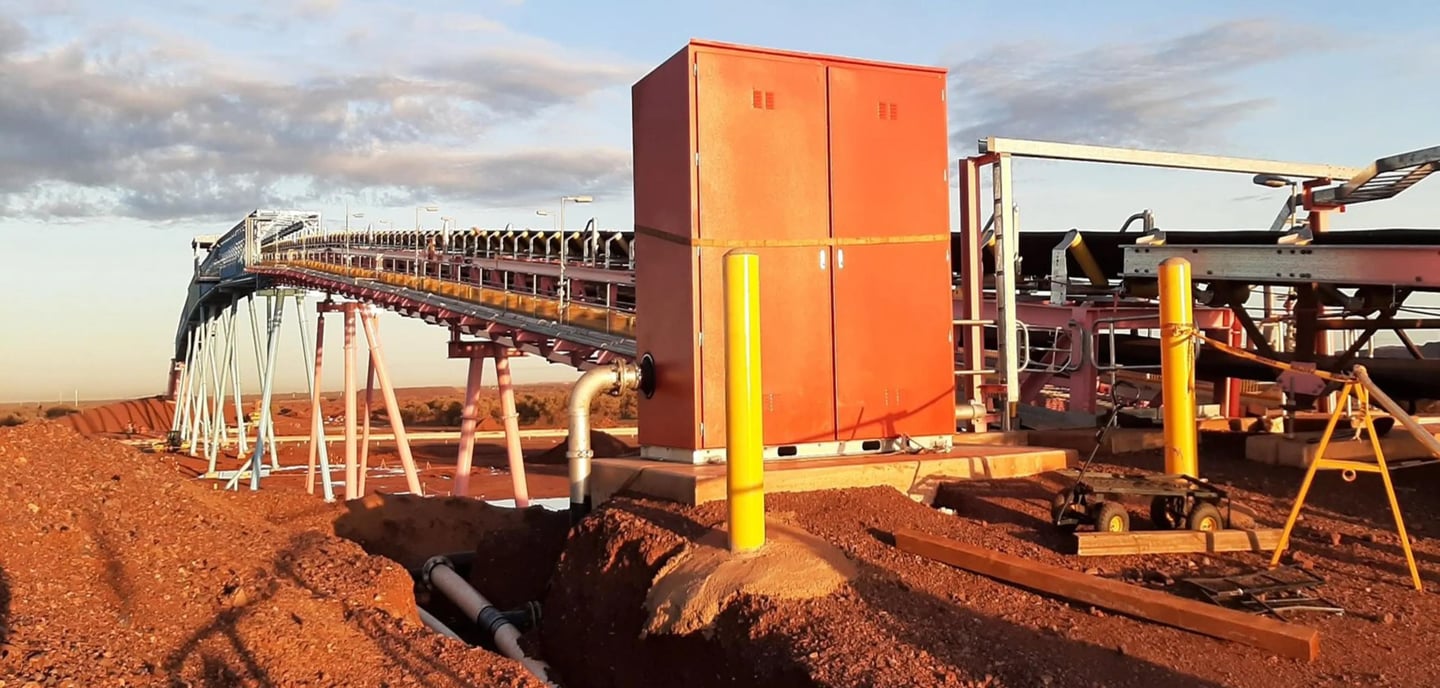
In modern high-tonnage open-cut mines, shiftable overland conveyor systems and mobile in-pit crushing and conveying installations are replacing conventional haul truck fleets to lower continuous fuel and labor costs. These conveyors utilize mobile tail-ends, track-mounted hopper units, and shiftable drive stations that relocate as pit walls advance.
Deploying overland mining conveyor cables rated for 20kV operation offers distinct operational advantages:
Long-Distance Single-Run Powering: 20kV power distribution allows single cable runs to extend several kilometres along conveyor corridors without requiring intermediate booster transformers or complex mid-line splice junctions.
Environmental Heat and UV Resilience: Unlike shovel cables that are frequently wound and unwound, conveyor trailing cables often lay paid out along hot pit floors or elevated cable trays for extended periods. They require outer sheaths formulated for maximum resistance against intense solar radiation, ozone exposure, and surface contact temperatures that can exceed 60°C.
Reduced Handling Mass: A lighter 20kV cable construction simplifies manual or tractor-assisted repositioning when conveyor modules are shifted sideways across the pit floor.
8. Cable Construction Overview
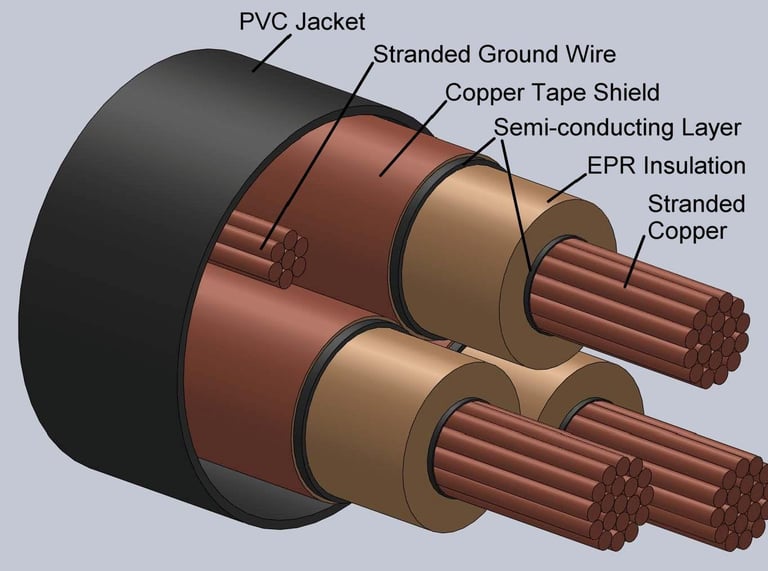
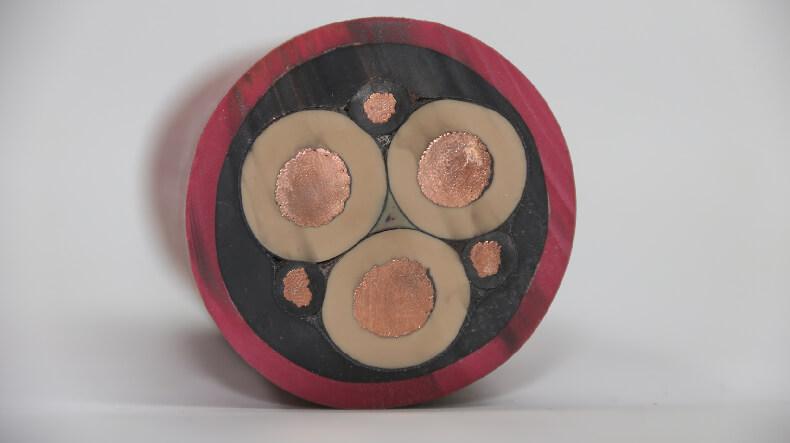
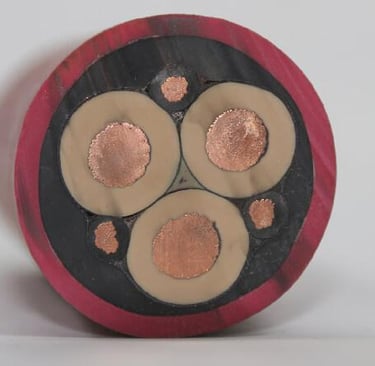
To perform reliably at 20kV under severe mechanical reeling stress, a cable requires a specialized, precision-engineered multi-layer internal structure. Each layer performs a vital electrical or mechanical protection function.
Flexible Conductors
Phase conductors are built from Class 5 fine-stranded tinned copper wires. Tinned coating prevents copper oxidation from moisture ingress and atmospheric exposure. Fine stranding arranged in short lay lengths allows the conductor to withstand hundreds of thousands of dynamic flex cycles on reel drums without suffering metal fatigue or strand fracture.
Specialized 20kV Australian Standard Models
In Australian mining specifications, standardized cable families are engineered specifically for medium-voltage trailing and reeling service. Heavy-duty 12/20kV cables manufactured to Australian standards—such as Type 209, Type 210, Type 240, and Type 245 cables—utilize flexible tinned copper conductors, specialized EPR phase insulation, semi-conductive field control screens, individual or overall copper braid screens, and split symmetrical earth cores. Australian compliance requires these exact structures to ensure fault-current protection and mechanical durability. Leading industrial manufacturers like Feichun Cable engineer 20kV mining cables to align fully with AS/NZS specifications, ensuring compatibility with Australian mine site safety requirements.
9. Why EPR Insulation Matters
At a 20kV medium-voltage rating, the electrical insulation system is subjected to high dielectric stress. Ethylene Propylene Rubber (EPR) insulation is universally preferred over rigid materials like Cross-Linked Polyethylene (XLPE) for dynamic mining reeling applications.
EPR insulation offers key performance characteristics:
Superior Mechanical Flexibility: EPR is a thermosetting elastomer that maintains excellent flexibility and rubber-like elasticity across a broad temperature range, whereas XLPE is relatively stiff and prone to micro-cracking under repeated tight-radius drum flexing.
High Dielectric Strength and Corona Resistance: EPR exhibits exceptional resistance to internal electrical partial discharge (corona) and electrical treeing, which is critical for suppressing dielectric breakdown under 20kV operating stress.
Thermal Performance: EPR handles continuous conductor operating temperatures of 90°C and short-circuit thermal surges up to 250°C without melting or permanently deforming, providing essential thermal margin during peak load cycles.
10. Shielding and Earth Protection
Operating flexible reeling cables at 20kV requires absolute control of internal electrical fields and comprehensive earth fault protection.
Semi-Conductive Field Control Screens
Because stranded copper conductors do not present a perfectly smooth outer surface, high localized voltage gradients occur at the crown of individual outer strands. To prevent electrical stress concentrations, an extruded layer of semi-conductive compound is applied directly over the conductor. A second semi-conductive screen layer is extruded over the outer surface of the EPR primary insulation. These dual semi-conductive layers ensure a uniform radial electric field across the entire insulation wall.
Metallic Screening and Split Earth Protection
Over the insulation screen, a metallic shield layer—typically consisting of fine tinned copper wire braids or composite metallic screens—is applied. This metallic screen provides multiple critical safety functions:
It maintains the outer surface of each phase core at true earth potential.
It carries capacitive charging currents and provides a dedicated return path for phase-to-earth fault currents, instantly triggering substation earth-leakage protective relays if insulation is punctured.
It protects surrounding personnel from electric shock if the cable suffers severe external mechanical damage.
In standard Australian mining cables, three split earth conductors are positioned symmetrically in the outer valleys between the main phase cores to maintain electrical balance and maximize physical flexibility. Central pilot cores are integrated to monitor continuous earth continuity loops, instantly isolating power if the safety earth circuit is interrupted.
11. Outer Sheath Materials
The outer sheath acts as the primary mechanical shield protecting internal 20kV electrical components from aggressive physical environments. In open-cast mining, sheathing compounds must withstand relentless abrasion, sharp rock impacts, hydraulic fluid spills, intense solar radiation, and extreme ambient temperatures.
Two heavy-duty synthetic compound families dominate high-performance 20kV reeling cable designs:
Chlorinated Polyethylene (CPE) / Heavy-Duty Rubber Compounds
Heavy-duty CPE compounds are thermosetting materials known for their balanced chemical and mechanical properties:
Flame Retardancy and Self-Extinguishing Nature: High chlorine content provides natural flame resistance, preventing fire propagation along cable trays or drum structures.
Chemical and Oil Resistance: CPE exhibits resistance to mineral oils, hydraulic fluids, and diesel fuel spills commonly encountered around machinery carbody frames.
Broad Thermal Stability: Maintains flexibility at low temperatures while resisting thermal softening in hot pit environments.
Thermoplastic Polyurethane (TPU / PUR) Compounds
Polyurethane outer sheaths represent a premium option for high-abrasion dynamic reeling applications:
Unmatched Abrasion Resistance: Polyurethane provides exceptionally high tear strength and resistance to sliding abrasion, making it ideal for cables frequently dragged across abrasive crushed granite, basalt, or iron ore pit floors.
High Tensile and Cut Growth Resistance: PUR resists sharp rock cuts and prevents small surface gouges from propagating into deep longitudinal tears under tension.
Extreme UV and Weather Resilience: Formulated with high-density carbon black, PUR provides long service life under relentless Australian sunshine without cracking or chalking.
12. Key Selection Factors
Selecting the correct 20kV medium-voltage reeling cable requires evaluating multiple interconnected electrical, mechanical, and thermal parameters.
Engineers and procurement teams must analyze the following parameters:
Nominal Operating Voltage ($U_0/U$): Confirm that the cable's voltage rating matches or exceeds system operating levels (e.g., 12/20kV rating for a 20kV line-to-line network).
Continuous Load Ampacity: Size phase conductors to carry full machine load current, applying appropriate derating factors for high ambient temperatures and multi-layer reel spooling.
Terminal Voltage Drop Limits: Calculate total voltage drop over maximum route length under both steady-state and peak motor-starting conditions.
Maximum Dynamic Tensile Pull: Ensure peak tensile pulling forces during reeler payout do not exceed maximum allowable conductor and aramid center member tension ratings.
Reel Drum Barrel Diameter: Verify that the storage drum barrel meets or exceeds the cable's minimum allowable dynamic bending radius (typically 10 to 12 times overall cable diameter).
Short-Circuit Withstand Capability: Ensure metallic screens and phase conductors can safely carry prospective system short-circuit fault currents for the duration of substation breaker clearing times.
13. What Engineers Should Check
Because a 20kV cable and its associated machine reeler operate as an integrated electro-mechanical system, cable selection should never be performed in isolation.
Mine electrical engineers and maintenance teams should verify the following operational checklists before finalizing cable specifications:
Machine Dynamics and Duty Cycle Check
What is the maximum physical travel distance and operating speed of the machinery?
How many dynamic spooling cycles does the cable execute per operating shift?
What is the active torque profile and tension setting of the machine's cable reeler drive system?
Mechanical Geometry Check
Does the cable reeler utilize a mono-spiral drum, a multi-layer cylindrical drum, or a random spooling basket?
What are the exact dimensions of guide sheaves, fairleads, and payout rollers? Are all contact radii large enough to satisfy minimum bending radius rules?
Is the internal diameter of the reel hub slip-ring assembly compatible with required cable entry glands?
Site Environmental Profile
What are peak summer ambient temperatures and ground radiation levels on active bench faces?
Is the cable likely to be submerged in acidic or saline pit water accumulated in sump areas?
What is the rock hardness and abrasiveness of the local bench floor (e.g., sharp silica sand, crushed iron ore, or jagged limestone)?
Manufacturers like Feichun Cable work closely with mine maintenance departments and machine OEMs to review these operational parameters, ensuring that selected 20kV cable constructions, conductor sizes, and outer sheaths match actual site requirements.
14. Conclusion
Stepping up to a 20kV medium-voltage reeling cable system provides a high-performance power distribution framework for ultra-heavy mining equipment operating in Australian open-cut mines.
By elevating operating voltage, mine operators achieve a step-change in physical and electrical efficiency:
Line currents drop by more than 66%, reducing $I^2 R$ thermal energy dissipation.
Terminal voltage drops over long bench runs are minimized, extending machine working radiuses.
Phase conductor sizes and overall cable weights are kept small enough to allow efficient spooling on machine reels.
Achieving these operational benefits requires treating cable selection as a complete electro-mechanical system design. By matching electrical ratings, EPR insulation properties, metallic screening structures, tensile reinforcement layers, and heavy-duty CPE or PUR outer sheathing with machine drive characteristics and harsh site conditions, mine operators can maximize continuous power reliability. Investing in properly specified 20kV reeling cables protects site personnel, prevents costly unplanned downtime, and delivers long-term tonnage performance across Australia’s most demanding mining environments.
How to Reach Us
Get in Touch
SiteMap
Product Catalogue
Festoon Cable
Shore Power Cable




Scan to add us on WeChat