
500-C-TPE Drag Chain Cable — High Flexibility, Halogen-Free, EMC-Optimized TPE Control Cable for Dynamic Applications
Discover the 500-C-TPE drag chain cable — halogen-free, abrasion-resistant, and EMC-preferred for continuous high-flex operations in demanding industrial environments.
hongjing.Wang@Feichun
2/24/20268 min read

1. Introduction to the 500-C-TPE Drag Chain Cable
In the world of industrial automation, the demand for reliable, high-performance cabling solutions has never been greater. As machinery grows more sophisticated and operational cycles become more intensive, engineers and procurement specialists alike face a common challenge: finding cables that can withstand the rigorous mechanical demands of continuous dynamic motion without compromising signal integrity or system safety. The 500-C-TPE drag chain cable is engineered precisely to meet these challenges.
Designed as a special drag chain cable for high mechanical stress, the 500-C-TPE is built to perform in energy chain systems where cables must endure millions of bending cycles without fatigue or failure. Its combination of a halogen-free control cable design, EMC-preferred shielding architecture, and thermoplastic elastomer (TPE) jacketing makes it one of the most capable solutions available for demanding dynamic applications. Industries such as robotics, automated assembly lines, CNC machining centers, material handling systems, and logistics conveyors all rely on cables of this class to maintain uninterrupted operations.
What sets this cable apart from conventional flexible cables is its carefully engineered balance of mechanical resilience and electrical performance. From the conductor geometry to the outer sheath compound, every element of its construction is optimized to reduce wear, minimize torsion, and maximize service life in continuous-flexing environments.
2. Key Features and Benefits
The 500-C-TPE cable is characterized by several outstanding features that directly address the real-world pain points of dynamic cable installations.
First and foremost is its high bending resistance, specifically tailored for energy drag chain systems. The cable is rated for a minimum bending radius of 5× the cable outer diameter during flexing operations, and 3× during fixed installation. This tight bending radius capability is critical in compact drag chain configurations where space is limited and travel distances are long.
The low torsion construction is another significant advantage. In drag chain applications, cables are subjected not only to repeated bending but also to slight rotational forces as the chain articulates. The optimized stranding geometry — with Unilay conductors arranged at short pitch lengths — counteracts these torsional stresses, significantly extending the operational lifespan of the cable.
EMC performance is addressed through an 85% coverage tinned copper braid screen, making the cable an EMC-preferred cable for environments where electromagnetic interference poses a risk to signal quality. This is particularly relevant in automation settings where servo drives, variable frequency drives (VFDs), and digital communication buses operate in close proximity. Finally, the halogen-free design ensures that in the event of a fire, the cable does not emit toxic or corrosive gases, supporting compliance with increasingly stringent workplace safety and environmental regulations.
3. Technical Data and Standards
The 500-C-TPE is designed and tested in accordance with DIN VDE 0285-525-2-51 and DIN EN 50525-2-51, the recognized European standards governing thermoplastic insulated flexible cables for drag chain applications. These standards ensure that the cable has been subjected to systematic mechanical endurance testing, insulation quality verification, and performance benchmarking under controlled conditions.
Key electrical parameters include a nominal voltage rating of U₀/U 300/500 V, with a test voltage of 3,000 V. The insulation resistance is specified at a minimum of 100 MΩ × km, ensuring stable dielectric performance across the entire cable length. The coupling resistance of the shielding system is specified at a maximum of 250 Ω × km, which governs the effectiveness of the EMC shield in real installation conditions.
The cable is rated for a continuous operating temperature of -30°C to +80°C during flexing, and -40°C to +80°C during fixed installation. This wide temperature range makes it suitable for both climate-controlled indoor environments and exposed outdoor installations where thermal cycling is a concern. Additionally, the cable offers radiation resistance of up to 100 × 10⁶ cJ/kg (100 Mrad), which is relevant for applications in environments with elevated levels of ionizing radiation.
4. Cable Construction Details
The internal architecture of the 500-C-TPE is the result of meticulous engineering aimed at maximizing flexibility while preserving electrical integrity.
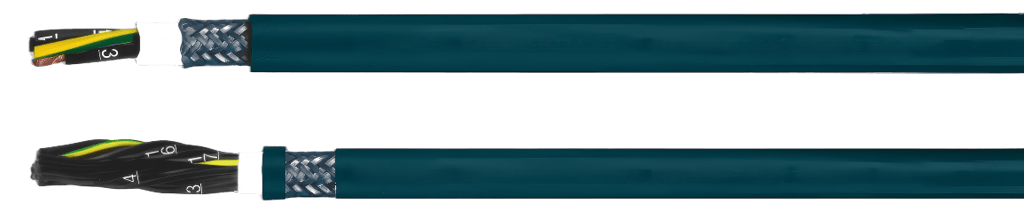
At the core are tinned copper fine-wire conductors, arranged in a Unilay configuration with a short pitch length. Tinning the copper serves a dual purpose: it protects against corrosion in the presence of aggressive gases such as hydrogen sulfide, ammonia, and sulfur dioxide, and it facilitates reliable termination in connector and terminal systems. Each core is insulated with a special polypropylene (PP) compound, selected for its excellent dielectric properties and resistance to mechanical abrasion, and identified with black insulation bearing continuous white numbering — a practical feature that accelerates installation and simplifies field maintenance.
For cables with three or more conductors, a green-yellow (GN-YE) protective earth conductor is included as standard. Stranding configuration follows a rule based on core count: cables with fewer than seven cores use a single-layer arrangement with an optimal lay-length around a central filler, while cables with seven or more cores adopt a bunch construction with carefully selected short lay-lengths, further reducing torsion stress in operation.
The inner sheath is made from a special TPE compound, extruded under pressure to fill all interstices between the stranded cores. This filled construction eliminates air pockets that could contribute to moisture ingress. The tinned copper braid screen follows, with 85% optical coverage and an optimized pitch angle that maintains shield continuity through repeated bending. A fleece separator is interposed between the inner sheath and the outer sheath, allowing the outer jacket to be stripped cleanly during termination without damaging the screen or inner components. The outer sheath, made from a special TPE-O compound, is extruded under pressure and finished in ocean blue (RAL 5020), with meter markings printed on the surface to assist with accurate length determination during installation.
5. Environmental and Mechanical Properties
The TPE materials used in the 500-C-TPE have been selected not only for their mechanical flexibility but also for their comprehensive resistance to environmental degradation. The cable exhibits proven microbe resistance, meaning it will not support fungal or bacterial growth — an important consideration for cables installed in food processing facilities, pharmaceutical plants, or persistently humid industrial environments.
Oil resistance is another essential attribute. In machine tool environments and hydraulic press applications, cables are routinely exposed to cutting oils, hydraulic fluids, and lubricants. The outer sheath resists surface degradation and swelling when exposed to these substances, maintaining mechanical integrity over extended service periods. UV and ozone resistance ensures that cables deployed in outdoor drag chain systems — such as those used in automated warehouses, port equipment, or outdoor gantry cranes — do not suffer from photo-oxidative degradation or surface cracking.
The cable also demonstrates excellent tear resistance and low surface adhesion, both of which contribute to longevity in high-cycle drag chain applications. Low adhesion prevents the cable from sticking to neighboring cables or chain links, reducing wear caused by friction during motion cycles. From a materials compliance perspective, the cable is cadmium-free and silicone-free. The absence of silicone is significant in manufacturing environments where lacquer coating processes are used, since silicone contamination is known to cause fish-eye defects in painted surfaces.
6. Application Areas
The 500-C-TPE is intended for permanent application in drag chain systems across a broad spectrum of industrial environments. It is rated for use in dry, moist, and wet indoor spaces, as well as in outdoor installations with free cable movement, provided that no tensile stress is applied to the cable during operation.
In automotive manufacturing plants, it connects servo axes on welding robots and press transfer systems where travel distances can exceed 20 meters and cycle rates may reach hundreds of thousands per year. In machine tool centers, it routes power and control signals to spindle motors, tool changers, and axis drives operating inside enclosures where cutting fluid exposure is unavoidable.
Material handling systems — including automated storage and retrieval systems (AS/RS), overhead cranes, and conveyor drives — rely on high bending-resistant drag chain cables to maintain continuous data and power transmission without maintenance interruptions. For these applications, the combination of a halogen-free EMC shielded cable for energy chains and robust mechanical properties makes the 500-C-TPE a cost-effective solution over the system's lifetime. In logistics automation, where cable carriers guide cables along shuttle systems and sorter lanes at high speeds, the durable TPE cable for continuous flexing provides the reliability necessary to meet demanding uptime requirements.
7. Common Application Challenges and Solutions
Engineers working with drag chain cable systems frequently encounter a set of recurring challenges. Understanding these issues — and how the design of the 500-C-TPE addresses them — can help operators avoid costly downtime and premature cable replacement.
Q: What causes premature cable failure in drag chains, and how can it be avoided?
The most common cause is improper cable selection — specifically, using cables not rated for continuous dynamic bending. Standard flexible cables will suffer conductor fatigue fractures, insulation cracking, and sheath splitting when subjected to millions of bending cycles. The 500-C-TPE is specifically engineered to DIN VDE 0285-525-2-51 for exactly these conditions. Correct installation is equally critical: the cable must be laid loosely within the chain links without tensile pre-stress, and the minimum bending radius of 5× the cable outer diameter must be respected at all times.
Q: How does electromagnetic interference affect cable performance in automation environments, and what is the recommended installation practice?
EMI is a significant concern in automation systems where variable frequency drives, servo amplifiers, and high-frequency switching devices generate conducted and radiated noise. An inadequately shielded cable can act as an antenna, introducing noise into control circuits and communication lines. The 500-C-TPE's 85% tinned copper braid provides effective shielding. To optimize electromagnetic compatibility, it is strongly recommended that the copper braid be connected to the equipment ground via a 360° circumferential contact at both cable ends, rather than a simple pigtail connection. This low-inductance bonding method dramatically reduces shield impedance at high frequencies.
Q: Can the cable be used in environments where chemical exposure is a concern?
Yes. The TPE sheath offers better chemical resistance compared to standard PVC jackets, making the cable suitable for environments with exposure to oils, weak acids, alkalis, and certain organic solvents. For environments involving specific aggressive chemicals, it is advisable to consult the material compatibility data for the TPE compound or conduct immersion tests prior to full-scale deployment.
Q: What are the signs that a cable in a drag chain installation needs replacement?
Early indicators include visible sheath cracking or surface erosion, increased coupling resistance measured at the shield terminals, irregular insulation resistance readings, or intermittent electrical faults that correlate with specific positions of the drag chain travel. Periodic inspection at predetermined maintenance intervals — particularly at the transition point between the fixed and moving sections of the chain — can detect damage before it escalates into a system failure.
8. Safety, Compliance, and Installation Guidance
The 500-C-TPE cable conforms to the EC Low-Voltage Directive 2006/95/EC, confirming its suitability for use within the European Economic Area. Its halogen-free construction aligns with growing regulatory and corporate sustainability requirements that favor materials with reduced environmental and toxicological impact over the product's full lifecycle.
The tinned copper conductor specification ensures compatibility with aggressive industrial atmospheres where bare copper would be susceptible to sulfidation or oxidation — particularly relevant for installations near chemical processing equipment or in locations where hydrogen sulfide or ammonia may be present in the ambient air.
For EMC-sensitive installations, the copper braid screen should make large-area, low-resistance contact with the cable gland or connector backshell at both ends of the cable run. Pigtail connections to a grounding lug introduce inductance that significantly degrades shield performance at frequencies above a few hundred kilohertz. The cadmium-free and silicone-free construction supports RoHS compliance for systems destined for markets with stringent substance-of-concern restrictions. For cleanroom-qualified versions of this cable, special ordering conditions apply, and users should confirm that the specific product lot meets the required particulate emission and outgassing standards before deployment.
9. Conclusion
The 500-C-TPE drag chain cable represents a comprehensively engineered solution for one of industrial automation's most demanding cabling challenges. By combining high bending-resistant drag chain cable construction with halogen-free materials, EMC-optimized shielding, and broad environmental resistance, it delivers the reliability and longevity that modern production environments require.
From the fine-wire Unilay conductors to the pressure-extruded TPE-O outer sheath, every element of its design serves a defined engineering purpose. Whether deployed in robotics, machine tool centers, conveyor systems, or outdoor material handling equipment, the cable provides consistent electrical performance and mechanical durability across millions of bending cycles and a wide operating temperature range.
For system designers and maintenance engineers evaluating cabling solutions for drag chain applications, the 500-C-TPE offers a technically sound choice that balances initial investment against total lifecycle value — minimizing unplanned downtime, reducing replacement frequency, and supporting full compliance with modern EMC and safety standards.
How to Reach Us
Get in Touch
SiteMap
Product Catalogue
Festoon Cable
Shore Power Cable



Scan to add us on WeChat