A Practical Guide to AS/NZS Industrial Cable Standards for Australian Port and Mining Projects
Master AS/NZS industrial cable standards for Australian port and mining projects. Learn the critical differences between AS/NZS 1802, 2802, and 1125, discover professional inspection strategies, and choose compliant, heavy-duty crane and trailing cables built for extreme environmental endurance.
hongjing.Wang@Feichun
7/1/202611 min read


How to Select the Right Cable Standard for Cranes, Mining Equipment, and Industrial Installations
Industrial operations across Australia operate under some of the most unforgiving environmental and operational conditions on Earth. From the high-throughput container terminals of Port Botany and the Port of Brisbane to the dust-heavy, high-vibration overland conveyor systems spanning the Pilbara region, heavy machinery relies completely on robust electrification. In these demanding environments, the mobile cables supplying power, control signals, and data telemetry are the literal lifelines of production.
Yet, selecting and specifying these cables is a frequent source of technical confusion for procurement engineers, project managers, and maintenance teams. Choosing a cable based solely on electrical conductivity or generic international catalogs often leads to premature mechanical failure, unexpected operational downtime, and costly compliance issues.
In Australia, industrial cable selection is governed by a rigorous framework of Australian and New Zealand Standards (AS/NZS). Understanding this framework is essential for managing project risk and ensuring long-term asset reliability. This guide provides a comprehensive, practical breakdown of the core AS/NZS cable standards, helping you navigate compliance, compare technical requirements, and make informed decisions for your next port, mining, or heavy industrial project.
1. Why Australia Uses AS/NZS Standards
When managing an engineering, procurement, and construction (EPC) project or upgrading heavy machinery in Australia, local compliance is a non-negotiable requirement. A common misstep among international original equipment manufacturers (OEMs) and overseas procurement teams is assuming that a cable with generic International Electrotechnical Commission (IEC) compliance is automatically acceptable for Australian industrial sites. While AS/NZS standards are frequently harmonised with IEC frameworks, they include critical, legally binding modifications tailored specifically to the unique realities of the Australian industrial landscape.
Australia’s industrial infrastructure faces a distinct combination of environmental and mechanical challenges. Cable systems must endure extreme ambient temperatures, intense ultraviolet (UV) radiation, corrosive marine salt spray in coastal ports, and abrasive, heavy-particle dust on mining sites. Furthermore, local installation codes and workplace health and safety laws place a heavy emphasis on structural risk management.
If a project specification explicitly dictates compliance with an AS/NZS standard, submitting an alternative cable based purely on overseas standards can halt a project during the audit phase. Local asset owners, government bodies, and tier-one mining contractors regularly reject non-compliant materials because generic standards may not account for the specific conductor stranding, sheath thickness, or flame-retardant properties required locally. Adhering to AS/NZS standards is not just about ticking a regulatory box; it is a fundamental strategy for preventing early asset failure and ensuring on-site operational safety.
2. AS vs AS/NZS: What Is the Difference?
To those new to the Australian regulatory landscape, the naming conventions of local standards can seem confusing. The primary distinction lies in the geographical and regulatory jurisdiction of the bodies that authored them.
The prefix AS stands for Australian Standard, which represents a technical standard developed by Standards Australia to be applied strictly within the commonwealth. On the other hand, the prefix AS/NZS indicates a Joint Australian/New Zealand Standard. These documents are authored co-operatively by Standards Australia and Standards New Zealand, establishing a unified, harmonised technical benchmark that satisfies the legal and operational requirements of both nations.
The transition from standalone AS standards to joint AS/NZS standards has been a gradual, deliberate process over the last several decades. As trade and engineering practices between Australia and New Zealand became more integrated, both nations recognized the immense value of standardising their electrical grids, safety practices, and industrial manufacturing rules. Today, older, purely Australian standards are systematically updated and replaced by joint AS/NZS variants when they undergo major technical revisions. For procurement teams, this means that while you may occasionally encounter historic AS references in legacy engineering drawings, modern compliance audits will almost universally demand the latest active AS/NZS publication.
3. Industries That Need to Care About These Standards
The application of AS/NZS cable standards extends far beyond traditional building electricians or commercial contractors. Heavy industries that rely on high-value, dynamic capital equipment must maintain a deep understanding of these rules to preserve their operational integrity.
Mining Equipment and Mobile Machinery
Whether operating an underground continuous miner, a massive longwall shearer, a roadheader, or an open-cut dragline, mining machinery subjects cables to constant pulling, twisting, and dragging. Cables in this sector must comply with strict mining-specific standards to ensure they do not cause catastrophic earthing faults or spark hazards in volatile environments.
Port Cranes and Maritime Logistics
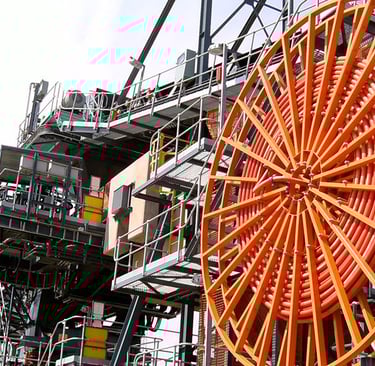
Ship-to-Shore (STS) container cranes, Rail Mounted Gantry (RMG) cranes, and Rubber Tyred Gantry (RTG) cranes require continuous power and high-speed data transmission while moving rapidly along port berths. The cables powering these structures must withstand continuous flexing, high travel velocities, and constant exposure to salt-laden coastal winds.
Conveyor and Stacker-Reclaimer Systems
Bulk material handling facilities utilize massive tripper conveyors, stackers, and reclaimers to move iron ore, coal, and grain. The reeling cables and flexible power lines feeding this machinery undergo continuous spooling and unspooling under significant mechanical tension.
Tunnelling and Civil Infrastructure
Modern civil engineering projects utilize massive Tunnel Boring Machines (TBMs) and heavy-duty water pumping infrastructure. These systems require high-voltage portable power supplies that can resist continuous moisture ingress, structural crushing, and sharp rock impacts.


4. AS/NZS 1802: Heavy-Duty Rubber Flexible Cables
For engineers working with dynamic material handling equipment, AS/NZS 1802 is one of the most critical standards in the entire regulatory library. This standard specifically governs the design, construction, and testing of heavy-duty flexible rubber cables, with a particular focus on trailing and reeling applications up to specific industrial voltage thresholds.
AS/NZS 1802 outlines strict manufacturing parameters that ensure a cable can survive millions of flex cycles without suffering structural or electrical breakdown. It dictates the exact configuration of fine copper conductor stranding to achieve optimum flexibility, the minimum thickness of the primary insulation, and the exact chemical properties required for the inner and outer rubber sheaths. These sheaths are engineered to provide outstanding resistance to continuous tearing, cutting, and ozone degradation.
In practical field applications, AS/NZS 1802-aligned cables are the gold standard for heavy overhead factory gantry cranes, high-speed festoon systems, outdoor ship loaders, and robust marine container handling installations. When an industrial machine requires a cable that can bend continuously around a compact trolley saddle or withstand the rapid, repeating start-stop acceleration curves delivered by modern Variable Speed Drives (VSD), specifying an AS/NZS 1802 cable ensures the core elements will resist work-hardening and early mechanical failure.
5. AS/NZS 2802: Mining and Trailing Cable Applications
When the operational environment shifts from heavy industrial plants to the extreme conditions of open-cut and underground mining, the governing standard changes to AS/NZS 2802. This standard represents the pinnacle of mechanical durability in the Australian cable industry, regulating severe-duty trailing and reeling cables used exclusively in mining applications.
Cables manufactured to AS/NZS 2802 are engineered to handle extreme physical abuse. In an open-cut mine, these cables are routinely dragged over sharp blasted rock, crushed by support vehicles, and exposed to intense, all-day solar heat. To survive these conditions, the standard mandates specialized internal architectures, including reinforced central strength members, integrated earth-continuity monitoring conductors, and robust, heavy-duty elastomer or polyurethane outer jackets. These materials provide exceptional tensile strength, preventing the cable from stretching or ovalizing when wound tightly onto high-tension cable reels.
Understanding AS/NZS 2802 is vital for maintaining site safety and legal compliance under Australian mining regulations. Because mining cables regularly carry high voltages directly to mobile machines operated by personnel, the standard places immense emphasis on electrical protection. It requires specialized metallic or semi-conductive insulation screens that ensure any physical puncture immediately triggers a phase-to-earth fault, tripping the upstream circuit breaker long before an electrical current can reach a human operator or ignite ambient gases.
6. AS/NZS 1125: Flexible Cords and Portable Cables
A frequent point of confusion during the procurement process involves the relationship between heavy industrial standards and AS/NZS 1125. This standard specifically covers conductors in insulated electrical cables and flexible cords, establishing the foundational rules for conductor construction, resistance values, and general flexibility classifications across the industry.
AS/NZS 1125 defines the specific classes of copper strands, ranging from rigid solid conductors used in permanent building wiring to highly flexible fine-wired configurations intended for portable tools and flexible appliances. However, a common mistake made by procurement officers is assuming that if a cable’s conductors are certified to AS/NZS 1125 for flexibility, the cable itself is automatically suitable for heavy industrial or dynamic crane service.
In reality, AS/NZS 1125 is a component standard rather than a full system application standard. It ensures that the copper wire inside a cable conducts electricity safely and bends without snapping, but it does not mandate the heavy-duty outer sheath thickness, internal anti-torsion braids, or environmental resistances required by AS/NZS 1802 or AS/NZS 2802. Using a cable certified only to basic flexible cord standards in a port crane or a mining conveyor will result in rapid jacket tearing and structural failure.
7. How the Three Standards Differ
To select the correct asset for your project, it is helpful to contrast these three foundational standards based on their intended duty profile, mechanical construction, and operational environment.
AS/NZS 1125 (Light-to-Medium Duty Component Level)
This standard focus primarily on the underlying conductor elements. It ensures proper electrical conductivity and standard flex characteristics for portable applications, control panels, and light-duty commercial equipment. It does not provide the robust structural protection required for continuous industrial movement.
AS/NZS 1802 (Heavy-Duty Industrial and Marine Dynamic Level)
This standard governs complete cable systems engineered for continuous mechanical flexing in general industrial environments. It features thick elastomer jackets, specialized core layouts, and high resistance to marine salt and UV rays, making it the ideal choice for port cranes, automated gantry systems, and industrial festoons.
AS/NZS 2802 (Severe-Duty Mining and Extreme Mechanical Level)
This standard represents the absolute highest tier of mechanical and electrical protection. It mandates specialized internal screening, earth monitoring cores, and high-tensile outer sheaths specifically engineered to survive being dragged across rock faces, wound onto high-tension reeling drums, and subjected to the severe vibration of heavy mining machinery.
8. Other Standards Often Referenced in Australian Projects
Cable selection for major industrial installations rarely happens in isolation. Procurement and design engineers must navigate a matrix of interconnected standards that govern how cables are sized, installed, protected, and monitored across an industrial site.
AS/NZS 3000 (The Australian Wiring Rules): This is the foundational legal document for all electrical installations in Australia. It dictates how cables must be terminated, routed, protected against overcurrent, and earthed to ensure total site safety.
AS/NZS 3008 (Cable Sizing and Current Capacity): This critical standard dictates exactly how to calculate a cable’s current-carrying capacity based on ambient temperatures, installation context (e.g., in open air, enclosed in conduit, or buried underground), and duty cycles, preventing hazardous thermal overloading.
AS/NZS 5000: This standard governs standard power cables with fixed insulation ratings, commonly utilized for the permanent structural power feeds supplying stationary port sub-stations and mining control buildings.
AS/NZS 60079 (Hazardous Area Compliance): Crucial for underground mining, gas installations, and grain handling facilities, this standard outlines the strict electrical safety rules required for cables operating in potentially explosive atmospheres.
AS/NZS 60529 (Ingress Protection): Governs the IP ratings of cable glands, connectors, and enclosures, ensuring that moisture and fine dust cannot breach critical electrical connections.
Fire Performance and Environmental Safety: Major infrastructure projects regularly mandate strict adherence to international flame propagation rules, smoke density limits, and acid gas emission standards, including IEC 60332, IEC 61034, and IEC 60754, ensuring cables do not release toxic fumes during a thermal event.

9. Typical Standards by Equipment Type
To ground these regulatory frameworks in practical reality, it is useful to look at how specific classes of industrial machinery align with particular cable standards during a typical site audit or asset procurement cycle.
Ship-to-Shore (STS) Cranes
Operating at high travel velocities along maritime berths, the core power and control feeds of these massive structures almost universally require heavy-duty flexible cables that align fully with the robust mechanical testing profiles mandated by AS/NZS 1802.
Rail Mounted Gantry (RMG) and Rubber Tyred Gantry (RTG) Cranes
Whether utilizing automated flat festoon systems or high-tension cable reels, these yard cranes rely on specialized flexible cables designed to resist continuous bending, directional changes, and high wind loads under the AS/NZS 1802 framework.
Stackers, Reclaimers, and Tripper Conveyors
Operating in the punishing environment of bulk material stockyards, these machines subject cables to continuous tension and heavy dust accumulation. As a result, engineering specifications frequently mandate mining-grade trailing cables certified to AS/NZS 2802 to guarantee structural longevity.
Tunnel Boring Machines and Roadheaders
Because these machines operate in tight, high-vibration underground environments surrounded by sharp fractured rock and continuous water ingress, their primary power lines are specified under the strict safety and earthing rules of AS/NZS 2802.
10. Common Misunderstandings from Procurement Engineers
Sourcing specialized industrial cables for Australian projects can be challenging for overseas procurement engineers. One of the most widespread errors is assuming that a cable carrying standard European or American certifications is completely interchangeable with an AS/NZS specified asset. For instance, while a German DIN VDE standard cable (such as an NSHTOU reeling cable or a PUR festoon cable) is an exceptionally high-quality product, its exact outer jacket thickness, core color identification, or earth conductor cross-section may not align perfectly with active Australian installation codes.
Another major misunderstanding is treating a cable’s nominal voltage rating as the single defining selection criterion. A procurement officer might source a generic 1 kV flexible PVC cable because the electrical system operates at 415 volts. However, if that cable is installed on an outdoor crane festoon system, it will likely fail within months.
Voltage rating only addresses electrical insulation safety. It does not account for dynamic bending radii, flex-cycle endurance, UV degradation, or resistance to hydraulic oils. The structural design and environmental suitability of the outer jacket are just as critical to the survival of the asset as the copper hidden inside. The specific project engineering brief and local regulatory standards must always take precedence over generalized catalog descriptions.
11. How to Select a Cable That Fits AS/NZS Expectations
When evaluating a manufacturer’s submittal or preparing a procurement order for an upcoming port or mining project, utilizing a structured, engineering-focused checklist ensures total compliance and long-term performance.
Verify the Specific AS/NZS Framework: Ensure the cable data sheet explicitly references the correct standard for the intended application, such as AS/NZS 1802 for heavy industrial flexibility or AS/NZS 2802 for mining-grade durability.
Analyze the Conductor Sizing and Stranding Class: Cross-reference the conductor cross-section with AS/NZS 3008 calculations to ensure proper current-carrying capacity, and confirm the stranding class provides genuine long-term flex performance.
Match the Minimum Bending Radius: Compare the manufacturer’s dynamic minimum bending radius against the physical dimensions of your crane's trolley saddles, festoon carriers, or reeling drums to prevent over-bending stress.
Evaluate Environmental Compound Resistances: Confirm the outer sheath compound is formulated to withstand the specific chemical threats of your site, whether that means high-index UV stabilizers for the Australian sun, oil-resistant polymers for hydraulic environments, or tear-resistant rubber for rocky terrain.
Confirm Safety and Protection Systems: For high-risk or high-voltage applications, verify that the internal insulation shields and earth-continuity conductors meet local safety regulations to guarantee reliable fault tripping.
12. How Feichun Can Support Australian Projects
Navigating the complexities of international trade, engineering compliance, and local industrial standards requires a highly technical, consultative partner. The Feichun Cable engineering team specializes in bridging the gap between advanced manufacturing capabilities and the rigorous on-site compliance expectations of the Australian port and mining sectors.
We do not simply supply generic cable parts; we provide comprehensive engineering support. Our specialists can review your existing project documentation, analyze your machinery’s travel velocities and acceleration profiles, and conduct detailed technical comparisons against AS/NZS 1802, AS/NZS 2802, and AS/NZS 1125 requirements. Whether you need an optimized high-speed festoon cable solution for an STS port crane, a rugged reeling cable for a mining reclaimer, or a specialized VSD cable system, we ensure your assets are engineered for maximum reliability and total regulatory compliance.
Not Sure Which AS/NZS Standard Applies to Your Project?
Choosing the wrong cable can lead to expensive compliance delays and premature field failures. Contact the Feichun Cable engineering team today to schedule a comprehensive technical review and secure a recommended cable solution tailored precisely to your operational requirements.
How to Reach Us
Get in Touch
SiteMap
Product Catalogue
Festoon Cable
Shore Power Cable


Scan to add us on WeChat