
Alternatives to Prysmian Crane Cables: A Practical Guide for Ports, Mining and Heavy Industry
Looking for alternatives to Prysmian crane cables? A practical guide to matching the performance of premium European reeling cables — voltage range, torsion, tensile strength and sheath construction — with shorter lead times and more flexible sourcing.
hongjing.Wang@Feichun
6/3/202610 min read
If you specify or buy reeling cable for cranes, mining equipment or mobile heavy machinery, you already know the name Prysmian. Its PROTOLON medium-voltage reeling cables have set the benchmark for decades, and for good reason — they're superbly engineered and field-proven the world over. But "the benchmark" and "the only sensible choice" aren't the same thing, and a growing number of engineers and procurement teams are actively looking for alternatives that deliver equivalent performance on better commercial terms.
This guide is for them. It walks through why people look beyond the premium European brands, what genuinely matters when you assess an alternative, how the key parameters stack up, and how to qualify a supplier so you don't trade reliability for a lower price. Along the way it draws on a real, recent shipment — a medium-voltage fibre-optic reeling cable supplied for a nickel mine — to show that the alternative route is more than theory.
It's a longer read, but if you're weighing up a cable decision worth tens of thousands of dollars and years of service, it's worth the fifteen minutes.
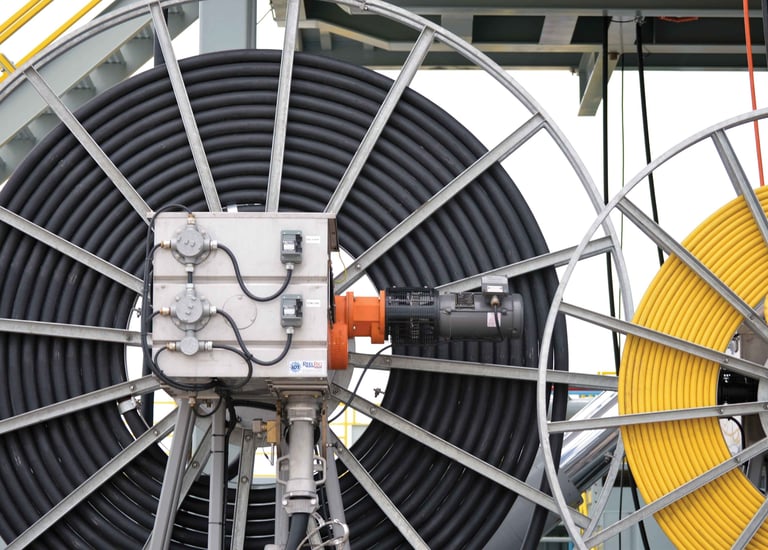
Why Engineers Look for Alternatives to Prysmian Crane Cables
The motivation is rarely about chasing the cheapest cable. It's usually about four very practical pressures.
The first is cost-effectiveness without a performance penalty. High-stress reeling applications are unforgiving, so nobody sensible wants a weaker cable — they want the same performance for less, or better performance for the same money. As more capable manufacturers have emerged, that's become a realistic ask rather than wishful thinking.
The second is lead time and minimum order quantity. Traditional European suppliers can carry long delivery times and high MOQs that simply don't fit every project. When a crane is down or a mine is commissioning on a tight schedule, a quoted lead time measured in many weeks — or a minimum order far larger than you need — is a genuine problem, not a minor inconvenience.
The third is customisation. Real projects have specific demands: a particular travel speed, a torsional-stress profile, an unusual core configuration, or environmental extremes like very low ambient temperatures. The ability to tailor a cable to the exact scenario, rather than picking the closest catalogue item, has real value.
The fourth is simply a proven track record. Buyers want evidence that an alternative has already performed reliably in container cranes, mining equipment and mobile heavy machinery — not promises, but shipment records and service history.
When an alternative ticks all four boxes, the case for sticking with the premium-priced incumbent out of habit gets a lot weaker.
The Common Limitations of Premium European Crane Cables
To be clear, this isn't a knock on the quality of premium European cable — it's excellent. The limitations are commercial and logistical rather than technical.
Extended delivery times can throw out a project schedule, particularly when a cable is on the critical path for a crane commissioning or a mine ramp-up. Higher overall project costs add up across a large cable order, and on a price-sensitive tender that margin matters. Flexibility for custom designs or modifications is often limited, because a large manufacturer's processes are built around standard catalogue products. And minimum order quantities can be awkward for smaller or urgent projects, where you need a few hundred metres quickly rather than a full production run.
None of these is a reason to accept an inferior cable. They're reasons to look carefully at whether an alternative can match the engineering while solving the commercial pain points.
What to Look for in an Alternative Crane Cable Supplier
This is the heart of the matter. An alternative is only worth considering if it genuinely matches the things that make a premium reeling cable good. Here's the checklist that actually counts.
Technical equivalence. The same or better mechanical, electrical and environmental performance — not "close enough", but a true match on the parameters that drive service life.
Voltage range. Support across the full ladder of medium-voltage classes — 1.8/3 kV, 3.6/6 kV, 6/10 kV, 8.7/15 kV and 12/20 kV, and ideally higher. A supplier that only covers part of the range can't be your single source.
Mechanical strength. This is where reeling cables live or die. You want high tensile capacity — on the order of 20 N/mm² on the conductor in normal duty, rising to around 30 N/mm² during acceleration, well above the bare DIN VDE 0298-3 minimum of 15 N/mm². You want a torsional-stress allowance around ±25°/m, and a small, compliant minimum bending radius.
Material quality. The benchmark construction is a high-grade EPR insulation (the equivalent of Prysmian's PROTOLON HS compound), a tough PCP-based outer sheath, and — critically — a reinforced anti-torsion braid of polyester threads vulcanised into a bond between the sheath layers. That braid is the single feature most responsible for surviving the twisting of reeling duty, so an alternative must have a real equivalent, not a token gesture.
Environmental resistance. Excellent resistance to oil, UV, ozone, water and weather — proven for unrestricted outdoor use, because ports and mines are brutal environments.
Customisation capability. The ability to modify the design for a specific usage scenario, rather than forcing your application onto a standard product.
Proven delivery history. Real shipment records for the identical or a closely similar model. This is the difference between a supplier who can make the cable and one who already has.
Certifications. Compliance with the relevant international standards — DIN VDE, GOST-R and the like — so you can trust the cable performs as specified.
Premium European versus the Alternative: How the Specs Compare
It's worth walking through the comparison parameter by parameter, because the headline is that a capable alternative can match the benchmark across the board — and beat it on the commercial points.
On voltage range, a premium European cable like Prysmian's PROTOLON (SMK) (N)TSCGEWOEU covers 1.8/3 kV through 12/20 kV. A strong alternative such as Feichun offers the same full range, including the higher classes.
On flexibility and torsion, the European benchmark is excellent, rated at around ±25°/m. A good alternative matches that, and because it's built to order, the torsional profile can often be tuned to the specific application rather than fixed by a catalogue.
On tensile load, the benchmark figures are roughly 20 N/mm² in normal operation and up to 30 N/mm² during acceleration. The right alternative is built to the same specification — there's no magic here, just the same engineering applied.
On bending radius, premium cable complies with DIN VDE 0298, and a capable alternative is equally compliant, sometimes optimised for a tighter installation.
On oil, UV and weather resistance, the benchmark is high, achieved through EPR and PCP compounds; a serious alternative uses equivalent compounds to reach the same resistance.
On the sheath system, the European design uses a sandwich structure with an anti-torsion braid. A strong alternative uses the same advanced sandwich-plus-braid approach — this is the construction that defines a real reeling cable.
Where the picture diverges is the commercial column. Lead time is long for the traditional supplier and significantly shorter for the alternative. MOQ is high for the incumbent and more flexible for the alternative. Customisation is limited for the standard catalogue product and high — tailored to the exact usage scenario — for the alternative. And current-carrying capacity is equivalent, with optimised values available on consultation.
In short: match on the engineering, win on delivery, flexibility and terms.
What "Technical Equivalence" Actually Means, Layer by Layer
It's easy to say a cable is "equivalent", so it's worth being precise about what that has to mean in a reeling cable, working from the conductor outwards.
It starts with the conductor. A reeling cable can't use the coarse stranding of a fixed-installation cable — it has to flex constantly, so it needs very finely stranded electrolytic copper, tinned for corrosion resistance, to class FS (per DIN VDE 0295). Fine stranding is more expensive to produce, but it's what lets the cable bend through its minimum radius thousands of times without the copper work-hardening and fracturing. An alternative that skimps here will fail early no matter how good the jacket looks.
Around the conductor sits the insulation and electrical field control. The benchmark uses a high-grade EPR compound with improved mechanical and electrical properties, plus inner and outer semiconductive layers that manage the electrical field in a medium-voltage cable — the outer one designed to strip cleanly when cold for easy termination. A real equivalent has to reproduce this whole system, not just the insulation, because the field-control layers are what make medium-voltage operation safe and the terminations practical.
Then comes the sheath system, which is where a reeling cable really distinguishes itself. The benchmark is a sandwich construction: a double-layer inner sheath (an EPR-based compound that doubles as a water barrier), the reinforced polyester anti-torsion braid vulcanised into a bond between the layers, and a double-layer outer sheath of abrasion- and tear-resistant PCP-based rubber. That sandwich is what gives the cable its rare combination of flexibility and toughness, and the braid is what stops it tearing itself apart under torsion. An alternative must match this layered approach — a single-layer sheath with no real braid is simply a different, lesser product wearing similar numbers.
Finally there's the proof of performance: reversed-bending and torsional-stress testing, compliance with the relevant DIN VDE standards, and certifications like GOST-R. Equivalence isn't a claim; it's something a serious supplier demonstrates with test data and documentation.
When an alternative genuinely reproduces all of this — conductor, insulation, field control, sandwich sheath, anti-torsion braid, and the test evidence to back it — then "equivalent" is an honest word rather than a sales pitch.
For container cranes, the demand is high-travel-speed reeling cable that can take extreme mechanical stress. The natural alternative is a cable equivalent to the (N)TSCGEWOEU family at 3.6/6 kV, in configurations such as 3×50+3×25/3 or 3×70+3×35/3.
The features that matter here are extreme mechanical-stress resistance for high-speed reeling, a low-interference symmetrical three-core design (which keeps electromagnetic interference down — important around sensitive crane automation), and the bright-red PROTOFIRM-type sandwich sheath with its anti-torsion braid. A 3.6/6 kV reeling cable of this type in the 3×50+3×25/3 size runs to roughly a 45 mm outer diameter and around 3,400 kg per kilometre, with a permissible tensile force around 3,000 N (rising to about 4,500 N dynamically), a conductor resistance near 0.39 Ω/km and a current-carrying capacity in the region of 200 A. Step up to the 3×70+3×35/3 size and you're at roughly a 49 mm diameter, about 4,300 kg/km, and around 250 A. These figures line up directly with the European benchmark because they're built to the same design intent — which is exactly the point of a true equivalent: you should be able to drop it into the same drum, the same lead-sheave geometry and the same electrical design without reworking anything.
It's also worth remembering why high travel speed matters so much for the cable choice. The benchmark design carries no speed restriction for gantry reeling operation up to around 240 m/min, with a recommendation to consult the manufacturer beyond that — and a quality alternative should be able to confirm the same, backed by reversed-bending and torsional-stress testing rather than assurances alone.
Alternative Cable Solutions for Mining Equipment
Mining is arguably the harshest test of a reeling cable. Mobile mining machinery subjects the cable to extreme torsional and dynamic tensile loads, often over long travel distances and in punishing conditions.
The alternative here is a heavy-duty reeling cable focused squarely on those torsional and dynamic-tensile demands, with the construction built around the anti-torsion braid and a high-grade abrasion-resistant sheath. Crucially, this is where customisation earns its keep: mining sites can demand very low ambient temperatures — the benchmark design rates down to around −50°C for fixed installation and −35°C in fully flexible operation — and a supplier who builds to order can tune the compounds and construction for the exact climate and duty cycle, rather than hoping a standard product copes.
A real example: medium-voltage fibre-optic reeling cable for a nickel mine
This isn't hypothetical. A recent shipment supplied a medium-voltage fibre-optic reeling cable for a nickel-mining operation in the New Caledonia region — the kind of remote, high-stress, continuous-duty environment that Australian mining buyers will recognise immediately.
The cable was a 3.6/6 kV reeling cable, type designation (N)TSKCGEWOEU — the fibre-optic variant of the (N)TSCGEWOEU family — configured as three 50 mm² power conductors, two 25 mm² pilot cores and six G9/125 µm optical fibres, combining power, control and data in a single reeled cable. The order was for 310 metres, supplied ex-works Hefei at USD $45.96 per metre, for a total of USD $14,247.60. At the early-June 2026 exchange rate of about 1.39 AUD to the US dollar, that's very roughly AUD $64 per metre, or around AUD $20,000 for the run before freight and duties.
The point of citing it isn't the price in isolation — it's the proof. A medium-voltage, fibre-integrated, mining-grade reeling cable equivalent to the European benchmark was specified, produced and shipped for a demanding real-world application. That's exactly the "proven delivery history" the qualification checklist calls for.
How to Qualify a Crane Cable Supplier
Matching specs on paper is necessary but not sufficient. Before you commit, put the supplier through a proper qualification.
Request detailed technical datasheets with the full parameter tables — conductor diameters, weights, tensile and dynamic-tensile forces, conductor resistance, current-carrying capacity and short-circuit ratings — so you can compare like for like against the benchmark rather than against marketing copy. Ask for sample production and testing, so you're judging a physical product, not a promise. Verify real shipment history, ideally of the same voltage class and a similar configuration — a previous 3.6/6 kV reeling cable delivery, for instance, tells you far more than a capability statement. Compare the current-carrying capacity, short-circuit ratings and mechanical parameters directly. And assess the after-sales technical support and how quickly the supplier responds on customisation — because that responsiveness is exactly what you're buying when you move away from a large incumbent.
Choosing the Right Alternative Without Sacrificing Reliability
The whole exercise comes down to one principle: match or exceed the parameters that actually determine service life, and don't compromise on them to save money.
That means insisting on the fundamentals — finely stranded class-FS copper conductors for flexibility, high-grade EPR insulation, and a robust sandwich sheath system with a real anti-torsion braid. It means leaning toward suppliers who have already produced and shipped the exact model you need, because a proven production record removes most of the risk. It means prioritising partners who offer both standard high-performance cables and genuine custom solutions, so they can handle your routine needs and your awkward ones. And it means keeping your eye on total cost of ownership rather than the headline price — reliable performance, faster delivery and better commercial terms together, not any one of them in isolation.
Get that balance right and the alternative isn't a compromise at all. It's a better-fitting solution.
The Bottom Line
Prysmian's crane cables earned their benchmark status, and any alternative has to be measured against them honestly — on voltage range, tensile and torsional performance, bending radius, material quality and environmental resistance. The encouraging news is that capable alternatives now meet that bar. A supplier like Feichun can match the technical envelope of premium European reeling cables — the full 1.8/3 kV to 12/20 kV range, the ±25°/m torsion, the 30 N/mm² acceleration tensile load, the EPR-and-PCP sheath with anti-torsion braid — while offering shorter lead times, more flexible minimum orders and real customisation support.
For port, mining and heavy-industrial applications, that combination is compelling: equivalent reliability, delivered faster, tailored to the job, on better terms. The right move isn't blind loyalty to the incumbent or a leap to the cheapest option — it's a careful, parameter-by-parameter qualification of an alternative that's already proven it can do the work.
Key topics covered
Alternatives to Prysmian crane cables · Prysmian crane cable alternative · medium-voltage reeling cable · (N)TSCGEWOEU equivalent · port crane reeling cable · mining reeling cable · anti-torsion reeling cable · crane cable supplier qualification · reeling cable for nickel mining
How to Reach Us
Get in Touch
SiteMap
Product Catalogue
Festoon Cable
Shore Power Cable




Scan to add us on WeChat