
AS/NZS 2802 Mining Cable Guide | Reeling, Trailing & Flexible Mining Cables Australia
Learn everything about AS/NZS 2802 mining cables, including Class 1 vs Class 2 constructions, trailing cables, reeling cables, and Type 409, 440, 441, 450, 451 and 455 cable applications across Australia's largest mining operations including BHP, Rio Tinto and Fortescue.
hongjing.Wang@Feichun
6/4/202615 min read
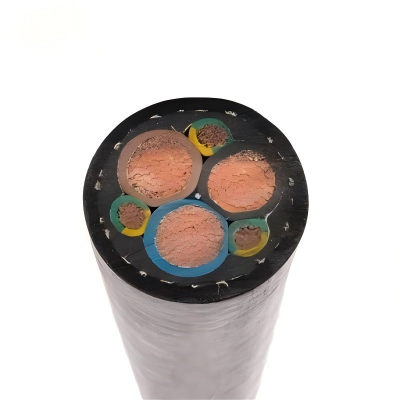
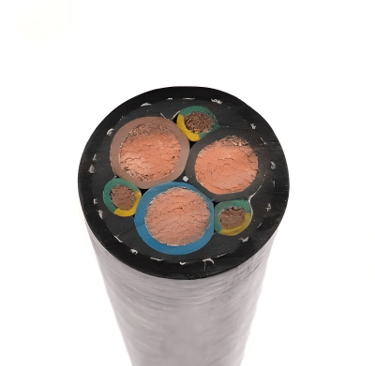
Understanding AS/NZS 2802: A Complete Guide to Reeling, Trailing and Flexible Mining Cables for Australian Mining Operations
Australia runs on mining, and mining runs on cable. The country is the world's largest iron ore exporter, with the Pilbara region in Western Australia sitting at the centre of that production, and a fast-growing sector in lithium, copper and other critical minerals layered on top. As mining operations push deeper into automation — autonomous trucks, remote-operated equipment, electrified processing — the demand for power that can move with the machine has only grown.
That last point is the crux of it. A fixed building cable can sit in a tray for fifty years and never move. A mining cable has to deliver thousands of volts to a machine that travels, swings, reels, drags and vibrates its way through a working shift, in heat and dust and rain, for years. Ordinary power cable simply cannot survive that duty. Mobile mining equipment needs cable engineered specifically for repeated mechanical stress while carrying serious power safely — and in Australia, the standard that governs how those cables are built is AS/NZS 2802.
This guide explains what AS/NZS 2802 covers, how its two cable classes differ, the specific cable types you'll encounter in the field, the difference between reeling and trailing cables, and how the right choice plays out across real Pilbara operations from the open-cut face all the way to the export wharf at Port Hedland. It closes with a practical expert summary you can use when specifying cable for your own projects.
What Is AS/NZS 2802?
Official Standard Scope
The standard in full is AS/NZS 2802:2000, Electric Cables – Reeling and Trailing – For Mining and General Use (Other Than Underground Coal Mining). It remains the current standard, having originated in Australia decades ago and been jointly revised into its present Australian/New Zealand form, and it has been reconfirmed in recent years, so it continues to be the active benchmark.
Its scope is deliberately broad. It specifies the requirements for flexible reeling and trailing cables used across surface mines, metal mines, quarry operations, bulk materials handling systems, port applications and general industrial mobile equipment. Anywhere movable plant needs an electricity supply and the cable has to move with it — short of underground coal mining, which has its own dedicated standard — AS/NZS 2802 is the framework that applies.
Voltage Range Covered
The standard covers a wide span of voltage classes, from 1.1/1.1kV at the low end up through 3.3kV, 6.6kV, 11kV, 22kV and on to 33kV at the top. That range is what lets a single standard govern everything from a modest auxiliary feed to the heavy medium-voltage supply feeding a dragline or a large reclaimer.
Why AS/NZS 2802 Matters
The reason the standard matters comes down to four linked outcomes. It underpins equipment safety, because the construction rules build in the protective features that keep people and plant safe when something goes wrong. It drives reliability, because cables built to a proven specification last longer under stress. It provides compliance, giving operators and contractors a defensible basis for the cable they install. And ultimately it reduces downtime, because a correctly specified, standard-compliant cable is far less likely to fail mid-production. In an industry where an hour of stopped production can cost more than the cable itself, that last point alone justifies the discipline.
Key Safety Features of AS/NZS 2802 Cables
What separates a mining cable from an ordinary flexible cable is as much about safety as about toughness. Several features are built in specifically to protect people and equipment.
Pilot Core Requirements
The pilot core is the quiet hero of a mining cable. It's a dedicated core used for earth continuity monitoring — a small control circuit that continuously checks the integrity of the earth connection back to the equipment. If that earth path is broken, the monitoring system can trigger an automatic power shutdown before the fault becomes dangerous. The practical effect is personnel protection: if a cable is damaged or a connection fails, the supply is cut rather than left live. Across the AS/NZS 2802 cable types, you'll see pilot cores configured in different ways — a single central extensible pilot core in some designs, or multiple pilots in others — but the safety function is the constant.
Earth Core Design
Alongside the pilot, the earth cores provide the fault current path. In the event of an insulation failure, these cores give fault current a safe, low-impedance route back to earth, which both protects the equipment and ensures protective devices operate correctly. In the typical AS/NZS 2802 construction, the earth cores are tinned copper and are disposed in the interstices — the gaps between the main power cores — often covered in a semiconductive elastomer. Designs vary between two-earth and three-earth arrangements depending on the cable type and its intended duty.
Screening Systems
Screening manages the electrical field around each power core, which becomes essential at medium voltage. AS/NZS 2802 cables use different screening approaches suited to different needs. A semiconductive screen uses a conductive elastomer layer over the insulation to control the field smoothly. A composite screen combines tinned annealed copper braiding interwoven with polyester yarn under a semiconductive tape, adding a metallic path that improves screening performance and earth-fault capability. The choice between a semiconductive elastomer screen and a copper-incorporating composite screen is one of the defining differences between otherwise similar cable types, and it affects both performance and cost.
Class 1 vs Class 2 Mining Cables
One of the most important concepts in AS/NZS 2802 is that it defines two distinct classes of cable construction. Understanding the difference is the single most useful piece of knowledge a specifier can carry.
Class 1 Cables
Class 1 cables are built around a high-grade ethylene propylene rubber insulation (designated XR-EP-90) that permits a reduced radial thickness of insulation compared with an equivalent Class 2 cable. They also run a reduced sheath thickness. The consequences flow naturally: lower weight, a smaller overall diameter, easier reeling, better flexibility and lower tension loads on the reeling system.
That combination makes Class 1 the natural choice wherever the cable has to move easily and often — reeling systems, port cranes, stacker reclaimers and ship loaders, where a lighter, more flexible cable reduces wear on both the cable and the handling gear. The typical Class 1 types you'll meet are Type 441, Type 450, Type 451 and Type 455.
Class 2 Cables
Class 2 cables take the opposite design stance. Built with standard R-EP-90 insulation, they carry thicker insulation and a thicker sheath, which delivers greater mechanical protection at the cost of more weight and a larger diameter. That ruggedness suits trailing systems, surface mining equipment and the harshest mining environments, where the cable is dragged over ground and abrasion and impact resistance matter more than easy reeling. The typical Class 2 types are Type 409, Type 412 and Type 440.
Class 1 vs Class 2 in Practice
Put side by side, the trade-off is straightforward. Class 1 is lighter, smaller in diameter and more flexible, which makes it ideal for reeling duty where the cable is wound and unwound constantly. Class 2 is heavier and larger but offers greater abrasion and mechanical protection, which makes it ideal for trailing duty where the cable takes a beating on the ground. Neither is "better" in the abstract — they're optimised for different jobs, and choosing the wrong class is one of the more common and costly specification errors. A reeling system saddled with heavy Class 2 cable suffers excess tension and premature wear; a trailing application fitted with lighter Class 1 cable may not survive the abrasion.
Common AS/NZS 2802 Cable Types Explained
With the class distinction clear, the individual types make much more sense. Here's what each one is built for.
Type 409
Type 409 is a heavy-duty trailing cable suited to drilling rigs, pumps and excavators. Its strength is exactly that — heavy-duty trailing performance and excellent durability where the cable is dragged and abused on a daily basis.
Type 412
Type 412 serves feed cables and auxiliary equipment, where the priority is reliable low-voltage power distribution rather than extreme mechanical performance. It's the workhorse for getting power to the supporting cast of equipment around a site.
Type 440
Type 440 is built for long-distance trailing behind surface mining equipment. Its distinguishing feature is a three-pilot-core arrangement, which gives enhanced monitoring capability — valuable on long runs where earth continuity assurance is especially important.
Type 441
Type 441 is a Class 1 semiconductive screened cable for general use, with lower insulation and sheath radials than a Class 2 cable and a smaller overall diameter and mass. It carries semiconductive elastomer screened power cores with three earth cores and one central extensible pilot core, tinned copper throughout, XR-EP-90 insulation, and an extra-heavy-duty PCP sheath reinforced with a polyaramid Kevlar® braid for exceptional tear and cut-through resistance. Rated across 3.3kV to 22kV, it suits general mining equipment and materials handling systems and is well matched to trailing and slow reeling. It's a flexible, versatile design that turns up in a great many applications.
Type 450
Type 450 is a Class 1 reeling cable that spans an unusually wide voltage range, from 3.3kV right up to 33kV. It's designed for everything from dragline cable duty to slow reeling applications where a copper-screened cable is required but light weight and smaller dimensions are also wanted. Its construction uses three flexible stranded tinned copper conductors, EPR insulation with a semiconductive elastomer insulation screen, and — distinctively — a composite screen of tinned annealed copper braiding interwoven with polyester yarn under a semiconductive tape. It carries two interstitial earth conductors and one interstitial pilot, with an extra-heavy-duty PCP sheath and open-weave braid reinforcement. The result is lightweight construction with excellent reeling performance, which is why it appears on draglines, electric shovels, bucket wheel excavators and port cranes alike.
Type 451
Type 451 is closely related to Type 450 — a Class 1 composite screened cable for medium-voltage reeling — but with a reduced pilot size, and it too is rated from 3.3kV up to 33kV. It's specified for draglines, shovels, excavators, wharf cranes and materials handling equipment. Like Type 450 it uses a composite tinned copper and polyester yarn screen under a semiconductive tape, EPR (XR-EP-90) insulation, two earth cores and one pilot disposed in the interstices, and an extra-heavy-duty XHD-85-PCP sheath with a polyaramid Kevlar® braid reinforcement. It's the choice when a flexible Class 1 reeling design with composite screening is required.
Type 455
Type 455 is the leaner cousin: a Class 1 semiconductive screened cable similar to Type 450 but without the composite insulation screen, rated from 3.3kV to 11kV. By dropping the copper composite screen in favour of a semiconductive elastomer screen alone, it sheds weight and diameter, which translates into reduced mass and superior bending performance. It carries three numbered phase cores, two earth cores and one pilot, with the same XR-EP-90 insulation and Kevlar®-reinforced XHD-85-PCP sheath as its siblings. It suits high-stress reeling operations, bulk handling facilities and mining machinery where keeping weight down is a priority and the full composite screen isn't required.
A useful way to hold the three medium-voltage reeling types in mind: Type 451 and Type 450 carry the heavier composite (copper-incorporating) screen for the most demanding electrical duty up to 33kV, while Type 455 trades that screen for lighter weight and better bending, capped at 11kV. All three share the same tough, Kevlar-reinforced rubber sheath and the same flexible tinned-copper, EPR-insulated foundation.
Reeling Cables vs Trailing Cables
Underlying all of these types is a fundamental split in how a mining cable is used, and getting this right is half the battle.
What Is a Trailing Cable?
A trailing cable is dragged behind moving equipment, in direct contact with the ground. Because of that ground contact, abrasion resistance is the critical property — the cable is constantly scraped over rock, dirt and debris. Trailing cables are the natural fit for drill rigs, excavators and mobile crushers, the kind of equipment that crawls across a site trailing its supply behind it.
What Is a Reeling Cable?
A reeling cable is wound onto and off a cable drum as the equipment travels. Instead of abrasion, its defining challenge is the sheer number of bending cycles it endures, plus the torsion that comes from winding onto a drum. Torsion resistance and fatigue life are everything here. Reeling cables are used on draglines, ship loaders, stacker reclaimers and bucket wheel reclaimers — machines that travel along a defined path while spooling cable.
How to Choose Between Them
The selection comes down to how the cable physically moves and a handful of related factors: the travel distance involved, the reeling speed if it's a drum application, the dominant mechanical stress (abrasion versus bending and torsion), and the installation method. A short, ground-dragging duty points to a rugged trailing cable, typically Class 2. A long, fast, drum-wound duty points to a lighter, more flexible reeling cable, typically Class 1. Matching the cable's design intent to the actual motion of the equipment is the foundation of every good selection.
Construction Features of AS/NZS 2802 Mining Cables
The performance of these cables comes from a consistent set of construction features, each chosen to solve a specific problem.
Flexible Tinned Copper Conductors
The conductors are flexible, finely stranded tinned copper. The fine stranding delivers the flexibility and long fatigue life that repeated bending demands, while the tin coating provides corrosion resistance — important in wet, salty or chemically aggressive environments where bare copper would degrade.
EPR Insulation Systems
Insulation is based on ethylene propylene rubber, in two grades that map directly onto the class system. Class 1 cables use the high-grade XR-EP-90, which allows the thinner insulation radial that makes Class 1 lighter and more flexible. Class 2 cables use the standard R-EP-90 with its greater thickness for added protection. Both are rated to a 90°C maximum operating temperature, with a minimum operating temperature around −25°C, giving the cables a wide working window.
Heavy-Duty Elastomer Sheaths
The outer sheath is where toughness lives. AS/NZS 2802 cables use extra-heavy-duty elastomer sheaths in chlorosulphonated polyethylene (CSP), chlorinated polyethylene (CPE) or polychloroprene (PCP) compounds, designated as extra-heavy-duty grades such as XHD-85-PCP. These compounds are chosen for a combination of UV resistance, oil resistance, flame retardancy and abrasion resistance — exactly the cocktail of threats a mining cable faces. The datasheets bear this out, rating these cables as fire retardant, suitable for direct solar and weather exposure, very good against frequent chemical exposure, and capable of handling heavy mechanical impact and even temporary water immersion.
Aramid Reinforcement (Kevlar®)
The feature that ties the sheath system together is a polyaramid yarn Kevlar® braid reinforcement built into the sheath. This braid delivers the tear resistance and mechanical strength that lets the cable survive snags, cut-through and the constant tension of reeling without the sheath failing. It's a large part of why these cables can take the punishment they do.
AS/NZS 2802 Cables in Australia's Largest Mining Operations
The real test of any standard is how it performs in the field, and across the Pilbara, AS/NZS 2802 cables are everywhere.
BHP Iron Ore Operations
BHP's Western Australia Iron Ore (WAIO) network spans a string of major operations including South Flank, Mining Area C, Mount Whaleback and Jimblebar. Across these sites, AS/NZS 2802 cables feed electric shovels, mobile conveyors and stacker reclaimers.
Take South Flank as a case in point. The site faces the full Pilbara cocktail of cable challenges: extreme heat, intense UV exposure, heavy dust and continuous round-the-clock operation. Those conditions point toward rugged, well-protected cables — the heavy-duty trailing performance of a Type 440 for ground-dragging surface equipment, and the lightweight reeling performance of a Type 450 for drum-wound machines like reclaimers. The combination covers both the trailing and reeling duties found across the operation.
Rio Tinto Operations
Rio Tinto's Pilbara portfolio includes Gudai-Darri, Brockman, Hope Downs and Western Range, supplying power to increasingly automated mining equipment and processing facilities.
Gudai-Darri, as one of Rio Tinto's most technologically advanced mines, illustrates the modern challenge set: long-distance power supply to mobile plant, integration with automation systems, and persistent dust contamination. A site like this draws on a spread of cable types — a heavy-duty Type 409 for trailing duties on drills and excavators, a flexible Type 441 for general mining equipment and materials handling, and a Type 450 for reeling applications on larger mobile machines. The mix reflects the variety of equipment a single modern operation runs.
Fortescue Operations
Fortescue operates across Cloudbreak, Christmas Creek, the Solomon Hub, Eliwana and Iron Bridge, with cable feeding mobile processing equipment, reclaimers and crushers.
At Cloudbreak, the dominant challenges are high abrasion, long trailing distances and the relentless demand of continuous production. That profile favours rugged trailing cable for the long ground runs — a Type 440 for the heavy long-distance trailing and a Type 441 for general equipment — alongside a Type 455 where a lighter, better-bending reeling cable suits high-stress reeling duty. The emphasis on abrasion and distance shapes the selection toward toughness and monitoring capability.
From Mine to Port: Where AS/NZS 2802 Cables Are Used
One of the strengths of AS/NZS 2802 is that it follows the ore the whole way from the pit to the ship. The same family of cables powers every link in the chain.
Open-Cut Mine Applications
At the face, the cables feed the biggest, most demanding equipment on site: electric shovels loading ore, drilling rigs preparing blasts, and excavators moving material. These are largely trailing and heavy reeling duties calling for rugged, well-protected cable.
Processing Plants
Once the ore is moving, processing plants run conveyors, crushers and stackers. Here the cables supply both fixed and mobile plant, with reeling and flexible types feeding the equipment that moves material through crushing and screening.
Rail Loading Facilities
Ore then heads to rail loading facilities, where wagon loading systems and mobile conveyors fill the trains for the journey to the coast. Mobile, reeling-fed equipment dominates this stage.
Export Port Applications
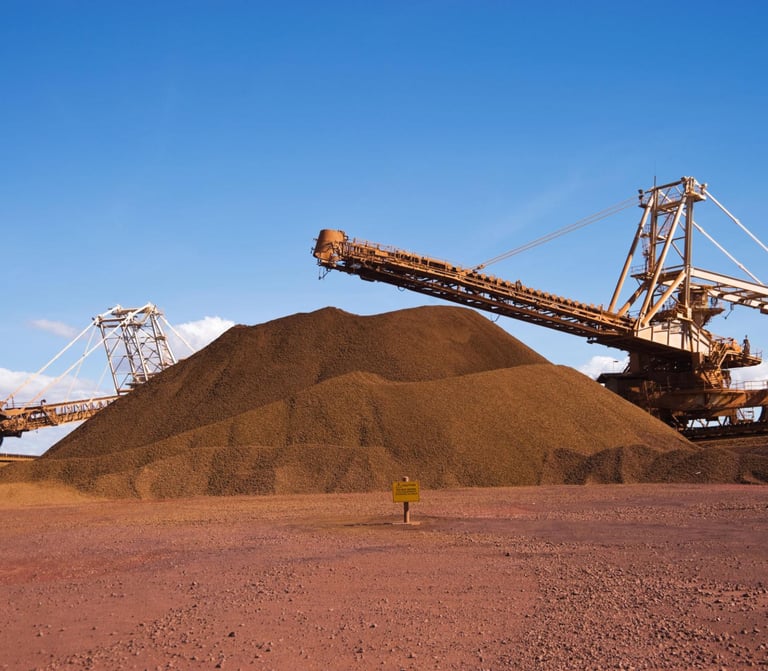
At the export port, the chain reaches its most cable-intensive point. Ship loaders, stacker reclaimers and rail-mounted machinery all depend on flexible reeling cables to move ore from stockpile to vessel. The long travel distances and constant reeling make this a showcase for Class 1 reeling types.
Port Hedland Case Study
Port Hedland deserves its own mention as the world's largest bulk export port, handling more than 570 million tonnes a year and serving as the main export hub for BHP, Rio Tinto and Fortescue. The cable challenges here are acute and stacked on top of one another: pervasive iron ore dust, salt spray from the marine environment, intense UV exposure, and long reeling distances on the wharf machines.
Those conditions make the case for Class 1 reeling cables built for exactly this duty. A Type 450, with its composite-screened, lightweight construction and excellent reeling performance up to high voltages, suits the larger wharf cranes and reclaimers. A Type 455, lighter still and with superior bending performance, suits high-stress reeling where weight reduction is the priority. In both cases the tinned copper conductors fight the salt, the Kevlar-reinforced PCP sheath handles the dust abrasion and UV, and the Class 1 flexibility keeps reeling wear in check. It's a near-perfect illustration of the standard's design logic meeting one of the harshest environments in the country.
How to Select the Right AS/NZS 2802 Cable
Pulling it all together, a sound selection works through a consistent set of questions. Start with the voltage rating the equipment requires, which narrows the field immediately. Identify the equipment type, because that points toward proven cable families. Determine whether the duty is reeling or trailing, the single biggest fork in the decision. Weigh the cable weight against the handling system's capacity, since an over-heavy cable strains both itself and the reel. Confirm the pilot core requirements for the monitoring and safety system in use. And finally, account for the environmental conditions — heat, UV, dust, salt, chemicals and water — that will attack the cable over its life. Work through those six in order and the right cable usually selects itself.
Common Mistakes When Specifying Mining Cables
A handful of errors recur often enough to be worth flagging directly.
The first is ignoring pilot core requirements — overlooking the monitoring and earth-continuity function that the pilot provides, which compromises the safety system the cable is meant to support.
The second is using trailing cables for reeling applications (or the reverse) — mismatching the cable class to the motion, which leads to excess tension, abrasion or fatigue and shortens life dramatically.
The third is ignoring bending radius — specifying or installing a cable on a drum or over rollers tighter than its minimum bending radius, which fatigues the conductors and cracks the sheath.
The fourth is underestimating cable weight — failing to account for the mass of a long run of heavy cable, which overloads the reeling system and the cable itself.
The fifth is ignoring environmental conditions — treating a Pilbara wharf the same as a temperate workshop and discovering too late that UV, salt and dust have destroyed an unsuitable cable.
Future Trends in Australian Mining Cable Technology
The direction of travel is clear. Autonomous mines and remote operation centres are reshaping how equipment is powered and monitored, and cable is being asked to do more than carry power. Fibre-optic hybrid mining cables — combining power cores with integrated optical fibres for data and control — are increasingly in demand as automation deepens. Smart monitoring systems that watch cable condition in real time are emerging, promising to catch degradation before it becomes failure. And the broad push toward electrification and decarbonisation is driving demand for more and higher-capacity mobile power.
The practical upshot is rising demand for hybrid power-plus-fibre cables, for medium-voltage reeling cables that can feed ever-larger electrified equipment, and for real-time condition monitoring that turns the cable from a passive component into a monitored asset. The AS/NZS 2802 framework provides the foundation these developments build upon.
Expert Summary
After all the detail, the practical wisdom distils to a few points worth keeping front of mind.
AS/NZS 2802 remains the benchmark standard for reeling and trailing cables in Australian mining and general mobile-plant use outside underground coal, and specifying to it is the baseline for safety and compliance. The most consequential decision you'll make is the Class 1 versus Class 2 choice: Class 1 (Types 441, 450, 451, 455) for lighter, more flexible reeling duty, and Class 2 (Types 409, 412, 440) for rugged, abrasion-resistant trailing duty. Get that match right, respect the cable's minimum bending radius and weight limits, and never treat the pilot core as optional — it's the heart of the safety system.
For the medium-voltage reeling applications that dominate ports and large mobile equipment, the Type 450, 451 and 455 family covers the field: composite-screened 450 and 451 for the heaviest electrical duty up to 33kV, and the lighter semiconductive-screened 455 where bending performance and weight savings matter most, up to 11kV. All share the tinned copper, EPR insulation and Kevlar-reinforced heavy-duty sheath that let them survive the Pilbara.
Correct cable selection is not a procurement afterthought — it directly improves safety, productivity and equipment reliability, and the Pilbara's mining operations and the Port Hedland bulk terminals will keep driving demand for high-performance trailing and reeling cable for years to come. The sensible move on any new project or replacement is to bring the full picture — voltage, equipment, duty, environment and monitoring requirements — to a cable specialist early, and let the engineering, rather than the catalogue, lead the decision.
How to Reach Us
Get in Touch
SiteMap
Product Catalogue
Festoon Cable
Shore Power Cable




Scan to add us on WeChat