
Australian Port Crane Cable Guide: (N)TSCGEWOEU Medium Voltage Reeling Cable for Shiploaders and Stacker Reclaimers
A technical overview for port engineers, procurement specialists, and equipment operators working with heavy-duty cable reeling systems in Australian bulk material handling terminals.
hongjing.Wang
3/10/20267 min read
What Is a Reeling Cable and Why Does It Matter in Australian Ports?
Australia is one of the world's largest exporters of bulk commodities — coal, iron ore, grain, and bauxite — and its port terminals depend on massive, continuously moving machines to keep supply chains running. At the heart of these machines is a component that is rarely discussed but absolutely critical: the medium voltage reeling cable.
Unlike fixed power cables, reeling cables are engineered to be wound and unwound thousands of times over their service life. They flex, twist, stretch, and endure torsional stress day after day. The wrong cable specification leads to premature failure, costly downtime, and potential safety hazards in an already demanding port environment.
The (N)TSCGEWOEU is the internationally recognised type designation for medium voltage reeling cables designed to meet these extreme conditions — and it is widely used across Australian export terminals for shiploaders, stacker reclaimers, and large mobile port cranes.
Australian Coal and Bulk Port Operations: Equipment Overview
Primary SEO keywords: Australian port crane cable, shiploader reeling cable Australia, stacker reclaimer cable specification, medium voltage port cable
Major Australian bulk export terminals — including those handling coal in New South Wales and Queensland, and iron ore in Western Australia — operate some of the most technically demanding material-handling equipment in the world. Key machines include:
Shiploaders – Load bulk cargo directly into vessels at berth, with a moving boom that requires dynamic power delivery over long travel distances.
Stacker Reclaimers – Stack incoming material onto stockpiles and reclaim it for ship loading; these machines travel hundreds of metres along rail tracks.
Conveyor Systems – Interconnect the entire terminal, often running kilometres in length.
Mobile Harbour Cranes – Used at multi-purpose berths for general cargo and bulk handling.
All of these machines share one requirement: a reliable, flexible cable system capable of delivering medium voltage power without failure under continuous mechanical stress.
Why Standard Industrial Cables Fail in Port Crane Applications
Long-tail SEO keywords: reeling cable vs standard power cable, why standard cables fail on cranes, port crane cable requirements Australia
Standard fixed-installation cables are not designed for dynamic applications. In a port crane or stacker reclaimer environment, cables face:
1. Extreme Travel Distances Stacker reclaimers at major Australian terminals can travel 500 metres or more in a single pass. This demands high tensile strength, excellent bending endurance, and a cable geometry that remains stable under repeated spooling.
2. Continuous Mechanical Cycling Every pass of the machine equals one wind/unwind cycle on the cable reel. Over a machine's 20–30 year service life, this amounts to millions of bending cycles. Only purpose-built reeling cables with extra fine stranded copper conductors and anti-torsion reinforcement can survive this.
3. Dynamic Tensile and Torsional Forces As a cable pays out across a reel, it experiences both tensile pull and rotational (torsional) stress. These forces must be distributed through the cable's cross-section without damaging the conductors or insulation. The (N)TSCGEWOEU design addresses this with a reinforced anti-torsion braid embedded within the sheath system.
4. The Harsh Australian Port Environment Australian coastal ports combine UV radiation, salt-laden marine air, coal or ore dust, moisture, and high ambient temperatures. Cables must be:
UV-resistant
Resistant to ozone and moisture
Oil and chemical resistant
Abrasion and tear-proof on the outer sheath
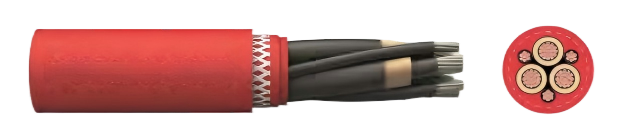
(N)TSCGEWOEU Cable: Technical Design Explained
SEO keywords: NTSCGEWOEU cable specification, medium voltage reeling cable DIN VDE 0250-813, EPR insulation reeling cable
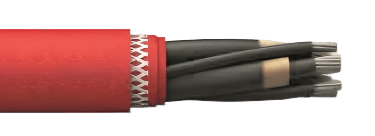
The (N)TSCGEWOEU designation follows German DIN VDE standards and describes a specific construction that has become the benchmark for heavy-duty port crane reeling cables worldwide. Here is what makes this cable design exceptional:
Conductor System
Electrolytic tinned copper, very finely stranded (Class FS) per DIN VDE 0295
Three-core design with the earth conductor split into three equal parts, positioned in the cable interstices
Fine stranding gives maximum flexibility, enabling tight bending radii without conductor fatigue
Insulation: High-Grade EPR Compound
EPR (Ethylene Propylene Rubber) insulation compound, quality rating at least 3GI3
Provides superior electrical performance, high thermal stability up to 90°C continuous conductor temperature
Short-circuit withstand up to 250°C
Features inner and outer semiconductive layers for electrical field control — the outer layer uses a modified NBR compound with Easy Strip design for fast, cold-stripping during termination
Anti-Torsion Sheath System (PROTOFIRM Sandwich)
This is the engineering feature that sets (N)TSCGEWOEU apart from generic reeling cables:
Double-layer inner sheath based on EPR compound (min. quality 5GM3), which also acts as a water barrier
Anti-torsion braid of reinforced polyester threads, vulcanised between the sheath layers — this distributes torsional stress across the cable cross-section rather than concentrating it on the conductors
Double-layer outer sheath of high-grade PCP (Polychloroprene) rubber compound (min. quality 5GM5), providing abrasion, tear, ozone, UV, and chemical resistance
The result is a cable that achieves torsional tolerance of ±25°/m — critical for reel-fed systems where the cable experiences rotational forces as it changes direction.
Voltage Ratings for Port Crane Reeling Cable Applications
Long-tail keywords: medium voltage reeling cable 6kV 10kV 15kV, shiploader cable voltage rating, stacker reclaimer power cable kV
The (N)TSCGEWOEU is available across a range of medium voltage ratings to match the drive and motor specifications of different port machines:
Rated VoltageMax. Permissible AC VoltageTypical Application1.8/3 kV2.1/3.6 kVAuxiliary systems, small crane drives3.6/6 kV4.2/7.2 kVMedium-duty shiploaders, mobile cranes6/10 kV6.9/12 kVLarge stacker reclaimers, major crane systems8.7/15 kV10.4/18 kVHigh-power shiploader boom drives12/20 kV13.9/24 kVExtra-high-power bulk handling equipment
For the largest Australian export terminals operating heavy stacker reclaimers and shiploaders, the 6/10 kV and 8.7/15 kV ratings are most commonly specified.
Mechanical Performance Data: What the Numbers Mean
Long-tail SEO keywords: reeling cable tensile strength port crane, cable bending radius crane reel, dynamic tensile force shiploader cable
Selecting a reeling cable requires more than matching voltage — the mechanical parameters must be validated against the specific machine's reel design and travel profile. Key parameters from the (N)TSCGEWOEU specification include:
Tensile Load Limits
Static maximum tensile load on conductor: 20 N/mm²
Dynamic tensile load during acceleration: up to 30 N/mm²
For a 3×185+3×95/3 mm² cable at 6/10 kV, this translates to a static permissible tensile force of 11,100 N and a dynamic tensile force of 16,650 N — figures that must be matched to the cable reel's pull-out force calculations.
Bending Radius Minimum free-moving bending radius is determined per DIN VDE 0298 Part 3, based on cable outer diameter. For example:
3×50+3×25/3 at 6/10 kV: outer diameter ~46.7 mm → minimum free-moving bending radius 467 mm
3×185+3×95/3 at 6/10 kV: outer diameter ~69.3 mm → minimum free-moving bending radius 693 mm
Specifying a drum diameter below the minimum bending radius will cause insulation cracking and premature failure — a common and costly mistake in port equipment retrofits.
S-Type Directional Changes For applications involving S-shaped cable guides (common in reclaimer boom systems), the minimum distance between direction changes is 20 × cable outer diameter.
Travel Speed No restriction for gantry reeling operation. For travel speeds exceeding 240 m/min, consultation with the cable manufacturer is recommended.
Conductor Cross-Section Selection Guide for Australian Port Cranes
Long-tail keywords: how to select cable cross section for crane, shiploader cable sizing guide, stacker reclaimer cable current capacity
Current-carrying capacity determines the minimum conductor cross-section for a given motor load. The following capacities apply for rubber cables laid on a surface at 30°C ambient temperature (VDE 0298-4, Table 15):
Cross-Section (mm²)Current Capacity (A)Typical Motor Power (approx. at 6 kV)3×25131–139 A~1.2–1.4 MW3×50202–215 A~1.9–2.2 MW3×95301–319 A~2.8–3.3 MW3×150404–428 A~3.8–4.4 MW3×185461–488 A~4.4–5.1 MW3×240540–574 A~5.1–6.0 MW3×300620–660 A~5.9–6.8 MW
Note: Derating factors should be applied for elevated ambient temperatures, grouped cable installations, or continuous high-duty-cycle operation typical of Australian port equipment.
For most large shiploaders and stacker reclaimers, 3×150 to 3×240 mm² is the most commonly specified range.
Temperature and Environmental Ratings: Suited to Australian Conditions
Long-tail keywords: reeling cable high temperature Australia, outdoor port cable UV resistance, marine salt spray cable rating
Australia's port environments present some of the most challenging conditions for cable systems:
Ambient temperature range (fixed installation): –50°C to +80°C
Ambient temperature (fully flexible operation): –35°C to +80°C — relevant for northern Australian ports with extreme summer heat
Weather resistance: Unrestricted outdoor and indoor use, resistant to ozone, UV, and moisture
Oil resistance: Per DIN EN 60811-404 — important for machine deck areas exposed to hydraulic fluid
Water resistance: Per HD 2216
The outer PCP sheath provides the UV and ozone resistance necessary for exposed cable trailing on outdoor port equipment — a requirement that eliminates many standard industrial rubber cables from consideration.
Key Selection Checklist for Port Engineers
Long-tail keywords: how to specify port crane reeling cable, crane cable procurement checklist Australia, reeling cable selection criteria
When specifying a reeling cable for a shiploader or stacker reclaimer in an Australian terminal, engineers should confirm the following:
✅ Voltage rating – Match to system drive voltage (typically 6/10 kV or 8.7/15 kV for large machines)
✅ Current-carrying capacity – Calculate from motor rating with appropriate derating for ambient temperature and duty cycle
✅ Tensile force – Calculate static and dynamic pull from cable reel geometry, cable weight, and machine acceleration profile
✅ Minimum bending radius – Verify drum diameter exceeds the cable's minimum free-moving bending radius
✅ Travel distance – Longer travel requires more cable on the drum; verify reel drum capacity and cable weight per metre
✅ Environmental exposure – Confirm sheath compound is rated for UV, ozone, salt mist, coal/ore dust as applicable
✅ Torsional requirement – For boom-mounted or rotating reel systems, confirm ±25°/m torsional tolerance is sufficient
✅ Standard compliance – Specify cables manufactured to DIN VDE 0250-813 or equivalent for assured quality baseline
✅ Special designs – Data transmission cores, fibre optics, or individually screened control pairs can be integrated into the cable design for combined power and signal applications
Retrofitting and Replacement Cables for Existing Port Equipment
Long-tail keywords: replacement reeling cable shiploader Australia, equivalent NTSCGEWOEU cable alternative, port crane cable retrofit
Many Australian ports are operating shiploaders and stacker reclaimers that have been in service for 15–25 years. As original cables reach end of life, procurement teams face a common challenge: sourcing replacement reeling cables that match the original specification, with acceptable lead times and competitive pricing.
Modern cable manufacturers producing to DIN VDE 0250-813 can supply equivalent (N)TSCGEWOEU designs that deliver:
Identical or superior mechanical performance to the original specification
The same voltage rating, conductor cross-section, and earth conductor arrangement
Equivalent current-carrying capacity and short-circuit ratings
Competitive pricing compared to original equipment supplier quotes
Shorter lead times through regional distribution or local warehousing in Australia
When ordering replacement cables, it is important to provide the full cable designation including number of cores, cross-section, earth conductor arrangement, and rated voltage — for example: (N)TSCGEWOEU 3×185+3×95/3 mm² 6/10 kV.
Conclusion: Reeling Cable Performance Determines Port Uptime
In Australian bulk export terminals, shiploader and stacker reclaimer availability directly determines export throughput. Unplanned cable failures translate to vessel delays, demurrage costs, and supply chain disruptions that affect commodity contracts worth millions of dollars.
The (N)TSCGEWOEU medium voltage reeling cable — with its fine-stranded copper conductors, EPR insulation, anti-torsion braid reinforcement, and abrasion-resistant PCP outer sheath — remains the global benchmark for this application. Understanding its specification in depth allows port engineers and procurement teams to make informed decisions, write precise tender documents, and evaluate alternative suppliers confidently.
For new installations, machine upgrades, or like-for-like cable replacements, specifying to the (N)TSCGEWOEU standard and DIN VDE 0250-813 provides the assurance that the cable system will perform reliably through years of continuous heavy-duty operation.
Keywords: (N)TSCGEWOEU cable Australia, medium voltage reeling cable shiploader, stacker reclaimer cable specification, port crane cable 6kV 10kV, DIN VDE 0250-813 reeling cable, EPR insulated port cable, heavy duty reeling cable Australian port, shiploader cable current capacity, anti-torsion reeling cable, crane cable replacement Australia
How to Reach Us
Get in Touch
SiteMap
Product Catalogue
Festoon Cable
Shore Power Cable




Scan to add us on WeChat