
Australian Testing Requirements for Crane Cable: Standards, Performance Tests, Certifications and Project Documentation
A practical guide to the testing and compliance crane cables actually need in Australia — AS/NZS standards, flame and flex tests, UV and abrasion verification, third-party certs and the FAT documentation EPC contractors will ask for.
hongjing.Wang@Feichun
6/12/202612 min read
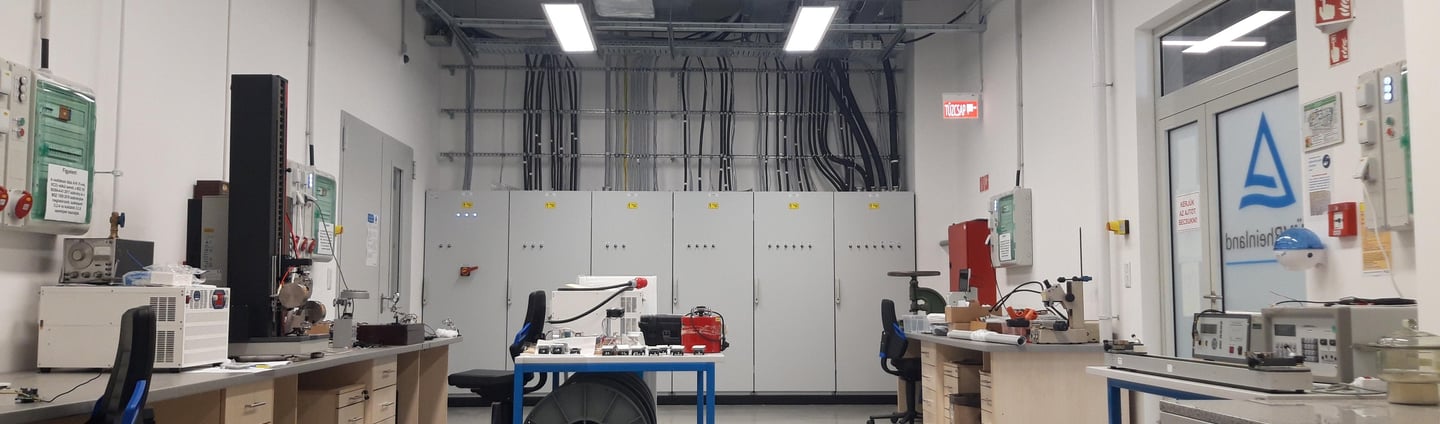
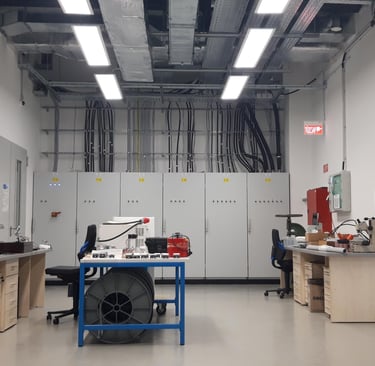
If you've ever had a cable knocked back at a port-side inspection, you'll know the feeling. The cable works. It's the right size, the right voltage, sitting on the reel doing its job. But the project engineer wants the test reports, the EPC contractor wants the FAT package, and the port authority wants documented evidence that the thing will survive five years of Australian sun, salt and dynamic load. No paperwork, no sign-off. And suddenly a cable that's electrically perfect is holding up commissioning.
That's the reality of crane cable procurement in this country. Australian ports, mines, container terminals and bulk handling facilities run cables in some of the harshest conditions on earth — continuous flexing, dynamic tensile loads, UV that'll cook a sheath, oil contamination, abrasion, temperature swings from desert mornings to midday heat. Choosing a cable here isn't just a matter of conductor size and voltage rating. Compliance with Australian standards, the right international test evidence, and a complete documentation package matter every bit as much.
This guide walks through what's actually required: the AS/NZS standards that govern crane cable, the mechanical and environmental performance tests that prove it'll last, the third-party certifications worth having, and the documentation Australian projects routinely ask for. It's written for the people who have to make it stack up — crane manufacturers, EPC contractors, project owners and the procurement folks caught between them.

Why Testing and Compliance Matter
The Risk of Getting It Wrong
Skip the compliance step and the failure modes are predictable and expensive. Electrical failures and the safety incidents that can follow are the headline risk. But there's a long tail beneath it: premature cable wear that has you replacing cable far ahead of schedule, project delays when a non-compliant cable can't be signed off, failed inspections that stall commissioning, and the steady drip of increased maintenance costs across a cable's service life.
That's why Australian projects increasingly insist on documented evidence rather than a supplier's word. A test report from an accredited lab is checkable. A reassuring sales conversation isn't. As project values climb and safety regulators tighten expectations, the burden of proof has shifted firmly onto the cable itself.
Which Applications Need It
The applications that drive these requirements are the dynamic ones — container cranes, RTGs, RMGs, ship loaders and unloaders, stacker reclaimers, mining shovels, bulk handling conveyors and automated warehouse cranes. What they share is movement. A cable in a fixed conduit lives a sheltered life and faces a modest test regime. A reeling or festoon cable on a working crane is flexed, tensioned, twisted and abraded millions of times across its life, which is exactly why dynamic applications demand far more extensive testing than fixed-installation cable. The test regime exists to simulate that punishment before the cable ever reaches site.
The Australian Standards That Govern Crane Cable
AS/NZS 3000:2018 — The Wiring Rules
AS/NZS 3000, universally known as the Wiring Rules, is the headline standard. It specifies requirements for the design, construction and verification of electrical installations, including the selection and installation of electrical equipment forming part of them. It's structured in two parts: Part 1 provides the minimum regulatory requirements for a safe electrical installation, and Part 2 provides work methods and installation practices deemed to comply with Part 1.
For crane cable, the relevant bite is in verification. The Wiring Rules require inspection and testing before an installation is energised, drawing on the companion standard AS/NZS 3017 for verification and AS/NZS 3008 for cable selection. The practical implication is that your cable construction and installation practice both have to support that verification — the cable has to be sized so it doesn't exceed its current rating once installation derating (grouping, drum layering, ambient temperature) is accounted for. A cable that can't be verified can't be signed off, no matter how good it looks on paper. Worth noting too that the standard isn't static — amendments were published in 2020, 2020 and 2025, so working from the current edition matters.
AS/NZS 5000.1 — Electric Cables
AS/NZS 5000.1 sets the construction and performance baseline for power cables rated up to 0.6/1 kV. It governs the insulation requirements, dimensional requirements and performance requirements a compliant cable must meet, and it requires cables to demonstrate that compliance through type testing rather than mere declaration. For low-voltage crane cable, this is the construction standard the rest of the documentation hangs off.
AS 60228 / IEC 60228 — The Conductor
This is the one that matters most for flex life, and it's worth understanding why. IEC 60228 covers solid and stranded copper conductors, aluminium conductors, and flexible copper conductors, and sets out their requirements in terms of resistance values. It defines conductor classes, and for crane cable the class to look for is Class 5 (or Class 6 for extreme flexibility).
The reason is mechanical. IEC 60228 only permits aluminium for Class 1 and Class 2 conductors; flexible cables in Class 5 and 6 require copper, because aluminium has inferior mechanical properties for repeated bending. A Class 5 conductor achieves its flexibility through a large number of very fine strands — each strand less than 1.0 mm in diameter — which is precisely what extension cords, welding cables and crane systems need for frequent bending. There's a small trade-off in resistance: Class 5 resistance runs roughly 4–5% higher than Class 2 at the same cross-section, the price you pay for many fine strands instead of fewer coarse ones. On a crane cable, that trade is always worth making — a coarse-stranded conductor work-hardens and fractures under repeated flexing, while a fine-stranded Class 5 keeps going.
Fire Performance Requirements
IEC 60332-1-2 — Single Vertical Flame Test
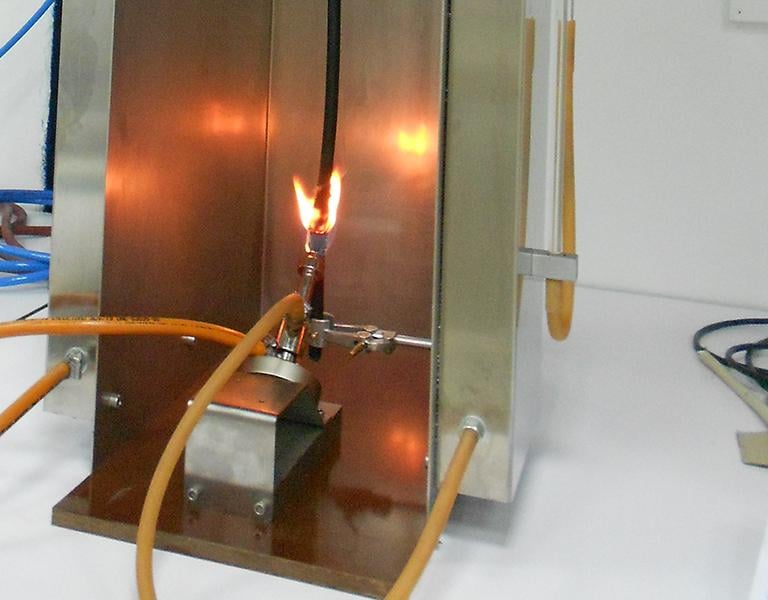
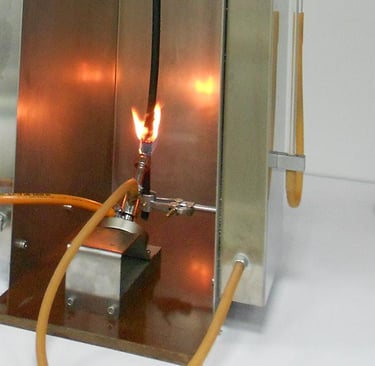
Flame retardancy is not optional on a crane installation, where cables run through trays, along structures and near plant. The single-cable vertical flame test mounts a 600 mm sample vertically and applies a flame at 45 degrees for a defined period. The pass criteria are about self-extinguishing behaviour: once the flame is removed, the cable must not continue to propagate fire up its length, with charring and damage confined within specified limits. In plain terms — if a fault or external fire ignites the sheath, the cable shouldn't carry the flame to the rest of the installation.
AS/NZS IEC 60332.3 — Bundle Flame Test
Single-cable testing is the floor, not the ceiling. On a real crane, cables run grouped — in trays, on ladders, bundled together — and a bundle behaves very differently from a lone cable. Grouped cables provide more fuel and can sustain a fire that a single cable would shrug off. The bundle test (Category A being the common specification) mounts cables on a ladder arrangement and applies a flame for an extended exposure, typically around forty minutes, to verify the bundle still self-extinguishes. This is the test that turns up in project specifications for terminals and plant rooms where cables are massed together, and it's worth confirming early whether your project calls for it.
Marine and Port Flame Requirements
For cranes on or serving regulated Australian vessels, marine-grade flame requirements under the relevant IEC 60332 marine provisions come into play, and marine operators frequently request additional flame-performance certification on top of the standard land-based tests. If your crane touches a regulated vessel, assume the flame bar is higher and check it before you order.
Mechanical Performance Testing
This is where crane cable earns or loses its reputation, because the mechanical stresses are what actually kill these cables in service.
Tensile Strength Testing
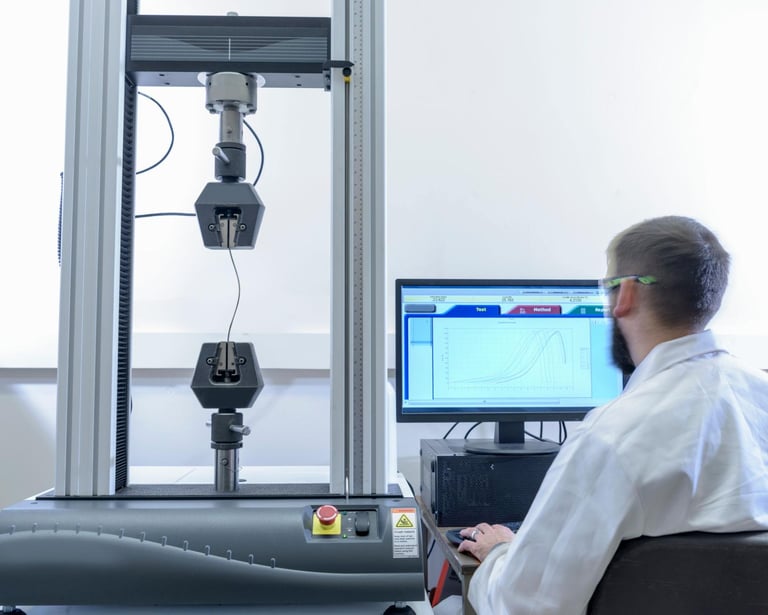
Reeling, unreeling, long-travel systems and festoon arrangements all generate dynamic tensile loads, and the tensile test exists to prove the cable can take them. A good test programme evaluates conductor strength, the strength of the cable assembly as a whole, and the adhesion between the cable's internal components — because a cable can fail at the bond between layers just as readily as in the copper itself.
The figures matter. A common reference point for trailing duty is a maximum tensile stress in the order of 20 N/mm² of the total phase-conductor cross-section, with dragging tension calculated from cable length, weight and a friction coefficient. The link to reliability is direct: a cable with insufficient tensile strength stretches its conductors, the stretch drives up resistance and heat, and premature failure follows. Get the tensile rating wrong at the design stage and you've built in the failure.
Flexing Endurance Testing
If tensile testing proves the cable can take the pull, flex testing proves it can take the cycles. Cyclic bending tests simulate real crane movement by bending the cable repeatedly around a mandrel — the ISO 19642 cyclic-bending approach uses 180-degree bend cycles with continuous monitoring of the conductors for the first sign of a break. Cables get sorted into flex-life categories — medium-flex, high-flex and ultra-high-flex — depending on the duty they're rated for.
Beyond the standardised bench tests, serious suppliers run application-specific rigs: reeling drum test rigs that wind and unwind cable exactly as a crane would, festoon test systems, and drag-chain testing equipment. These replicate the real operating geometry rather than an idealised lab bend, which is why test data from a representative rig is worth far more than a generic flex figure.
Torsion Resistance Testing
Crane cables don't just bend — they twist. Rotating booms, spreader systems on container cranes, mining machinery and even wind-induced cable movement all impose torsion, and torsion fatigues a cable in ways pure bending doesn't. Torsion testing applies repeated angular displacement — twisting the cable back and forth through a set angle for many cycles — and rates the cable for medium or high torsion performance. There's a useful parallel here with wind-turbine cable, which faces similar repeated twisting in the tower loop; the test methods and the design thinking carry across.
Abrasion Resistance Testing
For Australian mining and port work, abrasion resistance is arguably the single most important mechanical test. In mining operations, port terminals and material handling facilities, the sheath is in constant contact with abrasive surfaces, and once it's worn through, the failure cascade begins. Abrasion testing uses machines that simulate this wear under controlled, repeatable conditions, exposing how the jacket holds up. The failure modes it reveals — jacket wear, surface scoring, shield exposure, general mechanical degradation — map directly onto what you'll see on site. And because abrasion resistance governs how often you're back out there replacing cable, it translates straight into replacement intervals and lifecycle cost.
Environmental Resistance Testing
UV Resistance — Non-Negotiable in Australia
Few markets are tougher on a sheath than Australia. High UV-index conditions, outdoor crane operations and relentless sun drive accelerated ageing, and a cable that hasn't been UV-tested for these conditions will let you down. Common test references include UL 2556, ISO 4892-2 and BS EN 50289-4-17, which subject samples to accelerated UV exposure and then verify that mechanical properties haven't collapsed. The consequences of poor UV resistance are visible and progressive — discolouration first, then surface cracking, then brittleness, then a sheath that splits and opens the door to every other failure mode. For Australian outdoor cranes, UV test evidence isn't a nice-to-have.
Oil Resistance
Industrial and mining cranes live around hydraulic oils, lubricants and the occasional fuel spill, and a sheath that swells or degrades on contact with oil won't last. IEC 60811 sets out the oil-resistance test procedures, immersing samples and evaluating the change in mechanical properties afterwards. For mobile crane and mining applications especially, an oil-resistant sheath compound is a meaningful contributor to long-term reliability rather than a marketing line.
Ozone Resistance
Ozone attacks elastomers, causing fine surface cracking that can propagate into the sheath over time. Ozone-chamber testing exposes samples to a controlled ozone concentration and checks for that cracking. It's particularly relevant for outdoor and industrial installations where ozone exposure is sustained, and it's a test worth confirming for any cable that'll spend its life in the open.
Weather and Temperature
Real environments combine stresses, and weather testing reflects that — UV exposure, temperature cycling and humidity together rather than in isolation. Operating-temperature verification matters at both ends: low-temperature testing for cold desert mornings and high-temperature for the heat of the day, against the cable's rated continuous conductor temperature (commonly +90°C maximum, around −25°C minimum for these compounds). Australia's spread of desert, coastal and mining environments makes this breadth of testing genuinely necessary, not box-ticking.
Electrical Performance Verification
Voltage Withstand Testing
Routine AC voltage-withstand testing confirms insulation integrity on every length before it ships. For medium-voltage crane cable — across ratings like 3.6/6 kV, 6/10 kV, 8.7/15 kV and 12/20 kV — the test applies a specified AC voltage for a set duration, and the acceptance criterion is simple: the insulation holds without breakdown. It's the basic proof that the cable will hold its rated voltage in service.
Short-Circuit Performance
Beyond normal operation, a cable has to survive fault conditions. Short-circuit verification checks that the conductor can withstand the thermal spike of a fault current for the brief time before protection clears it, without the conductor temperature exceeding the limit that would damage the insulation. It's about survivability in the worst moment, not steady-state performance.
Third-Party Certifications and Independent Testing
Self-declared compliance is increasingly not enough for major Australian projects. Independent verification carries the weight.
CE compliance signals conformity with the relevant European directives and is commonly requested for imported crane cable as a baseline of credibility. RoHS compliance addresses environmental and hazardous-substance restrictions, confirming the cable is free of restricted materials. IEC compliance is the common technical language — Australian projects routinely reference IEC 60332 (flame), IEC 61034 (smoke density), IEC 60754 (acid gas), IEC 60228 (conductors) and IEC 60811 (mechanical and physical test methods). TÜV certification provides independent product verification that travels well on international projects.
Beyond the marks, EPC contractors often want test reports validated by recognised independent laboratories — names like VDE, KEMA, DEKRA, CESI and STRI carry credibility precisely because they're independent of the manufacturer. An independently verified test report answers the question a supplier's own report can't: who checked this, and can I trust them?
Documentation Australian Projects Will Ask For
The cable is only half the deliverable. On a serious Australian crane project, the documentation package is scrutinised as closely as the product.
Test Reports
At minimum, test reports should state the test methods used, the actual results, a clear compliance statement against the relevant standard, and the acceptance criteria applied. A result with no stated method or criterion is hard to act on — the detail is what makes it verifiable.
Factory Acceptance Test (FAT) Documentation
The FAT verifies compliance before the cable ever leaves the factory, which is exactly when problems are cheapest to fix. A typical FAT package pulls together the Inspection Test Plan (ITP), drawings, data sheets, test procedures and calibration certificates for the test equipment. For EPC and port-authority projects, a complete FAT package is frequently a contractual condition of shipment — no FAT sign-off, no dispatch.
Material Certificates and Traceability
Material certification covers the chemical analysis, mechanical properties and physical properties of the materials used. Component traceability extends that to purchased components, so a fault can be traced back to its source batch. Underpinning both, buyers expect ISO 9001 quality-management documentation as evidence that the manufacturing process itself is controlled.
Manufacturer and Regulatory Documentation
Australian regulatory expectations sit on top. Safe Work Australia frameworks set expectations for manufacturer records and compliance documentation, and for cranes on regulated vessels, AMSA requirements bring crane certification and examination obligations into the picture. Knowing which of these apply to your project before you order saves an awkward scramble later.
What Buyers Should Actually Request
Pulling it together, here's the checklist worth sending a supplier before you commit. Ask for the essential technical test reports — flame, tensile, flex, voltage withstand. Ask for independent third-party certifications rather than self-declarations. Ask for the full FAT documentation package, the material traceability records, and the quality-management certifications. And specifically for crane duty, ask for the UV, abrasion and flexing test results, plus any long-term dynamic performance data the supplier can provide. A supplier who can produce all of that quickly is one who's done it before. A supplier who goes quiet on half the list is telling you something.
Conclusion
Australian crane cable projects demand far more than basic electrical compliance. From the AS/NZS 3000 Wiring Rules and AS/NZS 5000 construction requirements, through Class 5 conductors to IEC 60228, through flame testing, flexing endurance, UV and abrasion verification, and on to the FAT and traceability documentation — a credible supplier has to demonstrate both technical performance and documented proof of it.
For ports, mines, EPC contractors and crane manufacturers, the payoff for getting this right is real: long service life, clean regulatory sign-off, and reliable operation in conditions that punish anything underspecified. The cable that arrives with a complete, independently verified test and documentation package isn't just easier to approve — it's the one most likely to still be running when the project's well into its operating life.
Expert Summary
The view from the procurement side: The mistake I see most often is treating testing and documentation as something to sort out after the cable's chosen. By then it's too late — you've locked in a product and you're hoping the paperwork catches up. Flip it. Make the test evidence and the FAT package part of the selection itself, and you'll never be the one holding up commissioning at an inspection.
Three things to anchor on. First, the conductor class is the foundation — for any reeling, festoon or trailing crane cable, insist on Class 5 (or Class 6) flexible copper to IEC 60228, because a coarse conductor will fatigue and fail no matter how good the rest of the cable is. Second, prioritise the tests that match your environment — in Australia that means UV, abrasion and flex endurance above almost everything, with marine flame performance on top if a regulated vessel is involved. Third, demand independent verification — a test report from VDE, KEMA, DEKRA or an equivalent accredited lab answers the question a supplier's own report can't.
And keep one eye on the standards themselves. AS/NZS 3000 has been amended as recently as 2025, and IEC 60228 moved to a new edition in 2023. Specifying against a superseded edition is a quiet way to fail an inspection you thought you'd passed. Build the documentation requirement into the purchase order, work from the current standards, and the compliance step stops being a hurdle and becomes the thing that protects your project.
How to Reach Us
Get in Touch
SiteMap
Product Catalogue
Festoon Cable
Shore Power Cable


Scan to add us on WeChat