

BS 5308 vs EN 50288-7 vs PAS 5308: Instrumentation Cable Standards Explained | Cable Compliance Guide
Understand the differences between BS 5308, EN 50288-7, and PAS 5308 instrumentation cable standards. Learn why cables were withdrawn, voltage ratings, and how to ensure compliance in petrochemical installations.
hongjing.Wang@Feichun
12/9/20258 min read
Introduction
The instrumentation cable market faces significant confusion regarding control and instrumentation cable standards. Three British cable specifications—BS 5308, EN 50288-7, and PAS 5308—have created ongoing debates among procurement specialists, cable engineers, and petrochemical industry professionals. Understanding the differences between these standards, why certain specifications were withdrawn, and how to ensure proper compliance has become critical for industrial installations.
This comprehensive guide clarifies the evolution of these cable standards, explains their technical differences, and provides practical guidance for cable selection in modern installations. Whether you're specifying cables for petrochemical facilities or maintaining existing industrial infrastructure, understanding these standards is essential for regulatory compliance and operational safety.
Historical Context: The Evolution of BS Cable Standards
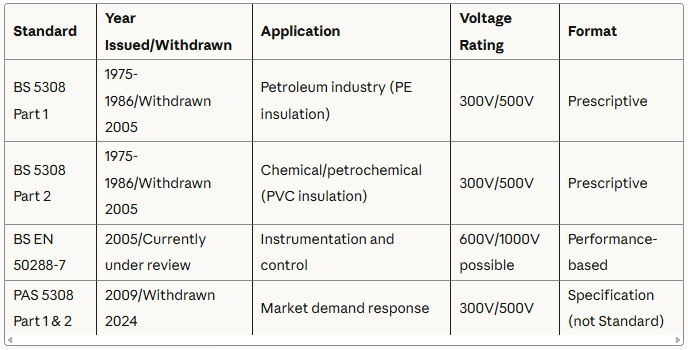
The story of British instrumentation cable standards begins in 1975 when BS 5308 Part 1 and Part 2 were first issued. These standards represented the prevailing approach of their era: prescriptive specifications that detailed exact requirements for cable construction, materials, and performance characteristics.
During the 1970s and early 1980s, most British Standards followed this prescriptive format, providing detailed instructions that manufacturers needed to follow precisely. This approach offered clarity but limited flexibility for innovation and new technologies. The standards were subsequently revised and updated in 1986 to reflect evolving industry needs and technological advances.
The shift from prescriptive to performance-based standards marked a significant philosophical change in standards development. Rather than dictating specific construction methods, performance-based standards define required outcomes, allowing manufacturers greater flexibility in achieving compliance. This evolution reflected a broader trend across European standardization efforts, ultimately leading to the development of EN 50288-7.
Standards needed to evolve because the prescriptive approach couldn't accommodate the rapid technological advances in cable manufacturing, new insulation materials, and changing installation requirements across diverse industrial environments.
Understanding BS 5308 Parts 1 and 2
BS 5308 specifically addressed control and instrumentation cables—not power cables. This distinction remains crucial for proper cable selection and application. The standard comprised two distinct parts, each targeting different industrial applications and insulation types.
Part 1: Polyethylene-Insulated Cables
BS 5308 Part 1 covered polyethylene-insulated cables used mainly by the petroleum industry. These cables were specifically designed for instrumentation applications in refineries, oil platforms, and related facilities where chemical resistance and reliability were paramount. The polyethylene insulation provided excellent electrical properties and resistance to many petroleum-based products.
Part 2: PVC-Insulated Cables
Part 2 specified PVC-insulated cables used mainly by the chemical and petrochemical industries. PVC insulation offered different performance characteristics, including flame retardancy and suitability for various chemical environments encountered in processing facilities.
Voltage Rating Specifications
The 1986 edition established voltage ratings of 300V rms to earth and 500V rms core to core. These low voltage instrumentation cables were specifically designed for signal transmission and control applications, not for power distribution. The voltage specifications reflected the typical requirements for connecting instruments, sensors, and control devices in industrial settings.
Key Scope Limitation
A critical specification stated in both parts: "Instrumentation cables are not for connection to a low impedance source, e.g. a public mains electrical supply." This limitation defined the fundamental application boundary for BS 5308 cables, distinguishing them clearly from power cables and preventing misapplication that could lead to safety hazards.
Market Applications
BS 5308 cables found extensive use in:
Petroleum refineries for process instrumentation
Chemical plants for sensor connections
Offshore platforms for control systems
Pipeline monitoring installations
Petrochemical facilities for distributed control systems
The Transition to BS EN 50288-7
In 2005, BS 5308 Parts 1 and 2 were withdrawn and superseded by BS EN 50288-7. This withdrawal stemmed from BSI/CENELEC rules requiring that when a new European standard covers the same cable types as an existing British Standard, the conflicting standard must be withdrawn to maintain harmonization across European markets.
Understanding EN 50288-7
The full title reveals its comprehensive scope: "Multi-element metallic cables used in analogue and digital communication and control. Sectional specification for instrumentation and control cables." This performance-based standard represents a fundamental shift in how cable specifications are written and applied.
Differences Between BS 5308 and BS EN 50288-7
The most significant difference lies in format and philosophy. While BS 5308 prescribed exact construction methods, EN 50288-7 focuses on performance requirements. This performance-based approach offers several advantages:
Flexibility for manufacturers to innovate
Accommodation of new materials and technologies
Broader application range within a single standard
Better alignment with European harmonized standards
The standard is all-encompassing, covering variants that could not be addressed under the old prescriptive format. However, this comprehensive scope sometimes creates challenges for users accustomed to the specific guidance provided by BS 5308.
Voltage Considerations Under EN 50288-7
For some installations, particularly where ducting only offers one compartment, voltage requirements have increased to 600/1000V. This elevation reflects modern installation practices and enhanced safety requirements while maintaining the fundamental distinction that these remain control and instrumentation cables, not power cables.
The Role of PAS 5308: Publicly Available Specification
In response to market demand, British Standards published PAS 5308 Part 1 and Part 2 in 2009. Understanding what PAS represents is crucial to avoiding common misconceptions.
What is a PAS?
A PAS (Publicly Available Specification) is an official document issued by BSI but is not classified as a true British Standard. PAS documents typically emerge when:
Market demand exists for specifications
Full standard development would be premature
Rapid guidance is needed for emerging technologies
Consensus for a full standard hasn't been achieved
Why PAS 5308 Was Introduced
Many petrochemical industry specifications and installation procedures specifically referenced BS 5308. When this standard was withdrawn, a gap emerged. Users wanted familiar specifications that aligned with established industry practices and existing documentation. PAS 5308 Part 1 and Part 2 were developed to address this market demand.
Common Misconception
Unfortunately, some people who do not understand the significance of the difference between a "Standard" and a "Specification" erroneously treat these Specifications as Standards. This misunderstanding has perpetuated confusion in cable procurement and specification processes. The negative response to EN 50288-7 was partly rooted in this confusion, as many petrochemical standards referred only to BS 5308.
PAS 5308 Withdrawal
In 2024, PAS 5308 Part 1 and Part 2 were withdrawn by BSI, further complicating the landscape for cable specifiers and procurement teams.
Current Regulatory Position (2024-2025)
The present position creates challenges for many in the industry. Currently, both BS 5308 Parts 1 and 2 plus PAS 5308 Part 1 and Part 2 have been withdrawn by BSI without issuing replacement standards, other than BS EN 50288-7:2005.
As of 2024, BS EN 50288-7:2005 is currently under review by BSI, but no new standard has been issued. This absence of replacement standards leaves some professionals with compliance concerns, particularly when existing installation specifications reference withdrawn documents.
Installation Implications
For those installing these types of cables, completing a deviation when signing off an installation may now be necessary. This requirement adds documentation burden and requires careful justification of cable selection decisions, particularly when project specifications reference withdrawn standards.
Application Scenarios and Industry Impact
Understanding proper application scenarios helps prevent common cable selection errors and ensures regulatory compliance.
Petroleum Industry Applications
In refineries and oil production facilities, instrumentation cables connect:
Temperature sensors in distillation columns
Pressure transmitters on process vessels
Flow meters in pipeline systems
Level indicators in storage tanks
Distributed control system (DCS) field devices
These environments demand cables with excellent chemical resistance, particularly to petroleum products, making the original BS 5308 Part 1 specifications highly relevant.
Chemical and Petrochemical Applications
Chemical processing facilities require cables that can withstand:
Exposure to various chemical vapors
Wide temperature ranges
Potential mechanical stress
Flame propagation risks
Long-term reliability requirements
PVC-insulated cables specified in BS 5308 Part 2 addressed these needs, though modern installations must now reference EN 50288-7 specifications.
Offshore Platform Installations
Offshore environments present unique challenges:
Salt spray and humidity exposure
Vibration from machinery and wave action
Limited space for cable routing
Difficulty accessing cables for maintenance
Stringent safety requirements
Cable standard compliance procedures become particularly critical in these applications where cable failure could have severe safety and environmental consequences.
Common Cable Problems and Solutions
Problem 1: Specification References Withdrawn Standards
Question: Our project specification references BS 5308 Part 1, but the standard has been withdrawn. How should we proceed?
Solution: Document a formal deviation noting that BS 5308 has been superseded by BS EN 50288-7. Specify cables meeting EN 50288-7 performance requirements with characteristics equivalent to the original BS 5308 specification. Work with cable manufacturers to confirm that selected cables meet both the performance criteria of EN 50288-7 and the specific requirements previously addressed by BS 5308 Part 1. Maintain comprehensive documentation showing the equivalence and rationale for cable selection.
Problem 2: Voltage Rating Confusion
Question: Our installation requires cables in single-compartment ducting. Are 300V/500V rated cables sufficient?
Solution: For installations where ducting offers only one compartment, increased voltage requirements of 600/1000V may be necessary to provide adequate safety margins. Consult with electrical engineers to perform a proper voltage assessment considering:
Maximum expected operating voltage
Transient voltage possibilities
Segregation requirements
Applicable electrical codes
Safety factor requirements
Never compromise on voltage rating specifications, as undersized cables pose serious safety risks.
Problem 3: Misunderstanding PAS 5308 Status
Question: Can we specify PAS 5308 cables for our new installation in 2024?
Solution: No. PAS 5308 was withdrawn in 2024 and should not be specified for new installations. While it's possible to reference withdrawn standards, doing so requires deviation procedures and may complicate compliance documentation. Instead, specify cables conforming to BS EN 50288-7, working with manufacturers to ensure the cables meet your specific application requirements. Update internal specifications and procurement procedures to reflect current standards.
Problem 4: Confusing Instrumentation Cables with Power Cables
Question: Can we use BS 5308-type instrumentation cables to connect equipment to mains power supply?
Solution: Absolutely not. This represents a dangerous misapplication. The scope of BS 5308 explicitly states: "Instrumentation cables are not for connection to a low impedance source, e.g. a public mains electrical supply." Instrumentation cables are designed for signal transmission and control applications, not power distribution. Using them for power connections could result in:
Cable overheating and fire
Inadequate fault protection
Regulatory violations
Safety hazards to personnel
Always specify proper power cables for mains connections, following appropriate power cable standards.
Problem 5: Working with Legacy Documentation
Question: Our facility has installation drawings and maintenance manuals referencing BS 5308. How do we maintain compliance?
Solution: Develop a cross-reference document mapping BS 5308 specifications to equivalent EN 50288-7 requirements. When maintaining or extending existing installations:
Identify installed cable characteristics
Select replacement cables meeting EN 50288-7 with equivalent performance
Update facility documentation to note both original and current standard references
Train maintenance personnel on the standard transitions
Document all cable replacements with current standard references
Key Differences Summary
Best Practices for Cable Selection in 2024
1. Consult Current Standards
Always reference BS EN 50288-7 for new installations. Obtain the most current version and review all applicable sections for your specific application.
2. Work with Knowledgeable Manufacturers
Engage cable manufacturers early in the design process. Reputable manufacturers understand the standard transitions and can recommend cables meeting EN 50288-7 specifications while addressing application-specific requirements previously covered by BS 5308.
3. Implement Proper Documentation
Maintain comprehensive records including:
Cable specifications and test certificates
Standard references and version numbers
Deviation documentation when necessary
Equivalence justifications for withdrawn standards
Installation records and compliance documentation
4. Establish Deviation Procedures
Develop clear procedures for documenting deviations when project specifications reference withdrawn standards. Ensure these procedures are approved by relevant authorities and stakeholders before installation begins.
5. Update Internal Specifications
Review and update all internal specifications, procurement documents, and installation procedures to reference current standards. This proactive approach prevents confusion and streamlines future projects.
6. Provide Staff Training
Ensure engineering, procurement, and installation teams understand the standard transitions, implications for cable selection, and proper compliance procedures.
Conclusion
Understanding the relationship between BS 5308, EN 50288-7, and PAS 5308 is essential for anyone specifying, procuring, or installing control and instrumentation cables in petrochemical and industrial facilities. While the withdrawal of BS 5308 and PAS 5308 has created challenges, EN 50288-7 provides a comprehensive, performance-based framework for modern cable applications.
The key takeaway is that BS EN 50288-7 now serves as the primary standard for instrumentation and control cables, offering flexibility while maintaining safety and performance requirements. Though the transition from prescriptive to performance-based standards required industry adaptation, the resulting framework better accommodates technological innovation and diverse application requirements.
Action Steps for Procurement Teams:
Audit existing specifications to identify withdrawn standard references
Establish relationships with cable manufacturers familiar with EN 50288-7
Develop internal guidelines for cable selection under current standards
Implement deviation procedures for legacy specification requirements
Train relevant personnel on standard transitions and compliance requirements
For further information, consult BSI directly regarding BS EN 50288-7 status updates, engage with cable manufacturers for technical guidance, and consider joining industry working groups addressing instrumentation cable standardization. The future of instrumentation cable standards will likely continue evolving toward harmonized European specifications, making ongoing education and adaptation essential for industry professionals.
By maintaining awareness of these standards, implementing proper compliance procedures, and working with knowledgeable suppliers, organizations can ensure their cable installations meet current regulatory requirements while maintaining the safety and reliability demanded by modern industrial operations.
How to Reach Us
Get in Touch
SiteMap
Product Catalogue
Festoon Cable
Shore Power Cable




Scan to add us on WeChat