
Cable Requirements for Port of Brisbane Expansion Projects: Power, Reeling and Fibre-Optic Solutions for Modern Container Terminals
A practical guide to the cable requirements behind the Port of Brisbane's expansion — covering STS cranes, automated stacking cranes, straddle carriers, medium-voltage reeling cables and fibre-optic hybrid systems for modern Australian container terminals.
hongjing.Wang@Feichun
6/3/202610 min read
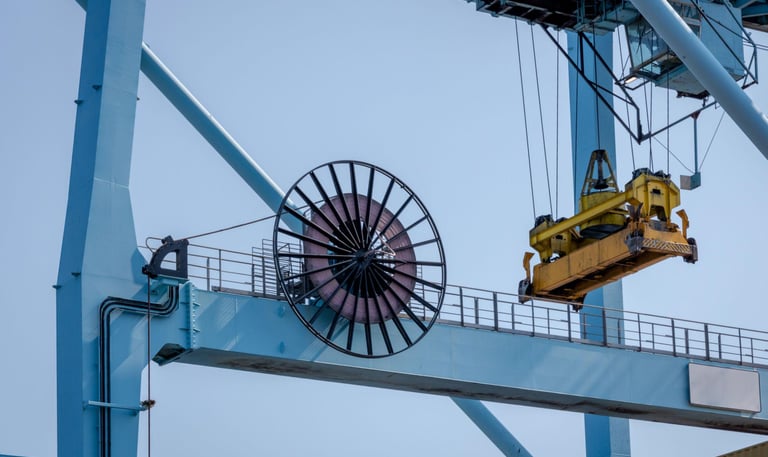
The Port of Brisbane doesn't often make the evening news, but it quietly underpins a remarkable share of Queensland's economy. It's the state's largest multi-cargo port and one of the fastest-growing container ports in the country, and right now it's in the middle of a generational rethink about how it will grow over the next few decades. Behind the headline projects — new land, deeper channels, more automation — sits a less glamorous but absolutely critical question: what keeps power and data flowing to all that moving equipment? The answer, in large part, is cable.
This guide takes a practical look at the cable requirements driving the Port of Brisbane's expansion. It's written for people who specify, install, maintain or simply want to understand the electrical backbone of a modern terminal — the ship-to-shore cranes, the automated stacking cranes, the straddle carriers and the growing web of fibre-optic links tying it all together. It's a longer read, but if cables and ports are your world, it should be a useful one.
Why Port Expansion Lives or Dies on Cable Infrastructure
Australian container throughput keeps climbing, and Brisbane sits squarely in that growth. The 2015 Australian Infrastructure Audit projected container trade through the port could roughly treble by 2045, and the port itself plans on the basis of decades of rising freight demand. Meeting that demand isn't just a matter of pouring more concrete — it means more cranes, more automation and more electrification, all of which lean heavily on reliable cable systems.
Here's the uncomfortable truth that terminal operators know well: a container crane is only as productive as the cable feeding it. When a reeling cable fails on a ship-to-shore crane, the whole machine stops, and with it the gang, the vessel schedule and the downstream logistics chain. In an industry where berth windows are measured in hours and demurrage costs mount quickly, cable reliability isn't a footnote — it's central to terminal productivity.
Brisbane as a strategic hub
Located at the mouth of the Brisbane River and largely free from urban encroachment, the Port of Brisbane handles the overwhelming majority of Queensland's international container trade and a large slice of the state's agricultural exports. Its container operations are split across three stevedores, all of whom run automated container-handling equipment — a detail that matters enormously when we get to cable selection, because automation changes what a cable has to do.
This guide covers the key container-handling equipment and what each demands of its cables, the electrical and communication challenges unique to a marine terminal, the specific cable solutions suited to modern port infrastructure, and the engineering considerations that should shape selection as the port grows.
Understanding the Brisbane Expansion Program
To understand the cable demand, it helps to understand the building program creating it. The port's current container capability runs to the equivalent of eight 300-metre container berths, roughly 2,469 metres of quayline. DP World Brisbane operates Berths 4 to 7 with four super-post-panamax cranes and one post-panamax crane — all twin-lift machines — plus sixteen automated stacking cranes. Patrick Terminals runs Berths 8 to 10 with five post-panamax cranes and a fleet of around thirty-five automated straddle carriers. Brisbane Container Terminals occupies Berths 11 and 12 with four post-panamax quay cranes and six automated stacking cranes.
That's already a lot of moving, powered, data-hungry steel — and the expansion program is set to add considerably more.
What's actually being built
Several major projects sit under the port's long-term vision, branded PortBris 2060 (also called Vision 2060), which was developed over three years of research and consultation and lays out growth across three horizons. A few strands of that vision drive cable demand directly.
The Future Port Expansion is a 224-hectare reclamation area on Fisherman Islands that will create new port land and additional quayline — one of the largest land-reclamation activities in the southern hemisphere. As those paddocks are progressively reclaimed and developed into operational terminal, each new berth and yard will need its own power distribution and communications backbone built from scratch.
The Channel Enhancement Project is a proposed 25-year program to deepen, widen and partly realign the shipping channels through Moreton Bay, involving on the order of 96.5 million cubic metres of dredging. Its purpose is to let progressively larger and deeper container vessels call at Brisbane. Bigger ships mean bigger cranes with longer outreach and taller lifts, and bigger cranes mean longer, harder-working power cables.
Alongside these sit dedicated rail connectivity and ongoing road upgrades, plus a strong push toward digital systems, real-time data and lower-emission, increasingly electrified operations.
How that translates into cable demand
Each of those threads has a direct line to the cable order book. New crane installations mean new reeling and festoon systems. Longer travel distances — longer quaylines, larger yards — mean longer cable runs that must reel and unreel further without fatiguing. Electrification and higher-capacity equipment push up power consumption, nudging operators toward medium-voltage supply. And the relentless growth in automation and remote monitoring demands far greater communication bandwidth, which is why fibre is creeping into more and more of the cabling.
The Electrical Challenges Unique to a Container Terminal
Before looking at specific cables, it's worth appreciating just how hostile a container terminal is to a cable.
High-speed dynamic movement. Reeling cables on ship-to-shore and yard cranes are continuously wound and unwound, often at high speed and with frequent acceleration and braking. Every cycle flexes the cable and works its conductors and sheath. Over a service life measured in millions of cycles, mechanical fatigue is the enemy, and a cable that can't handle repeated bending simply won't last.
A brutal marine environment. Salt spray, intense UV radiation, high humidity and the ever-present risk of corrosion all attack cable materials. A compound that performs beautifully in a dry inland warehouse can degrade quickly on an exposed Brisbane quay. Weather resistance — proven resistance to ozone, UV and moisture, with verified long-term water resistance — is non-negotiable.
Ever-increasing automation. Brisbane's terminals already run automated stacking cranes and machine-controlled straddle carriers. Automation needs real-time control systems, remote monitoring and reliable communication with autonomous vehicles, and that puts data integrity on equal footing with power delivery. A cable that drops a data link can halt an automated yard just as surely as a power fault.
The cost of downtime. Tie all this together and you arrive at the operator's core concern: minimising stoppages. The cost of a crane standing idle dwarfs the cost of the cable feeding it, which is exactly why cable reliability and sensible maintenance planning deserve serious engineering attention rather than being treated as a commodity purchase.
Cables for Ship-to-Shore Cranes
The super-post-panamax and post-panamax cranes along Brisbane's container berths are the most demanding cable application on site.
Medium-voltage power transmission. Large container cranes draw enough power that medium-voltage supply makes sense — it lets the same power move through a smaller, lighter, more manageable conductor than a low-voltage equivalent would need. Purpose-built medium-voltage reeling cables are offered across a ladder of standard classes — typically 1.8/3 kV, 3.6/6 kV, 6/10 kV, 8.7/15 kV and 12/20 kV — so the supply can be matched to the crane and the terminal's distribution network. For lower-voltage auxiliary and yard duties, the workhorse remains the 0.6/1 kV (600/1000 V) class.
What a reeling cable must deliver. On an STS crane the reeling cable needs high tensile strength to carry its own weight and the dynamic loads of reeling, anti-torsion construction to resist the twist that creeps in from guidance systems and oblique pay-out, strong resistance to repeated bending, and a genuinely long service life so replacements are rare. Quality medium-voltage reeling designs — the kind carrying type designations such as (N)TSCGEWÖU for round cables — achieve this with finely stranded class-5/FS tinned-copper conductors for flexibility, a three-core layout with the earth conductor split into the interstices, and a sandwich sheath system built around a reinforced polyester anti-torsion braid vulcanised between inner and outer sheaths. That braid is the secret to surviving the torsional and tensile stresses of high-speed reeling.
The challenges they face. STS reeling cables contend with long travel distances along the quay, high reeling speeds and effectively continuous operation. These cables are rated for demanding duty — torsional stress allowances on the order of ±50 degrees per metre on the toughest reeling and drum types, and tensile-load capacities well above the bare DIN VDE minimum — precisely because the application is so unforgiving.
Why hybrid power-and-fibre designs are taking over. As cranes get smarter, they need to send and receive data as well as draw power. Increasingly the answer is a hybrid cable that carries both — medium-voltage power cores plus integrated optical fibres in a single reeled cable. Designs with fibre classes such as G50/125, G62.5/125 (multimode) or E9/125 (singlemode) — carrying type designations like (N)TSKCGEWÖU — fold data straight into the power cable. That cuts the number of separate cable systems to manage, simplifies the reel, and directly supports smart-terminal operation.
Cables for Automated Stacking Cranes and Yard Automation
Back in the stacking yard, the demands shift from sheer power to precision and uptime.
Power distribution for automated cranes. Brisbane's automated stacking cranes run more or less around the clock, so their power supply has to be both continuous and dependable. Reliability is everything here: an ASC that loses power mid-move doesn't just stop, it can throw out the carefully choreographed sequence of an automated yard.
Festoon cable systems. For equipment that travels back and forth along a fixed rail or beam, festoon systems — where the cable hangs in loops from a trolley track and gathers or extends as the machine moves — are a proven, low-fuss approach to horizontal movement. Flat and round festoon cables built for this duty (type designations such as D12Y11Y for round and D12YC11Y for the screened version) are designed to flex through their travel without snagging or fatiguing. They suit the predictable, linear motion of many yard cranes well.
Reeling solutions for automation. Where movement is longer or more dynamic, motorised reeling drums take over, and the cable needs strong dynamic performance and low maintenance demands so it doesn't become the weak link in an otherwise autonomous system.
Supporting high-precision positioning. Automated cranes live or die on feedback — encoder signals, automation sensors and safety-control networks all have to communicate flawlessly. That's another reason data-carrying and well-screened cables matter as much in the yard as on the quay.
The Rising Importance of Fibre-Optic Hybrid Cables
If there's one clear direction of travel in port cabling, it's the steady spread of fibre.
Why ports need more data. Crane automation, AI-assisted logistics and remote or semi-remote operation all generate and consume large volumes of data in real time. Brisbane became, some years ago, the first Australian port where every stevedore used automated container-handling equipment, and the data appetite has only grown since. Copper alone can't keep up with the bandwidth modern terminals want.
What's inside a hybrid cable. A hybrid reeling or festoon cable bundles three things into one jacket: power conductors to drive the equipment, optical-fibre elements (multimode G50/125 and G62.5/125, or singlemode E9/125) for high-bandwidth data, and control cores for signalling and safety circuits. Getting all of that to survive continuous reeling in a marine environment is a genuine engineering achievement, which is why these are specialised products rather than off-the-shelf items.
Why it helps an expansion project. For a port building new berths and yards, hybrid cables simplify installation (one cable system instead of two or three), reduce the physical infrastructure footprint in already-crowded cable chains and reels, and improve overall reliability by cutting the number of separate runs, connectors and failure points. They also future-proof the terminal: as digital transformation, smart-port technology and autonomous equipment integration deepen, the data pathways are already in place.
Engineering Considerations When Selecting Port Crane Cables
Choosing the right cable for Brisbane's conditions comes down to four families of requirement.
Mechanical performance. The cable must handle the tensile loads of reeling, offer real torsional stability (the anti-torsion braid earning its place again), and resist abrasion from contact with drums, sheaves, flanges and adjacent wraps. These properties are verified through reversed-bending, roller-bending and torsional-stress testing rather than taken on faith.
Environmental protection. UV resistance, saltwater resistance, and oil and chemical resistance are baseline requirements on an exposed marine quay. The right elastomeric or polyurethane compounds are what let a cable shrug off Brisbane's sun, salt and humidity for years rather than months.
Electrical performance. The voltage rating must match the supply (from 0.6/1 kV auxiliaries up through the medium-voltage classes), the conductor cross-section must carry the required current without overheating, and the design must respect electromagnetic compatibility — particularly important around sensitive automation and control electronics, where screening keeps power circuits from interfering with data.
Standards compliance. Cables for Australian port projects should align with the relevant international and local frameworks — IEC standards, the German VDE standards that underpin much crane-cable design and testing, and Australian electrical requirements. Compliance isn't bureaucratic box-ticking; it's the shared language that lets an operator trust a cable will perform as specified.
Matching Cable Solutions to Brisbane's Expansion
Pulling it together, here's how the cable families map onto the work ahead.
Medium-voltage reeling cables for STS cranes. The natural fit for the big quay cranes on Berths 4–7, 8–10 and 11–12, and for whatever new super-post-panamax machines arrive with the Channel Enhancement Project's larger vessels. Their performance advantage is surviving high-speed, high-tension reeling over long travel distances with a long, dependable service life.
Festoon cables for yard cranes. Suited to the linear, repetitive travel of many automated stacking cranes and rail-mounted equipment, where their predictable behaviour and reliability keep automated sequences running.
Hybrid fibre-optic reeling cables. The increasingly default choice wherever power and high-bandwidth data need to travel together — squarely aligned with Brisbane's automation and smart-port direction.
Vertical-reel, basket and spreader cables. For the high-flex, continuous-motion duty of spreaders and vertical reeling on cranes, where torsional and bending performance is pushed hardest. Spreader-reel and basket designs (type designations such as D12YST11YU11Y) are built specifically for this punishing service.
Choosing a supplier, not just a cable
For a project on Brisbane's scale, the supplier matters as much as the product. The factors worth weighing are genuine engineering support (the ability to help match a cable to a specific crane, drum and route rather than just quoting a part number), real project experience in comparable port environments, and solid compliance and certification credentials against the standards above.
Where Australian Port Cabling Is Heading
A few trends will shape cable demand at Brisbane and beyond over the coming years. Container terminals are electrifying, replacing diesel plant with electric equipment and pushing up demand for robust power cabling. Automation and remote operation keep expanding, raising the bar for data-carrying and well-screened designs. Smart-port technologies — sensors, real-time visibility, data platforms — are being woven through operations, all of which need a communications backbone. Demand for combined power-and-data hybrid cables will keep rising. And across the board, operators increasingly expect longer service life and lower maintenance, because every avoided cable change is avoided downtime.
The Bottom Line
Reliable cable systems are not a side issue in port expansion — they're essential to its success, with a direct impact on productivity, a real bearing on operational safety, and a long-term reliability requirement that shapes the whole electrical design. As the Port of Brisbane works through its Future Port Expansion, Channel Enhancement Project and the broader PortBris 2060 vision, the equipment getting installed will be more automated, more electrified and more data-dependent than ever.
That's changing what cables have to do. The need for fibre-optic integration is growing, and so is the demand for high-performance reeling systems that can take the punishment of a busy marine terminal. Operators who treat cable selection as an engineering decision rather than a commodity purchase — matching mechanical, environmental, electrical and compliance requirements to the job, and choosing partners who can support that — will see the payoff where it counts: lower downtime, better equipment availability and a stronger return on a very large infrastructure investment.
Key topics covered
Port of Brisbane expansion · Port of Brisbane cable requirements · STS crane cable · automated stacking crane cable · reeling cable for container cranes · fibre-optic hybrid cable · port automation cable · medium-voltage reeling cable · port crane power cable · container terminal cable systems
How to Reach Us
Get in Touch
SiteMap
Product Catalogue
Festoon Cable
Shore Power Cable




Scan to add us on WeChat