Can Chinese Crane Cable Match European Standards? Engineering Reality, Certification Gaps, and Industrial Application Benchmarking
Can Chinese crane cable match European standards? Comparing IEC, EN, and VDE requirements against brands like Prysmian and LAPP, with real port, shipyard, and mining project evidence.
hongjing.Wanfg@Feichun
6/10/202619 min read
Introduction: The Real Question Behind "Chinese vs European Cable Quality"
There's a question that comes up in nearly every procurement conversation about crane and reeling cable, and it's usually framed the wrong way. People ask, "Can Chinese cable match European cable?" — as though the issue were whether a factory in Hefei or Ningbo is physically capable of extruding a length of medium-voltage reeling cable. That framing misses the point entirely. The manufacturing capability question was settled years ago. Chinese plants produce enormous volumes of sophisticated cable for global markets every single day, and a good deal of it ends up in cranes, ships, and mines around the world. The capability is not in doubt.
The real question is subtler and more important: not whether the cable can be made, but whether its performance can be proven to the standard that European buyers expect. That's a question about engineering validation and certification systems, not about extrusion lines and copper stranding. And it's a distinction that gets lost constantly, to the detriment of buyers and manufacturers alike.
European customers — and the Australian, Middle Eastern, and Asian buyers who have adopted European purchasing habits — don't evaluate a crane cable on the basis of whether it looks right or feels flexible in the hand. They evaluate it against a structured framework. Does it comply with the relevant IEC, EN, and VDE standards? Can the supplier demonstrate lifecycle performance under high-cycle fatigue, not just a one-off test result? Is the performance consistent across oil exposure, UV exposure, and marine environments, batch after batch? Those are the questions that actually determine acceptance, and they're questions about proof and documentation as much as about the physical cable.
This is why perception lags behind reality in the market. Chinese crane cables are already deployed at scale globally — in ports, on shipyards, in mining operations across multiple continents — yet the perception in conservative European procurement circles often remains cautious. That caution isn't about production; it's about proof. A buyer specifying a reeling cable for a container crane that costs tens of thousands of dollars a day in downtime is not going to gamble on a cable that can't show its working. They want the certification, the test data, the documentation trail. And that, rather than any deficiency in manufacturing, is the genuine gap that Chinese manufacturers have been closing.
So the honest answer to "Can Chinese crane cable match European standards?" is this: the manufacturing already does, in many cases. The challenge — and the opportunity — lies in matching the system around the cable: the certification, the lifecycle evidence, and the engineering documentation that turns a well-made cable into a provably compliant one. This article works through that argument in detail. We'll lay out the European standards framework that defines acceptance, benchmark against the European cable giants, examine Chinese manufacturing capability honestly, and then ground the whole discussion in real export projects — including a New Caledonia nickel-mine reeling cable that stands directly against a Prysmian benchmark, an Indonesian shipyard supply, and a Middle East marine project. Let's get into it.
European Standard System That Defines Cable Acceptance
To understand what "matching European standards" actually means, you first have to understand the standards themselves. They aren't a single hurdle but a layered system, and each layer does a different job. Clearing all of them is what separates a cable that claims European-grade performance from one that can demonstrate it.
IEC and EN Standards as the Core Technical Baseline
At the foundation sit the IEC and EN standards. These are the core technical baseline — the documents that define, in measurable terms, what a cable has to be and do. They specify conductor structure requirements, dictating how the copper is stranded and sized. They define insulation and sheath mechanical performance, setting out how the materials must behave under stress. They establish thermal and environmental resistance requirements, governing how the cable copes with heat, cold, and exposure. And they lay down safety and flame-retardancy behaviour, ensuring the cable doesn't become a hazard in a fire.
Within this baseline, IEC 60811 plays a particularly central role, because it governs the mechanical testing of insulation and sheath materials. It's the standard that turns vague claims like "abrasion-resistant" or "durable" into something measurable and repeatable. Under IEC 60811 you validate abrasion performance, elongation, and aging behaviour — the properties that actually determine whether a jacket survives years of reeling or cracks after a season. When a manufacturer says a cable meets European mechanical standards, IEC 60811 is a large part of what they're claiming, and it's testable. This matters because it gives buyers an objective yardstick: the cable either passes the elongation and aging tests or it doesn't, and the result is the same whether the lab is in Berlin or Hefei. IEC 60228, governing conductor structure and stranding classes, sits alongside it as the other foundational reference.
German VDE Standards as the Highest Market Barrier
If IEC and EN are the baseline, the German VDE standards are the high bar. For crane and flexible cable acceptance in Germany — and by extension in the conservative end of the European market — VDE 0250 and VDE 0295 are the critical references. VDE 0250 covers the requirements for flexible cables and their construction, while VDE 0295 governs conductor resistance and stranding requirements, defining the fine-stranded conductor classes that flexible and reeling cables depend on.
The focus areas of the VDE framework reveal what the German market really cares about. It demands conductor resistance consistency, meaning the electrical performance has to be reliable and repeatable, not just acceptable on a good day. It specifies fine-stranded flexibility levels, because a reeling cable that has to bend millions of times needs conductors built from very fine strands to survive the fatigue. And it requires structural stability under continuous movement, so the cable holds its internal geometry even as it's flexed, twisted, and reeled relentlessly.
What's worth understanding about the German expectation is that it isn't satisfied by performance alone. A cable might pass a single impressive test and still fall short of German acceptance, because the German market expects repeatability under industrial fatigue conditions. It's not enough for the cable to be good once; it has to be good every time, batch after batch, under the punishing repetitive stress of real industrial service. That demand for consistency, more than any single performance figure, is what makes VDE the highest barrier in the market — and what makes clearing it such a meaningful credential.
ISO System as the Manufacturing Credibility Layer
Surrounding the technical standards is a third layer that's about the manufacturer rather than the cable: the ISO system. ISO 9001 certification provides assurance of stable production quality control, evidence that the factory has the management systems in place to produce consistent output rather than relying on luck or heroics. ISO 14001 provides assurance of environmental compliance in the manufacturing process, increasingly important to buyers who have to answer for the sustainability of their supply chains.
The key thing to grasp about ISO certification in the European context is that it's treated as a baseline requirement, not an optional advantage. A Chinese manufacturer that holds ISO 9001 and ISO 14001 hasn't earned a gold star — it has merely cleared the threshold to be taken seriously at all. European buyers regard these certifications as table stakes. Without them, a supplier often won't even make it onto the shortlist; with them, the supplier has earned the right to have its actual cable performance evaluated. It's the entry ticket, not the prize.
Benchmarking Against European Cable Giants
You can't talk about matching European standards without talking about the companies that effectively define them in practice. Three names dominate the conversation in industrial and crane cable, and each represents a particular kind of benchmark. Understanding what each is known for clarifies exactly what a competing cable has to live up to.
LAPP Group Benchmark Position
The LAPP Group is the reference point for industrial automation and high-flex applications. Its reputation rests on consistent flex-life performance — cables that survive enormous numbers of bending cycles without failing — and on stable oil and chemical resistance that holds up in the chemically aggressive environments of factory floors. LAPP cables are known for high reliability in factory automation systems, where a cable failure can halt a production line and cost dearly. As a result, LAPP-style products serve as the reference model for dynamic industrial cable applications: when an engineer wants to specify a cable for a continuously moving automation system, LAPP is often the mental benchmark they're measuring against.
Prysmian Group Benchmark Position
For heavy-duty crane, port, and reel systems, the benchmark is Prysmian. This is the giant of the high-mechanical-stress world, and its strengths are exactly the ones that matter in reeling applications: high mechanical tensile strength to survive the dynamic loads of reeling, and meticulously detailed engineering parameters covering bending radius, conductor structure, weight, and current capacity. Prysmian cables are optimised for high-mechanical-stress environments, which is precisely the brief for a reeling cable on a fast-moving crane.
Prysmian-style cables are routinely used as the reference for port cranes, reeling systems, and offshore heavy equipment — the most demanding applications in the industry. A concrete and highly relevant example is the Prysmian PROTOLON(SMK) (N)TSCGEWOEU, a flexible medium-voltage reeling cable designed for application under high to extreme mechanical stresses: high travel speeds, dynamic tensile loads, multiple changes of direction across different planes, churning over rollers, and torsional stresses. It's built mainly for mobile equipment such as fast-moving container cranes and large moving equipment. Its construction tells the whole story of what a top-tier reeling cable looks like: tinned electrolytic copper conductors in the very fine class FS stranding referenced in VDE 0295; a high-grade EPR-based insulation; an inner semiconductive layer with an easy-strip outer semiconductive layer; and — critically — a sheath system that combines a double-layer EPR inner sheath acting as a water barrier, an anti-torsion braid of polyester threads vulcanised between the sheaths for high strength, and a double-layer outer sheath of abrasion- and tear-proof PCP-based rubber. It's rated to a conductor temperature of 90°C, with oil resistance to DIN EN 60811-404 and unrestricted outdoor use thanks to ozone, UV, and moisture resistance. The mechanical specification is equally exacting: a torsional stress rating of ±25°/m, defined permissible and dynamic tensile forces, and reeling travel speeds with no restriction up to 240 m/min. This is the bar. This is what "European standard" means in concrete, measurable terms for a reeling cable — and we'll return to it shortly, because it's exactly the cable that a Chinese-made (N)TSKCGEWOEU is positioned to substitute.
Nexans Benchmark Position
The third giant, Nexans, is distinguished by its focus on long-term reliability, certification-driven design, and stable lifecycle performance. Where some manufacturers compete on a single headline specification, Nexans builds its reputation on the cable performing predictably over its entire service life and on designing explicitly to certification requirements from the outset. It's widely used in European infrastructure and industrial automation systems, the kind of applications where the cable is expected to be installed and forgotten, performing reliably for decades. The Nexans benchmark, in other words, is about the long game — and it reinforces the broader European theme that what matters is proven, documented, repeatable performance over time.
Chinese Crane Cable Manufacturing Capability
With the European benchmarks established, we can look honestly at where Chinese manufacturing actually stands. The picture is more nuanced than either the boosters or the sceptics tend to admit.
Industrial Standard System in China
China has its own well-developed system of manufacturing standards for cable. The common references include GB/T 5013 and JB/T 8735, which together cover flexible cable design, crane cable classification, and the basic electrical and mechanical performance requirements that domestic production must meet. These aren't trivial standards — they define real and meaningful requirements, and a cable built properly to them is a competent product.
The point of friction is that these are domestic Chinese standards. A cable built to GB/T 5013 is built to a genuine standard, but it's not built to IEC 60811 or VDE 0295 unless the manufacturer has specifically designed and tested it to those references. The standards overlap substantially in intent, but they are not identical, and European buyers care about the specific standard cited. This is the first place where the "capability versus proof" distinction bites: the manufacturing capability exists, but the relevant proof has to be against the standard the buyer recognises, not merely against a competent equivalent.
Export Capability and Certification Path
For global markets, Chinese crane cable manufacturers have developed clear certification pathways. The export route typically relies on CE certification for the European market, IEC compliance testing to demonstrate conformity with the international baseline, and — depending on the destination market — optional VDE, NF, or EAC certifications for Germany, France, and the Eurasian Customs Union respectively. A manufacturer serious about export builds these certifications into its process rather than treating them as afterthoughts.
Here again the core theme reasserts itself: the key requirement is not production ability but certification-backed performance proof. A manufacturer can build an excellent cable, but if it can't present CE marking, IEC test reports, and the relevant national certifications, it hasn't given the European buyer what they actually need to say yes. The certification path is the bridge between capability and acceptance, and walking it fully is what separates an export-ready manufacturer from one that merely makes good cable for the domestic market.
Engineering Capability Reality
It's worth being concrete about what Chinese manufacturers already produce competently, because the capability is genuinely broad. They already make reeling cables for crane systems — the demanding, high-flex, torsion-resistant products at the centre of this discussion. They make drag-chain cables for automation, engineered for the relentless back-and-forth motion of energy chains. And they make high-flex industrial cables for machinery systems of all kinds. This is not a story of factories struggling at the edge of their ability; it's a story of factories producing sophisticated dynamic cable as routine output.
Where the real difference lies — and this is the honest assessment — is not in whether the cable can be made but in three specific areas: testing depth, documentation standards, and long-term lifecycle validation data. A European giant like Prysmian will hand you a datasheet specifying torsional stress to ±25°/m, dynamic tensile force in newtons for every cross-section, and bending radii to the millimetre, all backed by decades of accumulated field validation. The manufacturing gap between that cable and a well-made Chinese equivalent may be small or nonexistent. The gap in documented, tested, validated proof is where the work remains. Closing that gap — deeper testing, fuller documentation, accumulated lifecycle evidence — is precisely the path Chinese manufacturers are now on, and the leaders are well advanced along it.
Feichun Manufacturing Position and Export Example
To move from the general to the specific, consider the position of one export-oriented Chinese manufacturer and the real projects that illustrate where this capability has already been deployed. The projects below are described by cable type, country, and application only; client company details are deliberately withheld.
Company Background
Anhui Feichun Special Cable Co., Ltd. is an example of the export-focused end of the Chinese cable industry. The company specialises in reeling cables for crane systems, high-voltage industrial flexible cables, and custom-engineered cable solutions for export markets. It's located in Hefei, Anhui, China, and its orientation is squarely toward industrial export manufacturing rather than purely domestic supply. That export orientation matters, because it means the company is structured around the certification and documentation demands of international buyers — exactly the "proof" side of the capability-versus-proof equation.
Real Export Case Reference — New Caledonia Nickel Mine Reeling Cable
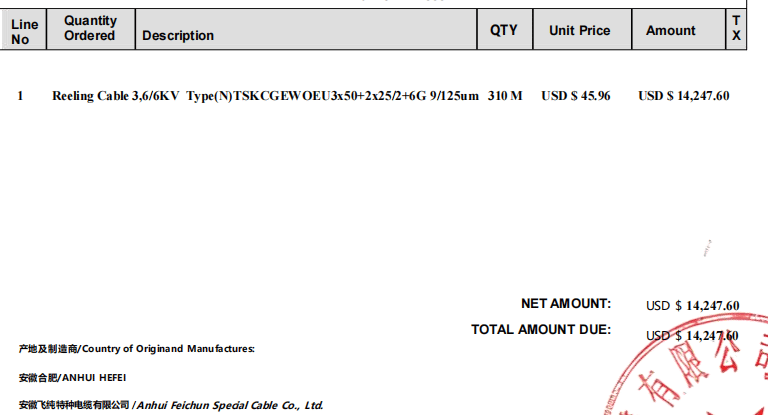
The most directly relevant project is a reeling cable supplied for a nickel mining application in New Caledonia. The product is a Reeling Cable rated 3.6/6 kV, type (N)TSKCGEWOEU 3x50+2x25/2 + 6G 9/125µm — a medium-voltage reeling cable with three 50 mm² power cores, earth conductors, control elements, and integrated 9/125 µm single-mode optical fibres for data transmission. It was engineered for a crane reeling system operating in a high-mechanical-stress environment, the kind of heavy-duty handling application where reeling cable is pushed hardest. The supply was structured on an EXW Hefei basis, with the cable engineered specifically for high-flex and industrial fatigue conditions, and priced in the mid-range industrial export segment — a meaningful cost position relative to the European benchmarks.
What makes this project the centrepiece of the whole argument is the cable type itself. Set the Feichun (N)TSKCGEWOEU beside the Prysmian PROTOLON(SMK) (N)TSCGEWOEU described earlier and the relationship is unmistakable: these are the same cable family, designed to the same construction principle, for the same job. The type designations differ by a single letter — the Feichun cable's "K" reflecting its integrated control and fibre-optic elements — but both are medium-voltage reeling cables built around tinned fine-stranded copper conductors, EPR-based insulation, anti-torsion sheath construction, and the abrasion- and torsion-resistant design that fast-moving crane reeling demands. The Prysmian datasheet defines the European benchmark for this exact application: torsional stress to ±25°/m, defined dynamic tensile forces, reeling speeds, oil resistance to DIN EN 60811-404, and full UV and ozone resistance. The Feichun (N)TSKCGEWOEU is engineered as a direct, drop-in substitute for that benchmark — same voltage class (3.6/6 kV), same reeling-cable construction philosophy, same heavy-duty application — with the added integration of fibre-optic data cores in a single cable and a competitive export cost position. For an operator at a remote nickel mine, where the Prysmian-grade reeling cable would otherwise be specified, this is the substitution case made concrete: a performance-matched cable built to the same engineering principles, available at a lower delivered cost.
Indonesia Shipyard Project Reference
A second project illustrates adaptability in a different environment. This was a marine and shipyard electrical system supply in Indonesia, providing special cable for vessel-related system integration. The operating environment was demanding in its own way: high humidity, salt corrosion exposure, and continuous mechanical vibration — the classic triad of shipyard and marine stressors. The cable supplied was an industrial special cable suited to vessel-related systems, and the project demonstrates the adaptability of Chinese manufacturing in offshore and marine environments, where corrosion resistance and vibration endurance are paramount. It's a different application from the New Caledonia reeling cable, but it reinforces the same point: the manufacturing capability extends across the demanding environments that define heavy industry.
Middle East Marine Project Reference
A third project, supplied into the Middle East (UAE), rounds out the picture with marine-grade power cable. This supply comprised marine XLPE/PUR power cables — specifically a 4G70 mm² type and a 3×95+1×50 mm² type — built to a specification that reads directly off the European standards framework. The conductors were tinned copper, stranded to Class 5 per IEC 60228; the insulation was cross-linked polyethylene (XLPE), heat- and moisture-resistant; and the outer jacket was polyurethane (PUR), specified as oil-resistant, abrasion-resistant, waterproof, UV-stabilised, and flame-retardant. The cables were rated 0.6/1 kV across a temperature range of −40°C to +90°C, with IP68-equivalent water resistance and high flexibility for dynamic movement, intended for submerged, offshore, marine, and hot industrial environments. Critically, they were manufactured in compliance with IEC 60502, IEC 60228, and EN 50525 — the European baseline standards cited explicitly on the documentation, with technical datasheets and certificates of conformity provided alongside shipment. This project is perhaps the cleanest illustration of the central argument: a Chinese manufacturer supplying cable built and documented to the named European standards, for a demanding marine application, with the certification trail attached. The proof travels with the product.
Key Comparison Between Chinese and European Crane Cables
Having looked at both the benchmarks and the real Chinese supply, we can draw the comparison directly. It comes down to two related dimensions: the performance-versus-certification gap, and the specific engineering parameters on which cables are judged.
Performance vs Certification Gap
The European brands compete on a particular basis. They emphasise certified lifecycle data — performance proven and documented over the full service life. They offer standardised engineering parameters, the kind of millimetre-precise, newton-precise datasheets that Prysmian's PROTOLON documentation exemplifies. And they back it all with strict compliance validation, an unbroken trail from standard to test to certificate.
Chinese manufacturers compete on a partly different and partly overlapping basis. Their strengths are strong production flexibility — the ability to engineer custom solutions and respond quickly — and a genuine cost advantage that can be substantial on delivered price. And, increasingly, they are aligned with IEC and EN requirements, designing and testing to the international standards rather than only to domestic ones. The trajectory is clearly toward closing the certification gap, and the leading exporters have largely closed it for the markets they target. The remaining difference, where it exists, is in the depth of accumulated lifecycle data — the decades of field history that a century-old European firm can point to and a newer exporter cannot yet match simply because the time hasn't elapsed.
Engineering Comparison Dimensions
When buyers actually compare cables head to head, they look at a consistent set of dimensions, and it's worth being explicit about them. Flex-life cycles under continuous bending stress: how many times can the cable bend before it fails? Temperature-range stability in extreme environments: does it stay flexible in the cold and intact in the heat? Oil and chemical resistance in industrial applications: does the jacket resist swelling and degradation? Mechanical tensile-strength consistency: does the cable survive the dynamic pulling loads of reeling, repeatably? And certification depth and documentation completeness: is the performance proven and papered, or merely claimed?
On the first four dimensions — the physical performance metrics — a well-engineered Chinese reeling cable like the (N)TSKCGEWOEU can and does meet the same targets as its European counterpart, because they're built to the same construction principles. The fifth dimension, certification depth and documentation, is the one that has historically separated them, and it's the one where the gap is now narrowing fastest. The lesson for buyers is to evaluate on all five dimensions rather than assuming origin determines quality.
Core Engineering Reality of Crane Cable Selection
Step back from the specifics and a single governing principle emerges, one that should anchor any crane cable decision.
The Real Industry Principle
The global crane cable industry runs on one rule: it is not where the cable is made, but how its performance is proven under international standards. Everything else is commentary. A brilliant cable with no proof is unsellable into a serious market; a competent cable with complete, credible proof is acceptable anywhere. Origin is a proxy that buyers historically used because proof was hard to verify; as verifiable proof becomes available regardless of origin, the proxy loses its force.
Why European Buyers Are Conservative
It's worth understanding why European buyers cling to caution, because their reasons are sound rather than merely prejudiced. They practise risk avoidance in downtime-critical systems, and crane and reeling systems are about as downtime-critical as industrial equipment gets. The cost of crane failure in ports and logistics systems is enormous — a stopped container crane bleeds money by the hour, and a failed reeling cable can stop one cold. And they show a strong preference for long-term validated suppliers, because in a downtime-critical context the cost of being wrong dwarfs the saving from being cheap. This conservatism isn't irrational; it's a rational response to asymmetric risk. The job of a Chinese manufacturer isn't to dismiss this caution but to neutralise it with proof.
Why Chinese Cables Are Increasingly Accepted
And neutralise it they increasingly do. Acceptance is rising for three concrete reasons. First, improved IEC compliance capability means the cables are genuinely built and tested to the standards buyers recognise. Second, competitive lifecycle-cost performance means that once the cable is proven, the economic case is compelling — comparable performance at a lower delivered cost, with the lifecycle maths working in the buyer's favour. Third, and perhaps most persuasively, real-world deployment in ports, shipyards, and mining environments provides exactly the accumulating field evidence that conservative buyers want to see. Every successful New Caledonia reeling installation, every Indonesian shipyard supply, every Middle East marine project adds to the body of proof. Acceptance follows evidence, and the evidence is mounting.
Application Scenarios Where Chinese Crane Cables Compete Directly
The competition isn't uniform across all applications. There are specific scenarios where Chinese crane cables compete most directly and most successfully, and they map closely onto the real projects discussed above.
Port Crane Systems
Port crane systems are a natural battleground. They involve high-frequency reeling operations that demand exactly the torsion-resistant, high-flex reeling cable that manufacturers like Feichun build. They expose cable to salt, wind, and vibration — the marine-industrial environment where proven jacket performance matters. And they are typically cost-sensitive, large-scale infrastructure projects, where a performance-matched cable at a lower delivered cost has obvious appeal to operators managing big capital budgets. When the cable can be proven to the standard, the cost advantage becomes decisive.
Shipyard and Offshore Environments
Shipyard and offshore environments, illustrated by the Indonesian and Middle East projects, are a second strong arena. They combine high humidity and corrosion risk with continuous mechanical movement, demanding cable durability under sustained marine stress. The Middle East marine XLPE/PUR cables built to IEC 60502, IEC 60228, and EN 50525, and the Indonesian shipyard special cable engineered for humidity, salt, and vibration, both demonstrate that Chinese manufacturing competes effectively here — provided, as always, the standards compliance is documented and the certificates travel with the goods.
Mining and Heavy Industry Applications
Mining and heavy industry, exemplified by the New Caledonia nickel-mine reeling cable, is the third and in some ways the most demanding arena. These applications impose high mechanical load, oil and dust exposure, and long-distance cable routing systems, all at once. The (N)TSKCGEWOEU reeling cable supplied into the New Caledonia nickel operation is precisely the kind of product that meets this brief — a medium-voltage, fibre-integrated, torsion-resistant reeling cable engineered for high-flex industrial fatigue conditions, standing as a direct substitute for the European Prysmian benchmark. In remote mining locations, where supply lines are long and downtime is ruinously expensive, the combination of proven performance and competitive cost is especially valuable.
Strategic Conclusion: The Real Meaning of "Matching European Standards"
So we return to the question we started with, now able to answer it properly. Can Chinese crane cable match European standards? Technically, the leading Chinese manufacturers already can and do — the manufacturing capability to build a reeling cable to the same construction principles, performance targets, and environmental specifications as a European benchmark is demonstrably present. The (N)TSKCGEWOEU reeling cable standing against the Prysmian PROTOLON(SMK) (N)TSCGEWOEU is the proof of that in a single, concrete comparison.
The real challenge was never manufacturing. It is, and has always been, certification validation, lifecycle testing evidence, and consistent engineering documentation — the proof layer that turns a well-made cable into a provably compliant one. That's where the work has been concentrated, and that's where the leading exporters have made the most progress. The honest final positioning is therefore precise rather than triumphalist:
Chinese crane cables can match European standards when they are designed, tested, and certified under IEC, EN, and VDE frameworks, and validated through real industrial applications. Each of those conditions matters. Designed to the standards, not merely to a domestic equivalent. Tested and certified, with the documentation to prove it. And validated in the field — in the ports, shipyards, and mines where the cable does its real work — because accumulated real-world evidence is what ultimately converts cautious buyers.
For Feichun specifically, the positioning that follows is clear. The company stands as an export-oriented industrial cable manufacturer, capable of supplying European-standard reeling cables, and focused on the crane, port, mining, and shipyard applications where this capability is proven. The marketing message writes itself from the engineering reality: Feichun delivers crane cable solutions engineered for European-standard performance with competitive industrial cost efficiency — a performance-matched alternative to the European benchmarks, built to the same standards, validated in the same demanding environments, and delivered at a cost position that makes the substitution compelling.
Expert Summary
If there's one thing worth taking away from all of this, it's that the "Chinese versus European" framing has quietly become obsolete, and clinging to it now costs buyers money. The meaningful question is no longer about origin; it's about proof. A reeling cable is a reeling cable — judged by its conductor stranding, its anti-torsion sheath construction, its abrasion and oil resistance, its flex life, and its certification trail — regardless of which country extruded it. When a Chinese-made (N)TSKCGEWOEU is built to the same EPR-insulated, anti-torsion, fibre-integrated construction as a Prysmian PROTOLON(SMK) (N)TSCGEWOEU, rated to the same 3.6/6 kV class, engineered for the same fast-moving crane reeling duty, and documented to the same IEC and VDE references, then it is a substitute in the only sense that matters: it does the job to the standard, and it can prove it.
The pattern across every real project examined here — the New Caledonia nickel-mine reeling cable, the Indonesian shipyard supply, the Middle East marine cables built to IEC 60502, 60228, and EN 50525 — is consistent. The manufacturing meets the brief; the differentiator is the discipline of designing to the recognised standard and attaching the proof. Conservative buyers are right to demand that proof, and the right response from a serious manufacturer is not to resent the demand but to satisfy it completely. Do that, and the cost advantage that Chinese manufacturing brings stops being a reason for suspicion and becomes simply a better deal on a cable that has already proven it belongs. The future of this market belongs to suppliers who compete on proven performance per dollar — and on that measure, the gap between "Chinese" and "European" is closing to the point of irrelevance. Specify to the standard, demand the documentation, validate in the field, and let the cable speak for itself.
How to Reach Us
Get in Touch
SiteMap
Product Catalogue
Festoon Cable
Shore Power Cable




Scan to add us on WeChat