
Choosing Alternatives to LAPP Industrial Cable: How to Reduce Costs Without Sacrificing Performance
Looking for a LAPP ÖLFLEX alternative? Learn what makes a true equivalent in crane and reeling cable — performance, compliance and total cost — and how to cut costs without losing reliability.
hongjing.Wang@Feichun
6/9/202610 min read
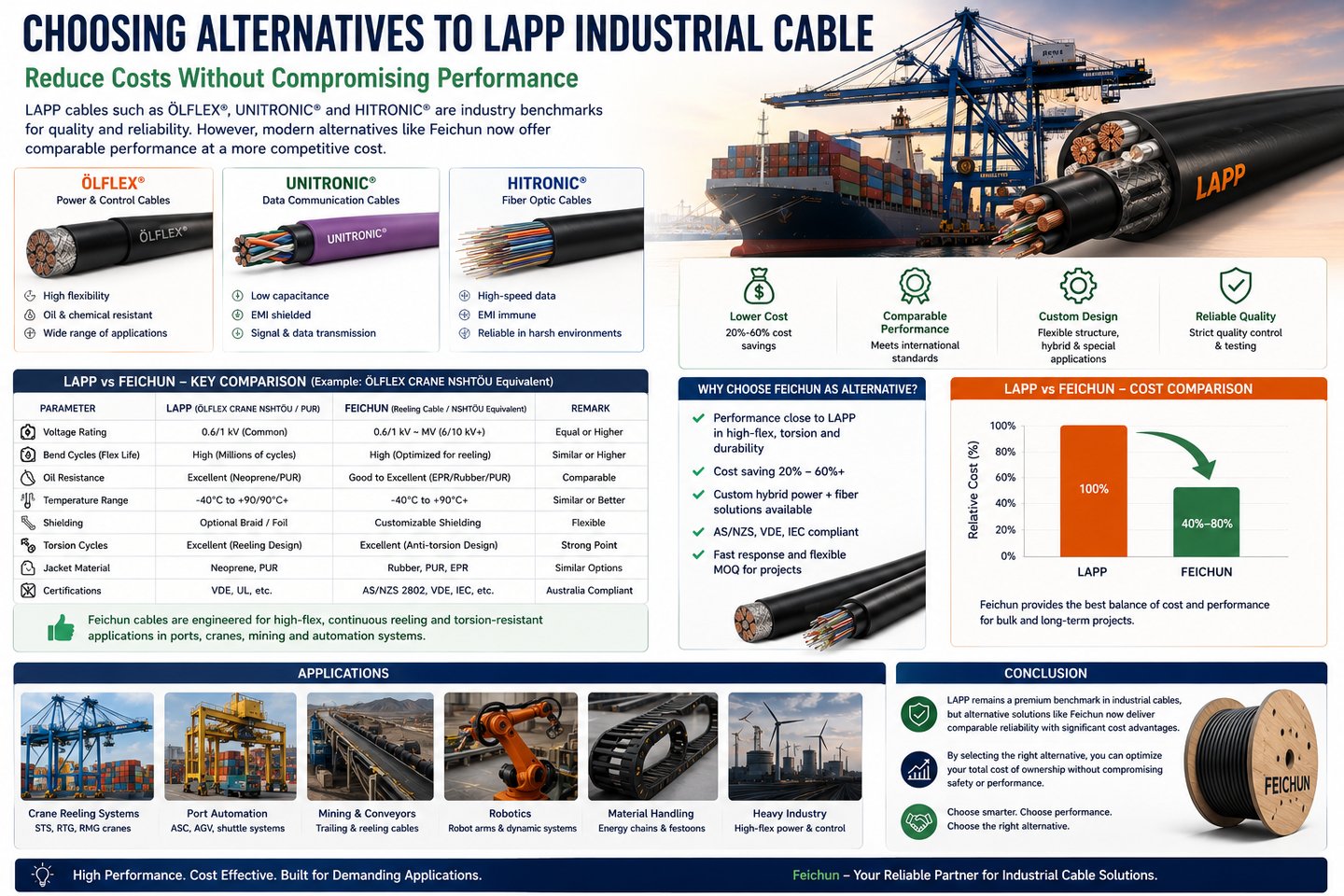
For decades, if you were specifying industrial cable for a serious application, LAPP was on the shortlist almost by default. The German manufacturer's ÖLFLEX, UNITRONIC, ETHERLINE and HITRONIC ranges have earned a reputation that's genuinely deserved — these are well-engineered cables backed by a deep library of approvals and a long field record. In Australian ports, mines, and material-handling operations, LAPP product has done a lot of reliable work.
But the question buyers are asking has changed. With material costs climbing and supply chains under pressure, the conversation in procurement meetings is no longer "can anything replace LAPP?" It's a sharper, more practical question: which alternative delivers comparable performance and compliance at a lower total cost?
That's a fair question, and it deserves a straight answer. This guide walks through why LAPP became the benchmark, when it makes sense to look at alternatives, what actually defines a good alternative, and how the options compare — European competitors, the broader rise of Chinese manufacturing, and where we at Feichun fit. We make heavy-duty, customisable mining and port cable, so we'll be upfront about where we compete and where we don't. The aim is to help you make a sound sourcing decision, and if your project fits what we do well, to make it easy to ask us for a quote.
1. Why LAPP Became the Industry Benchmark
You can't sensibly choose an alternative to something without understanding why the original earned its place. LAPP's position isn't marketing — it's the product of genuinely strong engineering across a coherent range.
1.1 The Success of the ÖLFLEX Series
ÖLFLEX is close to synonymous with flexible power and control cable. The breadth is part of the appeal: the ÖLFLEX CLASSIC 100 and 110 control cables cover the everyday workhorse role — the CLASSIC 110, for instance, is a VDE-registered, oil-resistant 300/500V control cable with fine-wire copper conductors, rated for fixed installation through to occasional flexing and power-chain use. Move up the range and ÖLFLEX ROBUST adds chemical and abrasion resistance for harsher environments, while ÖLFLEX CRANE is purpose-built for the reeling and pendant duty of crane systems.
Engineers reach for these cables for consistent reasons: flexible fine-wire conductor design, reliable oil resistance, mechanical durability, and — crucially — a broad set of global approvals that make sign-off straightforward. That last point matters more than it first appears. A lot of LAPP's value is in de-risking the approval process, not just the cable itself.
1.2 UNITRONIC and HITRONIC in Modern Automation
LAPP's data and communication ranges are the other half of the story. UNITRONIC covers industrial data and fieldbus communication; ETHERLINE serves industrial Ethernet networks like PROFINET in demanding environments; and HITRONIC handles fibre-optic transmission, moving large data volumes with immunity to electromagnetic interference. As ports and plants instrument themselves with sensors, cameras and real-time control, this power-plus-data capability has become central to automation integration — and it's a big part of why a single brand can supply so much of a project.
1.3 Where LAPP Cables Typically Live
In practice, you'll find LAPP product across crane reeling systems, automated stacking cranes (ASC), ship-to-shore (STS) cranes, AGV systems, robotics, and conveyor systems. These are exactly the high-cycle, high-stress, often safety-critical applications where cable failure is expensive — which is precisely why buyers have historically paid the premium without much argument.
2. When Does It Make Sense to Consider an Alternative?
If LAPP is so good, why look elsewhere? Because "good" and "right for this project" aren't the same thing. There are three situations where evaluating an alternative is simply sound procurement.
2.1 Rising Project Costs
Material costs — copper above all — have been volatile and broadly upward, and premium European pricing sits on top of that base. On a small specialist run, the premium is noise. On a large infrastructure project running kilometres of reeling and trailing cable, that premium becomes a line item big enough to attract the CFO's attention. When budget pressure is real, the cost of not testing the market is measured in real dollars.
2.2 Long-Term Procurement Strategy
Beyond any single project, smart operations are rethinking dependence on a single supplier. Multiple-sourcing strategies and supply-chain resilience moved from buzzwords to board-level priorities over the last few years, for obvious reasons. Qualifying a capable second source isn't disloyalty to an incumbent — it's basic risk management, and it gives you negotiating leverage you didn't have before.
2.3 Large-Volume Requirements
The economics tip hardest on volume. Port expansion projects, mining conveyor systems, and bulk crane cable replacement programs all involve quantities where a lower per-metre price compounds into serious savings. These are also, conveniently, the projects with enough lead time to manage an alternative supplier properly — which brings us to what "properly" means.
3. What Actually Makes a Good LAPP Alternative?
This is the heart of it. Switching supplier only works if the alternative genuinely matches the performance that mattered in the first place. Price alone is a trap. Here's the real checklist.
3.1 Equivalent Voltage Ratings
The alternative has to cover the voltage classes your application uses — typically 300/500V for control, 450/750V for heavier control and power, and 0.6/1kV for power distribution, with medium-voltage options where reeling cables feed higher-voltage plant. A credible alternative supplier offers this full ladder, not just the easy low-voltage end. Feichun's range spans low-voltage through medium-voltage reeling and trailing constructions, matching the classes used across port and mining plant.
3.2 High Flexibility and Bend Life
For reeling and dynamic applications, bend life is the whole game. The cable has to survive millions of bending cycles in continuous reeling operation without conductor fatigue or jacket cracking. This comes down to fine-wire conductor stranding, the support element, and jacket compound — construction details, not brand badges. It's an area where a manufacturer focused on heavy-duty flexible cable can compete directly on the engineering that determines field life.
3.3 Oil, UV, and Chemical Resistance
Port and outdoor environments are unforgiving — oil, salt, UV, abrasion. The answer is the right jacket technology: PUR (polyurethane) sheaths for abrasion, oil and chemical resistance in a light, flexible package, and rubber compounds where weather and mechanical robustness lead. A good alternative offers both PUR and rubber sheath options and selects between them by duty, exactly as the premium brands do.
3.4 Torsion Resistance
Bending isn't twisting. AGV systems, crane boom movements and rotating machinery subject cable to torsion, and a cable engineered only against bending will fail at the twist. Genuine anti-torsion construction — controlled lay length, balanced layers, appropriate support elements — is a distinct capability, and one worth confirming explicitly rather than assuming.
3.5 Compliance and Certification
This is non-negotiable and the most common place alternatives fall short — not because they can't comply, but because compliance has to be specified and verified. A serious alternative builds to AS/NZS standards where they apply, to IEC for the global technical baseline, and to VDE where relevant, and supplies the test documentation to prove it. The rule is simple: require the standards in writing, require the evidence, and treat any vagueness as a red flag. A capable manufacturer expects this and makes it painless.
4. Comparing LAPP and the Alternatives
4.1 European Alternatives
LAPP isn't the only premium European name. Helukabel, the Prysmian Group, and Tratos all offer proven performance and strong international certifications, and any of them can be a legitimate LAPP substitute at the high end. The challenge is that they largely share LAPP's cost structure — premium pricing and, since most are imported into Australia, procurement cycles that aren't dramatically shorter. Swapping one premium European brand for another diversifies your supplier base but doesn't fundamentally change the cost equation.
4.2 Chinese Manufacturers Entering the High-End Market
The more significant shift is the maturing of Chinese industrial cable manufacturing. The honest picture: a decade ago, "Chinese cable" carried real quality-variance risk, and that reputation was sometimes earned. That's no longer a fair blanket assessment. Manufacturing technology, quality control, and international certification coverage have improved markedly at the serious end of the market, and adoption in mining and port sectors — including by EPC contractors who carry real warranty risk — has grown accordingly. EPC contractors don't specify cable on price alone; their acceptance signals that the quality gap has narrowed to where it can be managed with proper qualification.
The key word is serious. The market still contains low-end producers who'll cut corners. The task isn't to trust "Chinese manufacturing" in the abstract — it's to identify the specific manufacturers who've invested in the engineering and certification to compete on performance, and then qualify them properly.
4.3 Where Feichun Fits
Among Chinese manufacturers, Feichun has deliberately not tried to be everything to everyone. We've focused specifically on heavy-duty flexible cable systems for crane, mining and port applications — which is to say, precisely the demanding, high-cycle category where cable engineering actually matters and where LAPP built its reputation.
What that focus means in practice: reeling cable expertise built around bend-life performance; genuine anti-torsion design for multi-axis movement; both PUR and rubber sheath options selected by duty; hybrid power-plus-fibre-optic constructions for automated equipment that needs power and data in one cable; and AS/NZS and IEC-compliant solutions with the documentation to back them. Typical applications are the ones driving Australian port and mining investment right now — STS cranes, ASC systems, AGV charging and power systems, and reclaimer and stacker machines.
We're not positioning ourselves as "better than LAPP" — that would be the wrong claim and you'd rightly be sceptical of it. The accurate claim is narrower and more useful: for heavy-duty, customisable crane and mining cable, we deliver comparable engineered performance and compliance at a meaningfully lower cost, and we'll customise to your exact application rather than offering the nearest catalogue match.
5. Technical Comparison: LAPP vs Feichun Reeling Cables
Setting the two side by side on the dimensions that decide a reeling-cable choice:
Voltage rating. Both offer comparable low-voltage and medium-voltage ranges across the 300/500V, 450/750V and 0.6/1kV classes and into MV reeling territory. No meaningful gap here for standard port and mining duty.
Flex life and mechanical durability. This is where reeling cable is won or lost. Both depend on fine-wire stranding and quality support elements for dynamic bending performance under high-cycle operation. Our engineering focus is squarely on this category, and we'll provide the bend-cycle and construction detail to let your engineer compare like for like rather than asking you to take it on faith.
Oil and environmental resistance. Both ranges use rubber and PUR jacket technologies; the right choice is duty-driven, and we supply both. For salt, UV and abrasion at the quayside, the jacket specification matters more than the badge.
Torsion performance. For multi-axis movement in port automation environments, both offer torsion-resistant construction. This is a capability to confirm against your specific application — boom rotation, AGV articulation — and we design to the actual movement profile.
Customisation capability. This is our strongest card. Shielding options, fibre-optic integration, core-count flexibility, and special drum and reel designs are where a focused, customisation-oriented manufacturer can serve a project better than a high-volume catalogue range. If your application needs a cable that doesn't exist on anyone's standard list, that's exactly the work we're built for.
6. Cost Comparison and Total Cost of Ownership
6.1 Initial Purchase Cost
The headline is real: capable alternative suppliers commonly come in 20–60% below premium European pricing for comparable construction, with the gap widening on larger orders. That's the number that gets attention, and it's legitimate — but it's only the start of the analysis.
6.2 Installation and Maintenance Costs
The costs that don't appear on the purchase order are the ones that decide value: service life, downtime risk, and replacement frequency. A cable that's cheaper to buy but fails sooner can cost far more over its life once you price in a stopped crane and an unplanned shutdown. This is the legitimate concern behind "you get what you pay for" — and the correct response isn't to dismiss it but to demand the field-life evidence that shows the cheaper cable isn't actually shorter-lived. A serious alternative welcomes that scrutiny.
6.3 Total Cost, Not Unit Price
The principle to hold onto: the lowest purchase price is not always the lowest operating cost — and neither is the highest. The right cable is the one that minimises total cost of ownership for the duty it's doing, which means matching construction to application precisely. Over-specifying a premium cable for a modest duty wastes money; under-specifying a cheap cable for a punishing duty wastes more. The win is equivalent engineered performance at a lower landed cost, verified on the numbers. That's the comparison we want you to run, because we're confident in where it lands.
7. Which Applications Can Safely Switch — and Which Shouldn't
Honesty about boundaries builds trust, so here's the straight version.
Strong candidates to switch. Port crane reeling systems, conveyor systems, automated warehouses, mining trailing cable systems, and AGV and automation projects are all well-suited to a carefully qualified alternative. These are high-volume, duty-defined applications where construction quality determines outcomes and where the cost saving is largest — the natural home for a focused heavy-duty manufacturer.
Where premium brands may still be the right call. Extremely specialised applications with unusual performance envelopes, situations governed by an existing OEM specification that names a brand, and projects requiring specific approvals that an alternative doesn't yet hold — in these cases, sticking with the incumbent can be the rational choice. We'd rather tell you that than sell you a cable that's wrong for the job. Often the smartest outcome is a dual-sourcing model: alternative supply for the large, duty-defined volume, premium brand for the genuinely specialised niches.
8. The Bottom Line
LAPP remains a leading industrial cable benchmark, and nothing here is an argument against that. The argument is simply that "benchmark" and "only sensible choice" have come apart. Alternative suppliers should be evaluated on the things that actually matter — performance, compliance, reliability, and total cost of ownership — rather than dismissed on reputation or chosen on price alone.
On those criteria, modern manufacturers focused on the heavy-duty category have substantially narrowed the gap in high-flex crane and reeling cable. For a great many Australian port and industrial projects, a carefully selected and properly qualified alternative reduces procurement cost while maintaining the long-term operational reliability the application demands.
If you're running a port expansion, a mining cable program, an automation rollout, or any sizeable crane and reeling cable requirement, the practical next step costs you nothing: put your specification in front of us and see how the numbers and the construction stack up.
We're Feichun. We make heavy-duty, customisable crane, mining and port cable — reeling and trailing cable, PUR and rubber sheathed, anti-torsion designs, hybrid power-plus-fibre constructions, built to AS/NZS and IEC requirements when you specify them. Send us your requirement — cable type, conductor configuration, voltage class, quantity, application, movement profile, and the standards your engineer needs met — and we'll come back with a clear quote and the construction detail behind it, so your team can compare it against any premium brand on equal terms.
Get in touch for a quote, and let's find out exactly what the right cable for your project should cost.
This article is a general industry overview, not engineering or procurement advice for any specific installation. Standards, pricing and lead times change; confirm current requirements with your specifying engineer and current pricing with suppliers. Brand and product names — including ÖLFLEX, UNITRONIC, ETHERLINE and HITRONIC — are trademarks of LAPP and are referenced here for technical comparison only; they remain the property of their respective owners.
How to Reach Us
Get in Touch
SiteMap
Product Catalogue
Festoon Cable
Shore Power Cable




Scan to add us on WeChat