
Choosing Between Local and Imported Crane Cable in Australia: What Port Operators Should Know About Cost, Lead Time, and Performance
Local or imported crane cable? Compare cost, lead time, compliance and customisation across Prysmian, Nexans and offshore OEM supply to build the right dual-sourcing strategy.
hongjing.Wang@Feichun
6/9/202611 min read
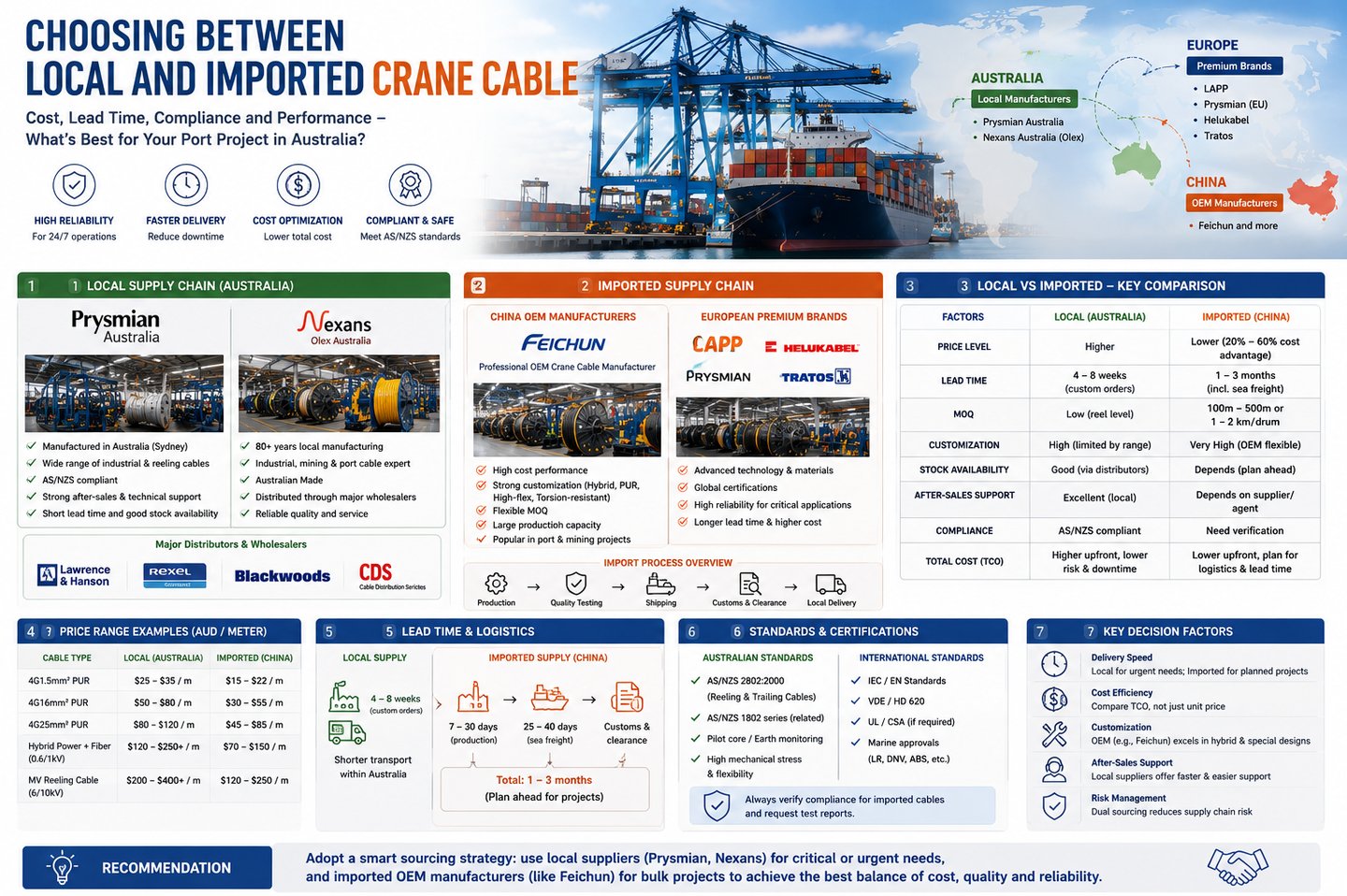
If you run a port terminal, a mine, or any operation that depends on cranes and reeling systems, you've probably had this conversation more than once: do we buy the cable locally, pay the premium, and sleep easy — or do we source it offshore, save a meaningful chunk of the budget, and manage the lead time and qualification ourselves?
It's not a trivial decision, and it's getting harder. Australia's port and automation sector is driving steady demand for high-flex and reeling crane cables, and the choice between local manufacture and imported supply now lands squarely on four things that matter to every project manager and procurement lead: project cost, delivery speed, system reliability, and compliance with Australian standards.
This is an honest walk through that decision — the strengths and the genuine limitations on both sides. We manufacture crane and reeling cable ourselves, so we have a horse in this race, and we'll say so plainly where it's relevant. But the goal here isn't to pretend imported always wins. It doesn't. The goal is to give you a clear enough framework that you can make the right call for your project — and to make the case that, for a large or planned project, getting a quote from a capable offshore manufacturer should be part of your process even if you ultimately split the order.
1. How the Crane Cable Supply Chain Actually Works in Australia
Before comparing options, it helps to see the whole field. Australia's crane cable market isn't a simple local-versus-foreign split — it's a layered ecosystem with local manufacturers, large distributors, and two distinct import streams.
1.1 The Local Manufacturing Base
Australia has a genuinely strong industrial cable manufacturing heritage, and that's worth respecting. Two names dominate the local heavy-industry conversation. Prysmian Group has Australian manufacturing operations and a long track record in energy, industrial and mining cable. Nexans — through its Olex heritage, a brand woven deep into Australian industrial history — has a long-established local manufacturing base, particularly strong in mining and heavy industry.
Their capabilities cover energy and industrial cables, mining and heavy-duty flexible cables, and selected crane and reeling cable product lines. The key phrase there is "selected." Local production is excellent at the mainstream of the market, but the specialised, highly customised reeling and hybrid constructions that modern automated terminals increasingly want are not always a core local product line — a point we'll come back to.
1.2 The Distribution Network
Sitting between manufacturers and end users is a mature distribution layer. Wholesalers like Lawrence & Hanson, Rexel Australia, and the Blackwoods industrial supply network hold stock and distribute multiple brands — Prysmian, Nexans, LAPP and others — under one roof. Their role is real value: stock availability and multi-brand choice mean that for standard items, you can often have cable on a truck the same week. That speed is a genuine advantage of the local ecosystem, and it's largely a distribution story rather than a manufacturing one.
1.3 The Imported Supply Streams
Imports come in two flavours that are often lumped together but behave very differently.
The first is European premium brands — LAPP, Helukabel, Tratos, and Nexans' European production lines. These are imported, but they sit at the top of the price ladder and compete on engineering and certification rather than cost.
The second is Asian OEM manufacturing — cost-driven, customisation-focused producers who build crane reeling and hybrid cables to specification. This is where we sit. We manufacture PUR-sheathed reeling cables, hybrid power-plus-fibre constructions, and high-flex torsion-resistant designs, and we're frequently specified as a cost-effective equivalent to premium brands like LAPP for port automation, ASC and AGV applications, and bulk procurement. The rest of this article spends most of its time comparing this stream against the local and European premium options, because that's where the real cost-and-performance trade-off lives.
2. Local Crane Cable Supply: The Strengths and the Limits
Let's give the local option its full due first, because for a category of projects it's simply the right answer.
2.1 The Local Manufacturing Advantage
When Prysmian or Nexans makes cable in Australia for an Australian project, several things go right at once. Delivery is fast because the product doesn't cross an ocean. Compliance with AS/NZS standards is built in and well understood, because the manufacturer lives inside that regulatory environment every day. Technical support is local — same time zone, same language, often someone who can come to site. And these suppliers hold established supply contracts on major infrastructure projects, which means relationships, history, and a track record an approving engineer can lean on.
For specialist applications, Prysmian's local range extends to industrial and reeling systems such as its PROTOLON family of reeling cables. The point isn't the specific model — it's that the local majors can serve real reeling applications with locally backed, locally compliant product.
2.2 Nexans / Olex — The Industrial Specialist
Nexans' Australian operation, built on the Olex foundation, has decades of presence in mining and heavy industry and a deep distribution footprint through the major wholesalers. For operations that already run Olex-heritage cable across their sites, continuity of supplier and known performance carry real weight.
2.3 The Honest Limitations
None of that is free, and there are three limits worth naming plainly. Local unit cost is higher than offshore manufacturing — sometimes substantially — because the cost base of manufacturing in Australia is what it is. Flexibility for highly customised hybrid cable designs can be limited; the local lines are optimised for their core, high-volume products, and a one-off hybrid power-and-fibre reeling cable for a specific automated crane isn't always something a local line is set up to produce quickly or cheaply. And for any non-stock item, you still wait — local doesn't mean instant once you're outside what the distributors hold on the shelf.
So the local advantage is real but bounded: it's strongest for standard product, urgent need, and projects where local compliance support and contract history matter most.
3. Imported Crane Cable: The Two Faces
3.1 European Premium Brands
The European premium brands earn their position. They offer advanced engineering for genuinely extreme applications, decades of proven reliability data, and broad global certification coverage that smooths approvals on international projects. LAPP's industrial cable systems are the reference many engineers reach for when writing a specification. If a project's risk profile demands the most thoroughly documented, most widely certified option and budget is secondary, this is a legitimate choice.
The trade-off is simply cost — and, since they're imported, lead time that's closer to the offshore story than the local one. You pay a premium for the brand and the certification library, and you wait for it to ship.
3.2 Asian OEM Manufacturers — Where We Compete
This is the option that's reshaped the economics of large cable projects, and it's where we operate. The proposition is straightforward: cost-effective supply for large-scale projects, with strong customisation capability. We build to specification — PUR-sheath reeling cables, hybrid power-plus-fibre-optic cables, and high-flex torsion-resistant designs — and we're routinely positioned as a LAPP-equivalent alternative, matching the construction principles that drive field life without the premium-brand price tag. The applications are exactly the ones Australian terminals are investing in: port automation systems, ASC and AGV deployments, and bulk procurement where the per-metre price multiplied across kilometres of cable becomes serious money.
The advantages are concrete: lower cost per metre, high customisation flexibility, and a short production cycle once the design is locked. We won't pretend there are no trade-offs, because there are, and a buyer who ignores them gets burned. Logistics lead time is longer — there's an ocean involved. Certification has to be verified rather than assumed, with the right test documentation supplied up front. And a first-time offshore supplier should go through a proper qualification process before you commit a critical order. Those aren't reasons to avoid offshore supply; they're the checklist for doing it well. A serious manufacturer expects every one of them and should make them easy.
4. Price and the Real Cost Structure
4.1 What Local Cable Costs
As a rough orientation for the Australian market: small cross-section PUR cables tend to land somewhere around AUD 25–35 per metre; medium industrial cables run from roughly AUD 50 to AUD 150 and up per metre; and high-voltage or hybrid constructions climb well above that. These are indicative ranges, not quotes — actual pricing swings with copper prices, specification, quantity and the day's exchange rate — but they give a sense of the baseline.
4.2 What Imported Cable Costs
Asian OEM supply typically comes in 20–60% below local pricing for comparable construction, with the gap widening on larger orders as economies of scale kick in. That headline saving is real, but a careful buyer adds the landed costs back in: freight, customs clearance, and drum handling. Even after those, the net saving on a sizeable order is usually significant — but the honest comparison is landed cost versus local price, not factory-gate price versus local price. We'd rather you run that full comparison, because we're confident in how it comes out and because a buyer who's done the real maths is a buyer who stays.
4.3 Total Cost of Ownership Is the Number That Matters
Purchase price, local or imported, is only the visible part. The number that actually governs value is total cost of ownership: downtime cost when a cable fails in service, maintenance frequency, replacement cycle length, and installation risk. A cable that's 30% cheaper but lasts 60% as long is a false economy — and so is a premium cable bought at a premium when an equivalent construction would have delivered the same field life for less. The right cable is the one that minimises lifecycle cost for the duty it's doing, and that's a calculation worth running before any sourcing decision. It's also exactly the conversation we like to have, because matching construction to duty — rather than over- or under-specifying — is where genuine value lives.
5. Lead Time and Logistics
5.1 The Local Speed Advantage
This is local supply's strongest card. Stock held by distributors can be immediate; non-stock local manufacture typically runs four to eight weeks. For urgent maintenance or a breakdown replacement where a stopped crane is costing thousands an hour, that responsiveness is hard to beat, and it's the single best reason to keep a local supplier in the mix.
5.2 The Imported Timeline
Offshore is a planning game. Production from an Asian OEM commonly runs 7–30 days depending on specification and order size; shipping adds roughly 25–40 days. All in, expect one to three months from order to delivery. That's the honest figure, and anyone who quotes you dramatically less should be questioned.
5.3 What This Means for Planning
The implication writes itself. Imported cable is well suited to planned projects with a known timeline — new terminal builds, scheduled automation rollouts, capacity expansions — where one to three months is comfortably inside the project schedule and the cost saving flows straight to the bottom line. Local supply is the better tool for emergency replacement. The smartest operators don't choose one; they map their needs and use each where it's strongest.
6. Standards, Compliance and Certification
This section deserves care, because compliance is where offshore supply most often gets a bad name — usually unfairly, and occasionally fairly.
6.1 Australian Standards (AS/NZS)
The reeling and trailing cable standard most often cited in Australia is AS/NZS 2802:2000, which specifies construction, dimensions and tests for flexible reeling and trailing cables for mining (other than underground coal) and general use, at system voltages from 1.1/1.1 kV up to 33/33 kV. It's worth being precise about scope: AS/NZS 2802 is fundamentally a mining-and-general-use reeling cable standard rather than a dedicated port-crane standard, and it sets out things like mechanical durability, conductor protection, and earth and pilot core arrangements. For port and crane applications, the relevant standard depends on the specific cable, voltage and duty — so the right move on any project is to confirm with the specifying engineer exactly which standards apply, rather than assuming a single one covers everything.
The key point for sourcing: a capable offshore manufacturer can build to AS/NZS requirements when they're specified — but you must specify them, in writing, and require the test evidence. Compliance isn't a quality that cable has by default; it's a quality you ask for and verify.
6.2 International Standards (IEC / VDE)
Most premium and global product is built to IEC, with European product also referencing VDE. Prysmian, Nexans, LAPP and competent OEM exporters all work to IEC, which gives a common technical language across the comparison. When you're weighing an offshore quote against a local one, asking both to state the standards they're certifying to puts the comparison on equal footing.
6.3 Marine and Port-Specific Requirements
Port applications add their own demands: oil resistance, UV resistance, and abrasion resistance for the harsh quayside environment, and in some cases additional marine certifications such as Lloyd's Register or DNV approvals. These can be decisive for crane applications, and they're exactly the kind of requirement that should appear in your enquiry from the outset. A manufacturer that can show the relevant approvals, or produce cable to earn them, belongs on your shortlist; one that goes quiet when you ask does not.
7. The Procurement Decision, Factor by Factor
7.1 Speed Versus Cost
The core tension. Local: fast response, higher cost. Imported: lower cost, longer lead time. Neither is universally right — the right answer depends on whether your constraint today is the calendar or the budget.
7.2 Customisation Capability
This is where the ranking shifts in the offshore manufacturer's favour. Asian OEM supply offers strong flexibility for hybrid and bespoke cable design — we'll build the construction your application actually needs rather than the nearest catalogue match. European brands offer high engineering precision within their established ranges. Local production can be the most constrained for genuinely custom work, because its lines are optimised for core volume products. If your project needs a non-standard hybrid power-and-data reeling cable, the offshore custom route is often the only one that delivers exactly the right cable rather than a compromise.
7.3 After-Sales Support
Honesty matters here too. Local manufacturers offer the strongest direct support and troubleshooting — same time zone, on-site presence, established relationships. Offshore support depends on the supplier and any local distribution arrangement. This is a real consideration, and the way to manage it is to choose an offshore partner who's responsive, communicates clearly across the time difference, and stands behind the product. Ask for references; a manufacturer worth working with will have them.
7.4 A Sensible Hybrid Procurement Strategy
Put it all together and the smart pattern is rarely all-or-nothing. Critical, time-sensitive, or compliance-heavy items often sit best with local supply. Large-scale, planned, cost-sensitive volume is where imported OEM supply — ours included — delivers the biggest win. Genuinely extreme-performance niches may justify European premium product. Most well-run operations end up with a dual-sourcing model that uses each channel for what it does best.
8. The Bottom Line — and Where We Fit
Australia's crane cable market is a hybrid supply ecosystem, and no single solution fits every project. The right choice depends on your cost pressure, your automation level, your lead-time requirements, and your compliance standards. Local suppliers genuinely dominate on reliability of response and speed for urgent and standard needs. Imported OEM suppliers — including us — dominate on cost and customisation for planned, large-scale, and bespoke work. For most operators, the optimal strategy is a dual-sourcing model that plays each to its strength.
Here's the practical takeaway. If you've got a planned project, an automation rollout, a capacity expansion, or any sizeable reeling and crane cable requirement, the cost of not getting an offshore quote is real money left on the table. You don't have to commit anything to find out — just put the specification in front of us and let the numbers and the construction speak for themselves.
We manufacture PUR-sheathed reeling cable, hybrid power-plus-fibre cable, and high-flex torsion-resistant designs, built as cost-effective equivalents to the premium brands, customisable to your application and to the standards your engineer specifies. Send us your requirement — cable type, conductor configuration, voltage, quantity, application, and the standards you need met — and we'll come back with a clear quote and the construction detail behind it. If a dual-sourcing approach makes sense for your operation, we're happy to be the half of it that takes the cost pressure off your big planned orders.
Get in touch for a quote, and let's work out exactly what the right cable for your project costs.
This article is a general industry overview and not engineering or procurement advice for any specific installation. Standards, pricing and lead times change; confirm current requirements with your specifying engineer and current pricing with suppliers. Brand names are referenced for technical comparison only and remain the property of their respective owners.
How to Reach Us
Get in Touch
SiteMap
Product Catalogue
Festoon Cable
Shore Power Cable




Scan to add us on WeChat