

Conductor Strand Types for Cables: From Concentric to Compact and Compressed Conductors
Learn about the main conductor strand types for cables, including concentric strand, bunch strand, rope strand, sector conductor, segmental conductor, annular conductor, compact strand and compressed strand, and how each affects cable size, flexibility and AC resistance.
hongjing.Wang@Feichun
1/22/202610 min read
When engineers design power distribution systems or control circuits, the choice of conductor construction plays a critical role in determining cable performance, installation ease, and long-term reliability. Different conductor strand types for cables have evolved to address specific challenges in electrical systems—from managing skin effect in high-frequency applications to reducing overall cable diameter in crowded conduits. Understanding the structural characteristics and performance advantages of each stranding method enables informed decisions that balance electrical efficiency, mechanical flexibility, and cost-effectiveness.
The selection between concentric, bunch, rope, sector, segmental, annular, compact, and compressed conductor configurations depends on application requirements including current-carrying capacity, installation environment, voltage level, and space constraints. This article explores how each conductor strand type addresses distinct engineering challenges in modern cable systems.
Overview of Common Conductor Strand Types
A stranded conductor consists of multiple individual wires assembled together to form a single conductive path, in contrast to a solid conductor made from a single piece of metal. Stranding offers significant advantages over solid conductors, particularly in larger sizes where flexibility becomes essential for installation and where fatigue resistance matters in applications subject to vibration or repeated bending.
The main conductor strand types for cables include:
Concentric stranded conductors feature a systematic layered arrangement with each layer containing six more wires than the previous layer. Bunch stranded conductors for flexible cables consist of wires twisted together without geometric precision, prioritizing flexibility over uniformity. Rope stranded conductor construction takes the concentric principle further by using pre-stranded groups as building blocks. Sector conductors employ a non-circular cross-section to optimize space utilization in multi-conductor cables. Segmental conductors divide the cross-section into slightly insulated sectors to combat AC resistance. Annular conductors arrange strands around a nonconducting core to exploit skin effect performance benefits. Compact stranded conductors for smaller diameter applications use formed wires and compression to eliminate air spaces. Finally, compressed conductors occupy a middle ground between standard and compact designs.
Each construction method addresses specific performance parameters, and the optimal choice depends on whether the priority is minimizing diameter, maximizing flexibility, reducing AC losses, or achieving cost efficiency.
Concentric Stranded Conductors
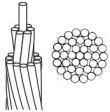
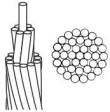
The concentric stranded conductor for power cables represents the most common and standardized construction in the industry. This design features a central wire or core surrounded by one or more layers of helically laid wires. The mathematical relationship governing layer construction is straightforward: each successive layer contains exactly six more wires than the layer beneath it. For example, a typical concentric conductor might have a single-wire core, surrounded by a first layer of six wires, then a second layer of twelve wires, and a third layer of eighteen wires.
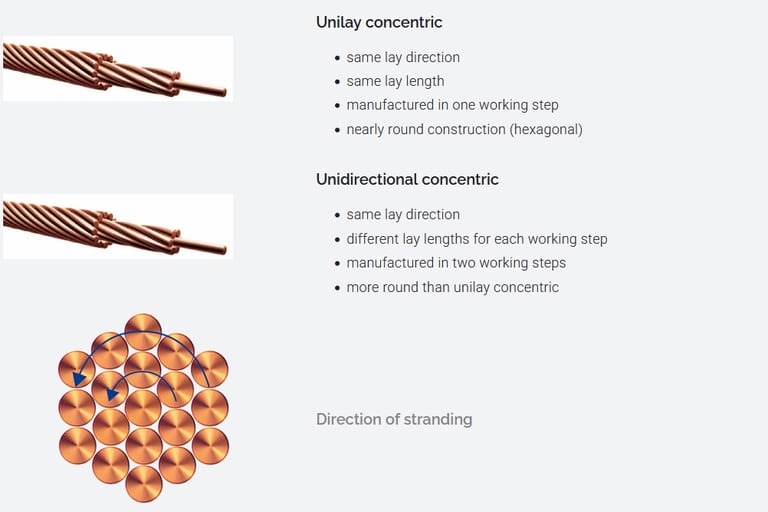
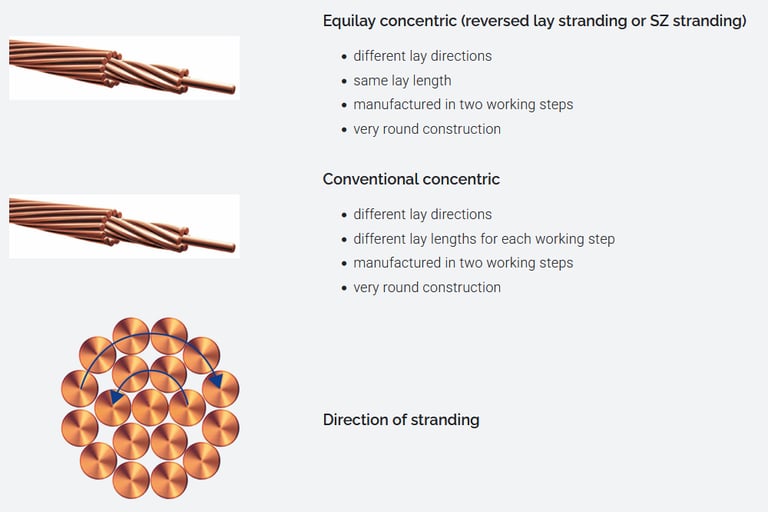
Except in compact stranding variations, each layer is usually applied with a lay direction opposite to that of the layer beneath it. This alternating lay direction provides several benefits: it creates a balanced construction that resists unwinding during handling, improves the conductor's structural stability, and allows the finished conductor to maintain its round shape without telescoping when the cable is bent.
Concentric stranded conductors are widely used in medium-voltage distribution cables, building wire, and industrial power feeders where a balance of flexibility, current-carrying capacity, and manufacturing economy is required. The standardized nature of concentric stranding means that electrical properties such as DC resistance and weight per unit length can be precisely calculated and are consistent across manufacturers who follow industry standards like ASTM B8 or IEC 60228.
Common application scenario: A 500 kcmil concentric stranded copper conductor used in a 15 kV distribution feeder provides sufficient flexibility for installation in underground duct banks while maintaining excellent current-carrying capacity for loads up to several hundred amperes. The systematic layer arrangement ensures uniform current distribution and predictable thermal performance.
Bunch and Rope Stranded Conductors
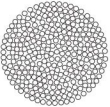
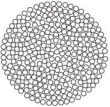
The bunch stranded conductor for flexible cables takes a fundamentally different approach to construction. Rather than organizing wires into precise geometric layers, bunch stranding simply twists multiple wires together in the same direction without concern for systematic arrangement. This results in a highly flexible conductor ideal for applications requiring frequent movement or tight bending radii.
The random arrangement of wires in bunch stranding creates more air space between conductors compared to concentric designs, which slightly increases the overall diameter for a given cross-sectional area of copper or aluminum. However, this construction excels in portable cord applications, welding cables, and any situation where extreme flexibility outweighs the need for compact diameter. Bunch stranded conductors are commonly found in equipment grounding conductors, flexible connections to motors and transformers, and temporary power distribution systems.
Rope stranded conductor construction represents a sophisticated evolution of the concentric principle. In this design, each strand that would form a layer in a conventional concentric conductor is itself a stranded assembly. The rope stranded conductor is specified by indicating both the number of component groups and the number of wires within each group. For instance, a rope conductor described as "7×7" contains seven groups, each composed of seven individual wires, for a total of forty-nine wires.
This construction provides enhanced flexibility compared to equivalent concentric conductors while maintaining better geometric control than bunch stranding. Rope stranded conductors are particularly valuable in extra-high-voltage transmission cables and submarine cables where very large cross-sections are required. The multiple levels of stranding allow the finished conductor to bend more easily despite its large size, facilitating installation on cable drums and through pulling equipment.
Common application scenario: Mine power cables operating in harsh environments often use rope stranded conductors because the construction withstands repeated flexing as cables are dragged across the ground or coiled and uncoiled during mining operations. The multi-layer stranding distributes mechanical stress more evenly than simpler constructions.
Sector, Segmental and Annular Conductors
Sector conductors represent an ingenious solution to the space utilization challenge in multi-conductor cables. A sector conductor features a cross-section approximately shaped like a sector of a circle—essentially a pie-slice shape. When three sector conductors are assembled in a cable, they nest together efficiently, creating a cable with significantly smaller overall diameter compared to a cable using three round conductors of equivalent cross-sectional area.
The sector conductor vs round conductor diameter advantage becomes increasingly important in large cables where conduit fill requirements and cable weight are critical concerns. A three-core cable with sector-shaped conductors might achieve a 15-20% reduction in overall diameter compared to round conductors, translating to substantial savings in conduit size, installation labor, and material costs. Sector conductors are commonly used in medium-voltage power distribution cables rated from 5 kV through 35 kV.
Potential cable problem and solution: When sector conductors are used in cables subjected to significant bending during installation, there is a risk that the shaped conductors may distort or that individual strands may protrude at the sector edges. Solution: Manufacturers often apply a thin binding tape over sector conductors before insulation to maintain the sector shape and prevent strand displacement. Additionally, minimum bending radius specifications should be strictly followed during installation.
The segmental conductor lower AC resistance design addresses a fundamental challenge in alternating current systems: the skin effect. In AC applications, current tends to concentrate near the conductor surface, effectively reducing the useful cross-sectional area. A segmental conductor is a round stranded conductor divided into three or four sectors that are slightly insulated from one another by thin barriers of insulating material or oxide film.
This segmental construction increases the effective surface area available for current flow while preventing circulating currents between segments. The result is measurably lower AC resistance compared to a solid round conductor of the same total cross-sectional area. Segmental conductors are particularly valuable in high-current feeders operating at 60 Hz or higher frequencies, and in applications where minimizing I²R losses is economically significant.
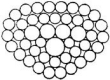
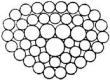
The annular conductor skin effect performance takes a complementary approach to managing AC resistance. An annular conductor arranges strands in a ring around a central core made wholly or mostly of nonconducting material such as jute, paper, or synthetic fiber. By moving conducting material away from the center—where skin effect would render it largely useless for AC conduction—and concentrating it near the outer surface where AC current naturally flows, the annular design achieves lower total AC resistance for a given cross-sectional area of conducting material.
Annular conductors are particularly effective in transmission-line applications and in any high-current, medium-to-high-frequency scenario where AC resistance reduction justifies the slightly more complex manufacturing process. The nonconducting core also provides a convenient pathway for optical fiber elements in modern hybrid cables that combine power and communication functions.
Common application scenario: A 1000 kcmil annular conductor in a 138 kV transmission cable can achieve 10-15% lower AC resistance compared to a standard concentric conductor of the same copper content, resulting in reduced energy losses over the decades-long service life of the transmission line. This efficiency gain often justifies the higher initial cost of annular construction.
Compact and Compressed Stranded Conductors
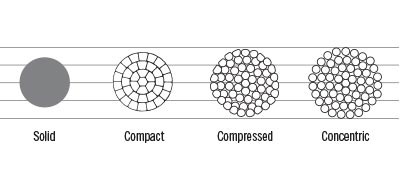
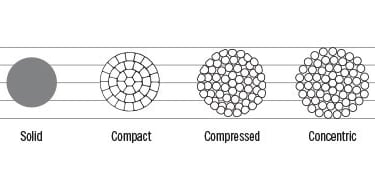
The compact stranded conductor smaller diameter design represents perhaps the most sophisticated approach to minimizing cable size. In compact conductor construction, all layers are stranded in the same direction rather than alternating, and each wire is preformed into a trapezoidal or keystone shape before stranding. After stranding, the entire conductor may be rolled or drawn through a die to compress it into a predetermined ideal shape.
The finished compact conductor features a remarkably smooth surface and contains practically no interstices or air spaces between wires. This elimination of air space results in a diameter reduction of approximately 8-12% compared to a standard concentric conductor of the same cross-sectional area. For multi-conductor cables, this diameter reduction compounds—a three-core cable with compact conductors might have an overall diameter 15-20% smaller than the same cable with standard conductors.
Beyond size reduction, compact conductors offer improved electrical properties. The tighter packing reduces the possibility of corona discharge at the conductor surface in high-voltage applications, and the smooth surface provides a better interface with extruded insulation systems, potentially improving the cable's dielectric strength and long-term reliability.
Potential cable problem and solution: Compact stranded conductors can be less flexible than standard concentric conductors of the same size due to the compressed construction and unidirectional lay. Problem: This reduced flexibility may complicate installation in tight conduit bends or where multiple 90-degree turns are required. Solution: Verify that the cable's minimum bending radius specification is compatible with the raceway layout before specifying compact conductors. In situations requiring very tight bends, consider using compressed conductors or standard concentric stranding instead.
The compressed conductor vs compact conductor comparison reveals an important middle ground. Compressed conductors are manufactured by taking a standard concentric stranded conductor with round wires and passing it through a die that "squeezes out" some of the air space between wires. The wires themselves remain essentially round in cross-section but are pressed more tightly together.
This results in a conductor intermediate in size between standard concentric and fully compact designs—typically achieving a 3-6% diameter reduction compared to standard stranding. Compressed conductors cost less to manufacture than compact conductors because the wires do not need to be preformed into trapezoidal shapes, yet they still provide meaningful space savings. The flexibility of compressed conductors generally remains good because the basic concentric layer structure is preserved.
For cable designers, compressed conductors offer an attractive compromise when moderate diameter reduction is desired but the cost premium or reduced flexibility of fully compact conductors is not justified. Compressed conductors are widely used in building wire, industrial control cables, and medium-voltage distribution cables where space is at a premium but extreme compactness is not required.
Choosing the Right Conductor Strand Type for Cable Design
Selecting among the various conductor strand types requires careful consideration of multiple factors that affect both initial installation and long-term performance. Cable diameter is often the first consideration in retrofit applications where existing conduit must accommodate new cables, or in new installations where minimizing conduit size reduces costs. In these scenarios, compact stranded conductors or sector conductors deliver the smallest overall cable dimensions.
Flexibility requirements vary dramatically across applications. Portable equipment cords, welding cables, and any application involving frequent movement demands the superior flexibility of bunch stranded conductors. Fixed installations in straight underground duct runs can readily accommodate the firmer construction of concentric or even compact conductors. Rope stranded conductor construction provides an excellent middle ground for large cables that must be installed around curves but do not require the extreme flexibility of portable cord.
Manufacturing cost considerations cannot be ignored, particularly in competitive bid situations for large projects. Standard concentric stranded conductors represent the lowest-cost option for most applications because manufacturing processes are highly standardized and automated. Bunch stranding costs slightly more due to the less controlled process, while compact conductors command a premium for the wire preforming and additional processing required. Rope stranded conductors involve multiple stranding operations and are consequently more expensive than single-level constructions.
AC resistance becomes the dominant consideration in high-current feeders, transmission lines, and any application where energy losses over the cable's service life represent a significant economic factor. For these applications, segmental conductor lower AC resistance or annular conductor designs can deliver substantial life-cycle cost savings that dwarf the higher initial investment. A detailed economic analysis comparing the present value of energy losses against the cost premium for advanced conductor designs often justifies the more sophisticated construction.
Practical application guidance:
For distribution cables operating at 5-35 kV in utility systems, sector conductors in three-core configurations minimize cable diameter while maintaining good current-carrying capacity. The compact cable size reduces installation costs and allows smaller vaults and manholes.
For high-current feeders supplying industrial plants or large commercial buildings, especially those operating continuously at high load factors, segmental or annular conductors reduce AC resistance and energy losses. The efficiency gain typically recovers the additional conductor cost within 3-5 years of operation.
For flexible connections to motors, transformers, and portable equipment, bunch stranded conductors provide the flexibility needed for installation and service while maintaining adequate current-carrying capacity. The slightly larger diameter is acceptable in these applications where conduit fill is rarely limiting.
Potential cable problem and solution: When transitioning from aluminum to copper conductors in an existing installation, engineers sometimes overlook that copper's higher density means a copper conductor of equivalent ampacity may be physically smaller than the aluminum it replaces, potentially allowing use of compact or compressed conductors for even greater space savings. Problem: Simply specifying "equivalent ampacity" may result in oversize conductors. Solution: Perform a detailed size analysis considering both electrical and mechanical requirements to optimize the conductor strand type selection.
Understanding the structural and performance characteristics of different conductor strand types for cables enables electrical engineers and cable designers to optimize installations for their specific requirements. Whether the priority is minimizing diameter with compact stranded conductors, maximizing flexibility with bunch stranding, reducing AC losses with segmental or annular designs, or balancing multiple factors with compressed or rope constructions, each strand type offers distinct advantages. By matching conductor construction to application demands, designers can achieve electrical systems that perform reliably, install efficiently, and operate economically throughout their service life.
How to Reach Us
Get in Touch
SiteMap
Product Catalogue
Festoon Cable
Shore Power Cable




Scan to add us on WeChat