
Copper vs Aluminium Conductor Cables: Which Should You Choose for Australian Industrial Applications?
Learn when to use copper or aluminium conductor cables for Australian industrial, crane and mining applications. Compare conductivity, flex life, standards and real-world project costs.
hongjing.Wang@Feichun
6/2/202613 min read
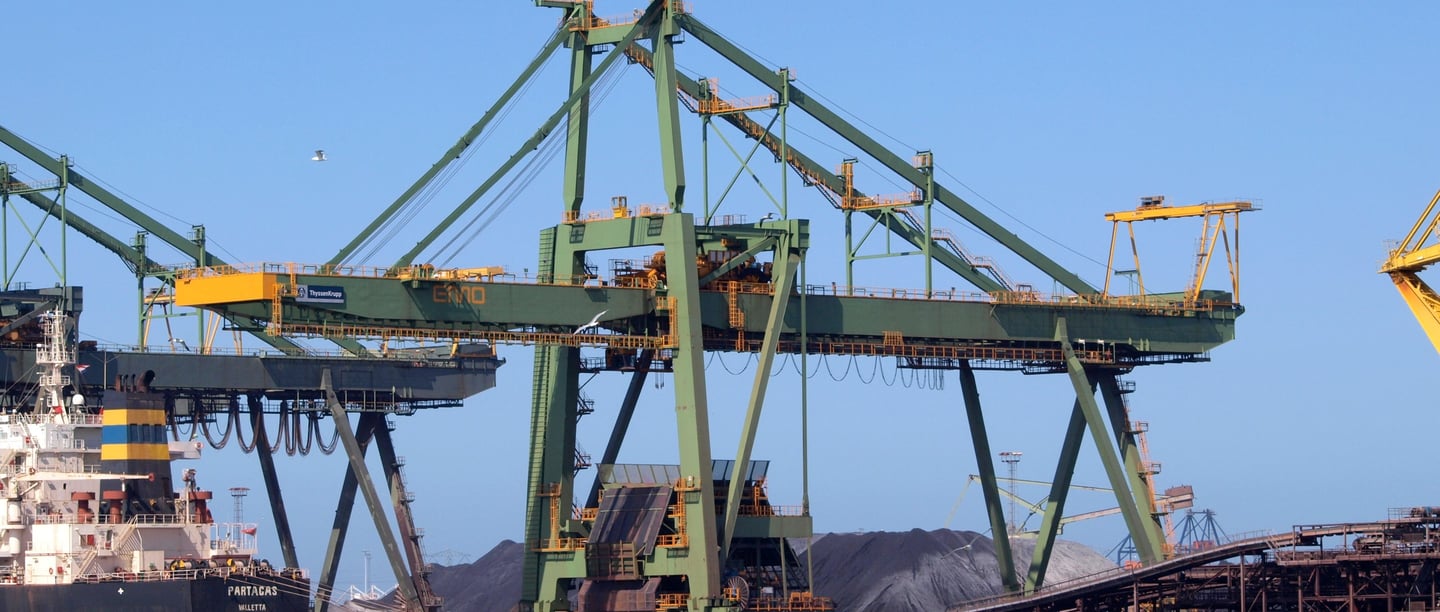
When you're specifying cables for an Australian industrial project — whether that's a bulk handling terminal in the Pilbara, a container port upgrade in Brisbane, a new substation feeding a solar farm across regional Queensland, or underground mining equipment in the Northern Territory — one of the most consequential decisions you'll make is conductor material. Copper or aluminium?
Get it right and you've set the project up for decades of reliable, low-maintenance operation. Get it wrong and you're looking at voltage drop problems, premature cable failure, or unexpected downtime at the worst possible moment. In industries where unplanned stoppages cost tens of thousands of dollars per hour, the conductor material decision is never trivial.
This guide breaks down exactly when each conductor material makes sense, drawing on the real-world demands of Australian mining, port infrastructure and industrial power systems — and the specific cable types that serve those applications.
Understanding the Fundamental Differences Between Copper and Aluminium Conductors
Electrical Conductivity: Why Size Isn't Everything
Copper sits at approximately 100% IACS (International Annealed Copper Standard), making it the global benchmark for electrical conductivity. Aluminium comes in at roughly 61% IACS — meaning for the same cross-sectional area, an aluminium conductor carries significantly less current and introduces considerably more resistance into the circuit.
In practical terms, an aluminium conductor typically needs to be sized one to two cross-section steps larger than a copper equivalent to match the same current-carrying capacity. For a long feeder run where you have space and weight budget to accommodate the larger conductor, this difference is manageable with careful design. For a compact installation where routing space is limited — a switchroom on an offshore platform, or a cable tray inside a crane girder — it can create real headaches.
Higher resistance also translates directly to power losses over the length of a cable run. On a short interconnecting cable this is negligible, but on a feeder running several kilometres to a remote substation, those losses accumulate and become a genuine lifecycle cost consideration when you're calculating the true economic case for each conductor material.
Weight: Where Aluminium Has the Clear Advantage
Aluminium weighs roughly 70% less than copper for an equivalent conductor volume. On large infrastructure projects — long cable bridge spans carrying hundreds of circuits, elevated tray systems running across an iron ore processing plant, or overhead distribution lines stretching across remote Western Australian mining leases — the reduction in structural load is substantial and can meaningfully reduce the engineering cost of supporting infrastructure.
Lighter cables also reduce physical installation effort, lower the load ratings required for cable support steelwork, and can simplify logistics on remote projects where helicopter lifts and expensive transport are the norm. For any project in the Kimberley or the Pilbara where road access is seasonal and every freight movement has a cost, shaving weight off the cable schedule is worth serious consideration.
Mechanical Strength and Flexibility: The Critical Differentiator
This is where copper separates itself decisively for certain applications. Copper offers superior tensile strength, excellent fatigue resistance under repeated bending, and a much higher tolerance for the mechanical stresses that come with dynamic cable systems — systems where the cable itself moves as part of normal operation.
Aluminium has lower flex endurance. It work-hardens with repeated bending cycles, becoming progressively more brittle and susceptible to fatigue cracking over time. For any cable that moves — wound on a reel, travelling through a festoon system, subjected to constant vibration from a running machine — aluminium is not a suitable conductor material. This distinction is fundamental to understanding where each material genuinely belongs, and it's the single most important factor to understand before specifying conductor material for any industrial application.
When Copper Conductor Cables Are the Better Choice
Dynamic Crane and Reeling Applications
This is copper's home ground, and it is where the material's mechanical properties make it functionally irreplaceable. Container cranes, rubber-tyred gantries (RTGs), ship unloaders, stacker reclaimers, bucket wheel reclaimers — virtually every piece of major port and bulk handling equipment that relies on a reeling cable system will specify copper conductors, and the reasoning is well established across decades of industrial practice.
A reeling cable on a container ship unloader, for example, might complete between 50,000 and 150,000 extension and retraction cycles over its design service life. Every single cycle subjects the conductors to bending, torsion and tension loads simultaneously. Copper handles this without degrading. Aluminium would develop micro-fractures at the conductor strands over time, leading to increased resistance, localised heating at fault points, and ultimately conductor failure — typically at the most inconvenient moment during a vessel discharge operation.
Purpose-built flexible crane cables are specifically engineered to exploit copper's mechanical properties. The R-(N)TSCGEWOEU is one of the most widely specified designs for crane reeling applications across Australian port and mining projects. It is a rubber-insulated, steel-wire-braided flexible cable with fine-stranded copper conductors and an integrated earth conductor, designed to handle both the electrical duty and the physical punishment of high-cycle reeling service. The conductor construction uses either bunched or rope-lay stranding specifically to maximise flex life while maintaining stable conductor geometry under torsion — characteristics that simply cannot be replicated with aluminium.
The (N)SHTÖU is another important design in this category — a flat travelling cable commonly used in overhead crane festoon systems, hoist applications and runway crane installations. Its flat profile allows it to run through festoon trolley systems without tangling, while its fine-stranded copper conductors handle the continuous back-and-forth movement of festoon travel without accumulating fatigue damage. For automated crane systems with high daily cycle rates, the flex life delivered by the fine-stranded copper construction in the (N)SHTÖU is what allows these cables to achieve meaningful service intervals between replacement.
For medium-voltage crane applications — stacker reclaimers and ship loaders operating at 6.6 kV or 11 kV — purpose-built MV reeling cables incorporate the same fine-stranded copper conductor philosophy within a construction rated for the higher voltage class. These cables typically comply with IEC 60502-2 or relevant VDE standards, which are widely referenced in Australian heavy industry specifications for crane and materials handling equipment. Cross-sections from 50 mm² to 240 mm² are common in these applications, with the specific size determined by the machine's power demand, cable length and acceptable voltage drop over the cable run.
The common thread across all of these designs is the copper conductor. There is no aluminium equivalent in the flexible crane cable space, because the physics simply does not support it.
Compact Industrial Installations
In motor control centres, switchboards, equipment skids and offshore electrical cabinets, routing space is typically at a premium. Copper's higher conductivity means smaller conductor cross-sections achieve the same current rating — which translates to more manageable cable bundles, easier termination work and less congestion in cable ducts and trays.
On an offshore platform or a compact onshore LNG processing module — where every cubic metre of topsides space is allocated and cable tray is a finite resource — the ability to route smaller copper cables rather than larger aluminium equivalents is a genuine engineering advantage. It also simplifies termination work inside panels and junction boxes, where aluminium conductors require bi-metallic lug arrangements and more careful torque management to achieve reliable, stable connections.
For fixed wiring in industrial facilities using multicore power cables to AS/NZS 5000.1, copper conductors are the standard choice in most panel and equipment feed applications, and for good reason — the combination of compact sizing, reliable termination and long service life makes copper the practical default for anything that isn't a long-distance feeder.
Safety-Critical and High-Availability Facilities
Hospitals, data centres, airport infrastructure and LNG processing plants share a common requirement: the electrical system cannot fail. In these environments, copper is almost universally specified, and the reasons go beyond simple conductivity.
Copper terminations are inherently more stable over time. Copper oxide, which forms on exposed conductor surfaces, still conducts electricity reasonably well. Aluminium oxide, by contrast, is a highly effective insulator — which means improperly prepared or torqued aluminium terminations can develop high-resistance connections that generate heat and eventually fail. Managing aluminium terminations correctly requires bi-metallic lugs, appropriate jointing compounds and strict torque discipline. All of this is achievable, but it requires consistent process discipline that not every installation team delivers reliably in the field.
For a hospital critical power system, or a data centre where a single termination failure can take down a UPS feed serving a whole building, copper's inherent termination stability is not a luxury — it is a fundamental risk management measure. The same logic applies to safety-instrumented systems in LNG plants, where a single cable fault in the wrong circuit can trigger an emergency shutdown with significant financial and operational consequences.
When Aluminium Conductor Cables Make More Sense
Long-Distance Power Distribution
Once you move into fixed, static cable installations over long distances — utility feeders, solar farm export cables, transmission connections feeding remote substations — aluminium's economics become genuinely compelling, and the engineering case for copper weakens considerably.
Across the large-scale infrastructure projects being developed in Queensland, Western Australia and the Northern Territory, aluminium conductors are the standard choice for exactly these applications. The cable runs are long, the installations are static, and the lower material cost of aluminium makes a very real difference to capital budgets when you're procuring and installing cable across tens or hundreds of kilometres. On a 50 km underground feeder for a remote renewable energy project, the cost difference between copper and aluminium conductors can run into millions of dollars — a figure that demands serious engineering justification before copper is specified.
Aluminium conductor steel reinforced (ACSR) constructions have been the backbone of Australian utility distribution networks for decades, and underground aluminium feeder cables — typically XLPE-insulated to AS/NZS 5000.1 — are standard specifications for utility-scale power distribution across all Australian jurisdictions. With careful cross-section selection to compensate for lower conductivity, aluminium performs reliably and cost-effectively in these static feeder applications.
Cost-Sensitive Large-Scale Projects
The raw material cost of aluminium runs at roughly one-third to one-quarter that of copper on a per-kilogram basis, and on large projects — industrial estates, renewable energy farms, major substation builds, large commercial developments — this difference accumulates very quickly across the cable schedule. When the application suits aluminium (fixed installation, adequate cross-section, appropriate termination practices), there is no compelling engineering reason to insist on copper, and a strong economic reason to choose aluminium.
For EPC contractors working to tight capital budgets on large infrastructure projects, aluminium conductors in fixed power distribution cables represent a sensible and well-proven choice. The key discipline is matching the specification precisely to the application: using appropriate aluminium-rated termination hardware, following correct jointing procedures, and sizing conductors properly to account for the lower conductivity.
Weight-Critical Fixed Installations
Long-span cable bridges, elevated tray systems and installations where structural support capacity is constrained are natural candidates for aluminium conductors. Reducing cable weight reduces the load on supporting steelwork, which can have meaningful downstream effects on structural design and cost — particularly in retrofit projects where adding cable weight to an existing structure must be carefully managed against the original structural design envelope.
In remote area projects where the supporting infrastructure itself has to be engineered and installed from scratch, minimising cable weight is a practical advantage that carries real dollar value across the full project cost.
Why Copper Remains the Engineering Standard for Crane and Mining Cable Systems
It is worth being unambiguous about this: in dynamic cable applications — crane cables, mining trailing cables, reeling systems of any kind — aluminium is not a viable option, regardless of how attractive the cost saving might appear on a project cost plan. This is not a conservative or overcautious position. It reflects the straightforward mechanical reality of aluminium's behaviour under cyclic loading.
The physics of metal fatigue explains it clearly. Aluminium work-hardens with repeated flexing. Once the metal hardens, it becomes brittle and susceptible to cracking at individual conductor strands. In a reeling cable that cycles many thousands of times per year, this fatigue accumulation is dramatically accelerated compared to a static installation. The result is conductor failure well within the expected cable service life — sometimes within months on high-cycle applications.
Copper maintains its ductility and fatigue resistance through repeated bending cycles. Fine-stranded or rope-lay copper conductor constructions used in purpose-built crane cables — the geometry used in designs like the R-(N)TSCGEWOEU, the (N)SHTÖU, and in mining trailing cables complying with AS/NZS 2802 — can achieve extraordinary flex life while maintaining stable conductor geometry and reliable electrical performance across millions of bending cycles.
For port gantry cranes, mobile harbour cranes running on the berth, underground mining loaders and shovels, and stacker reclaimers at bulk export terminals, the consequences of a cable failure during operation extend well beyond the cost of the replacement cable itself. Downtime at a container terminal during a vessel call, or a production stoppage at a mine when equipment availability is critical — these operational costs dwarf the material cost difference between copper and aluminium by a very large margin. The conductor material for dynamic applications is not a value engineering target. It is a fundamental engineering requirement.
Australian Standards and Compliance Considerations
Cable selection in Australia sits within a framework of both national and international standards, and conductor material is one of several key parameters that project specifications typically address explicitly.
AS/NZS 3000 (the Wiring Rules) covers general installation practice across low-voltage systems. The AS/NZS 5000 series addresses power cables more specifically — AS/NZS 5000.1 covers cables for voltages up to and including 0.6/1 kV, while AS/NZS 5000.2 covers aerial bundled cables. For crane and mining applications, the relevant standards include AS/NZS 2802 (Trailing and reeling cables for use in mines) and the IEC 60502 series for XLPE-insulated cables across various voltage classes. Flexible rubber-insulated cables for industrial and crane applications are covered by IEC 60245 and relevant VDE standards, which form the basis of most Australian crane cable specifications.
In practice, the installation environment, voltage class, fire performance requirements and mechanical duty cycle all contribute to the final specification. A medium-voltage reeling cable on a coal stacker reclaimer has a fundamentally different duty profile to a fixed underground feeder cable on the same site, and the standards framework — and the engineering decisions it informs — reflects that distinction clearly.
For projects subject to Queensland, Western Australian or Northern Territory mining regulations, or infrastructure subject to state-based electrical safety legislation, conductor material selection and cable construction should always be confirmed against the applicable standards and any project-specific requirements, particularly where fire performance classifications, hazardous area compliance or special mechanical duties apply.
Practical Selection Guide for Australian Engineers
The conductor material decision can be resolved by working through a straightforward set of questions about the installation conditions and operational requirements.
If the cable will move as part of normal operation — reeling, travelling through a festoon system, serving as a trailing cable for mobile equipment — copper is the only technically appropriate conductor choice. No amount of cost pressure justifies aluminium in a dynamic cable application. Specialised designs like the R-(N)TSCGEWOEU and (N)SHTÖU exist precisely for these applications, and they are built around copper conductors for good engineering reasons.
If the cable is fixed and static, the conductor material decision becomes primarily economic and practical. For short runs in compact installations, copper's higher conductivity allows smaller cable sizes that are easier to handle and terminate. For long runs in open installations — particularly where cable weight and structural loading are genuine considerations — aluminium deserves serious evaluation. The cross-section will need to be larger, the termination hardware will need to be aluminium-rated, and jointing practices will need to follow correct procedures, but none of this is technically difficult when the specification is clear and the installation team is properly briefed.
For safety-critical or high-availability systems — hospitals, data centres, emergency power, safety-instrumented systems in process plants — specify copper regardless of run length, and specify it with appropriate termination hardware and QA practices. The long-term reliability advantage of copper in these applications justifies the additional material cost.
Real-World Example: Stacker Reclaimer Cable Upgrade at a Queensland Coal Terminal
Consider a bulk handling terminal on the Queensland coast carrying out a major refurbishment of the power supply to an existing stacker reclaimer. The machine is critical to the terminal's throughput — when it is down, the terminal is down — and the existing reeling cable has reached end of life after years of high-cycle service.
The replacement cable specification is a medium-voltage reeling cable, 6.6 kV rated, with three power cores, an earth core and a pilot core arrangement to suit the machine's control system. The conductor is fine-stranded copper in a rope-lay construction, sized at 95 mm² to meet the machine's load demand with adequate voltage drop margin over a 200-metre cable run at full extension. The cable construction complies with IEC 60502-2 for the voltage rating and incorporates a reinforced outer jacket with abrasion resistance appropriate for the operating environment — coal dust, moisture, UV exposure and the mechanical loading of the reel drum.
The terminal's engineering team evaluated whether an aluminium conductor could be used to reduce procurement cost, given the size of the cable and the current copper price. The analysis was straightforward: at the machine's operating cycle rate of approximately 80,000 traverse cycles per year, an aluminium conductor cable would be expected to develop fatigue cracking at the conductors well within the ten-year service life targeted for the installation. The cost of an unplanned mid-life cable replacement — including crane downtime, potential vessel delay costs and full installation labour — was calculated to exceed the initial material cost saving by a significant multiple, even in an optimistic scenario. Copper was specified without further debate.
This kind of analysis plays out regularly across Australian port and mining operations. The conductor material choice for dynamic applications is not a value engineering opportunity. It is a fundamental engineering requirement, and the economics confirm what the engineering already dictates.
A Note on Aluminium Termination Practices
One area that deserves specific attention for engineers and installation teams working with aluminium conductors is termination quality. More aluminium cable failures in service can be traced to poor termination practice than to any inherent deficiency in the conductor material itself, and understanding the correct procedure is essential to getting reliable performance from aluminium installations.
Aluminium conductors must be terminated using lugs and connectors specifically rated for aluminium use — typically identified as bi-metallic or aluminium-rated hardware. The conductor end must be wire-brushed or abraded to remove the aluminium oxide layer immediately before crimping or bolting, and jointing compound should be applied to prevent rapid re-oxidation of the freshly exposed metal. Termination torque values must be followed precisely, using a calibrated torque wrench. Aluminium connections that are over- or under-torqued can develop high resistance over time as the metal creeps under sustained load or the connection loosens with thermal cycling.
For fixed installations specified with aluminium conductors, these practices are well understood and entirely manageable. The key is ensuring that installation teams are briefed on the requirements before work begins, that the correct hardware is on site, and that termination quality is included in the project's QA inspection programme.
Final Thoughts: The Right Conductor for the Right Application
There is no universal answer to the copper versus aluminium question, and projects that adopt a blanket policy in either direction are likely to be either overspending or under-engineering in different parts of the installation.
Aluminium conductors in fixed, long-distance power distribution installations — solar farm export cables, utility feeders, large substation connections — represent a well-proven, cost-effective choice entirely consistent with engineering best practice across Australia. Projects that insist on copper for these applications without specific technical justification are simply spending more capital than the application requires.
Copper conductors in dynamic cable applications — crane reeling cables, mining trailing cables, festoon systems, any installation where the cable moves as part of normal service — are not a premium choice. They are the minimum acceptable specification. Designs like the R-(N)TSCGEWOEU for low-voltage crane reeling, the (N)SHTÖU for festoon and travelling applications, and purpose-built medium-voltage reeling cables for large crane and bulk handling equipment represent decades of engineering development aimed at maximising the service life that copper's mechanical properties make possible.
The conductor material decision, made correctly at the specification stage, is one of the most cost-effective engineering decisions on any project. Made incorrectly — and the most common error is specifying an unsuitable conductor in a dynamic application — it generates maintenance costs, operational downtime and premature capital replacement that can significantly outweigh the apparent savings many times over.
Need Expert Advice on Crane Cable Selection?
Specifying the right cable for dynamic crane and bulk handling applications requires more than choosing a conductor material — it involves understanding the full mechanical and electrical duty of the system, the applicable Australian and IEC standards, and the cable constructions with proven track records in real-world Australian service.
Whether you're specifying medium-voltage reeling cables for a new stacker reclaimer, flexible festoon cables for a container crane upgrade, crane spreader cables for a port terminal, or mining trailing cables for an underground or open-cut operation, getting the right specification from the start is the most cost-effective investment you can make in the long-term reliability of the installation.
How to Reach Us
Get in Touch
SiteMap
Product Catalogue
Festoon Cable
Shore Power Cable




Scan to add us on WeChat