Engineering Selection Guide: FESTOONFLEX C-PUR-HF (D12YC11Y) Screened Control vs. TROMMELFLEX PUR-HF (D12Y11YU11Y) Heavy-Duty Reeling Cable
Compare D12YC11Y vs D12Y11YU11Y cable types and choose the right PUR flexible cable for control signals, power supply, crane movement, and industrial motion systems.
hongjing.Wang@Feichun
7/24/20269 min read
Introduction
Selecting the right flexible trailing and reeling cables is one of the most vital decisions electrical engineers, asset managers, and procurement specialists face in modern industrial operations. Heavy machinery—including container portal cranes at busy maritime terminals, massive stacker-reclaimers across mining bulk export yards, and dynamic factory automation tracks—relies on heavy-duty moving cables to maintain continuous power and control data transmission while in non-stop motion.
When specifying high-performance polyurethane (PUR) cabling for these demanding systems, engineers frequently encounter a primary selection dilemma:
The Core Engineering Question: When should an operator specify a screened festoon control cable like FESTOONFLEX C-PUR-HF D12YC11Y, and when must they deploy a reinforced heavy-duty reeling power cable like TROMMELFLEX PUR-HF D12Y11YU11Y?
While both cables feature rugged halogen-free polyurethane sheathing, Class 5 copper conductors, and identical low-voltage electrical ratings (0.6/1 kV), they are engineered to solve entirely different mechanical and operational problems. Misapplying a festoon control cable on a motorized spooling reel—or installing a non-screened power cable where sensitive control signals operate—can lead to catastrophic sheath rupture, conductor fatigue, severe electromagnetic interference (EMI), and costly unscheduled facility downtime.
This guide explores the design architecture, mechanical thresholds, electrical capabilities, and real-world Australian application scenarios for both cable families—including options engineered by industry manufacturers such as Feichun—to help you make the right choice for your site.
Cable Overview and Designation Breakdown
To choose the best cable for your equipment, you must first understand how each model is designed and what its technical designation signifies under German VDE engineering conventions.
FESTOONFLEX C-PUR-HF D12YC11Y: Screened Festoon Control Cable
The FESTOONFLEX C-PUR-HF D12YC11Y is a flexible, low-voltage, screened round cable designed specifically for energy and control signal transmission in festoon systems, drag chains, and mobile machinery operating under frequent bending stress.
D: Identifies a heavy-duty flexible industrial cable constructed to VDE standards.
12Y: Denotes the halogen-free polyester-based conductor insulation.
C: Highlights the overall tinned copper wire braided screen for Electromagnetic Compatibility (EMC) protection.
11Y (First Instance): Represents the inner polyurethane (PUR) protective bedding used in multi-core configurations.
11Y (Second Instance): Specifies the tough, flame-retardant polyurethane outer protective jacket.
-J / -O Suffix: -J indicates the inclusion of a green/yellow protective grounding conductor, whereas -O signifies an ungrounded multi-core layout.
This cable is engineered to handle continuous planar flexing, hanging loop movement, and rapid direction changes without compromising internal signal integrity.
TROMMELFLEX PUR-HF D12Y11YU11Y: Reinforced Reeling Power Cable
The TROMMELFLEX PUR-HF D12Y11YU11Y is a flexible, low-voltage reeling power cable built specifically to withstand extreme tensile loads, continuous reel winding, and severe rotational stress.
D: Heavy-duty dynamic flexible cable rating.
12Y: Halogen-free polyester-based insulation.
11Y (First Instance): Polyurethane (PUR) inner sheath.
U: Denotes an embedded open synthetic textile braiding that provides anti-torsion reinforcement.
11Y (Second Instance): Polyurethane (PUR) outer sheath.
Unlike standard flexible control cables, the D12Y11YU11Y features a central strain-relief core and embedded textile armor that locks the inner and outer sheaths together. This structural layout absorbs high tensile pulling forces and counteracts torque created during high-speed spooling.
Relevant Standard References
Both cable models are built and tested in accordance with recognized international and European standards:
DIN VDE 0250: Specifies construction principles and code designations for flexible reeling and festoon cables.
DIN EN 60228 / IEC 60228 (Class 5): Dictates conductor flexibility standards using fine plain copper wires.
DIN VDE 0293-308: Governs standard core color identification systems.
DIN VDE 0298-4: Establishes current-carrying capacities, grouping factors, and thermal derating requirements.
IEC 60332-1: Defines flame-retardant performance under direct fire testing.
IEC 60811 Series: Covers physical testing procedures for oil resistance, tear growth, tensile strength, and sheath durability.
Core Usage Difference: Control vs. Power
Although these two cables share high-grade PUR jacketing and identical nominal voltage classes, they fulfill completely different operational roles across an industrial installation:
The Control Side: FESTOONFLEX C-PUR-HF D12YC11Y
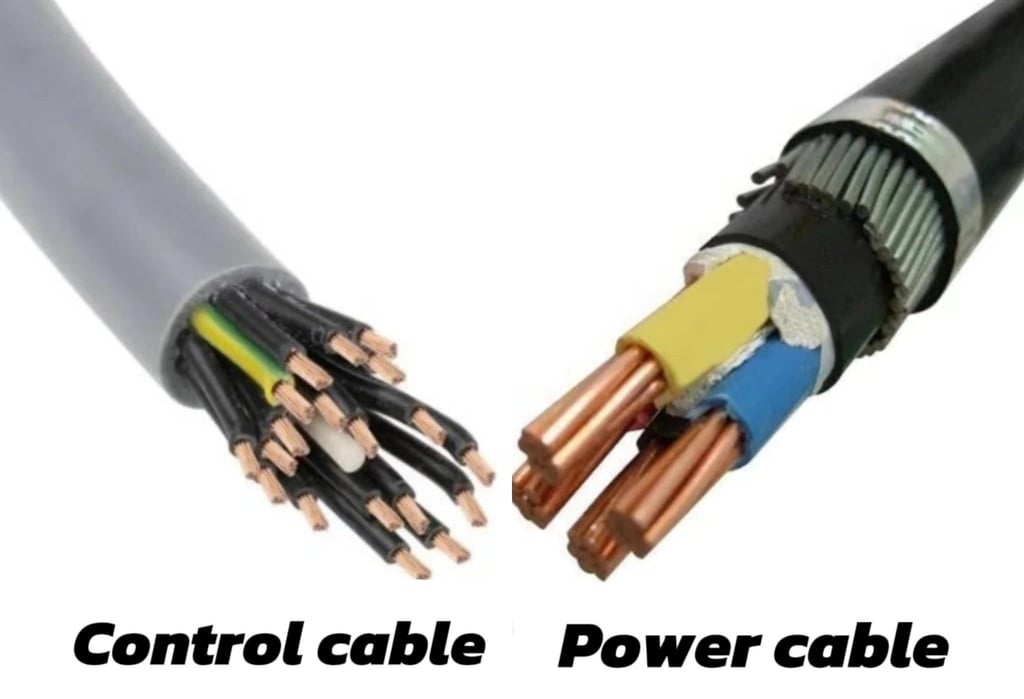
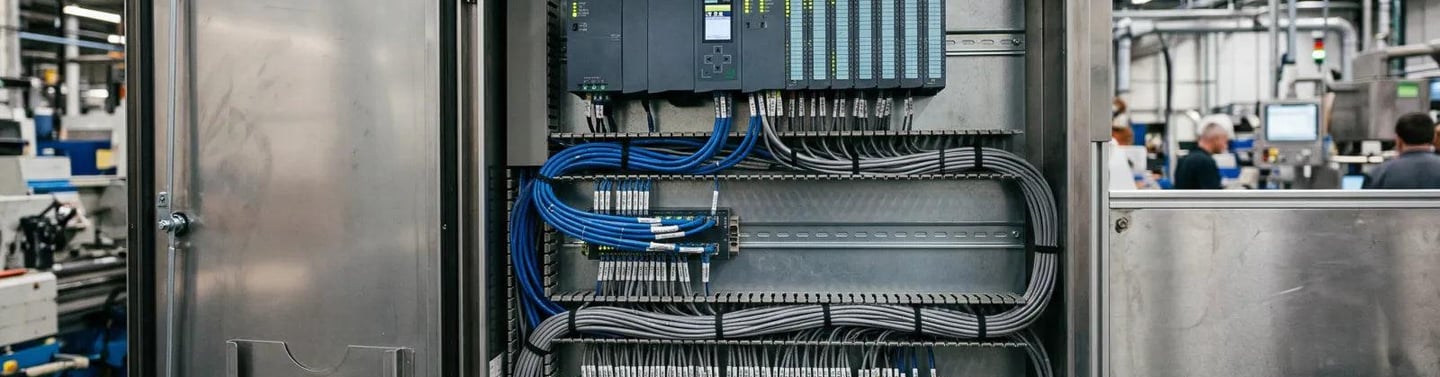
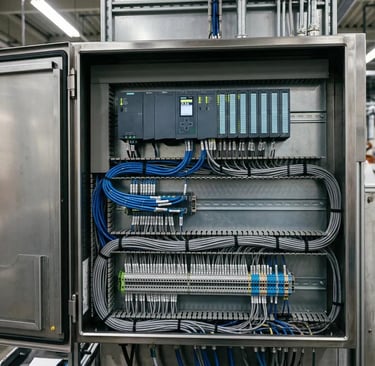
This cable belongs on the signal and automation side of your equipment. It is optimized for multi-core control lines, sensor feedback, programmable logic controller (PLC) connections, low-current auxiliary circuits, and remote-control pendants. Its primary strength lies in its tinned copper braided screen, which blocks high-frequency electromagnetic noise generated by surrounding machinery and variable speed drive (VSD) motors.
The Power Side: TROMMELFLEX PUR-HF D12Y11YU11Y
This cable belongs on the primary energy-feed side of your site. It is designed to carry heavy motor currents, feed main hoisting winches, supply travel drives, and power mobile portal cranes. Its primary strength lies in its high tensile rating (25 N/mm²) and torsional resistance (±50°/m), which allow it to be spooled repeatedly onto motorized cable reels under high pulling forces.
Structural Construction Comparison
Examining the internal layers of both cables highlights how their physical designs reflect their functional duties:
Conductor Architecture
D12YC11Y: Features Class 5 flexible plain copper wires. Cores or pairs are wound with short lengths of lay around a flexible central core element, allowing easy movement during dynamic bending.
D12Y11YU11Y: Uses Class 5 flexible plain copper conductors wound around a dedicated high-tensile central textile carrier unit with short lay lengths to prevent internal bundle collapse under tension.
Insulation Properties
Both cables feature an advanced halogen-free polyester-based insulation compound. This material supports thin insulation wall profiles, provides continuous conductor temperature resistance up to +90°C, and emits zero toxic halogen gases in fire situations.
Core Identification
Up to 5 Cores: Color-coded in full compliance with DIN VDE 0293-308.
6 Cores and Above: Natural white cores marked with clear black sequential numbering, accompanied by a green/yellow earth conductor in -J variants.
Inner Sheathing and Reinforcement Layers
D12YC11Y: Select cross-sections incorporate an inner polyurethane sheath beneath an overall screen made of tinned copper wire braiding. This braid provides shielding coverage while retaining planar flexibility for festoon systems.
D12Y11YU11Y: Features a heavy polyurethane inner sheath covered by an open braiding of support—an embedded anti-torsion synthetic textile mesh. This layer prevents sheath delamination and neutralizes twisting forces generated during high-speed spooling.
Outer Sheathing
Both cables use an opaque black, halogen-free, flame-retardant Polyurethane (PUR) outer jacket. Polyurethane provides exceptional resistance to tearing, mechanical abrasion, mineral oils, hydraulic fluids, and severe weather exposure.
Electrical Performance Profiles
From an electrical engineering standpoint, both cables operate within identical nominal voltage boundaries:
Rated Operating Voltage (Uo/U): 0.6 / 1 kV (600 / 1000 Volts AC).
Maximum Permissible AC Voltage: 0.7 / 1.2 kV AC.
Maximum Permissible DC Voltage: 0.9 / 1.8 kV DC.
Factory AC High-Voltage Test: Tested at 4 kV AC for 5 minutes continuous duration.
Thermal Conductor Thresholds: Normal operation up to +90°C; short-circuit rating up to +250°C (for up to 5 seconds).
Current Carrying Capacity: Rated according to DIN VDE 0298-4 parameters.
This operational overlap reinforces an essential selection principle: you cannot select between these two cables based on voltage ratings alone. The true distinction lies in their mechanical capabilities and shielding performance.
Mechanical Parameter Comparison
Understanding the mechanical limits of each cable is critical to preventing premature failure in the field:
Maximum Tensile Loading
D12YC11Y: Rated for a maximum conductor tensile load of 15 N/mm². This rating is optimized for festoon loops and energy chain systems where pulling forces are supported by trolley carriers or chain tracks.
D12Y11YU11Y: Delivers a maximum conductor tensile load rating of 25 N/mm²—a 66% increase in tensile strength. This allows the cable to withstand continuous pulling tension on motorized reels without stretching internal copper conductors.
Torsional Stress Limits
D12YC11Y: Torsional stress is strictly NOT ALLOWED (0°/m). Twisting this cable distorts the tinned copper wire shield, causing the braid to break, puncture internal insulation, and degrade EMC protection.
D12Y11YU11Y: Engineered to absorb up to ±50° of torsional rotation per meter. The anti-torsion textile braid neutralizes twisting forces caused by spooling alignment errors or angled guide sheaves.
Travel Speeds and Bending Radii
Minimum Bending Radius: Both cables require a minimum dynamic bending radius of 6 times the outer diameter (6 x D), verified through dynamic flexing testing per HD 22.2 Part 3.1.
D12YC11Y Travel Speeds: Reaches travel speeds up to 210 m/min in festoon systems and up to 210 m/min in drag chains. (Note: For long drag chain runs, operating at lower speeds extends overall cable service life).
D12Y11YU11Y Travel Speeds: Supports festoon travel speeds up to 180 m/min, with no speed restrictions on reeling operations under standard engineering conditions (consult technical specialists for speeds exceeding 180 m/min).
Shielding and Electromagnetic Compatibility (EMC)
Electromagnetic interference (EMI) is a major challenge in modern automated facilities. High-power Variable Speed Drives (VSDs), solid-state switching, and heavy electrical motors generate strong electromagnetic fields that disrupt unshielded control cables.
Why D12YC11Y Uses Tinned Copper Braid
The FESTOONFLEX C-PUR-HF D12YC11Y includes an overall tinned copper braid screen designed for two main functions:
Suppression: Prevents high-frequency drive noise from escaping the cable and interfering with nearby sensitive machinery.
Immunity: Protects delicate digital feedback signals, sensor loops, and safety interlocks inside the cable from external electrical noise.
Why D12Y11YU11Y Uses Synthetic Braid
In contrast, TROMMELFLEX PUR-HF D12Y11YU11Y uses a non-metallic, open synthetic textile braid for structural reinforcement. Metallic braid shielding is poorly suited for heavy reeling applications because continuous high-tension spooling breaks fine copper wires, leading to internal short circuits and sheath punctures. The synthetic textile braid in D12Y11YU11Y provides high tensile strength and anti-torsion protection without introducing metal fatigue risks.
Application Breakdown: Control Cables
Control networks rely on multi-core cables to transmit data, operational commands, and system feedback across moving equipment. These circuits carry low currents (typically under 10 Amps per core) and use smaller conductor sizes (1.5 mm² to 2.5 mm²), but require high core counts (7, 12, 18, 24, 30, or 36 cores) to manage complex automation systems.
In these application profiles, FESTOONFLEX C-PUR-HF D12YC11Y provides distinct operational advantages:
Festoon Control Systems: Supplies clean control power and feedback data across crane festoon loops operating at speeds up to 210 m/min.
Automated Drag Chains: Feeds control signals to moving machine carriages and automated assemblies.
Machine Tools & Material Handling: Connects limit switches, safety light curtains, and encoder feedback systems where space is limited and EMC protection is critical.
By blocking electromagnetic noise, D12YC11Y ensures automation systems receive accurate, uncorrupted control signals.
Application Breakdown: Reeling Power Cables
Power distribution systems feed main drive motors, heavy hoisting winches, and high-capacity pumps. These applications require higher current capacities, larger conductor sizes (4 mm² to 35 mm² and larger), and lower core counts (3, 4, or 5 cores).
In heavy power applications, TROMMELFLEX PUR-HF D12Y11YU11Y is engineered to withstand extreme mechanical forces:
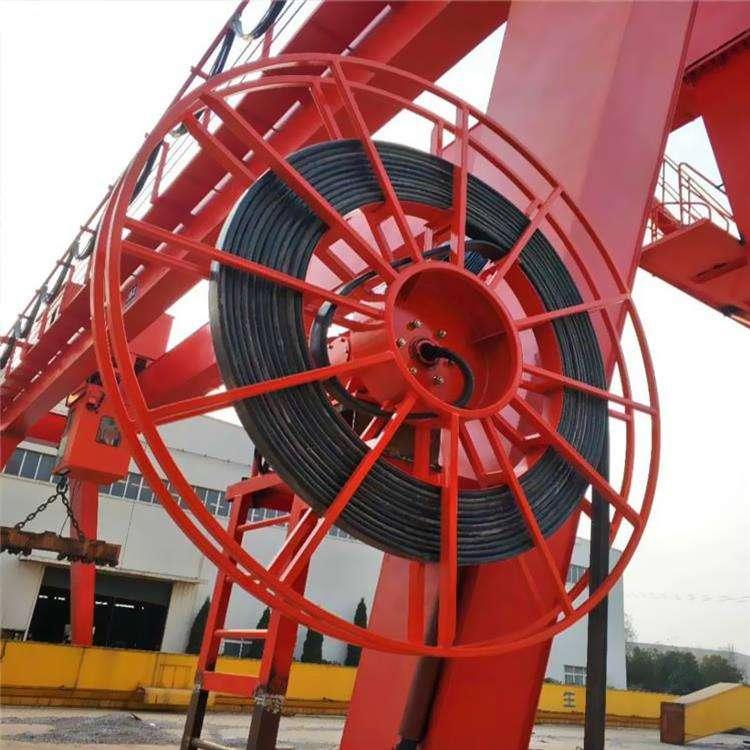
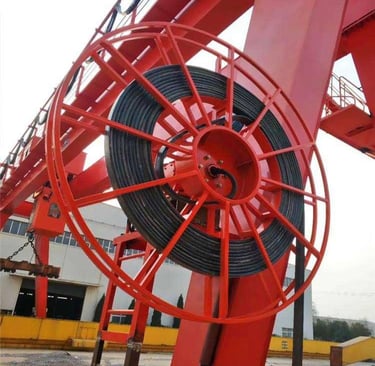
Motorized Cable Reel Drives: Handles constant spooling, directional reversals, and high acceleration forces on gantry travel reels.
Container Handling Cranes (RTG / RMG / STS): Delivers main low-voltage power to ship-to-shore and container yard cranes, enduring thousands of winding cycles every week.
Bulk Material Stacker-Reclaimers: Manages long linear travel runs across mining export terminals, absorbing high tensile loads over hundreds of meters.
The structural combination of Class 5 copper conductors, a central textile strain relief, and an anti-torsion PUR inner jacket allows D12Y11YU11Y to carry heavy motor currents reliably under intense dynamic stress.
Performance in Australian Operating Environments
Industrial operations across Australia face extreme climate and environmental conditions. Mobile cables must perform reliably under high solar heat, intense UV rays, abrasive mineral dust, and marine atmospheric exposure.
Both D12YC11Y and D12Y11YU11Y—including models produced by manufacturers such as Feichun—are engineered to meet these tough site requirements:
High UV Solar Exposure and Thermal Resistance
In regions like the Pilbara, inland Queensland, and the Northern Territory, summer ambient temperatures regularly exceed +40°C, pushing black cable surface temperatures above +65°C.
The Exposure Risk: Standard PVC jackets leach plasticizers under intense UV radiation, causing surface hardening, cracking, and premature jacket failure.
The Engineering Solution: Polyurethane (PUR) sheathing provides high UV stability and retains structural flexibility across operating temperatures from -40°C up to +80°C.
Resistance to Abrasive Mineral Dust
Bulk export ports and mining facilities handle vast quantities of coal, iron ore, bauxite, and mineral sands every year.
The Exposure Risk: Fine mineral dust gets trapped in festoon saddles, guide sheaves, and cable reels, grinding away soft cable sheaths.
The Engineering Solution: Polyurethane sheathing offers superior tear growth resistance, cut resistance, and abrasion tolerance compared to standard rubber or PVC jackets.
Coastal Marine Air and Wet Season Submersion
Coastal ports in Hedland, Dampier, Newcastle, and Gladstone experience constant salt mist, while tropical wet seasons bring heavy downpours that flood cable trenches.
The Exposure Risk: Salt mist corrodes un-tinned copper conductors, while water ingress causes insulation breakdowns and earth faults.
The Engineering Solution: Both cable models are rated for continuous underwater submersion up to 50 meters depth (non-potable water). In addition, D12YC11Y uses tinned copper wire braiding to prevent oxidation and extend screen service life in humid coastal environments.
Practical Engineering Selection Matrix
To help select the correct cable for your installation, review the criteria below:
FESTOONFLEX C-PUR-HF D12YC11Y Summary
Primary Application: Festoon systems, drag chains, and mobile control lines.
Main Circuit Function: Control, signal transmission, PLC wiring, and sensors.
EMC Shielding: Yes (Integrated tinned copper wire braid screen).
Maximum Tensile Rating: 15 N/mm².
Torsional Resistance: None (0°/m—torsion strictly prohibited).
Maximum Festoon Speed: Up to 210 m/min.
Submersion Rating: Rated up to 50 meters depth.
Outer Sheath: Polyurethane (PUR), black, halogen-free, flame retardant.
TROMMELFLEX PUR-HF D12Y11YU11Y Summary
Primary Application: Motorized reeling drums, spring reels, and heavy gantry travel.
Main Circuit Function: Main energy supply, motor power feed, and dynamic power distribution.
EMC Shielding: No (Uses non-metallic synthetic anti-torsion fiber braid).
Maximum Tensile Rating: 25 N/mm².
Torsional Resistance: Yes (Rated up to ±50° per meter).
Maximum Festoon Speed: Up to 180 m/min (No limit stated for reeling duty).
Submersion Rating: Rated up to 50 meters depth.
Outer Sheath: Polyurethane (PUR), black, halogen-free, flame retardant.
Quick Decision Rule
When specifying mobile industrial cables, apply this simple rule of thumb:
If the cable transmits information, low-voltage control signals, or requires EMC protection—choose FESTOONFLEX C-PUR-HF D12YC11Y.
If the cable delivers motor power, operates on a winding reel, or experiences high pulling tension—choose TROMMELFLEX PUR-HF D12Y11YU11Y.
Conclusion
Both FESTOONFLEX C-PUR-HF D12YC11Y and TROMMELFLEX PUR-HF D12Y11YU11Y are premium polyurethane-sheathed cables built for demanding dynamic environments. However, choosing the right model requires aligning the cable's structural design with your system's physical movement and electrical requirements.
The D12YC11Y is the ideal solution for screened control lines, festoon systems, and EMC-sensitive automation circuits where planar flexibility and noise suppression are essential. The D12Y11YU11Y is the superior choice for high-stress spooling reels, main drive motors, and high-tension mobile equipment requiring high tensile strength and torsional resistance.
By specifying specialized dynamic cables—such as those supplied by Feichun—and matching the right design to your operating environment, you ensure maximum equipment reliability, extended service life, and lower overall maintenance costs across your industrial facilities.
How to Reach Us
Get in Touch
SiteMap
Product Catalogue
Festoon Cable
Shore Power Cable
Scan to add us on WeChat