
Festoon Cable for Automated Warehouse Cranes
Learn how to select the right festoon cable for automated warehouse cranes, AS/RS systems and stacker cranes. Discover key design considerations, cable construction, PUR vs PVC performance, flex life requirements and common installation mistakes.
hongjing.Wang@Feichun
6/8/202636 min read
Introduction
Walk into a modern distribution centre and you might be struck by how few people are in it. Where you once would have seen rows of forklifts and pickers moving through aisles, you now see towering racking systems serviced by cranes that move on their own — gliding along aisles, rising dozens of metres, retrieving and storing loads with a precision and speed no human operation could match. Warehouse automation has moved from novelty to necessity, driven by the relentless pressure of e-commerce, the demands of modern manufacturing, and the logistics industry's constant hunt for efficiency.
The investment flowing into this space is substantial. Companies are pouring money into automated storage and retrieval systems — AS/RS, in the industry shorthand — along with automated warehouse cranes, stacker cranes and goods-to-person systems that bring the products to a stationary picker rather than sending the picker to the products. The names behind much of this equipment are well known in the field: Daifuku, the global heavyweight in material handling automation; Dematic, a major force in automated distribution; KUKA, bringing its robotics and automation expertise from the factory floor into the warehouse. These firms and others like them are building the automated warehouses that increasingly underpin how goods move through the economy.
When people talk about warehouse automation, the conversation usually centres on the glamorous parts — the robotics, the artificial intelligence directing the movements, the warehouse management software orchestrating it all. What gets far less attention, and deserves more, is the humble but critical infrastructure that keeps these moving machines powered and connected. Every automated crane needs electricity to move and lift, and it needs a continuous flow of data to know where to go, what to do, and how the rest of the system is behaving. Delivering that power and data to a machine that's constantly in motion is a genuine engineering challenge, and the way it's solved has everything to do with reliability. A brilliant automation system brought down by a failed cable is no better than no automation at all.
This is where festoon cables come in. Among the various ways to feed power and data to moving equipment, the festoon system — where the cable hangs in loops from trolleys running along a track, expanding and contracting as the equipment moves — is one of the most widely used solutions in automated warehouses. The festoon cable itself, the flexible cable engineered to survive this constant looping and flexing, is a component that quietly determines whether the whole system runs reliably or becomes a recurring source of downtime. This article looks at how to select the right festoon cable for automated warehouse cranes, what design and performance requirements matter, how cable construction and jacket materials affect the outcome, and the common mistakes that lead to premature failure.
Why the Cable Deserves More Attention Than It Gets
It's worth dwelling for a moment on why such an apparently humble component repays serious thought, because the instinct to treat cable as an afterthought is exactly what leads to trouble. Consider the economics of a modern automated warehouse. The capital invested in the racking, the cranes, the control systems and the software runs into the millions, and the facility's entire commercial logic depends on it running with very high availability — often the whole point of automating was to achieve round-the-clock operation with minimal interruption. Now consider what happens when a single festoon cable on a single crane fails. That crane stops. Depending on the layout, an entire aisle of storage may become temporarily inaccessible, because the crane serving it can't move. Orders that needed stock from that aisle are delayed or rerouted. A maintenance response has to be mobilised, the faulty cable diagnosed and replaced, and the crane recommissioned — all while the facility runs below capacity.
The cable that caused all this might have cost a tiny fraction of one per cent of the system's value. Yet its failure can idle a meaningful chunk of the operation for hours. This asymmetry — a cheap component whose failure carries an expensive consequence — is precisely why the cable deserves disproportionate care in selection. Spending a little more on a cable properly matched to the duty, and a little more thought on getting the selection right, is trivially cheap insurance against a class of failure that is both costly and entirely avoidable. The engineers who design these systems understand this, which is why cable management is treated as a serious discipline within the field even though it rarely makes the headlines.
What Is a Festoon Cable?
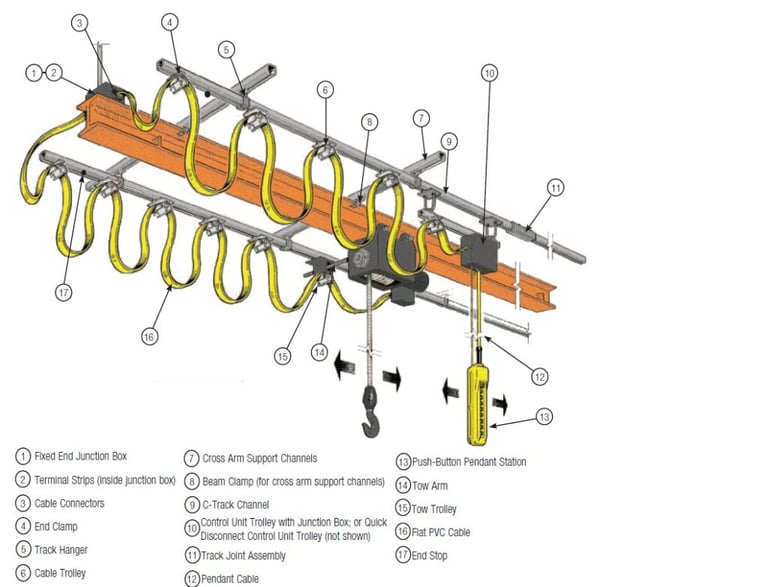
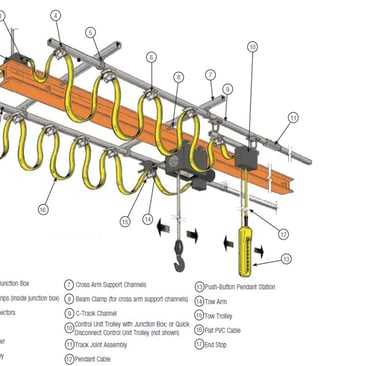
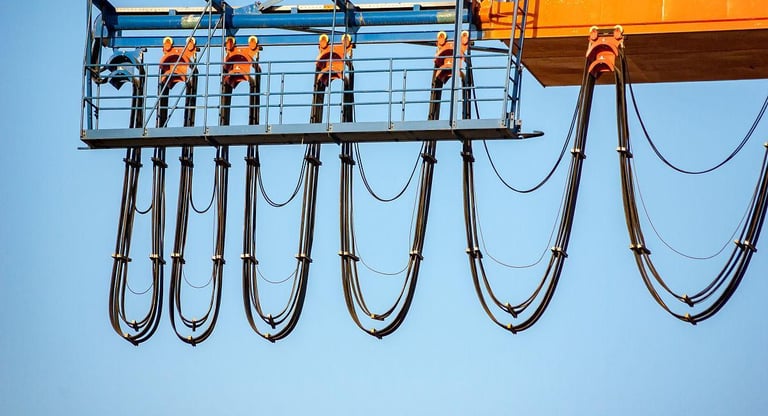
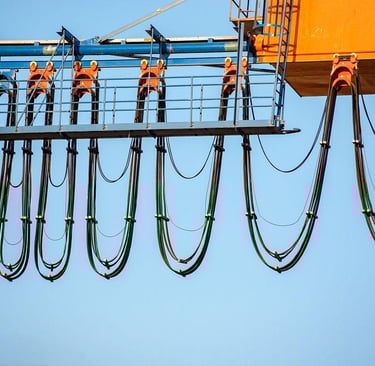
A festoon cable is a flexible cable specifically designed to operate in a festoon system — an arrangement where the cable is supported at intervals by trolleys that run along a track, allowing the cable to hang in loops between them. As the equipment moves, these loops expand and contract: when the moving end travels away from the fixed end, the loops stretch out and the trolleys spread apart along the track; when it travels back, the loops gather up and the trolleys bunch together. The word "festoon" comes from exactly this draped, looping appearance, like a garland strung between points.
The defining feature of a festoon cable is that it's built for repeated bending. Every time the equipment moves, the cable flexes at the points where it loops, and over the life of the system this happens an enormous number of times. An ordinary cable, designed to be installed once and left alone, would fatigue and fail under this treatment. A festoon cable is engineered from the inside out to tolerate the constant flexing — its conductors, insulation and jacket all chosen and constructed to survive repeated bending without breaking down.
It's worth placing festoon cable alongside the other common methods of feeding moving equipment, because choosing the right approach is the first decision, before any cable selection. A festoon cable hangs in loops from a track and suits a wide range of horizontal travel applications, particularly indoors. A reeling cable winds onto and off a motorised drum as the equipment moves, which suits long travel distances and outdoor applications where a hanging festoon would be impractical. A drag chain cable (also called a continuous-flex or energy-chain cable) runs inside an articulated chain or carrier that guides and protects it as the equipment moves, common where the cable path needs tight control and protection in a compact space. And a conductor bar system dispenses with a travelling cable altogether, using fixed conductor rails along the travel path with a collector that slides along them to pick up power — though this carries power well, it's less suited to the rich data communication that automated systems increasingly need.
Each solution has its place. Conductor bars suit simple, power-only applications over long runs. Drag chains suit compact, protected, often shorter travel paths. Reeling systems suit long-distance and outdoor travel. Festoon systems suit a broad swathe of indoor material-handling travel where simplicity, reliability and the ability to carry both power and data matter — which is exactly why they're so common in automated warehouses. The festoon cable, then, is the right tool for a specific and very widespread job, and getting the cable right within that system is what the rest of this article addresses.
A useful way to think about the choice between these systems is to ask what the application most needs to optimise. If the priority is the longest possible travel with compact cable storage, and especially if the environment is outdoors, a reeling system tends to win. If the priority is tight, protected guidance of the cable over a shorter, well-defined path — common in machine tools and compact automation — a drag chain is often the answer. If the priority is simply carrying power over a long fixed path with a sliding pickup, and data needs are minimal, conductor bars do the job economically. And if the priority is a simple, reliable, low-maintenance way to carry both power and data to equipment travelling a horizontal path indoors, the festoon system is hard to beat. Automated warehouse cranes overwhelmingly fall into that last category — indoor, horizontal travel, needing both power and rich data, valuing simplicity and easy maintenance — which is precisely why festoon systems and festoon cable are so prevalent in this sector. Recognising why festoon is the natural fit also helps clarify the boundary cases where another system might serve better, a point returned to when comparing festoon and reel systems directly later in this article.
Understanding Automated Warehouse Crane Systems
To select the right festoon cable, you first need to understand the equipment it serves, because different automated warehouse cranes impose different demands. The term covers a family of machines, all sharing the basic role of moving loads into and out of high-density storage automatically, but varying considerably in size, speed and the nature of what they handle.
Unit Load AS/RS Cranes
At the heavy end sit unit load AS/RS cranes — the machines that handle full pallets and large loads. These are the towering cranes you see servicing high-bay warehouses, running down long aisles between racking that can soar to considerable heights. Systems from major suppliers handle substantial weights, with lifting capacities running to several tonnes per load, and they operate in storage structures that can exceed 40 metres in height. A crane working in this environment travels long horizontal distances down the aisle and lifts loads dozens of metres into the air, all while carrying and being fed by its cabling.
The demands on the festoon cable here are shaped by scale. Long travel distances mean long cable runs and many loops. Heavy loads mean significant power demand, which influences conductor sizing. And the sheer size of the equipment means the cable has to perform reliably over a large physical envelope. These are serious machines, and the cable feeding them has to match their seriousness.
Mini Load and Tote Handling Systems
At the lighter, faster end are mini load and tote handling systems — cranes designed to handle smaller items, totes, cartons and trays rather than full pallets. These systems are workhorses of e-commerce fulfilment, pharmaceutical warehouses and distribution centres, where the priority is high-speed handling of large numbers of small items. A mini load crane moves quickly and cycles frequently, retrieving and storing totes at a rapid pace to feed goods-to-person picking stations or order assembly.
The defining characteristic here is speed and cycle frequency rather than raw load. These cranes accelerate, decelerate and reverse constantly, and they do so all day, every day. The festoon cable serving a mini load system faces a punishing regime of frequent, fast movement — fewer demands on power capacity than a unit load crane, perhaps, but far more demands on flex life and the ability to withstand high-speed, high-frequency motion.
Stacker Cranes
Stacker cranes — the general term often used for the aisle-running cranes in AS/RS systems — combine horizontal travel along the aisle with vertical travel of the lifting carriage. This dual motion is central to how they work: the crane positions itself horizontally at the right location along the aisle, then the carriage rises or descends to the right level to access the storage location. Both motions need power and, increasingly, data, and the cabling must accommodate the geometry of a machine moving in two directions.
Cable flexibility is essential for stacker cranes precisely because of this constant, multi-directional movement. The cable has to flex as the crane travels the aisle and, depending on the system design, may also need to accommodate the vertical motion of the carriage. A stiff or poorly chosen cable simply won't survive the continuous flexing these machines demand, which is why purpose-built flexible festoon cable is the standard choice. Across all these crane types — unit load, mini load and stacker — the common thread is constant motion, and constant motion is exactly what festoon cable is built to handle.
How Festoon Systems Work
Understanding the mechanics of a festoon system helps clarify why the cable is specified the way it is. The system is elegantly simple in concept, though the details matter for reliability.
C-Track Rail
The foundation of many festoon systems is the track along which everything runs. A common form is the C-track — a rail with a C-shaped profile that the trolleys run within or along. The track provides the path and the support structure for the whole festoon arrangement, guiding the trolleys as they move and bunch and spread. It runs the length of the equipment's travel, mounted to the structure above or beside the crane's path. A well-aligned, properly installed track is the basis of smooth festoon operation; a track that's misaligned or damaged causes the trolleys to bind or run unevenly, which translates into uneven cable movement and accelerated wear.
Trolleys
The trolleys are the moving carriages that support the cable along the track. They run on the track and carry the cable at intervals, holding it up so it loops cleanly between them rather than dragging or piling. A festoon system typically distinguishes a few roles among its trolleys. The leading trolley (sometimes called the tow trolley) is connected to the moving equipment and pulls the whole festoon assembly along as the equipment travels. The intermediate trolleys are the carriages in between, supporting the cable at regular points along its length and spreading or gathering as the system extends and retracts. The end trolley sits at the fixed end of the arrangement, near the anchor point. As the equipment moves away from the fixed end, the leading trolley pulls the intermediate trolleys apart, stretching the loops; as it moves back, the trolleys gather together and the loops gather up.
Cable Loops
Between the trolleys, the cable hangs in loops, and it's these loops that do the work of accommodating the equipment's movement. When the system is fully retracted, with the equipment near the fixed end, the loops are gathered and deep. As the equipment travels away, the loops open out and the trolleys spread along the track until, at full extension, the cable is drawn out along its travel. This expansion and retraction is repeated on every movement of the crane, and the flexing it imposes at the loops is the primary mechanical stress the cable experiences. The depth and geometry of the loops, governed by the cable's bending radius and the spacing of the trolleys, are central design parameters — loops that are too tight over-bend the cable, while a well-designed loop keeps the bending gentle.
Anchors and End Stops
Holding the whole arrangement in place are the anchors and end stops. The fixed end of the cable is anchored securely, providing the stationary reference point from which the loops extend and to which they return, and ensuring the cable's connection to the fixed power and data source is stable and protected from movement. End stops on the track define the limits of travel for the trolleys, preventing them from running off the ends and maintaining the system's stability at the extremes of movement. These components might seem minor, but proper anchoring in particular is important — a poorly anchored cable can be subjected to forces and movements it wasn't designed for, contributing to several of the failure modes discussed later.
[Suggested diagram: a festoon system illustration showing the track, the leading, intermediate and end trolleys, the cable loops in both extended and retracted states, the moving crane and the fixed anchored end.]
Why Festoon Cables Are Critical in Automated Warehouses
It's tempting to view the cable as a minor component in a sophisticated automated system, but that view gets the reliability equation backwards. In an automated warehouse, the cable is critical precisely because the system is automated, and automation changes everything about the duty the cable faces.
The defining feature of an automated warehouse crane is that it operates continuously. A manually operated machine works when an operator is present and pauses when they're not; an automated crane works whenever there are orders to fulfil, which in a busy distribution centre means around the clock, day after day. This translates into very high duty cycles — the crane is in motion a large fraction of the time, far more than most manually operated equipment. Continuous movement means the festoon cable is flexing, looping and unlooping continuously, accumulating bending cycles at a rate that quickly reaches into the hundreds of thousands and then the millions.
Compounding this is the pattern of movement. Automated cranes don't drift gently from place to place; they accelerate hard to reach high travel speeds, then decelerate sharply to position precisely, reversing direction frequently as they work through their task list. This frequent acceleration and deceleration subjects the cable to dynamic forces and rapid, repeated flexing rather than slow, gentle motion. The combination of high duty cycle, continuous movement and frequent hard acceleration is exactly the regime that finds out any weakness in a cable.
This is why ordinary industrial cables often fail prematurely in these conditions. A standard cable, even a reasonably flexible one, is not built for millions of flexing cycles under dynamic loading. Pressed into festoon service in an automated warehouse, it fatigues — conductors break, insulation cracks, the jacket wears — and it fails far sooner than the system needs it to. The result is unplanned downtime in a facility whose entire value proposition rests on running automatically and reliably. The cable that seemed like a place to save a little money becomes the reason the automated crane keeps stopping. This is the core argument for treating festoon cable selection seriously: in an automated warehouse, the cable's reliability is the system's reliability, and a cable not built for the duty undermines the whole investment.
It's worth being concrete about just how quickly the cycles accumulate, because the numbers explain why ordinary cable stands no chance. Imagine a mini load crane in a busy e-commerce fulfilment centre. It might complete a storage or retrieval movement every minute or two during peak operation, working long shifts day after day. Each movement flexes the festoon cable as the loops extend and retract. Tally those movements over a single day, then over a week, a month, a year, and the cable has flexed many tens of thousands of times before the year is out — and a system designed to run for many years needs the cable to survive a cumulative total reaching well into the millions of cycles. A cable rated for tens of thousands of cycles would be exhausted within weeks; even one rated for hundreds of thousands might last only a season. Only a cable genuinely built and rated for millions of cycles can keep pace with this duty over the system's life. This is the gulf between general-purpose cable and purpose-built festoon cable, and it's why the distinction is not a matter of marketing but of whether the cable physically survives the application. The relentless arithmetic of continuous automated operation is unforgiving, and it's the single biggest reason festoon cable for these systems must be chosen with the duty cycle squarely in mind.
Key Performance Requirements for Warehouse Festoon Cables
Given that demanding duty, what must a warehouse festoon cable actually deliver? Several performance requirements stand out, and understanding them is the basis for sensible selection.
Continuous Flexing Resistance
The headline requirement is resistance to continuous flexing — the ability to bend, loop and straighten repeatedly without fatiguing. As noted, cables in automated warehouse service may experience hundreds of thousands or even millions of bending cycles over their service life. A cable's "flex life" — the number of flexing cycles it can survive before failure — is therefore one of its most important characteristics. A long flex life is what separates a cable that lasts the life of the system from one that needs replacing repeatedly. Everything in the cable's construction, from the way the conductors are stranded to the choice of insulation and jacket, contributes to flex life, and it's the single attribute most worth scrutinising when selecting a festoon cable for a high-duty automated application.
Small Bending Radius
Warehouse equipment is often compact, and space within an automated system is at a premium. This frequently means the cable has to loop within a tight space, which requires it to tolerate a small bending radius — to bend into relatively tight loops without damage. Every cable has a minimum bending radius below which it suffers internal damage, and for a festoon cable in a compact warehouse system, that minimum needs to be small enough to suit the loop geometry the system allows. A cable with too large a minimum bending radius simply won't loop neatly in the available space, and forcing it to do so over-bends it and shortens its life. Selecting a cable whose bending radius suits the system's loop design is essential, and it's one reason genuinely flexible, purpose-built festoon cable is needed rather than stiffer general-purpose cable.
High Mechanical Strength
Beyond flexing, the cable faces a range of mechanical stresses that demand robustness. There are tensile forces — the cable is pulled as the loops extend and as the leading trolley tows the assembly, and it must withstand this pulling without its conductors being stretched and fatigued. There are impact loads — the knocks and shocks of a busy operating environment, and the dynamic forces of hard acceleration and deceleration. And there's abrasion — the wear from the cable contacting trolleys, guides and, where things aren't quite right, structures it shouldn't touch. A festoon cable needs the mechanical strength to absorb all of this over a long service life, which means a tough construction and a jacket that resists wear and impact.
Stable Electrical Performance
The cable's job, ultimately, is to deliver power and data reliably, and it must do so continuously despite all the flexing and movement. Stable electrical performance means the power conductors maintain their integrity and carry current reliably cycle after cycle, and — increasingly important — that any data cores maintain clean, uninterrupted communication signals. In an automated system, a momentary loss of power or, just as critically, a corrupted or interrupted data signal can halt the crane or disrupt the coordination between it and the wider system. The cable must therefore preserve not just power delivery but signal integrity through millions of flex cycles, which places real demands on the construction of the data cores in particular, as discussed shortly.
Lightweight Construction
A less obvious but genuinely valuable requirement is lightweight construction. The festoon cable hangs from trolleys and is towed along the track, so its weight directly affects the loading on the trolleys and the forces needed to move the assembly. A lighter cable reduces trolley loading, which reduces wear on the trolleys and track, lowers the forces involved in moving the festoon, and can improve the overall efficiency and responsiveness of the system. As cranes get faster and cycle more frequently, the benefit of shaving weight from the moving cable grows. This is why modern festoon cable design pays attention to keeping weight down while maintaining strength and flex life — a balance that good cable engineering achieves and poor cable selection ignores.
Cable Construction for Automated Warehouse Applications
The performance requirements above are delivered through the cable's physical construction. Understanding the components of a modern festoon cable explains why purpose-built cable performs so much better than general-purpose alternatives, and what to look for when selecting.
Fine-Stranded Conductors
The conductors are the heart of the cable, and for flexing applications their construction is critical. Festoon cables use fine-stranded conductors — the copper conductor is made up of many very fine strands rather than a few thick ones or a solid core. The reason is mechanical: when a cable bends, the conductor on the outside of the bend must stretch slightly and the inside must compress, and finely stranded conductors accommodate this far better than coarse ones, because each thin strand flexes easily and the strands can move relative to one another. A solid or coarsely stranded conductor would fatigue and fracture quickly under repeated bending, whereas finely stranded conductors survive vastly more cycles. The fineness of the stranding is one of the clearest indicators of a cable built genuinely for dynamic flexing service, and it's foundational to flex life.
The way the strands are arranged matters as much as their fineness. In a well-designed flexing conductor, the fine strands are bundled and laid up in a deliberate helical pattern, so that as the cable bends, the strands can slide and redistribute the strain among themselves rather than concentrating it on any single strand. The lay length — how tightly the strands are twisted — is chosen to balance flexibility against the cable's overall stability. Some high-performance cables go further, using specially designed bundle structures or supporting elements that help the conductor return to its relaxed state after each flex rather than gradually deforming. These are the kinds of construction details that don't show on a simple specification sheet but make an enormous difference to real-world flex life, and they're a large part of why two cables with seemingly similar headline ratings can perform very differently in service. When a manufacturer has clearly invested in conductor design — fine stranding, considered lay-up, perhaps reinforcement — it's a strong signal that the cable is built for genuine dynamic duty rather than dressed up to look the part.
High-Flex Insulation Materials
Surrounding each conductor is insulation, and in a flexing cable the insulation must itself tolerate constant bending without cracking or degrading. High-flex insulation materials are chosen for their durability under repeated flexing — they remain flexible and intact through the bending cycles rather than hardening and cracking. The insulation also has to maintain its electrical properties throughout, since its job is to keep the conductors electrically separated and safe. Insulation that cracks or breaks down under flexing leads directly to electrical faults, so the choice of a suitable high-flex insulation material is an important part of a durable festoon cable.
Reinforced Outer Jacket
The outer jacket is the cable's armour against the outside world. A reinforced outer jacket protects the cable's interior from abrasion, impact and mechanical damage — the wear from contact with trolleys and guides, the knocks of the operating environment, and the general rigours of constant movement. The jacket is the first thing to encounter any abrasion or impact, and a tough, well-chosen jacket material absorbs this punishment and protects the conductors and insulation within. As discussed in detail shortly, the choice of jacket material — particularly polyurethane versus PVC — is one of the most consequential decisions in festoon cable selection, precisely because the jacket bears so much of the mechanical and environmental load.
Shielded Data Cores
Modern automated systems run on data as much as power, and many festoon cables incorporate data cores alongside the power conductors. Where data is carried, those cores typically need shielding — a screen around the data conductors that protects the signals from electromagnetic interference. In an environment full of motors, drives and power cables, electrical noise is everywhere, and unshielded data conductors would pick up interference that corrupts the communication signals. Shielded data cores keep the signals clean, ensuring the reliable communication that automated coordination depends on. The shielding must itself tolerate the flexing, which is a design challenge, since a shield that breaks up under bending loses its effectiveness and can even introduce its own problems.
Hybrid Power and Data Cables
The increasing integration of power and data within a single cable — the hybrid cable — is one of the clearest trends in festoon cable for automation. Rather than running separate cables for power and data, a hybrid cable combines power conductors and data cores (which may be shielded electrical pairs or, increasingly, optical fibres) in one construction. This simplifies the festoon system, reduces the number of cables and trolleys to manage, and ensures power and data arrive together at the moving crane. The demand for these hybrid solutions grows directly with the sophistication of warehouse automation, as cranes need ever more data alongside their power. Designing a hybrid cable that flexes reliably while protecting delicate data elements is a genuine engineering achievement, and it's an area where purpose-built cable from capable manufacturers earns its place.
PUR vs PVC: Which Jacket Material Is Better?
Of all the choices in festoon cable selection, the jacket material is one of the most consequential and most frequently debated. Two materials dominate: PVC (polyvinyl chloride) and PUR (polyurethane). Understanding their differences is central to making a good selection.
PVC Cables
PVC is the long-established, general-purpose cable jacket material, and it has genuine virtues. Its biggest advantage is lower cost — PVC is inexpensive, which makes PVC-jacketed cable attractive on initial price. It's perfectly suitable for light-duty installations, where the cable doesn't flex much, doesn't move fast, and isn't subjected to demanding mechanical or chemical conditions. For static wiring and gentle, low-cycle applications, PVC does the job at low cost.
The limitations show up under demanding dynamic conditions. PVC has limited flexibility compared to PUR, and crucially, its flex life under continuous high-cycle bending is much shorter. It tends to harden and crack over time, especially with flexing and temperature variation, and it offers less resistance to abrasion and to chemicals. In a high-duty automated warehouse festoon application, PVC's shortcomings become liabilities — the cable simply doesn't last. PVC remains acceptable, and economical, in light-duty and static roles, but it's increasingly out of its depth in demanding dynamic service.
PUR Cables
PUR is the higher-performance material, engineered for exactly the demanding dynamic conditions where PVC struggles. Its advantages are substantial. It offers superior flexibility, bending more easily and tolerating tighter loops. It has excellent abrasion resistance, standing up to the wear of contact with trolleys and guides far better than PVC. It provides better chemical resistance, shrugging off oils and many of the contaminants found in industrial environments. And — the decisive factor for festoon service — it delivers a much longer dynamic life, surviving far more flexing cycles before failure. These properties make PUR well suited to continuous, high-cycle, mechanically demanding applications.
This is why most modern AS/RS and stacker crane systems prefer PUR-jacketed cables. The duty these systems impose — millions of flex cycles, high speeds, abrasion, continuous operation — plays directly to PUR's strengths and exposes PVC's weaknesses. For the cranes at the heart of an automated warehouse, PUR is generally the material that delivers the reliability the system requires.
Which Material Is Best for Automated Warehouse Cranes?
The practical guidance follows from matching the material to the duty. For genuinely light-duty, low-cycle or static applications, PVC may be perfectly adequate and its lower cost makes it sensible. But for the demanding, high-cycle, continuous-duty service of automated warehouse cranes — unit load, mini load and stacker cranes working around the clock — PUR is generally the right choice, and the better that duty's demands, the clearer the case for PUR becomes.
The reason this matters financially comes down to lifecycle cost rather than initial price. PUR cable costs more to buy than PVC, and a buyer focused only on the purchase price will be tempted by the cheaper option. But in a demanding festoon application, the PVC cable's shorter flex life means it fails sooner and needs replacing more often, and every replacement carries not just the cost of the new cable but the cost of the downtime to fit it — downtime that, in an automated warehouse, is expensive. The PUR cable, lasting far longer in the same duty, avoids these repeated replacements and the associated downtime. Over the life of the system, the PUR cable's higher initial cost is typically repaid many times over by its longer service life and the downtime it prevents. This is the lifecycle argument: the cheapest cable to buy is often the most expensive to own, and for critical automated equipment, the durable choice usually wins on total cost even though it loses on sticker price.
A simple way to see this is to think through what each replacement actually costs. The purchase price of the cable is only the visible part. Around it sit the labour to remove the old cable and install the new one, any cost of having the right cable on hand or sourcing it, and — by far the largest item in an automated warehouse — the value of the operation lost while the crane is down for the work. If a cheaper cable lasts, say, a third as long as a premium one in the same punishing duty, then over the life of the system you buy it three times instead of once, and you incur the installation and downtime cost three times instead of once. Even if each cheap cable costs noticeably less to buy, the multiplied installation and downtime costs usually swamp the saving on purchase price, and the premium cable comes out far ahead on total cost of ownership. The calculation tips even more decisively towards the durable cable as the cost of downtime rises — and in a high-throughput automated facility, downtime is costly indeed. This is why experienced specifiers for automated systems rarely choose cable on purchase price alone; they look at the whole-of-life cost, and that calculation consistently favours matching the cable properly to the duty.
Flex Life Testing and Performance Validation
Claims about flex life and durability are only meaningful if they're validated, and reputable cable manufacturers test their festoon cables rigorously to verify how they perform under the kinds of stress they'll face in service. Understanding the common tests helps in interpreting manufacturers' specifications and in trusting the cable you select.
Several standard test types simulate the different motions a flexing cable experiences. Tick-tock testing (sometimes called reciprocating or oscillating flex testing) flexes the cable back and forth in a repeated motion, simulating the constant bending of festoon service and counting the cycles until failure. Rolling bend testing simulates the rolling flex of a cable as it bends around a moving point, much as it does in a loop or a drag chain, replicating the way the bend travels along the cable. Torsion testing twists the cable repeatedly about its axis, validating its resistance to the torsional stresses that can arise from installation or system geometry. And S-bend testing flexes the cable through an S-shaped path, bending it in alternating directions to simulate more complex flexing patterns. Each test stresses the cable in a particular way, and together they build a picture of how the cable will hold up across the range of motions it might encounter.
Manufacturers use these tests to verify cable durability and to substantiate the flex-cycle ratings they publish. A cable that has survived millions of cycles in tick-tock and rolling bend testing has demonstrated, under controlled and repeatable conditions, that it can withstand the kind of duty an automated warehouse imposes. When selecting a cable, the existence and results of such testing are a meaningful indicator of quality and of whether the manufacturer's flex-life claims can be trusted.
What Do Flex Cycle Ratings Mean?
Flex cycle ratings express how many bending cycles a cable is rated to survive, and they vary across a wide range that maps roughly onto application demands. A rating in the tens of thousands of cycles suits light-duty applications with infrequent movement — adequate where the cable doesn't flex much. A rating in the hundreds of thousands of cycles serves more demanding applications with regular movement. And a rating in the millions of cycles is what genuinely demanding, continuous-duty applications — like high-throughput automated warehouse cranes — require, indicating a cable built to survive the relentless flexing of round-the-clock operation.
The connection between these ratings and expected service life is direct, though it requires translating cycles into the application's actual motion. A crane that completes a certain number of movements per day, each imposing a certain number of flex cycles on the cable, accumulates cycles at a calculable rate, and dividing the cable's rated cycle life by that rate gives an estimate of how long the cable should last. This is why matching the cycle rating to the duty matters: a cable rated for hundreds of thousands of cycles in a million-cycle application will be exhausted long before the system's expected maintenance interval, while a cable rated for millions of cycles in the same application lasts as intended. Reading and respecting the flex cycle rating, in the context of the application's real movement, is one of the most practical things a selector can do to ensure the cable lasts.
Common Festoon Cable Problems in Automated Warehouses
Even with good selection, problems arise — and understanding the common failure modes helps both in preventing them and in diagnosing them when they occur. Several recurring problems affect festoon cables in automated warehouse service.
Abrasion damage is among the most common. The cable contacts trolleys, guides and sometimes structures it shouldn't touch, and the repeated rubbing wears away the jacket. Over time this can wear through the protective jacket and expose the interior, leading towards failure. Abrasion often concentrates wherever the cable makes consistent contact with something, so a worn patch in a particular spot points to a contact problem to be found and fixed.
Jacket cracking results from ageing and material fatigue. Over the cable's life, especially with flexing, temperature variation and time, the jacket material can harden and crack — a particular weakness of PVC under demanding conditions, but possible in any aged cable. Once the jacket cracks, its protective function is compromised, and the path is opened for contaminants and further degradation.
Excessive bending — violating the minimum bending radius — fatigues the cable internally. When loops are too tight, or the cable is forced around too sharp a bend, the conductors and insulation suffer strain beyond what they're built for, leading to internal damage that's invisible until it manifests as a fault. This frequently traces back to a loop geometry or a system design that asks too tight a bend of the cable.
Twisting and corkscrewing usually originates from installation problems. A cable installed with a built-in twist, or subjected to torsional forces from poor anchoring or system geometry, can develop a helical, corkscrewed form. This distorts the cable's internal construction and concentrates stress, leading to fatigue and failure. Because it's installation-related, it's largely preventable through correct installation practice.
Conductor fatigue is the underlying failure mode behind much of the above — the breaking of conductor strands from repeated flexing. It's the natural end point of a cable that has exhausted its flex life or been subjected to over-bending, and it manifests as intermittent then permanent electrical faults as strands progressively fracture. A cable with the right flex life, operated within its bending limits, resists conductor fatigue far longer than one that's under-specified or over-stressed.
Communication signal failures are a problem peculiar to the data side and particularly disruptive in automated systems. The data cores, or their shielding, can be damaged by flexing, abrasion or over-bending, degrading the communication signal even while power may still be delivered. In an automated warehouse, a corrupted or lost data signal can halt the crane or disrupt its coordination just as effectively as a power failure, and these faults can be harder to diagnose because the cable may appear to be working. Protecting the data cores — through proper shielding designed to survive flexing, and through respecting the cable's limits — is essential to avoiding these failures.
How to Select the Right Festoon Cable
Pulling the threads together, selecting the right festoon cable is an engineering exercise that weighs several factors specific to the application. Working through them systematically leads to a cable matched to the duty, which is the foundation of reliability.
Travel distance is a primary input. The distance the crane travels determines the length of cable needed and the design of the festoon — how many loops, how many trolleys, how the loops extend and retract. Longer travel means more cable and a larger festoon arrangement, and it influences the loop geometry that in turn affects the bending the cable experiences. Getting the festoon design right for the travel distance is the starting point, and the cable is selected to suit that design.
Operating speed strongly influences the mechanical demands. Higher travel speeds increase the dynamic stresses on the cable — faster flexing, greater acceleration forces, more cycles accumulated per unit time. A high-speed system needs a cable built for the dynamic punishment that speed imposes, with the flex life and mechanical strength to match. Underestimating the effect of speed is a common path to premature failure, because a cable adequate at modest speeds may be overwhelmed by a fast, hard-cycling system.
Load weight drives the power demand and therefore the conductor sizing. Heavier loads require more power to lift and move, which means larger conductors to carry the current without overheating. The cable must be sized so its power conductors handle the system's electrical load comfortably, with appropriate margin. This is the more conventional electrical side of selection, but it's no less important — an undersized cable overheats, and heat shortens cable life and risks failure.
Environmental conditions shape the choice of materials and ratings. Temperature matters — both the ambient temperature of the warehouse and any extremes, since temperature affects cable flexibility and ageing. Humidity can drive moisture concerns. Dust, common in many warehouse environments, contributes to abrasion and contamination. And chemicals — any oils, cleaning agents or process substances present — demand a jacket material that resists them, which is one of the factors favouring PUR where chemical exposure is a concern. The cable's materials and ratings must suit the actual environment it will work in, not an idealised clean room.
Duty cycle ties much of this together by determining how hard and how often the cable works. A crane operating intensively around the clock imposes a far higher duty cycle than one working intermittently, and the duty cycle directly affects how quickly the cable accumulates flex cycles and wear, and therefore how long it lasts. A high duty cycle demands a cable with a high flex-life rating and robust construction, because it will be worked relentlessly. Honestly assessing the duty cycle — and resisting the temptation to assume gentler operation than reality — is essential to selecting a cable that will last, and it's the factor that most directly justifies investing in a high-performance, long-flex-life cable for a demanding automated system.
Installation and Maintenance Best Practices
Selecting the right cable is half the battle; installing and maintaining it correctly is the other half, and many premature failures trace back not to a poor cable choice but to how the cable was put in or looked after. A few practices make a substantial difference to how long a well-chosen cable actually lasts.
Correct installation begins with how the cable comes off its delivery drum. A festoon cable should be paid off the drum in a way that introduces no twist — pulling it off the side of a stationary drum, rather than letting it unwind freely, builds a twist into the cable for every turn taken off, and that built-in twist becomes the corkscrewing and torsional damage discussed earlier. Taking the cable off correctly, ideally by rolling it off a rotating drum, keeps it twist-free from the start. The cable should then be installed without being forced around tight bends that violate its minimum bending radius, even temporarily, since over-bending during installation can plant damage that surfaces later.
Proper anchoring at the fixed end is critical. The anchor must hold the cable securely and prevent it from rotating or being pulled in ways that impose torsion, while protecting the electrical connection from movement. A loose or poorly designed anchor lets forces reach the cable that it wasn't designed to absorb, and these accumulate into fatigue and failure over time. Similarly, the trolleys must be set up so the cable is supported cleanly, with the loops hanging freely and the cable not catching, rubbing or being pinched anywhere along the track. Getting the loop depth and trolley spacing right ensures the cable flexes gently within its bending radius rather than being over-bent at any point.
On the maintenance side, regular inspection is the single most valuable habit. A periodic look at the cable and the festoon system catches the early warning signs — a developing abrasion patch, the beginnings of jacket cracking, any sign of twisting or corkscrewing, uneven or catching movement of the trolleys — while they're still minor and correctable. The key is to treat any localised wear as a question to investigate rather than a finding to note: a worn patch in one spot means the cable is contacting something there, and the fix is to find and address that contact, not merely to wait for the cable to fail. Checking that the trolleys run freely, that the track is clean and aligned, and that the anchoring remains sound keeps the whole system operating as designed. A modest, consistent inspection routine turns unpredictable cable failures into planned, low-cost replacements made at a time of the operator's choosing rather than at the worst possible moment mid-operation.
There's also value in keeping simple records of cable performance over time. Noting when cables are installed, inspected and replaced, and what condition they were in, builds a picture of how long cables actually last in the specific application. If cables are consistently reaching their expected life, the selection and installation are sound. If they're failing early, the records — particularly any pattern in where and how they fail — often point towards the cause, whether it's a selection issue, an installation problem or a system fault like a catching trolley or a tight loop. This turns each replacement into a learning opportunity that gradually improves the reliability of the whole system.
Festoon Cable vs Cable Reel Systems
Festoon systems aren't the only way to feed moving warehouse equipment; cable reel systems are the other widely used technology, and understanding the trade-off between them clarifies when each makes sense. Both are common in material handling, and each has genuine strengths.
Advantages of Festoon Systems
Festoon systems are valued first for their simplicity. The arrangement of track, trolleys and looping cable is mechanically straightforward, with no motorised reel, no tensioning system and no rotating electrical connection to manage. This simplicity brings a lower installation cost in many cases — a festoon system is often cheaper to install than a motorised reel, with less complex equipment to mount and commission. And it brings easy maintenance: with fewer moving parts and a clear, accessible layout, a festoon system is generally simple to inspect and service, and a worn cable or trolley is straightforward to access and replace. For many indoor applications, this combination of simplicity, lower cost and easy maintenance makes festoon the natural choice.
Advantages of Cable Reels
Cable reel systems earn their place where the demands exceed what festoon suits well. Their biggest advantage is handling longer travel distances — a motorised reel can store and pay out long lengths of cable, accommodating travel distances that would require an impractically long and cumbersome festoon track. They offer better space efficiency in some configurations, since the cable is stored compactly on the drum rather than strung along a track for the full travel length. And they're better suited to outdoor applications, where a hanging festoon would be exposed to weather and wind in ways a reel can better tolerate. For long-travel and outdoor material handling — the large cranes of ports and yards, for instance — reels dominate for these reasons.
Which Is Better for Automated Warehouses?
For automated warehouses specifically, the answer usually favours festoon systems, though not universally. The typical automated warehouse crane works indoors, over travel distances that suit a festoon arrangement, in a controlled environment where the weather isn't a factor. In this setting, the simplicity, lower installation cost and easy maintenance of a festoon system are real advantages, and the conditions that favour reels — very long travel, outdoor exposure — generally don't apply. So festoon systems are often preferred for indoor AS/RS cranes, while cable reels dominate the larger outdoor applications outside the warehouse. That said, the choice should always follow the specifics: a warehouse crane with unusually long travel, or particular space constraints, might still favour a reel, and the sensible approach is to weigh the actual travel distance, environment and maintenance preferences rather than assuming. For the great majority of indoor automated warehouse cranes, though, the festoon system is the well-matched solution, which is exactly why festoon cable is so prevalent in this sector.
Asia-Pacific Warehouse Automation Case Studies
The growth of warehouse automation across the Asia-Pacific region, including Australia, is best illustrated by the kinds of installations the major automation providers deliver. While the specifics of any given project are particular to that site, the patterns are instructive.
Daifuku high-rise AS/RS installations exemplify high-density storage taken to its logical conclusion. As one of the world's largest material handling automation companies, Daifuku delivers high-bay automated storage systems that pack enormous quantities of goods into tall, dense racking served by unit load cranes running long aisles and lifting loads many storeys high. These high-rise installations maximise storage in a given footprint by building upward, and they depend on cranes operating reliably at height and over distance — which in turn depends on the cabling that powers and coordinates them performing flawlessly through continuous duty.
Dematic automated distribution centres illustrate the high-throughput end of the spectrum. Dematic is a major provider of automated distribution and fulfilment solutions, and its automated distribution centres are built for moving large volumes of goods quickly — the kind of high-throughput fulfilment that e-commerce and modern retail demand. These facilities run their automated cranes and handling systems hard, cycling constantly to meet order volumes, which places a premium on the reliability of every component in the constantly moving equipment, cabling included.
KUKA smart logistics solutions show the convergence of warehouse automation with manufacturing automation. KUKA, with its strong heritage in industrial robotics, brings automation expertise that bridges the factory and the warehouse, integrating logistics automation with manufacturing processes in smart, connected systems. This integration reflects a broader trend of warehouses becoming more tightly woven into automated production and supply chains, with all the data connectivity and coordination that implies.
What these projects have in common is a complete dependence on highly reliable cable management systems. However sophisticated the robotics, the software and the system design, the automated cranes at the heart of these installations cannot function without reliable power and data delivered to them as they move. The festoon and reeling cable systems that provide this are, in every case, foundational to the reliability the whole installation depends on. The headline technologies vary, but the underlying truth is constant: these automated systems run on cable as surely as they run on code, and the cable has to be up to the duty. As automation continues to expand across Australia and the wider Asia-Pacific region, this dependence — and the demand for the high-performance cable that satisfies it — grows in step.
Future Trends in Warehouse Crane Cable Technology
Festoon cable technology isn't standing still; it's evolving alongside the automation it serves. Several developments point to where warehouse crane cabling is heading.
Hybrid power and fibre optic cables are an increasingly prominent trend. As automated systems demand ever more data bandwidth — for high-resolution sensors, machine vision, dense networks of devices and tighter real-time coordination — optical fibre becomes attractive for its vast capacity and immunity to electrical interference. Integrating fibre with power in a single flexing festoon cable, so that a moving crane receives high-bandwidth data and power through one managed system, is a natural direction, and the engineering to make fibre survive the flexing duty continues to advance.
Lightweight high-flex cable designs respond to the pressure for faster, more efficient systems. As cranes get quicker and cycle more frequently, reducing the weight of the moving cable — while maintaining or improving flex life — pays off in lower trolley loading, reduced wear and better system responsiveness. Cable makers continue to refine constructions that shave weight without sacrificing durability, a balance that benefits high-speed automated systems directly.
Predictive maintenance systems and smart condition monitoring represent perhaps the most transformative direction. Rather than waiting for a cable to fail or relying solely on periodic inspection, these approaches aim to monitor the cable's condition continuously and predict when it will need attention before it fails. Sensing technologies that track a cable's electrical or physical condition, feeding data into systems that flag developing problems, would let operators replace cables just in time — neither wastefully early nor disastrously late. As warehouses become ever more instrumented and data-driven, extending that intelligence to the cabling is a logical and valuable step, turning cable maintenance from reactive to predictive.
Increased automation and higher travel speeds are the overarching trend driving all the others. As warehouses automate further and push their cranes faster to meet ever-rising throughput demands, the duty imposed on festoon cable intensifies, and the requirements for flex life, data capacity, weight and reliability all climb. The cable technology has to keep pace with the automation it enables, and the trajectory points firmly towards more demanding cable serving faster, smarter, more connected automated systems. The festoon cable of the future will carry more data, weigh less, last longer and increasingly report on its own health — because that's what the warehouses of the future will require.
Conclusion
Festoon cables play a critical role in the reliability of automated warehouse cranes — a role out of all proportion to the attention they usually receive. In a facility whose entire value rests on running automatically and continuously, the cable that feeds power and data to the constantly moving crane is not a minor accessory but a foundational component, and its performance directly shapes whether the system runs reliably or becomes a source of recurring downtime.
The central lesson is that selecting the correct cable — the right construction, the right jacket material, and a flex-life rating matched to the duty — significantly reduces downtime and maintenance costs over the life of the system. Fine-stranded conductors, high-flex insulation, a reinforced and well-chosen jacket, properly shielded data cores, and increasingly hybrid power-and-data designs all contribute to a cable that survives the millions of flexing cycles an automated warehouse imposes. The PUR-versus-PVC decision, the flex-cycle rating, and an honest assessment of travel distance, speed, load, environment and duty cycle together determine whether the cable is matched to its job. Get these right, and the cable disappears into reliable background service, as it should. Get them wrong, and the cable becomes the weak link that undermines an expensive automation investment.
As AS/RS systems continue their rapid expansion across Australia and the Asia-Pacific region — driven by e-commerce, by the economics of automation, and by the relentless demand for faster, more reliable fulfilment — the demand for high-performance festoon cables is set to grow accordingly. The warehouses are getting bigger, faster, smarter and more automated, and every one of those automated cranes needs a cable equal to its duty. The festoon cable, quietly looping and unlooping millions of times in the background, will remain one of the unsung essentials of the automated warehouse.
Expert Summary
Having worked through the full picture, here are the points worth carrying away:
The cable's reliability is the system's reliability. In an automated, continuously operating warehouse, a festoon cable failure stops the crane and disrupts the whole facility. The cable deserves to be treated as critical infrastructure, not a commodity to be minimised on price — because its failure costs far more than the cable ever saved.
Flex life is the single most important attribute. Automated warehouse cranes impose hundreds of thousands to millions of bending cycles, and the cable's rated flex life, matched honestly against the application's real duty cycle, is what determines whether it lasts the system's life or fails early. Read the cycle rating, translate it into the application's actual movement, and select with margin.
PUR usually wins on lifecycle cost, even though PVC wins on price. For the demanding, high-cycle, continuous duty of automated warehouse cranes, polyurethane's superior flexibility, abrasion resistance, chemical resistance and dynamic life make it the durable choice. The higher purchase price is typically repaid many times over in longer life and avoided downtime. Reserve PVC for genuinely light-duty or static roles.
Construction details determine performance. Fine-stranded conductors for flex life, high-flex insulation that won't crack, a reinforced jacket against abrasion, and properly shielded data cores that survive bending — these are what separate a purpose-built festoon cable from a general-purpose cable pressed into a duty it can't handle. Look for them.
Don't neglect the data side. As automation deepens, communication signal integrity matters as much as power delivery. A corrupted data signal halts an automated crane just as surely as a power loss, and data faults can be harder to diagnose. Shielded, flex-rated data cores — and increasingly hybrid power-and-fibre designs — protect the connectivity automation depends on.
Match the technology to the application. Festoon systems suit most indoor AS/RS cranes for their simplicity, lower installation cost and easy maintenance; cable reels suit longer-travel and outdoor applications. Within the festoon choice, weigh travel distance, speed, load, environment and duty cycle systematically rather than reaching for whatever cable is cheapest or nearest to hand.
The trajectory is towards more demanding cable. Faster, smarter, more automated warehouses will ask more of their festoon cables — more data, less weight, longer life, and increasingly self-monitoring through predictive maintenance and condition monitoring. Specifying with the future duty in mind, not just today's, is the mark of a system built to last.
The festoon cable is one of the quietest components in an automated warehouse and one of the most consequential. Understand what it has to do, select it for the duty it will actually face, and it will keep the automated cranes moving reliably — which, in the end, is what the whole investment depends on.
How to Reach Us
Get in Touch
SiteMap
Product Catalogue
Festoon Cable
Shore Power Cable




Scan to add us on WeChat