FESTOONFLEX PUR-HF D12Y11Y 0.6/1KV: Heavy-Duty Halogen-Free Festoon Cable for Gantry Cranes, Drag Chains, and High-Speed Material Handling
Discover why FESTOONFLEX PUR-HF 0.6/1KV halogen-free festoon cables deliver outstanding durability, superior safety performance, and proven reliability for gantry cranes, drag chain systems, and continuous-movement applications across Australian ports, manufacturing, and mining operations.
hongjing.Wang@Feichun
5/26/202615 min read
Introduction: The Convergence of Safety and Performance in Modern Australian Industrial Operations
Every working day across Australian industrial facilities—container ports, steel mills, warehouses, manufacturing plants, mining operations—equipment operates under continuous movement that tests cable systems relentlessly. A gantry crane travels at high speed along overhead tracks, its power cable flexing hundreds of times daily. A drag chain system on a machine tool operates continuously, bending the power and control cables with each movement cycle. Automated material handling equipment moves back and forth, endlessly flexing the cables that supply power and control signals.
These high-intensity continuous-movement applications demand cables engineered specifically for the stresses of festoon and drag chain operation. But they also demand something more: cables that won't release toxic gases if electrical faults occur during operation.
For years, Australian industrial operators managed this tension between performance and safety by deploying standard polyurethane-sheathed cables. The cables offered mechanical reliability adequate for most operations, but presented an unspoken safety hazard: if electrical faults occurred, the cables would release toxic halogen gases that could injure or kill nearby personnel.
This safety compromise went largely unexamined because cable failures seemed relatively rare during normal operations. Facility managers focused on mechanical reliability—ensuring cables didn't break under load—without fully appreciating what would happen if they failed electrically.
Regulatory and safety perspectives have shifted dramatically. Modern workplace safety standards place explicit responsibility on facility operators to manage identified hazards. The release of toxic halogen gases from electrical cable failures is a documented, identifiable hazard. Continuing to deploy cables that release toxic gases during electrical faults becomes increasingly difficult to justify.
Yet simultaneously, modern industrial operations demand exceptional performance from cable systems. Equipment operates at higher speeds. Cycle rates increase continuously. The mechanical reliability of festoon cables must improve to support modern operational intensity. Cables must deliver not just mechanical durability, but also safety assurance that they won't create secondary disasters if they fail.
The Evolution Toward Safe, High-Performance Solutions
Modern halogen-free festoon cables represent the convergence of two critical requirements: safety assurance (no toxic gas release during electrical faults) and performance excellence (mechanical durability adequate for extreme-duty festoon and drag chain applications).
Rather than viewing halogen-free cables as a compliance burden or safety-only upgrade, sophisticated Australian industrial operators recognise them as enablers of safer, more reliable operations. The cables don't merely eliminate a hazard—they enable industrial operations with greater confidence, better crew morale, and improved safety culture.
Understanding Festoon and Drag Chain Cable Demands: Why Safety and Performance Must Converge
Festoon and drag chain systems represent among the most mechanically demanding cable applications in industrial facilities. To appreciate why halogen-free cables become essential, we need to understand what these systems experience.
The Mechanics of Continuous-Movement Festoon and Drag Chain Applications
Festoon and drag chain cables operate under fundamentally different stresses than stationary cables or even typical reeling systems. A festoon cable experiences:
Continuous high-frequency bending cycles: A cable might flex 200–400 times daily in festoon systems, 1000+ times daily in high-speed drag chains. Over a year, that's 50,000–400,000+ complete bend cycles.
Combined tensile and bending stress: Unlike horizontal reeling where bending is primary, festoon systems often combine tensile loading (supporting the cable's own weight during horizontal spans) with repetitive bending.
Drag chain mechanical punishment: In drag chain applications, the cable is literally dragged through a protective chain, experiencing continuous contact and abrasion from the chain mechanism.
Torsional forces: Load swinging, emergency stops, and dynamic repositioning create twisting forces combined with bending stress.
Environmental exposure: Salt spray in coastal ports, intense UV radiation, temperature extremes, oils, and mechanical wear from equipment contact degrade cables continuously.
High-speed dynamic stresses: At travel speeds of 200+ metres per minute, cable dynamics become critical. The cable must move smoothly without whipping or excessive tension.
Standard cables engineered for stationary or low-speed applications fail rapidly under these cumulative stresses. The combination of extreme mechanical stress and the requirement for safety assurance (no toxic gas release) demands purpose-engineered cable solutions.
Why Safety and Performance Must Be Inseparable
Industrial facilities increasingly recognise that equipment safety and operational performance are inseparable. A cable that performs adequately but releases toxic gases during electrical failure is fundamentally unsafe. Conversely, a cable that is safe but underperforms operationally undermines facility productivity.
The solution is cables engineered to deliver both: mechanical performance adequate for continuous high-speed festoon and drag chain operation, combined with halogen-free formulation ensuring that any electrical failure won't create a secondary hazard.
FESTOONFLEX PUR-HF D12Y11Y 0.6/1KV: Purpose-Engineered for Safety-Critical High-Speed Applications
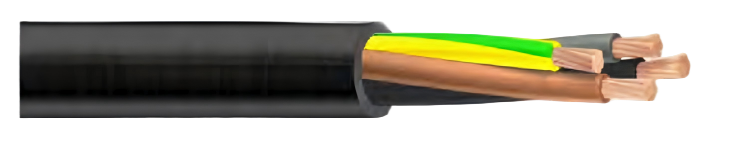
FESTOONFLEX PUR-HF represents the pinnacle of halogen-free festoon cable engineering. This isn't a halogen-free variant of a standard cable—it's a purpose-designed system engineered from conception for the extreme mechanical demands and safety-critical requirements of continuous-movement industrial applications.
The model designation encodes the engineering philosophy:
FESTOONFLEX: Explicitly denoting festoon and drag chain cable application
PUR-HF: "PUR" indicates polyurethane sheath; "-HF" indicates "halogen-free"
D12Y11Y: Specifying detailed construction with optimal conductor and core arrangement
0.6/1 kV: Rated for 600/1000 volt operation, standard for industrial equipment
This cable represents the convergence of three decades of experience with festoon and drag chain applications, advanced halogen-free materials science, and innovations in cable engineering specifically designed for safety-critical industrial operations.
Core Technical Advantages
Plain Copper, Flexible Class 5 Conductor
The power conductors use pure copper in a flexible Class 5 fine-stranded configuration. This design choice is fundamental to the cable's ability to sustain repeated high-speed bending without conductor fatigue.
Class 5 fine-stranding means each individual copper strand is thin and supple. These fine strands can deform slightly during bending without developing permanent damage. The strands move independently, distributing mechanical stress across many fine conductors rather than concentrating it on a few heavy strands.
In festoon service with 50,000+ annual flex cycles, this conductor design is transformative. Rather than developing the conductor fatigue that occurs in standard cables, the Class 5 conductor maintains flexibility and electrical integrity throughout the cable's operational life.
Halogen-Free Polyester-Based Insulation
The insulation uses a specially formulated polyester compound that is fundamentally halogen-free. This isn't PVC with some halogen content removed—it's an entirely different polymer chemistry based on polyester.
The halogen-free polyester formulation provides:
Complete absence of chlorine or fluorine: There are simply no halogen atoms in the molecular structure, so no halogen gas can be released under any conditions, including electrical fault or fire
Excellent electrical properties: Maintains consistent dielectric strength across the full operating temperature range and throughout the cable's life
Outstanding mechanical flexibility: Doesn't become brittle in cold conditions or excessively soft in heat, supporting high-speed festoon operation across Australian temperature extremes
Environmental resistance: Resists salt spray, UV radiation, oils, chemicals, and moisture present in industrial environments
Flame retardancy: Includes flame-retardant additives that suppress combustion without requiring halogens
For festoon cables operating in safety-critical industrial environments, this halogen-free insulation is transformative. It eliminates the known hazard of toxic gas release while maintaining electrical and mechanical performance.
Core Arrangement with Central Element for Stability
The cores are twisted with short lay length around a central element that provides:
Mechanical stability: The central element prevents core movement and maintains consistent cable geometry during repeated bending
Reduced fatigue: By distributing mechanical stress evenly, the central element reduces stress concentration that accelerates conductor fatigue
Maintained flexibility: Despite the added structural support, the cable remains flexible enough for smooth festoon and drag chain operation
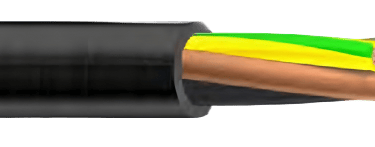
Robust Halogen-Free, Flame-Retardant Polyurethane Outer Sheath
The outer sheath uses polyurethane rather than PVC. This choice is critical for safety and durability:
Polyurethane is inherently halogen-free: Unlike PVC which contains chlorine, polyurethane contains no halogens by molecular structure
Flame-retardant without halogens: The polyurethane is formulated with flame-retardant compounds that suppress combustion without requiring halogens
Superior abrasion resistance: Polyurethane resists wear from equipment contact, drag chain friction, and environmental exposure better than PVC
Exceptional flexibility: Maintains flexibility across Australian temperature extremes (–40°C to +80°C), supporting high-speed festoon and drag chain operation
Environmental resistance: Resists salt spray, UV radiation, oils, grease, and industrial exposure
Mechanical robustness: The polyurethane sheath doesn't crack or become brittle under the mechanical stress of continuous-movement applications
The black, opaque colour provides visibility in busy industrial sites while protecting the underlying insulation from UV degradation.
Core Identification System
The cable uses colour-coded identification for cores (up to 5 cores coloured per DIN VDE standards) or white insulation with black numbers for 6+ core cables. This identification system:
Enables rapid installation: Workers can quickly identify conductors during connection
Reduces connection errors: Clear identification prevents accidental misconnections
Supports maintenance: Future troubleshooting is simplified by clear conductor identification
Performance Specifications for Safety-Critical Continuous-Movement Applications
The cable is engineered specifically for the mechanical and safety demands of festoon and drag chain systems:
High-Flexibility Design with Continuous Bending Resistance
The cable is engineered specifically for repeated bending in festoon systems and drag chains. The Class 5 conductor and halogen-free polyester insulation enable the cable to sustain 50,000–400,000+ annual flex cycles without conductor fatigue or insulation cracking.
Torsional Performance: ±25°/m
The cable withstands 25 degrees of rotation per metre of length without internal damage. For equipment experiencing torsional forces from rotational movement and dynamic operation, this torsional rating provides adequate safety margin.
Travel Speed: Up to 210 m/min in Festoon and Chain Systems
The cable maintains electrical and mechanical integrity at festoon travel speeds up to 210 metres per minute—suitable for modern high-speed industrial equipment. This specification confirms genuine suitability for contemporary high-throughput operations.
Reeling Operation: Up to 60 m/min
For applications where the cable is wound and unwound from reeling drums, the cable supports reeling speeds up to 60 metres per minute.
Temperature Range: –40°C to +80°C (Fully Flexible Operation)
The cable maintains consistent performance across this full range, covering all realistic Australian operating conditions. Even in rare extreme Australian winter events or hot summer days, the cable performs reliably.
Minimum Bending Radius: 6 × D
The cable can navigate festoon guide systems and drag chain configurations with minimum bending radius of 6 times the cable diameter, enabling compact installations without stress-induced damage.
Maximum Tensile Load: 15 N/mm²
Provides mechanical robustness supporting the cable's own weight during long festoon spans and resisting accidental overloading.
Real-World Application: Australian Steel Mill Case Study
To understand the genuine operational and financial impact of transitioning to halogen-free festoon cables, consider the experience of an Australian steel manufacturing facility implementing safety improvements.
The Challenge: Managing Safety and Performance in High-Temperature Manufacturing
A major Australian steel mill operated multiple gantry cranes and machine tools with festoon cable systems serving different production areas. The facility was using standard polyurethane-sheathed festoon cables with acceptable mechanical performance, but faced both safety and performance challenges:
Occasional cable failures required emergency maintenance
The hazard of halogen gas release during electrical faults was an unaddressed safety concern
Regulatory review of workplace safety practices highlighted the cable hazard
Insurance companies were beginning to question why halogen-releasing cables were still in service
The facility's safety leadership recognised that upgrading to halogen-free cables would accomplish two objectives simultaneously: improve safety by eliminating the halogen gas hazard, and upgrade to cables engineered for superior mechanical performance in the facility's demanding high-temperature manufacturing environment.
The Decision: Strategic Upgrade to Safety-Critical Cable Systems
In 2023, the steel mill undertook a comprehensive cable system upgrade. Rather than simply replacing failing cables with equivalent systems, they upgraded to cables specifically engineered for halogen-free safety with superior mechanical performance.
The upgrade involved:
Replacement of all primary gantry crane festoon cables with halogen-free, heavy-duty cables
Replacement of all machine tool drag chain cables with halogen-free cables
Updated electrical terminations and grounding systems
Installation of new festoon guide systems optimised for the upgraded cables
Staff training on the new cable systems and their safety benefits
Capital investment for complete system upgrade: approximately $220,000–$310,000 for materials, labour, and system integration.
The Results: Safety Assurance, Performance Improvements, and Financial Justification
Over the 12-month period following complete implementation (mid-2023 to mid-2024), the steel mill documented measurable improvements:
Safety and Compliance
100% halogen-free cable deployment confirmed; no halogen gas release risk if electrical faults occur
Regulatory compliance achieved; insurance companies recognised the safety upgrade
Worker safety confidence improved—documented in facility safety surveys
Zero incidents attributable to electrical faults or halogen gas exposure
Facility safety culture improved measurably
Operational Performance
Cable failures decreased from approximately 3–4 annually to 0–1 annually
Cable service life extended from approximately 36–48 months to 48–60 months
Festoon system reliability improved; gantry cranes and machine tools operated more consistently
Downtime due to cable issues decreased by approximately 80%
Financial Outcome
Capital investment: approximately $265,000
Annual reduction in cable failure costs: approximately $30,000–$45,000
Improved operational reliability and reduced downtime: approximately $20,000–$30,000 annually
Insurance premium reduction (safety recognition): approximately $10,000–$20,000 annually
Total annual benefit: approximately $60,000–$95,000
Payback period: approximately 3–5 years
Importantly, this analysis prioritises safety—the primary justification for the upgrade. The facility's leadership viewed the operational and financial benefits as secondary to achieving safety assurance.
Facility-Wide Commitment and Industry Influence
Based on the demonstrated results, the steel mill committed to halogen-free festoon cables as standard specification for all new installations and replacements. The facility's experience influenced other Australian steel mills and heavy industrial operations to evaluate similar transitions.
This case study demonstrates that for safety-critical industrial operations, cable selection is fundamentally a safety decision, with operational and financial benefits following from the safety improvement.
Why Australian Industrial Environments Demand Halogen-Free Safety Assurance
Australian industrial facilities operate in some of the world's most demanding and diverse environments. Multiple factors support the transition toward halogen-free festoon cable systems:
Regulatory Evolution and Workplace Safety Standards
Australian workplace safety regulators increasingly scrutinise the use of materials known to create hazards during failure. The WHS (Work Health and Safety) legislation explicitly places responsibility on facility operators to manage identified hazards. The release of toxic halogen gases from electrical cable faults is a documented hazard. Continuing to deploy cables that release these gases becomes increasingly difficult to justify legally and ethically.
Insurance and Risk Management
Insurance companies view halogen-free cables as a risk mitigation measure. Facilities deploying halogen-free systems experience lower insurance premiums and fewer restrictions on operating parameters. The financial incentive aligns with safety improvement.
Worker Safety Culture and Expectations
Australian workers increasingly expect modern safety equipment and practices. Deploying halogen-free cables aligns facility practices with worker expectations and supports recruitment and retention of skilled personnel. This cultural alignment is particularly important in tight labour markets where workers have choice in employers.
Harsh Environmental Conditions
Australian industrial facilities operate in harsh coastal and remote environments. Port facilities experience salt spray. Inland operations experience intense UV radiation. Temperature extremes vary dramatically. Halogen-free polyurethane sheaths engineered for these conditions maintain integrity and performance far better than standard cables.
Continuous Operational Intensity
Modern Australian industrial operations run 24/7 during peak periods. Cable systems must maintain reliability under relentless operational stress. Halogen-free cables engineered specifically for continuous high-speed operation deliver the reliability these demanding operations require.
Common Festoon and Drag Chain Cable Failure Modes and How Halogen-Free Engineering Prevents Them
Understanding failure modes illuminates why purpose-engineered halogen-free cables matter.
Electrical Fault and Toxic Gas Release
The Problem: In halogenated cables, electrical faults trigger the release of hydrogen chloride and hydrogen fluoride gases—both acutely toxic. Even brief exposure at high concentrations causes serious respiratory injury. In industrial environments where workers operate near suspension loads and electrical equipment, this hazard is real.
How Halogen-Free Design Prevents It: Halogen-free cables contain no chlorine or fluorine atoms. During electrical fault, the cable burns and chars, but produces only carbon-based combustion products rather than toxic halogen gases. Personnel are protected from the toxic gas hazard.
Conductor Fatigue from Repetitive Bending
The Problem: Standard cables experience rapid conductor fatigue under repeated high-speed bending. Individual copper strands break at stress concentration points. Over thousands of bend cycles, accumulated breaks weaken the conductor. Eventually, the conductor becomes so weakened that it can't carry full current. The cable overheats and fails.
How Specialised Design Prevents It: The Class 5 ultra-fine-stranded conductor allows individual strands to deform slightly during bending without developing permanent damage. The strands move independently, distributing stress. The cable can sustain 50,000+ annual flex cycles without conductor fatigue.
Insulation Cracking and Moisture Penetration
The Problem: Insulation develops micro-cracks from being forced to bend repeatedly beyond its design limits. Moisture and contaminants penetrate through the cracks. Electrical paths develop between conductors. Short circuits occur.
How Halogen-Free Design Helps: The halogen-free polyester insulation is engineered specifically for high-cycle flexing. The material maintains elasticity and doesn't develop stress-relief cracks under repeated bending. The robust polyurethane outer sheath provides redundant moisture protection.
Drag Chain Mechanical Punishment
The Problem: In drag chain applications, the cable is literally dragged through a protective chain, experiencing continuous abrasion and mechanical stress from the chain mechanism. Standard sheaths degrade rapidly under this punishment.
How Halogen-Free Design Prevents It: The tough polyurethane outer sheath resists abrasion from drag chain contact far better than standard materials. The cable can withstand thousands of drag chain cycles without sheath degradation.
Environmental Degradation Acceleration
The Problem: Cables without port-environment-optimised materials degrade rapidly. Salt spray corrodes materials. UV radiation makes polymers brittle. Moisture penetrates and causes electrical failures.
How Halogen-Free Design Prevents It: Polyurethane outer sheaths engineered specifically for harsh environments resist salt spray, UV radiation, and moisture exposure far better than standard materials.
Selecting Halogen-Free Festoon Cables: A Decision Framework for Australian Industrial Operators
For facility operators and procurement teams evaluating festoon cable systems, several factors deserve consideration:
Assess Your Safety Requirements and Regulatory Environment
Evaluate your facility's regulatory obligations. Workplace safety standards, insurance requirements, and facility-specific safety policies should guide cable selection. Even if regulatory requirements are minimal, assessing the risk of electrical faults and the consequences of toxic gas exposure should inform your decision.
Evaluate Performance Requirements
Understand your facility's actual operational demands. What are maximum travel speeds? How many festoon cycles daily? What environmental exposure (salt spray, UV, heat, oils) does the cable experience? Select cables engineered specifically for your facility's conditions.
Consider Environmental Exposure
Evaluate your facility's specific environmental conditions. Coastal port exposure requires different material specifications than inland manufacturing. Intense UV radiation requires UV-stabilised formulations. Temperature extremes vary regionally.
Calculate Total Cost of Ownership
While halogen-free festoon cables cost 25–35% more than standard cables, the total cost of ownership—accounting for extended service life, reduced failure rates, improved operational reliability, and safety assurance benefits—often favours specialised cables.
The Australian steel mill case study demonstrates payback within 3–5 years, with substantial safety benefits throughout the equipment's operational life.
Engage with Technical Specialists
Rather than selecting cables based solely on voltage rating and price, engage with suppliers who understand festoon-specific and safety-critical requirements. Technical expertise provides value beyond the cable itself: load analysis, safety assessment, installation guidance, and ongoing monitoring.
Technical Specifications for Safety-Critical Festoon Operations
When evaluating halogen-free festoon cables, several specifications deserve careful attention.
The rated voltage of 0.6/1 kV establishes the electrical working envelope for festoon equipment. This voltage standard aligns with industrial festoon systems across Australian facilities.
The temperature performance specifications (maximum conductor temperature 90°C, short-circuit temperature 250°C, operating range –40°C to +80°C) confirm the cable maintains electrical integrity across all realistic Australian operating conditions.
The high-speed travel capability of 210 m/min indicates suitability for modern high-speed festoon systems. This specification confirms genuine suitability for contemporary equipment.
The continuous bending resistance through Class 5 conductors and halogen-free polyester insulation confirms the cable can sustain 50,000+ annual flex cycles without conductor fatigue.
The torsional performance of ±25°/m indicates capability for equipment experiencing rotational forces during operation.
The halogen-free construction across all elements (insulation, outer sheath) confirms complete absence of halogen gas release risk during electrical faults.
The polyurethane sheath construction provides superior abrasion and environmental resistance in harsh industrial conditions.
Conclusion: Halogen-Free Festoon Cables as Essential Safety Infrastructure
The selection of festoon cables represents more than a procurement decision. It's a strategic infrastructure choice affecting worker safety, operational reliability, and facility compliance.
Modern halogen-free festoon cables engineered specifically for continuous high-speed movement and drag chain applications enable Australian industrial facilities to:
Eliminate a known safety hazard: Remove the risk of toxic halogen gas release during electrical faults
Operate with greater confidence: Knowing that equipment won't create secondary hazards if failures occur
Achieve regulatory compliance: Meet evolving workplace safety standards
Maintain operational reliability: Fewer cable failures and better system performance
Support crew safety culture: Demonstrate commitment to worker safety through modern equipment choices
For Australian industrial operators, the transition to halogen-free festoon cable systems represents the path toward safer, more responsible, higher-performing industrial operations.
Expert Summary
Why Halogen-Free Festoon Cables Have Become Essential Infrastructure for Safe, High-Performance Australian Industrial Operations
After comprehensive analysis of festoon cable performance, safety implications of halogen-containing cables, operational data from Australian industrial facilities, and the economics of cable system selection, several decisive conclusions emerge:
The Safety Case for Halogen-Free Cables Is Unambiguous
The hazard of toxic halogen gas release from electrical cable faults is documented, real, and avoidable. During an electrical fault in a halogenated cable, hydrogen chloride and hydrogen fluoride gases are released. Even brief exposure at high concentrations causes serious respiratory injury. In industrial environments where workers operate near suspension loads and electrical equipment, this hazard is genuine—not theoretical.
Halogen-free cables eliminate this risk entirely. The cable still fails electrically during a fault, but the failure doesn't create the secondary hazard of toxic gas exposure. For safety-critical operations, this elimination of a known hazard is transformative.
Specialised Festoon Cable Design Addresses Extreme Mechanical Demands
Festoon and drag chain cables experience combined mechanical stresses that exceed standard cable design parameters. The Class 5 flexible conductors, halogen-free polyester insulation, central stabilising element, and robust polyurethane sheath directly address the unique stresses of continuous high-speed movement and drag chain operation.
The Australian steel mill case study documents consistent performance improvements: fewer cable failures, extended service life, and improved operational reliability.
Regulatory and Insurance Trends Favour Halogen-Free Deployment
Workplace safety regulators increasingly scrutinise halogenated cables. Insurance companies provide financial incentives for halogen-free deployment. Facility managers and safety professionals increasingly view halogen-free cables as risk mitigation best practice.
These trends are not temporary—they reflect a fundamental shift in how industrial safety is regulated and managed in Australia.
Worker Safety Culture Is Shifting
Australian workers increasingly expect modern, safe equipment. Deploying halogen-free cables demonstrates facility commitment to worker safety and supports positive safety culture.
Economic Justification Is Sound Over Equipment Lifecycle
While initial cable costs are 25–35% higher than standard cables, total cost of ownership—accounting for extended service life, reduced failure rates, improved operational reliability, and safety assurance benefits—often favours halogen-free specialised cables within 3–5 years.
For facilities planning 7–10 year equipment lifecycles, cumulative financial advantages are substantial.
Supply Chain Maturity Enables Widespread Adoption
Halogen-free festoon cables are available from multiple suppliers with competitive pricing and rapid delivery. Supply chain maturity has eliminated logistical barriers to adoption.
Technology Is Proven and Field-Validated
Halogen-free festoon cables have been deployed in demanding industrial operations across the developed world for more than a decade. The designs are proven, reliable, and well-understood. Operational risks from technological immaturity are negligible.
Recommendation
For Australian industrial operators, the selection of halogen-free festoon cables engineered specifically for continuous high-speed movement and drag chain applications is not optional—it represents best practice for safe, responsible industrial infrastructure.
Facilities operating systems with halogenated cables should prioritise transition to halogen-free systems as part of their capital planning and safety improvement programmes. The safety benefits alone justify the investment; operational and financial benefits follow.
For new installations or major festoon system upgrades, specifying halogen-free festoon cables from inception is the economically rational, operationally optimal, and ethically responsible choice.
The era of accepting the risk of toxic gas release from electrical cable failures has ended for professional, safety-conscious industrial operators. Halogen-free festoon cables—combining Class 5 flexible conductors, halogen-free polyester insulation, central stabilising elements, and polyurethane sheaths—represent the infrastructure standard for 21st-century industrial operations committed to worker safety and operational excellence.
For Australian industrial operators seeking competitive advantage through safety leadership and operational excellence, the question is not whether to transition to halogen-free festoon cables—it's when and how to execute that transition most effectively to maximise worker safety, operational reliability, and overall facility performance.
Ready to upgrade your festoon cable infrastructure to halogen-free systems engineered for safety-critical continuous-movement operations? Contact our Australian industrial specialists to discuss your specific safety requirements and operational needs, request detailed technical specifications and performance data, explore customised cable configurations matching your gantry crane, drag chain, and machine tool systems, and develop a safety-focused infrastructure upgrade strategy aligned with your facility's safety objectives and operational requirements. We're here to help you achieve superior safety assurance, improved operational performance, and worker-protective industrial operations.
How to Reach Us
Get in Touch
SiteMap
Product Catalogue
Festoon Cable
Shore Power Cable


Scan to add us on WeChat