
How Long Does Custom Crane Cable Manufacturing Take? The Full Production Timeline, What Drives It, and How to Get Cable Faster
Meta description: How long does custom crane cable manufacturing actually take? A stage-by-stage breakdown of the production timeline, the factors that stretch or shorten it, honest lead-time benchmarks, and how a direct-factory model delivers brand-equivalent cable in 1 to 5 weeks instead of months.
hongjing.Wang@Feichun
6/5/202612 min read
Why lead time is the question that actually matters
Ask anyone who has stood in front of a stopped ship-to-shore crane waiting on a drum of reeling cable, and they will tell you the price of the cable was never the problem. The problem was the calendar. A custom crane cable is a small fraction of the capital value of the machine it feeds, but when the wrong one fails or the right one is months away, it can hold an entire berth, a stockpile or a commissioning schedule hostage. That is why, in Australian port and mining procurement, the first real question is almost never "what does it cost." It is "when can I actually have it."
This guide answers that question properly. It walks through the full manufacturing timeline of a custom crane cable, stage by stage, so you understand where the days actually go. It explains the factors that stretch or compress that timeline, from cable complexity and voltage to shielding, hybrid construction, order quantity and raw-material availability. It sets out realistic industry benchmarks, including the uncomfortable truth about how long the big European brands can take once you factor in stock position and shipping to this part of the world. And it is honest about the commercial reality underneath all of it: the technical performance the famous brands deliver is reproducible, everything they can do a capable direct manufacturer can do too, and typically at a better delivered price with a one-to-five-week production capability rather than a multi-month wait. We say that plainly, then we tell you exactly how to verify it, because you should never take a lead-time promise or an equivalence claim on trust. You should make the supplier prove both.
Read it end to end and you will be able to plan procurement around real timelines instead of optimistic ones, and to tell the difference between a supplier who can genuinely move fast and one who is just hoping you will not ask hard questions.
Part one: what a custom crane cable actually is, and why it takes time
Before the timeline makes sense, it helps to remember why these cables are not a commodity you pull off a shelf. A crane reeling or festoon cable is a layered, engineered structure built to survive the harshest electromechanical duty in heavy industry. It carries serious power, sometimes data and fibre alongside it, while being bent, wound, twisted and dragged through sun, salt and grit thousands of times a shift for years. Every layer in it exists to answer a specific threat, and every layer adds a manufacturing step.
At the centre is fine-stranded copper, drawn down and bundled into hundreds of thin strands precisely so the conductor can flex endlessly without the metal work-hardening and fracturing. Around that goes an insulation layer, a rubber, EPR or polyurethane-based compound chosen for flexibility, heat tolerance and dielectric strength. The insulated cores are then stranded together, often in carefully controlled layers or twisted around a central tensile element, because the geometry of that lay-up is what gives the finished cable its bending life and its torsion resistance. Over that may go a tinned-copper braid screen for electromagnetic protection, and finally a tough outer sheath, the cable's skin, formulated to shrug off abrasion, oil, ozone, UV and saltwater.
Each of those layers is a separate, controlled process with its own machinery, its own quality checks and its own cure or calibration time. That is the fundamental reason custom crane cable cannot be made in an afternoon. It is also, importantly, the reason a manufacturer who has the right machinery, the right compounds in stock and a pre-validated design can move through those steps far faster than the calendar most buyers have been conditioned to expect.
Part two: the full production timeline, stage by stage
Here is what actually happens, and roughly how long each stage takes in a well-run factory. Think of these as the building blocks; the total depends on how many of them your particular cable needs and how complex each one is.
The first stage is conductor production, typically one to three days. This is where copper rod is drawn down to fine wire, bundled into the fine-stranded class 5 or class 6 flexible conductor that dynamic crane cables demand, and tinned where corrosion resistance calls for it. The conductor class and strand count are not cosmetic. They are what let the cable bend a million times without failing, so this stage is done carefully rather than quickly.
The second stage is insulation extrusion, around one to two days. The chosen compound, rubber, PVC or EPR depending on the cable type, is extruded over each conductor to form the electrical insulation, and the dielectric strength of that layer is checked. Get this wrong and the cable fails electrically under load; get it right and it carries its rated voltage with margin for years.
The third stage is stranding and core assembly, one to three days. The insulated cores are twisted together, built into the layered or central-element structure that gives the cable its flexibility and, where required, its torsion resistance. This is where a reeling or spreader-basket cable earns its mechanical life, and the more demanding the dynamic duty, the more this stage matters.
The fourth stage is outer sheath extrusion, one to two days. The jacket, polyurethane, rubber or PVC, is applied over the assembled cores, engineered for abrasion, oil, UV and saltwater resistance, and the final diameter is calibrated. For a coastal Australian environment this is arguably the most important layer of all, because the sheath is what stands between salt and the cable's interior.
The fifth stage is electrical and mechanical testing, usually about a day. This covers high-voltage testing, tensile-strength verification, bending and torsion simulation, surface inspection and compliance checks against the relevant standards. A serious manufacturer treats this as non-negotiable, because a cable that has not been tested is a cable you cannot trust on a crane.
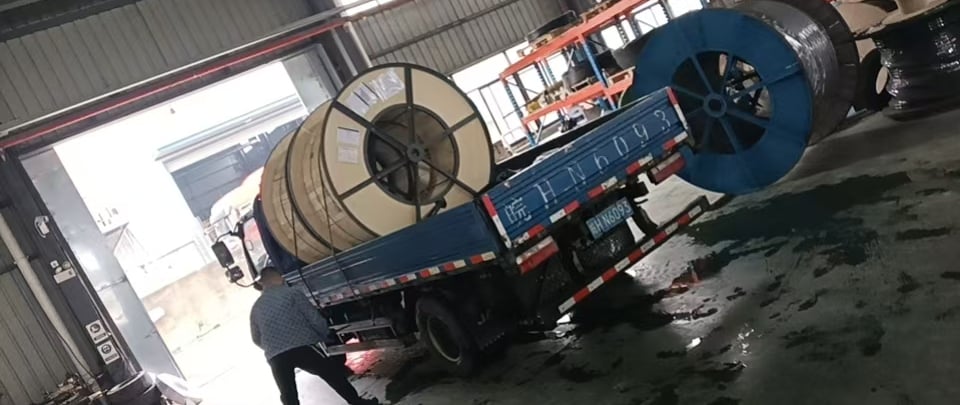
The sixth and final stage is packaging and dispatch preparation, one to three days. The finished cable is wound onto a drum or coil, cut to the exact custom length the project needs, and packaged and labelled for export. Cutting to the precise metre per drum, rather than forcing you into fixed lengths, is one of the quiet advantages of a flexible factory and a real saving on a large project.
Part three: total lead time, in honest ranges
Add those stages up and group them by cable complexity, and you get realistic manufacturing windows. A standard crane cable, simpler construction, common sizes, comes together in roughly seven to fifteen days. A heavy-duty reeling or festoon cable, with its more demanding conductor, insulation, stranding and sheath requirements and more thorough testing, runs roughly fifteen to thirty days. A highly customised hybrid cable, integrating power, control and fibre optics, sits around twenty to thirty-five days, because the fibre integration and the multi-stage inspection add genuine complexity.
Those are manufacturing times, the days it takes to actually make the cable. They are deliberately presented as ranges, because anyone who quotes you a single hard number for every cable is either guessing or hiding something. The honest answer to "how long does it take" is "it depends on what you are asking us to build," and the rest of this guide is about what it depends on.
Part four: the factors that stretch or compress the timeline
Five things move the needle most, and understanding them lets you both predict a realistic timeline and, often, shorten it.
The first is cable-type complexity. Reeling cables demand higher mechanical precision than simple power cables. Torsion-resistant designs, the kind a spreader basket needs, add production steps. Festoon cables require the layered flexibility optimisation that gives them their bending life. The more the cable has to do mechanically, the more careful, and therefore the longer, the build.
The second is voltage level. A low-voltage cable in the 0.6/1 kV class moves through production relatively quickly. A medium-voltage cable at 6/10 kV or higher needs additional insulation and additional testing cycles, because the dielectric stakes are higher, and that adds time.
The third is shielding and hybrid design. A shielded cable adds a braiding process. Fibre-optic integration adds assembly complexity and demands its own optical testing. A combined power-plus-control-plus-data cable requires multi-stage inspection because there are simply more things that have to be right. Every layer of capability you add is a layer of process you add.
The fourth is order quantity and minimum-order behaviour. A very large batch may have to wait in a scheduling queue. Conversely, and this is the part that matters for urgent maintenance, a small urgent order can often be prioritised and fast-tracked in a flexible factory that is not locked into rigid minimum-order constraints. The same flexibility that lets a factory cut a custom length lets it slot in an emergency run.
The fifth is raw-material availability. Copper price and supply affect scheduling, and the availability of the specific rubber or polyurethane compound can influence the start date. A manufacturer that keeps the common compounds and conductor sizes in stock can begin almost immediately; one that has to source everything for each order cannot.
Part five: the benchmark, including the part nobody likes to say out loud
Set against the global market, the manufacturing windows above are competitive. A standard industrial cable globally runs somewhere in the seven-to-twenty-day band. A heavy-duty crane reeling cable runs fifteen to thirty days. That is the manufacturing reality for a capable factory.
Now the uncomfortable part. The high-end European brands, the Conductix-Wampflers, Prysmians and Nexans of the world, frequently run four to ten-plus weeks depending on stock position and region. That is not because their cable takes fundamentally longer to make. It is because of where the stock sits, how the global distribution chain is structured, and how far the product has to travel. And when you are in Australia, South-East Asia or the Middle East, you then add export shipping on top, commonly another fifteen to thirty-five days depending on the logistics route. Stack a multi-week brand lead time on top of a multi-week ocean voyage and you can see how a "simple" cable replacement becomes a two-or-three-month event, which is exactly the scenario that leaves a crane idle and a project manager furious.
This is the gap that a direct, flexible manufacturer is built to close, and it is worth being precise about why the gap exists. It is logistics and positioning, not physics.
Part six: why production sometimes takes longer than it should
It is worth naming the legitimate reasons a crane cable can take longer than a buyer expects, because they help you tell a real delay from an avoidable one. Multi-layer insulation and sheath structures are genuinely complex to build well. Strict testing and compliance requirements take time and should not be rushed. Custom engineering design for a specific crane system adds a design loop before anything is made. Global logistics bottlenecks are real. And surges in demand from port-modernisation and mining-automation programmes can fill a factory's schedule.
These pressures show up most on exactly the projects where downtime hurts most: container terminal expansions, mining automation upgrades, and ship-to-shore crane electrification. The lesson is not that long lead times are always someone's fault. It is that a buyer who understands the legitimate drivers can plan around them, and can recognise when a supplier is using "it's complex" as an excuse for a supply chain that simply is not set up to move quickly.
Part seven: yes, production can be accelerated, and here is how
The good news is that a great deal of the typical lead time is compressible without cutting any corner that matters. Acceleration is real, and it comes from a few specific conditions rather than from heroics.
Priority scheduling for urgent orders is the first. A factory that can reorder its queue can put an emergency maintenance run ahead of a non-urgent batch. Pre-validated cable designs are the second and most powerful. If the construction already exists and has been engineered and tested, there is no design loop to wait through; production can start almost immediately. Standard conductor sizes and configurations are the third. Common sizes mean common tooling and common materials, which means no waiting on a bespoke setup. And in-stock raw material is the fourth. If the copper and the right compound are already on the floor, the clock starts on day one rather than after a procurement delay.
Put those together and fast-track production can compress the timeline dramatically while still passing the full high-voltage, tensile, bending and compliance testing regime. Fast does not have to mean unverified. It means a factory that was set up, deliberately, to move quickly without skipping the tests.
Part eight: the commercial case, stated plainly
Here is the part procurement teams actually care about, and we will not be coy about it.
The technical performance that makes a Conductix-Wampfler, Prysmian or Nexans crane cable good, fine-stranded class 5 or class 6 copper, the right EPR, rubber or polyurethane insulation and sheath compounds, tinned-copper screening, hybrid power-control-fibre constructions, conformity to the recognised DIN VDE, IEC, UL and CSA standards, is well-understood, documented engineering. The materials are commodities available on the open market. None of it is secret physics locked inside a brand. Which means it is reproducible by any manufacturer willing to build to the same conductor class, the same insulation and sheath systems, the same standards and the same test regime.
So we will state the claim directly: everything those brand-name manufacturers can do, an equivalent direct manufacturer can do. The same conductor structure, the same insulation systems, the same abrasion, oil, UV and saltwater-resistant sheaths, the same low-voltage and medium-voltage ratings, the same shielded and hybrid constructions, full compatibility with port crane and mining equipment standards. Engineered to the same standards, proven with the same tests.
On top of matching the performance, a direct-factory model adds the two advantages this whole guide has been circling. The first is the production cycle: a one-to-five-week capability, with flexible scheduling, short-batch manufacturing and genuine emergency-production support for urgent maintenance, instead of a multi-week brand lead time followed by a multi-week ocean voyage. The second is cost: direct manufacturing pricing with no distributor markup, optimised material sourcing and a more competitive total project cost. And alongside both, real customisation, custom length cut to the exact metre, tailored cross-sections and conductor configurations, and hybrid designs combining power, control and fibre. When a reeling cable fails on a live crane, the number that decides the size of your loss is not the price of the cable. It is the days the machine sits idle waiting for the replacement. A supplier who can build and ship the right, correctly specified cable in a fraction of the time is worth more than a famous name on a longer lead.
We would never ask you to take any of that on faith, and you should not.
Part nine: how to verify both the speed and the equivalence
A lead-time promise and an equivalence claim are only worth anything if they survive scrutiny. Run the checks, on us and on anyone else.
On equivalence, ask for the full performance specification against the same recognised standards the original cites, the conductor class to VDE 0295, the insulation and sheath standards, the IEC 60332 flame ratings, the oil and ozone test methods, and any UL, CSA or other approvals your application needs. Ask for type-test and routine-test certificates, not just a glossy datasheet. Ask for the material datasheets on the jacket and insulation compounds so you can confirm the sheath is formulated for marine UV and salt exposure rather than a generic compound that will craze in a coastal summer. Ask for documented dynamic reeling and bending-fatigue results, because for a moving cable the fatigue life is the whole game. And ask for a track record in comparable port and mining applications.
On lead time, be just as rigorous. Ask for a written manufacturing lead time for your specific cable, broken down by the stages in Part two, not a vague "a few weeks." Ask whether your design is pre-validated or needs an engineering loop, and how long that loop is. Ask whether the conductor sizes and compounds are in stock. Ask for the realistic shipping time to your port on top of the manufacturing time, so you are comparing total time to site, not just time to leave the factory. And ask what emergency or priority-scheduling options exist if a cable fails mid-project.
Then put every candidate side by side on exactly those criteria, plus delivered price. If the specifications match, the certificates are in order, the fatigue data holds up, and the total time to site and the price are better, the decision makes itself. A capable supplier is confident in where that comparison lands, which is precisely why it should encourage you to run it rather than skip it.
Part ten: balancing lead time, cost and performance
The honest conclusion is that custom crane cable manufacturing time depends on design complexity, material selection and testing requirements, and that the realistic windows are roughly seven to fifteen days for standard cable, fifteen to thirty for heavy-duty reeling and festoon cable, and twenty to thirty-five for complex hybrids, before shipping.
But the deeper point is that procurement should never optimise for lead time alone, any more than it should optimise for price alone. The right decision balances three things at once: technical equivalence with the global brands, a shorter and more flexible production cycle, and a competitive total cost, all without compromising reliability in a harsh marine or mining environment. Chase only the cheapest cable and you will buy it twice. Chase only the fastest and you may get something untested. Chase only the brand and you will overpay and over-wait. The smart outcome is the one that holds all three in balance.
With an optimised manufacturing system, you can have exactly that: the same technical standards the premium brands deliver, proven with the same tests, with faster, more flexible delivery and better cost efficiency. For port operators under modernisation pressure, mining companies running continuous production, and EPC contractors managing large upgrades, that combination is the genuinely smart procurement result.
So before your next drum of crane cable goes on order, ask for the timeline broken down, the certificates in full, the fatigue data, the total time to site and the price, and compare them head to head. We are confident in where that comparison lands, and we are happy to be tested on every claim we have made here. That is the conversation worth having.
How to Reach Us
Get in Touch
SiteMap
Product Catalogue
Festoon Cable
Shore Power Cable




Scan to add us on WeChat