
How Much Does Crane Cable Cost in Australia? A Practical Guide for Ports, Mining and Industrial Applications
How much does crane cable cost in Australia? A practical look at pricing for reeling, festoon, medium-voltage and fibre-optic hybrid crane cables — what drives the price, a real project example, and how to lower total lifecycle cost.
hongjing.Wang@Feichun
6/3/202610 min read
It's one of the most common questions we hear from people specifying cable for the first time: "What does crane cable actually cost per metre?" And it's one of the most frustrating to answer, because the honest reply is "it depends" — followed by a list of about a dozen things it depends on.
That's not a dodge. Two cables can have the identical conductor size and look almost the same on a cut sample, yet one costs a fraction of the other. The difference is in everything you can't see at a glance: the voltage class, the sheath system, the anti-torsion construction, whether there's fibre buried in the core, and how hard the cable is expected to work over its life. This guide unpacks all of that for an Australian audience — the rough price ranges, what moves them, a real project example with real numbers, and, most importantly, how to think about cost over the whole life of the cable rather than just the day you buy it.
It's written for the people who actually have to make these calls: port operators, mining companies, crane manufacturers, EPC contractors, maintenance engineers and procurement managers.
Why Crane Cable Pricing Isn't Straightforward
The single biggest source of confusion is assuming crane cable is a commodity priced mainly on copper content. It isn't. A standard industrial cable and a heavy-duty crane cable might both be, say, a three-core 50 mm² design, but they're built for completely different lives. The industrial cable is made to sit still in a tray or conduit. The crane cable is made to be wound onto a drum thousands of times, dragged across rollers, twisted at the entry point, baked in the sun, splashed with salt or oil, and flexed through its minimum bending radius over and over without the conductors fatiguing or the sheath tearing.
All of that engineering costs money, and it's why two cables with the same conductor size can be priced worlds apart. It's also why the smart buyers stopped comparing on price-per-metre alone a long time ago and started thinking in terms of lifecycle cost — purchase price plus installation, plus the downtime and replacement costs over the years the cable is in service. A cheaper cable that fails in eighteen months on a crane that earns thousands of dollars an hour is not, in any meaningful sense, the cheaper cable.
This guide will give you average price ranges, walk through the major cost factors, share a real project example, and finish with how to get an accurate quote and reduce your total cost of ownership.
The Crane Cables Commonly Used in Australia
Before talking price, it helps to know the families, because each is priced differently.
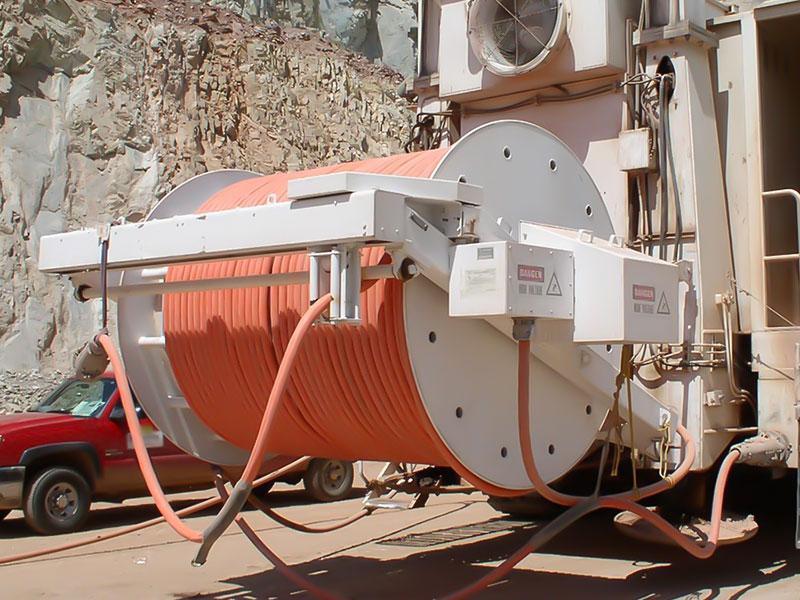
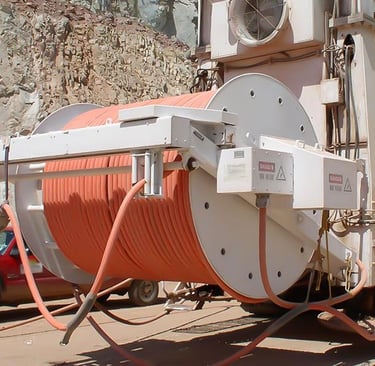
Reeling cables are the workhorses of continuous winding and unwinding. You'll find them on ship-to-shore cranes, rubber-tyred gantries, stacker reclaimers and a great deal of mobile mining equipment. They're built to be reeled on and off a drum endlessly, which demands high flexibility, tensile strength and torsional stability.
Festoon cables travel back and forth in loops hung from a trolley track, suited to the horizontal movement of gantry cranes and automated yard systems. The motion is gentler and more predictable than reeling, which generally makes them less costly than a comparable reeling cable.
Basket and spreader cables handle vertical lifting duty and the high-flex demands of spreaders. These are specialised high-flex constructions, and the engineering pushes the price up.
Fibre-optic hybrid crane cables combine power and communication in a single cable. They're increasingly common in automated terminals, where data has to travel alongside power, and the optical elements add meaningfully to the cost.
Medium-voltage crane cables carry power at higher voltage classes — common in ports and mines where power has to travel a long way to mobile equipment. The extra insulation and screening make these the most expensive family by some margin.
Average Crane Cable Prices in Australia
A few honest caveats first. Cable prices move with the copper market, the exchange rate (most premium crane cable is imported and priced in euros or US dollars), freight, and order quantity. The Australian dollar has spent recent months trading around 1.39 to 1.40 to the US dollar, which matters a great deal when you're buying a product quoted in USD. So treat the following as indicative ranges, not quotes.
Low-voltage crane cables (the 0.6/1 kV class, in common conductor sizes for general reeling, festoon and control duty) sit at the affordable end. For lighter sizes you might be looking at a low double-digit figure per metre in Australian dollars, climbing as the conductor size and core count grow.
Medium-voltage reeling cables are where prices climb sharply. Once you move up through the 1.8/3 kV, 3.6/6 kV, 6/10 kV and higher classes, the insulation system, the semiconductive field-control layers and the mechanical protection all get substantially more involved. It's common for a medium-voltage crane cable to cost two to five times its low-voltage equivalent in the same conductor size.
Fibre-optic hybrid crane cables add another layer of cost on top, because you're now paying for integrated optical fibres and the precision construction needed to keep them intact through continuous reeling. The trade-off is that one hybrid cable replaces two separate systems — power and data — which can simplify the installation and reduce the overall infrastructure footprint.
Imported versus local supply is the other big variable. European-engineered crane cables carry a premium but bring proven performance and full technical documentation. Australian distributors add local stock, support and lead-time certainty. And direct manufacturer sourcing — buying ex-works from the factory — can lower the headline price considerably, though you then take on the freight, the currency risk and the import logistics yourself. The right choice depends on how much engineering support and supply security you need.
What Actually Drives the Price
Here's where the "it depends" gets specific. These are the levers that move a crane cable quote.
Voltage rating. The jump from low to medium voltage is the single biggest step-change in price. A medium-voltage design needs thicker, higher-grade insulation (typically a high-quality EPR compound), inner and outer semiconductive layers for electrical field control, and tighter manufacturing tolerances — none of which a low-voltage cable requires.
Conductor size. This is the part people expect. More copper means more cost, and it scales roughly with cross-sectional area, so stepping up from 50 mm² to 95 mm² is a serious jump in raw material. Crane cables also use very finely stranded copper for flexibility, which costs more to produce than the coarse stranding in a fixed-installation cable.
Number of cores. Every additional element adds cost — power cores, control or pilot cores, earth conductors and any fibre-optic elements. A simple three-core power cable is far cheaper than a three-core design with pilot cores and a fibre bundle.
Reeling speed and mechanical stress. The more dynamic the application, the stronger and more complex the construction has to be. A cable destined for high travel speeds and heavy dynamic tensile loads needs more reinforcement than one for a slow, gentle duty, and that manufacturing complexity shows up in the price.
Torsion resistance. Reeling and slewing twist a cable, and cables aren't naturally fond of torsion. Quality designs build in an anti-torsion braid — typically reinforced polyester threads vulcanised into a bond between the sheath layers — to resist twisting and extend service life. That braid is part of why a proper reeling cable outlives a cheap substitute, and part of why it costs more.
Fibre-optic integration. Whether you need single-mode (E9/125) or multimode (G50/125 or G62.5/125) fibres, and how many, affects the hybrid construction cost. Optical elements are delicate, and protecting them through a reeling life is a genuine engineering exercise.
Environmental requirements. UV resistance, oil resistance, chemical resistance and marine-grade protection all rely on specific compounds. A cable rated for unrestricted outdoor use, resistant to ozone, UV and moisture, and tested for oil and water resistance, is built from more expensive materials than a basic indoor cable.
A Real Project Example: Medium-Voltage Fibre-Optic Reeling Cable for a Nickel Mine
Abstract ranges only get you so far, so here's a real one. This was a genuine order for a continuous-duty mobile mining application — a nickel operation in the New Caledonia region, which is exactly the kind of harsh, remote, high-stress environment Australian mining buyers will recognise.
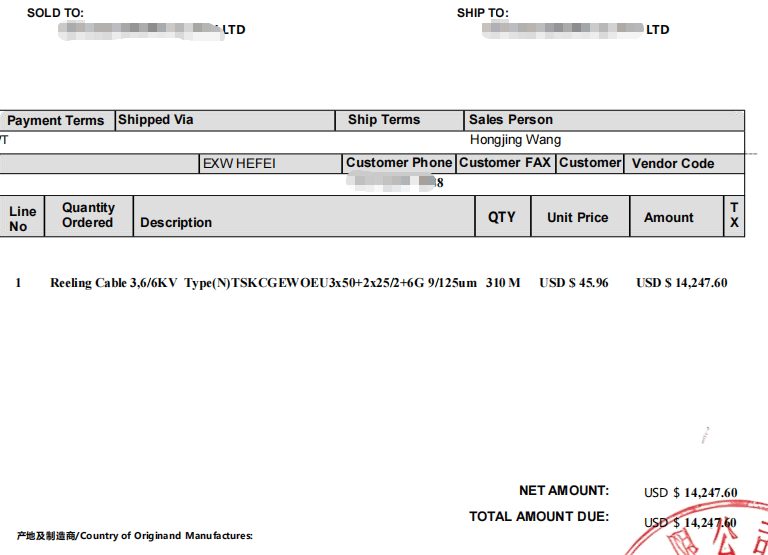
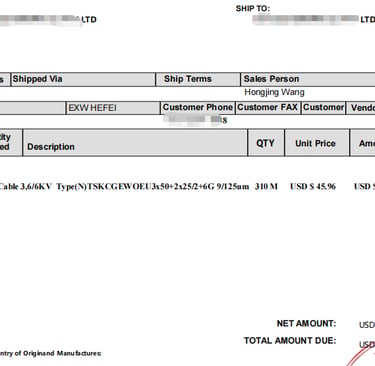
What was specified. A medium-voltage fibre-optic reeling cable, type designation (N)TSKCGEWOEU, rated 3.6/6 kV. The configuration was three 50 mm² power conductors, two 25 mm² pilot cores, and six G9/125 µm optical fibres — power, control and data all in one reeled cable. The order was for 310 metres.
What it cost. The delivered project price worked out to USD $45.96 per metre, for a total of USD $14,247.60, supplied ex-works. At recent exchange rates around 1.40, that's very roughly AUD $64 per metre, or somewhere near AUD $20,000 for the run before freight and duties — though the exact landed cost in Australia would depend on the rate on the day, shipping and import charges.
Why it cost more than a standard industrial cable. Five things, really. It's a medium-voltage design with a full EPR insulation and field-control system. It has integrated optical fibre, with all the protection that implies. It's built to mining-grade mechanical standards. It's a reeling cable, so it has the anti-torsion braid and abrasion-resistant sheath needed to survive continuous winding. And it carries high tensile-strength requirements — this family is rated to handle tensile loads on the conductor up to around 30 N/mm² during acceleration, well beyond a basic cable, with a torsional allowance of roughly ±25 degrees per metre.
The lesson. A cable like this is never going to be cheap per metre. But the right question isn't "is $45.96 a metre expensive?" — it's "what does it cost me if the cheap alternative fails in a remote nickel mine and stops production?" Application-specific design that matches the cable to the duty is what keeps the equipment running and the replacement cycle long, and that's where the real money is saved.
Low Voltage versus Medium Voltage: Where the Price Gap Comes From
It's worth dwelling on this gap, because it surprises people.
The construction differences are substantial. A medium-voltage cable has much thicker insulation, the semiconductive screening layers that a low-voltage cable simply doesn't have, and heavier mechanical reinforcement. Each of those is added material and added manufacturing steps.
The performance differences justify it. Medium-voltage cables carry more power for a given conductor size, perform better over long distances (less voltage drop), and are the only sensible option when power has to travel a long way to mobile equipment — exactly the situation in big ports and sprawling mine sites.
The cost difference that results is the two-to-five-times figure mentioned earlier. It's not a markup; it's the price of a genuinely different and more capable product.
Why Cheap Crane Cables Often Cost More in the End
This is the heart of the lifecycle-cost argument, and it shows up in four predictable ways.
Premature jacket wear. A cheaper cable with a lower-grade sheath loses its abrasion resistance faster, which means more frequent inspection and earlier intervention. The sheath is the cable's armour; when it goes thin, everything underneath is exposed.
Internal conductor failures. Copper that isn't finely stranded enough, or isn't supported properly, fatigues under repeated bending. The cruel part is that these failures are often invisible — the jacket looks fine while the conductors quietly break inside, producing intermittent faults that are maddening to diagnose.
Torsional damage. Without a proper anti-torsion design, a reeling cable twists, and twisting leads to bird-caging — where the internal strands displace outward and the cable structure swells and destabilises. Bird-caging is permanent; once it happens, that section is finished.
Operational downtime. This is the big one. The cost of a crane shutdown — the emergency replacement, the lost production, the knock-on scheduling chaos — routinely dwarfs the price difference between a cheap cable and a good one. On a high-earning crane, a single avoidable failure can cost more than a decade's worth of the price premium you tried to save.
Typical Budgets by Application
Different applications call for different cable strategies and different budgets.
Ship-to-shore cranes lean on medium-voltage reeling systems, increasingly with fibre-optic integration for automation and monitoring. These are among the most expensive cable installations in any terminal.
RTG and RMG cranes use a mix of festoon and reeling cables, with automation pushing more data-carrying designs into the spec.
Mining shovels and stacker reclaimers operate in high-mechanical-stress environments over long cable travel distances, demanding tough, heavy-duty reeling cables — much like the nickel-mine example above.
Bulk material handling equipment runs continuous-duty operations that reward robust, long-life cable, because the cost of stopping a bulk line is high and the operating conditions are punishing.
How to Reduce Total Cost of Ownership
The good news is that lifecycle cost is largely within your control. Four habits make the biggest difference.
Select the correct cable design. Match the cable structure to the actual application — voltage, mechanical stress, environment, data needs. Over-specifying wastes money; under-specifying guarantees early failure. The sweet spot is a cable engineered for the duty.
Invest in better materials. Higher-grade compounds and construction cost more up front and deliver longer service life and fewer replacements. Over the life of a crane, that maths almost always favours quality.
Improve installation practices. This is the cheapest win of all. Getting the fleet angle right, keeping the drum and sheaves aligned, and handling the cable properly during installation all dramatically extend service life. A perfect cable installed badly will still fail early.
Run a preventive maintenance program. Regular inspections, early wear detection and a planned replacement strategy turn cable management from a series of emergencies into a predictable, budgeted process.
How to Get an Accurate Quote
A vague enquiry gets a vague (and usually high, to cover the unknowns) quote. To get a sharp price, give the supplier the full picture.
The information they need includes the application type, voltage rating, current load, reeling length, drum dimensions, reeling speed and the environmental conditions the cable will face. With those in hand, a good manufacturer can specify precisely rather than padding the quote.
The common mistakes to avoid are leaving out the mechanical data, giving incomplete operating parameters, and — the classic — focusing only on conductor size as if that's the whole story. As this guide has hopefully made clear, conductor size is just one line in a much longer specification.
Finally, it pays to work with experienced crane cable manufacturers who offer real engineering support, can produce custom designs for unusual duties, and will help you evaluate lifecycle cost rather than just hand you a price. The right partner saves you money in places that never appear on the invoice.
The Bottom Line
Crane cable prices depend on far more than copper content. Mechanical performance, voltage rating and application requirements all shape the number, which is why two superficially similar cables can be priced so differently. The lowest purchase price is rarely the lowest operating cost — reliability matters, and on a working crane the cost of downtime almost always exceeds the cost of the cable itself.
Choose the right crane cable — matched to the duty, built from good materials, installed well and maintained properly — and you get longer service life, more reliable operation and a lower total cost of ownership. That's a better deal than a cheap cable every time, even when the cheap cable wins on the day you sign the purchase order.
Key topics covered
Crane cable cost Australia · crane cable price Australia · reeling cable price · medium-voltage crane cable · STS crane cable cost · mining reeling cable price · fibre-optic crane cable cost · what affects crane cable pricing · crane cable quote Australia · reeling cable for nickel mining operations
How to Reach Us
Get in Touch
SiteMap
Product Catalogue
Festoon Cable
Shore Power Cable




Scan to add us on WeChat