JZ-HF-CY / OZ-HF-CY DIN VDE-Certified Oil-Resistant PVC Drag Chain Cables for EMC-Optimized Automation
Discover JZ-HF-CY / OZ-HF-CY oil-resistant screened drag chain cables, DIN VDE 0285-525-2-51 certified PVC EMC cables built for reliable performance in industrial automation, robotics, and drag chain systems—ensuring interference-free signal transmission.
hongjing.Wang@Feichun
2/6/20269 min read


Introduction: Meeting Demands in Dynamic Industrial Environments
In today's automated manufacturing facilities, robots move with precision along assembly lines, handling machines shuttle components between workstations, and drag chain systems constantly flex and retract to power moving equipment. Yet behind this seamless choreography lies a critical challenge: maintaining reliable electrical connections and interference-free data transmission through cables that endure millions of flexing cycles in harsh industrial conditions.
Consider a pharmaceutical packaging line where robotic arms operate 24/7, their power and control cables snaking through drag chains that bend up to 60 times per minute. These cables must resist oil contamination from machinery, withstand constant mechanical stress, and transmit precise digital signals without electromagnetic interference—all while maintaining safety standards in a regulated environment. This demanding scenario exemplifies why specialized cable design matters.
The JZ-HF-CY and OZ-HF-CY cables represent a precisely engineered solution for such applications. These oil-resistant PVC drag chain cables comply with DIN VDE 0285-525-2-51 and DIN EN 50525-2-51 standards, featuring screened construction that makes them particularly suitable for electromagnetic compatibility (EMC) requirements. Designed specifically for continuous flexing applications, they combine mechanical durability with superior electrical performance, ensuring data integrity in environments where standard cables would quickly fail.
Core Technical Specifications
Understanding the technical parameters of these cables reveals why they excel in demanding automation applications. The temperature performance range demonstrates their versatility: when installed as flexible cables in moving applications, they operate reliably from -10°C to +80°C, while fixed installations can withstand temperatures from -40°C to +80°C. This broad range accommodates everything from climate-controlled electronics facilities to industrial environments with significant temperature fluctuations.
The electrical ratings provide robust safety margins. With a nominal voltage specification of U₀/U 300/500V AC, these cables handle standard industrial control and power distribution requirements. The test voltage of 4000V between cores and an impressive breakdown voltage of 8000V ensure exceptional insulation integrity, critical for preventing electrical faults in densely packed cable trays or drag chain assemblies where cables run in close proximity.
For drag chain applications, the minimum bending radius specifications are particularly important. Flexible installations require a bending radius of at least 10 times the outer diameter, while fixed installations need only 5 times the outer diameter. For instance, a cable with a 15mm outer diameter would require a 150mm bending radius in drag chain applications—a specification that directly influences the physical design of the cable management system. The coupling resistance of approximately 250 Ohm/km at 30 MHz indicates controlled impedance characteristics that support high-frequency signal transmission without excessive signal degradation.
Compliance with DIN VDE 0285-525-2-51 / DIN EN 50525-2-51 standards ensures these cables meet stringent European safety and performance requirements. Additionally, they carry EAC certification for markets requiring conformity to technical regulations of the Eurasian Economic Union. The flame-retardant properties according to DIN VDE 0482-332-1-2 / DIN EN 60332-1-2 / IEC 60332-1-2 and oil resistance per DIN VDE 0473-811-404 / DIN EN 60811-404 / IEC 60811-404 demonstrate comprehensive testing that validates real-world performance claims.
Innovative Cable Structure for Superior Performance
The construction of JZ-HF-CY and OZ-HF-CY cables reflects decades of engineering optimization for drag chain applications. At the core, conductors are manufactured from bare copper wire with extra-fine stranding according to DIN VDE 0295 Class 6 / IEC 60228 Class 6. This stranding class features significantly more individual wire strands than standard conductors, providing the flexibility necessary to withstand millions of bending cycles without conductor fatigue or breakage. The fine stranding also reduces the skin effect at higher frequencies, improving signal transmission characteristics.
Each conductor receives insulation made from PVC compound type Z 7225, specifically formulated for mechanical durability and electrical performance. Core identification follows DIN VDE 0293-334 standards, with black cores featuring consecutive white digit labeling that remains legible even after extended service. For cables with three or more cores, the "G" designation indicates the presence of a green-yellow protective conductor positioned in the outer layer for optimal grounding performance, while the "x" designation in OZ variants indicates configurations without a protective conductor.
The assembly process employs layered stranding with optimally matched lay lengths—a critical detail that prevents conductor bunching during flexing and ensures even stress distribution. Each stranding layer receives fleece wrapping that acts as a sliding layer, reducing friction between conductor groups during cable movement and preventing the inner cores from damaging each other. An inner PVC sheath then encapsulates the entire conductor assembly, providing mechanical protection and preventing oil or contaminants from penetrating to the conductors.
The screening layer distinguishes these cables as EMC-preferred types. A braided screen of tinned copper wires provides approximately 85% coverage, creating an effective electromagnetic shield that attenuates both incoming interference and outgoing emissions from the cable itself. The tinning prevents corrosion and ensures consistent electrical contact, while the braid construction maintains screening effectiveness even during flexing—a critical advantage over foil screens that can crack under mechanical stress.
Finally, the outer sheath utilizes oil-resistant special PVC according to DIN VDE 0207-363-4-1 / DIN EN 50363-4-1, specifically compound type TM5. This formulation resists degradation from hydraulic oils, lubricants, and coolants commonly encountered in industrial environments. The grey sheath (RAL 7001) provides professional appearance and easy visibility for inspection, while length markings in meters facilitate accurate cable management during installation.
Importantly, all materials are cadmium-free, contain no silicone, and remain free from substances that would interfere with lacquer wetting properties—making these cables compatible with subsequent painting or coating processes in manufacturing applications.
Ideal Applications and Installation Guidelines
These screened drag chain cables find their primary applications in dry and damp indoor environments where continuous cable movement occurs without direct outdoor exposure. They excel in standard drag chain systems where the cable experiences free movement without tensile stress or forced motion control, making them ideal for energy chains on CNC machines, automated storage and retrieval systems, and gantry robots.
In automated handling machines, these cables provide reliable power and control signal transmission to moving components like grippers, actuators, and sensors. The oil resistance proves particularly valuable around hydraulic systems or in machining centers where cutting fluid contamination is inevitable. Industrial robots benefit from the cables' flexibility and screening, ensuring precise servo motor control and encoder feedback without electromagnetic interference from nearby variable frequency drives or welding equipment.
The EMC-preferred designation makes these cables especially suitable for applications in electronics manufacturing, measurement systems, and precision control technology where data signal integrity cannot be compromised. Paired versions are available for differential signaling applications like RS-485 communication or analog sensor signals requiring balanced transmission to reject common-mode noise.
For optimal electromagnetic compatibility performance, installation guidelines emphasize creating a double-sided, all-round large contact area of the copper braiding. This means the screen should be properly terminated at both cable ends with metal backshells or cable glands that provide 360-degree contact with the braiding, ensuring the screen effectively shunts interference to ground. Poor screen termination—such as pigtail connections—significantly degrades screening effectiveness and should be avoided.
When designing drag chain installations, several parameters require attention. The selection tables provided by manufacturers should be consulted for specific application parameters including chain length, travel distance, speed, and acceleration. Assembly instructions must be strictly observed to ensure proper cable support and prevent premature failure. For energy supply systems, the cables should be installed with appropriate strain relief to prevent tension on the conductors during movement, though the cables themselves are designed for applications without sustained tensile stress.
For special applications—such as cleanroom environments where low particulate generation is critical—cleanroom qualification testing is available on analog types and should be specified when ordering. Applications involving unusual environmental conditions, exceptional speeds, or unique mechanical requirements warrant consultation with cable specialists using detailed data entry forms to ensure proper cable selection.
Common Cable Challenges and Solutions
Challenge 1: Premature Cable Failure in Drag Chains
Problem: Cables failing after only months in drag chain applications, exhibiting conductor breaks or insulation cracking.
Solution: This typically results from incorrect bending radius or improper cable selection. Always verify that the drag chain's bend radius meets or exceeds the cable's minimum specification (10x outer diameter for flexible installation). Additionally, ensure the cable cross-section and core count are appropriate—oversized cables or those with too many cores for the chain width can experience excessive mechanical stress. The layered stranding with fleece wrapping in JZ-HF-CY / OZ-HF-CY cables specifically addresses this issue by distributing stress evenly and reducing inter-conductor friction.
Challenge 2: Intermittent Signal Errors and Communication Failures
Problem: Control systems experiencing sporadic communication errors, sensor misreadings, or inconsistent servo motor performance despite verified software and hardware functionality.
Solution: Electromagnetic interference often causes these symptoms, especially in environments with multiple VFDs, high-current switching, or welding equipment. The 85% copper braid screening in these cables provides robust EMC protection, but effectiveness depends critically on proper termination. Ensure both cable ends have 360-degree screen termination to equipment chassis ground through metal cable glands or backshells. Avoid pigtail connections where the braid is twisted into a single wire—this destroys the screening effectiveness. Additionally, verify that signal cables run separately from high-power cables where possible.
Challenge 3: Oil Contamination Degrading Cable Jacket
Problem: Cable outer sheaths becoming tacky, swollen, or cracked after exposure to hydraulic oils or cutting fluids.
Solution: Standard PVC cables often lack adequate oil resistance for industrial environments. The JZ-HF-CY / OZ-HF-CY cables employ special compound type TM5 PVC specifically formulated and tested for oil resistance according to DIN VDE 0473-811-404 / DIN EN 60811-404 / IEC 60811-404. When selecting cables for machinery environments, verify that oil resistance testing documentation is available. For extreme chemical exposure, consider requesting compatibility information for specific oils or coolants present in your application.
Challenge 4: Uncertainty About Conductor Size Requirements
Problem: Confusion about whether to specify cables by metric (mm²) or AWG sizes, leading to incorrect orders or voltage drop issues.
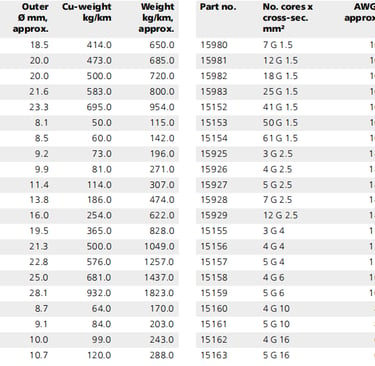
Solution: These cables are metrically constructed (mm²), with AWG numbers provided as approximations for reference only. Always specify and calculate based on the mm² cross-section. For voltage drop calculations, use the conductor resistance values provided in technical data and calculate based on circuit length, current draw, and acceptable voltage drop (typically 3-5% for power circuits, lower for sensitive control circuits). Remember that the extra-fine Class 6 stranding has slightly higher resistance than solid or less-flexible conductors due to increased strand surface area, though the difference is minimal and worth the mechanical flexibility gained.
Why Choose JZ-HF-CY / OZ-HF-CY for Your Projects
When comparing these cables to standard drag chain offerings, several advantages become apparent. The combination of oil-resistant outer sheath, screened construction, and Class 6 fine stranding in a single cable design eliminates the need to compromise between mechanical durability, chemical resistance, and electrical performance. Many standard flexible cables offer only one or two of these features, requiring engineers to accept limitations or resort to more expensive specialty cables.
The mechanical resilience of the layered stranding with fleece wrapping between layers directly translates to extended service life in continuous flexing applications. Field reports from automated handling equipment manufacturers indicate service lives exceeding five years in applications with 60 cycles per minute—representing over 150 million flexing cycles. This longevity reduces maintenance costs and production downtime compared to cables requiring replacement every 18-24 months.
The cadmium-free, silicone-free material composition with lacquer-wetting compatibility makes these cables suitable for applications where equipment undergoes finishing processes or where material restrictions apply for health, safety, or performance reasons. In industries like food processing equipment or medical device manufacturing where material certifications matter, these specifications provide documentation for compliance.
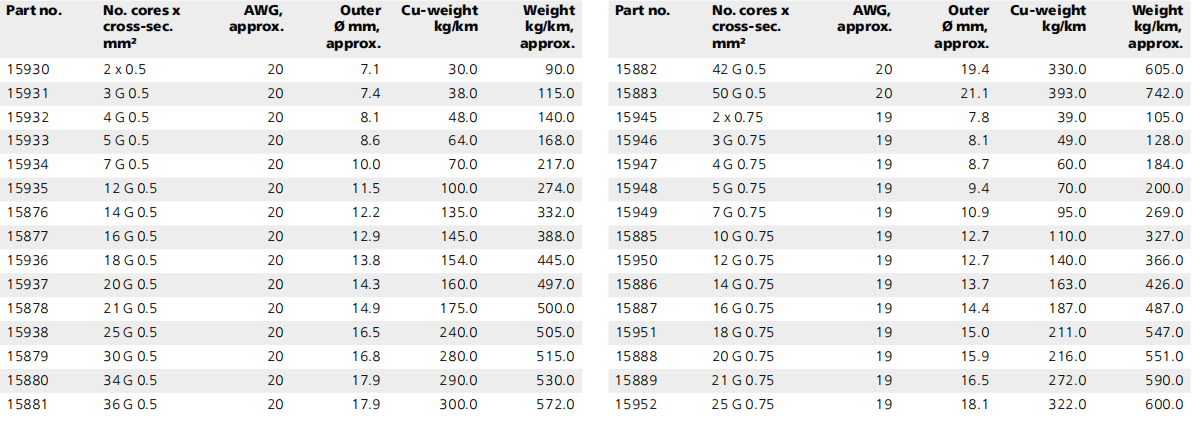
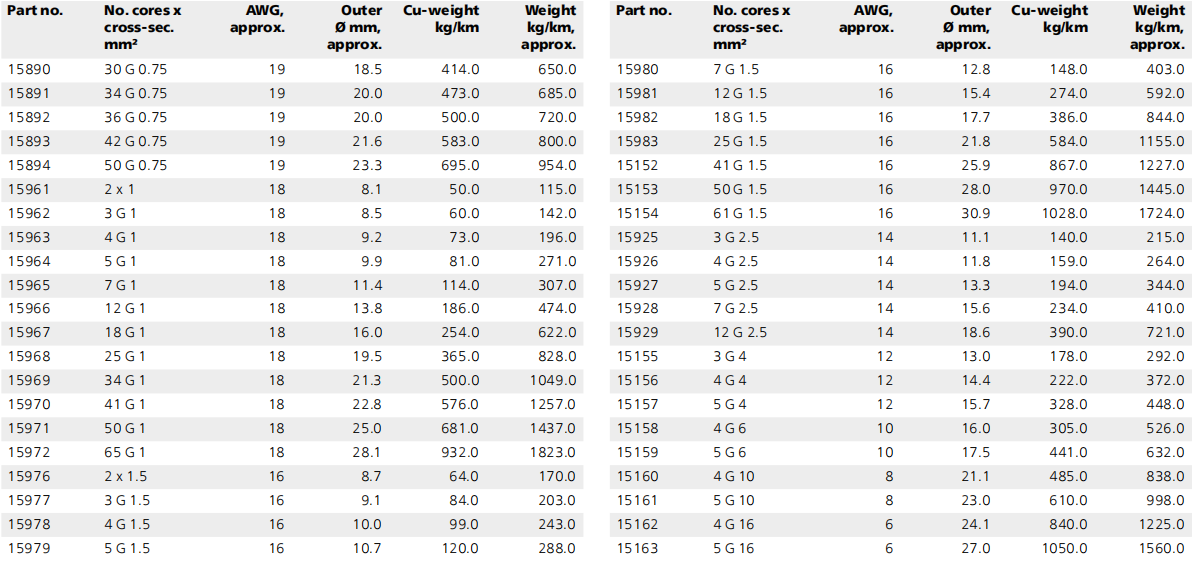
The availability of configurations from 2 cores up to 65 cores, with cross-sections ranging from 0.5mm² to 16mm², means a single cable family can address the majority of automation applications. This standardization simplifies inventory management, reduces procurement complexity, and provides consistency in installation practices across different machines or production lines.
For custom requirements—non-standard lengths, special voltage ratings, or unique conductor configurations—consultation is available to determine feasibility. Many applications can be accommodated through slight modifications to standard designs without the lead times or costs associated with fully custom cable development.
Conclusion: Powering the Future of Automation
As industrial automation continues evolving toward greater precision, higher speeds, and more complex integration of control systems, the demands on cable infrastructure intensify. The JZ-HF-CY and OZ-HF-CY oil-resistant PVC drag chain cables represent a proven solution that balances the mechanical requirements of continuous motion with the electrical performance necessary for interference-free data transmission.
Their comprehensive compliance with DIN VDE and EN standards, combined with practical features like oil resistance and EMC screening, positions them as reliable components in modern automated systems. From pharmaceutical packaging lines to automotive assembly robots, from CNC machine tools to warehouse logistics systems, these cables provide the consistent performance that keeps production running.
The evolution toward Industry 4.0, with its emphasis on connected sensors, real-time data acquisition, and adaptive control systems, only increases the importance of cables that can reliably transmit both power and data in challenging environments. The EMC-preferred design of these screened cables anticipates these needs, ensuring compatibility with increasingly sophisticated automation systems.
For engineers and maintenance professionals specifying cables for drag chain applications, the JZ-HF-CY and OZ-HF-CY series offer confidence that comes from proven designs meeting recognized standards. Whether retrofitting existing equipment or designing new automation systems, these cables deliver the performance and reliability that modern manufacturing demands.
How to Reach Us
Get in Touch
SiteMap
Product Catalogue
Festoon Cable
Shore Power Cable


Scan to add us on WeChat