
MP-GC 8kV Three-Conductor Mine Power Feeder Cable: XLPE Insulated PVC Jacket
Industrial-grade MP-GC mining feeder cable rated 8kV with tinned copper grounding and ground check conductors. XLPE insulation, PVC jacket. ASTM B-8 & CAN/CSA C22.2 No. 96 compliant. Underground mining equipment power supply solutions—download technical specs.
hongjing.Wang@Feichun
1/4/202610 min read
Understanding MP-GC Mining Cable Technology
The delivery of reliable electrical power in mining operations requires specialized cable solutions engineered to withstand extreme environmental conditions, mechanical stress, and operational demands that far exceed conventional industrial applications. The MP-GC three-conductor mine power feeder cable represents a sophisticated electrical distribution solution specifically designed for medium-voltage power transmission in mining environments. This 8kV mining power cable integrates advanced materials and construction techniques to deliver dependable performance across diverse mining applications, from underground coal extraction to surface hard rock operations.
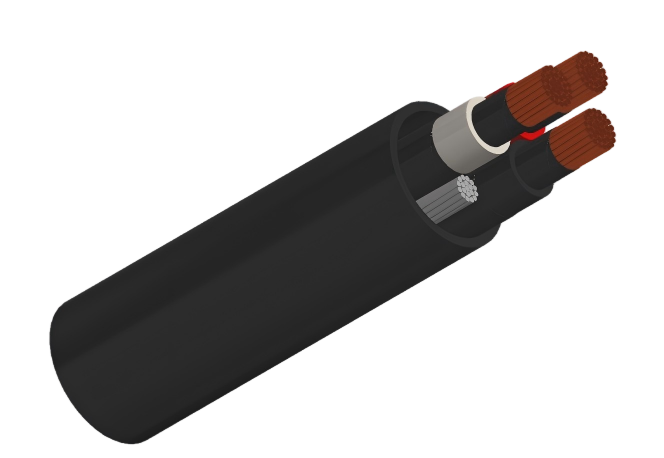
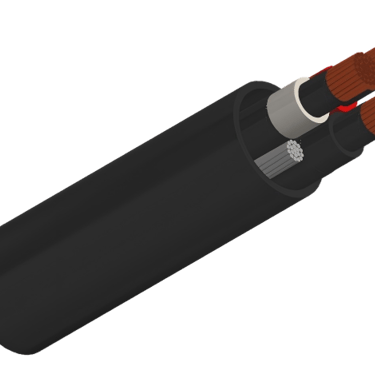
The MP-GC designation identifies this cable type as Mine Power with Ground Check capability, distinguishing it from standard industrial power cables through the incorporation of a dedicated ground integrity monitoring conductor. Rated at 8,000 volts, this mining feeder cable serves as the critical electrical link between distribution substations and heavy-duty mining equipment including longwall shearers, continuous miners, draglines, electric rope shovels, and high-capacity dewatering pumps. The integration of cross-linked polyethylene insulation with a robust polyvinyl chloride jacket creates a cable structure optimized for the demanding conditions encountered in mining operations.
Manufacturing compliance with established industry standards forms the foundation of reliable cable performance. The MP-GC cable conforms to ICEA S-75-381 specifications for portable and power cables, NEMA WC 58 mining cable requirements, and ASTM B-8 standards governing copper conductor construction. Additional certification under CAN/CSA C22.2 No. 96 ensures suitability for Canadian mining operations. This comprehensive standards compliance validates the cable's performance across multiple installation methods: the mining cable suitable for duct, conduit, and direct burial installations provides installation flexibility essential for both permanent infrastructure and temporary portable mining equipment connections.
Advanced Construction and Technical Design
Copper Conductor System
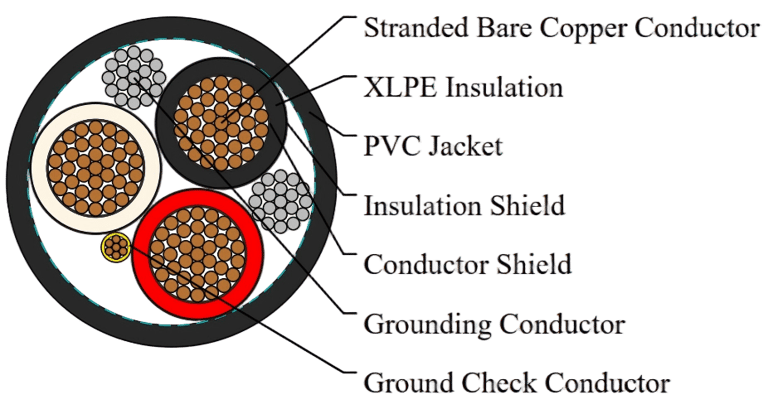
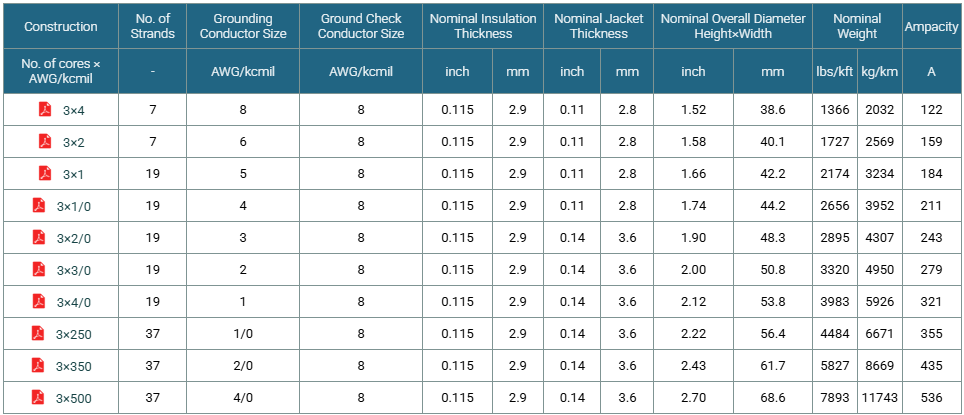
The electrical conductors consist of stranded annealed bare copper configured in three-phase arrangement for AC power distribution. The stranding pattern follows concentric-lay construction per ASTM B-8 specifications, with individual copper wires arranged in concentric layers around a central wire. This configuration provides mechanical flexibility essential for portable mining applications while maintaining excellent electrical conductivity characteristics. Conductor sizes typically range from 35 mm² through 400 mm², accommodating ampacity requirements from moderate feeder circuits to high-capacity equipment power supplies.
The stranded conductor design offers significant advantages over solid conductor configurations in dynamic mining applications. Each conductor comprises multiple individual copper strands that distribute mechanical flexing stress, dramatically extending service life in applications involving cable coiling, repositioning, and vibration exposure. The bare copper construction ensures minimal DC resistance, critical for minimizing voltage drop across extended cable runs common in large-scale mining operations where equipment may operate several kilometers from distribution points.
XLPE Insulation Technology
Cross-linked polyethylene insulation represents a transformative advancement in cable dielectric materials. The XLPE insulated mining cable employs molecular cross-linking that creates three-dimensional polymer networks, fundamentally altering the material's thermal and mechanical properties. Unlike thermoplastic materials that soften at elevated temperatures, cross-linked polyethylene maintains structural integrity at conductor temperatures reaching 90°C continuous operation.
The thermal stability of XLPE insulation enables higher ampacity ratings compared to conventional polyethylene or polyvinyl chloride insulated cables of equivalent dimensions. This performance advantage translates directly to reduced conductor sizes for given load requirements or increased power transmission capacity within existing conduit infrastructure. The puncture resistance of cross-linked polyethylene substantially exceeds standard thermoplastic materials, providing enhanced mechanical protection in mining environments where cables contact sharp rock surfaces, equipment edges, and abrasive mineral materials.
Each conductor features a semiconducting layer serving as the copper conductor shield, applied directly over the stranded copper. This conducting layer ensures uniform electrical stress distribution across the insulation system, preventing stress concentration at the conductor surface that could initiate insulation breakdown. The insulation shield consists of a semiconducting layer combined with copper tape construction, providing comprehensive coverage that facilitates effective grounding while enhancing electromagnetic interference suppression.
Ground Check Conductor Innovation
The MP-GC cable incorporates dual grounding elements that distinguish it from conventional three-conductor power cables. The primary equipment ground consists of a tinned copper grounding conductor sized according to fault current requirements and regulatory specifications. Tin plating provides corrosion resistance essential in wet mining environments where copper oxidation could compromise ground path integrity over extended service periods.
The ground check conductor represents an advanced safety feature enabling continuous cable condition monitoring without interrupting equipment operation. This yellow polypropylene insulated conductor runs the entire cable length alongside the power conductors, providing a dedicated path for ground continuity verification testing. The MP-GC cable with ground check conductor and tinned copper grounding offers mining operators real-time capability to detect insulation degradation or mechanical damage before catastrophic failure occurs.
Ground check functionality addresses a critical mining safety imperative: maintaining reliable ground paths in environments where cables experience severe mechanical abuse, chemical exposure, moisture penetration, and thermal cycling. Mining operations can implement ground check monitoring as part of pre-shift equipment inspections, enabling early detection of developing problems. This proactive approach prevents unintended contact hazards by identifying compromised insulation before energized conductors become exposed, significantly reducing electrical shock and arc flash risks to personnel.
Protective Jacket System
The standard polyvinyl chloride jacket, manufactured in black for UV resistance and professional appearance, provides comprehensive mechanical and environmental protection. PVC offers excellent abrasion resistance, protecting the cable during installation through rigid metal or PVC conduit systems and during operation when cables drag across mine floors or equipment surfaces. The material's inherent flame-retardant characteristics comply with IEC 60332-3-24 Category C requirements, preventing fire propagation along the cable length even under direct flame exposure.
Chemical resistance properties protect against common mining contaminants including hydraulic fluids, diesel fuel, weak acids from blasting residues, and alkaline solutions. The PVC jacket maintains integrity across the service temperature range from -20°C to +90°C, accommodating both frigid surface conditions in northern mining operations and elevated temperatures in deep underground workings. Alternative jacket materials including chlorosulfonated polyethylene (CSP), polychloroprene (PCP), nitrile butadiene rubber (NBR), and thermoplastic polyurethane (TPU) accommodate specific environmental challenges beyond standard PVC capabilities.
Electrical and Mechanical Performance Specifications
Operating Parameters
The 8kV voltage rating establishes this cable's application in medium-voltage distribution systems, typically 4,160V or 6,600V nominal system voltages with appropriate safety margins. The maximum conductor operating temperature of +90°C enables continuous high-ampacity service while the cable maintains functionality across service temperature extremes from -20°C through +90°C. This thermal range accommodates arctic surface mining operations, temperate climate installations, and elevated temperature underground environments simultaneously.
Emergency overload conditions allow conductor temperatures reaching 130°C for limited duration, providing temporary overload capacity during peak demand periods or equipment startup transients. Short-circuit events lasting up to 5 seconds permit conductor temperatures reaching 250°C without catastrophic insulation failure, though such thermal excursions require immediate cable inspection and potential replacement depending on duration and magnitude.
The minimum bending radius specification of 12 times the cable outer diameter represents industry-leading flexibility for medium-voltage mining cables. This generous bending radius facilitates installation through existing conduit systems, enables field reworking without internal structural damage, and accommodates the coiling requirements of portable equipment applications. For example, a cable with 50mm outer diameter requires a 600mm minimum bend radius during installation and service—substantially less restrictive than many competing cable designs requiring 15× or greater outer diameter multiples.
Mining Applications and Installation Methods
Primary Equipment Applications
Continuous mining machines represent primary applications for this three-conductor feeder cable. These massive cutting machines require reliable power supplies to drive rotary drum cutters, gathering arms, conveyor systems, and hydraulic circuits simultaneously. The cable's flexibility accommodates the continuous miner's mobility as it advances through coal seams, while the ground check conductor ensures operator safety in confined spaces where equipment and cable interact constantly.
Longwall mining systems utilizing shearer equipment depend on high-capacity feeder cables capable of delivering megawatt-level power to cutting drums traveling along longwall faces hundreds of meters in length. The MP-GC cable's 8kV rating matches typical longwall distribution voltages, while conductor sizes up to 400 mm² provide ampacity meeting even the largest shearer power requirements. The XLPE insulation's thermal performance proves essential in longwall applications where cables operate in elevated ambient temperatures created by ventilation air heated during passage through kilometers of underground workings.
Dragline and electric rope shovel equipment in surface mining operations require portable mining equipment power cables capable of following equipment movement while withstanding severe mechanical abuse. These enormous machines consume several megawatts during digging cycles, creating sustained high-current conditions interspersed with regenerative braking periods. The cable's stranded conductor construction accommodates the constant coiling and uncoiling inherent in trailing cable service, while the PVC jacket protects against abrasion from dragging across pit floors and spoil piles.
Underground mining feeder cable applications include fixed installations supplying section power centers, pump stations, ventilation fans, and conveyor drive systems. Direct burial mining cable installations eliminate conduit costs in areas where mechanical protection proves unnecessary, while duct and conduit installations protect cables in high-traffic areas or locations requiring future replacement access. The cable's suitability for wet location installations accommodates the moisture-laden environments characteristic of underground mining, where water infiltration remains a constant challenge.
Installation Method Selection
Mining cable duct conduit installation provides maximum mechanical protection in permanent installations subject to equipment traffic or falling rock hazards. Rigid metal conduit or heavy-wall PVC conduit systems protect the cable while facilitating future replacement without excavation. Installation through conduit requires careful attention to pulling tension calculations, bend radius compliance at conduit elbows, and appropriate lubricant selection to prevent jacket damage during pulling operations.
Direct burial installations offer economic advantages for temporary or semi-permanent applications where mechanical protection from vehicle traffic or rock falls is not required. The cable's moisture resistance and corrosion-protected grounding conductor enable direct earth contact without additional protective measures. Installation depth typically follows local electrical codes, generally 600mm minimum cover in areas without vehicular traffic and 900mm minimum under roadways and equipment operating areas.
Portable installations for mobile equipment utilize cable reeling systems or drag configurations where the cable follows equipment movement. These applications demand maximum flexibility and abrasion resistance, making the MP-GC cable's 12× outer diameter bending radius and PVC jacket particularly advantageous. Cable management systems should minimize sharp bends, prevent kinking, and protect the cable from crush hazards created by equipment tracking over cables during repositioning.
Common Mining Cable Problems and Practical Solutions
Problem 1: Intermittent Ground Faults in Wet Environments
Challenge: Mining operations frequently experience nuisance ground faults that appear during wet conditions and clear during dry periods, complicating troubleshooting and creating safety concerns.
Analysis: Moisture infiltration at termination points or through jacket damage creates conductive paths that reduce insulation resistance. The tinned copper grounding conductor may experience corrosion at termination points where improper techniques exposed bare copper to moisture.
Solution: Implement comprehensive termination procedures using heat-shrink or cold-shrink systems specifically rated for mining service. Apply silicone-based moisture barriers at all termination interfaces. Utilize the ground check conductor to identify affected cable sections through resistance measurements—increased resistance between ground check and equipment ground indicates moisture infiltration. Replace affected cable sections or terminations rather than attempting field repairs in critical applications. Establish quarterly insulation resistance testing protocols using megohm meters, with readings below 100 megohms at operating voltage triggering investigation.
Problem 2: Premature Cable Failure at High-Flex Points
Challenge: Cables serving mobile equipment experience premature conductor fatigue or insulation cracking at points of repeated flexing, particularly near equipment connection points and cable reel interfaces.
Analysis: Violation of minimum bending radius specifications concentrates mechanical stress, accelerating conductor strand breakage and insulation cracking. Improper cable management allowing sharp bends or kinking multiplies stress concentration. High-flex applications may exceed the cable's design parameters even when bending radius specifications are observed.
Solution: Verify compliance with the 12× outer diameter minimum bending radius throughout the cable route using radius gauges during installation. Install strain relief fittings at equipment connection points to distribute flexing stress over extended cable lengths. For extreme high-flex applications, consider increased conductor stranding (more, smaller individual wires) to enhance flexibility. Implement regular cable inspections focusing on high-flex areas, replacing cables showing jacket cracking or stiffness changes indicating conductor damage. Consider upgrading to specialized extra-flexible cable designs for applications exceeding standard MP-GC flex capabilities.
Problem 3: Voltage Drop Exceeding Acceptable Limits
Challenge: Mining equipment experiences performance degradation, overheating, or protection system nuisance trips due to excessive voltage drop in long cable runs.
Analysis: Inadequate conductor sizing for the combination of load current and cable length creates I²R losses that reduce voltage at equipment terminals below acceptable levels. Phase voltage unbalance from unequal conductor lengths or poor connections compounds the problem.
Solution: Calculate voltage drop using the formula: VD = 2 × L × R × I × PF, where L represents one-way cable length, R is conductor resistance per unit length at operating temperature, I is load current, and PF is power factor. For a 300-meter cable run with 95 mm² conductors carrying 150A at 0.85 power factor and conductor resistance of 0.206 ohms/km at 90°C: VD = 2 × 0.3 × 0.206 × 150 × 0.85 = 15.7 volts, approximately 2.3% drop at 6,600V nominal. If calculations exceed acceptable limits (typically 3-5%), upsize to the next standard conductor size or implement intermediate distribution points reducing cable run lengths.
Problem 4: Installation Damage During Cold Weather Operations
Challenge: Cable installations in cold climates result in jacket cracking or installation difficulties when handling stiff, cold cables that exceed pulling tension limits.
Analysis: PVC jacket materials lose flexibility at temperatures below 0°C, becoming brittle and susceptible to cracking during handling. Cold conductors exhibit reduced flexibility, increasing pulling tension and bending resistance.
Solution: Precondition cables by storing in heated facilities at 15°C minimum for 24 hours before installation. Use portable heating systems to maintain cable temperature during installation in cold environments. Select winter-grade PVC or alternative jacket materials (NBR offers superior low-temperature flexibility) for permanent installations in arctic climates. Reduce pulling tensions by 25% from calculated limits when installing at temperatures below 0°C. Install cables during warmest daily periods when ambient temperatures exceed freezing.
Problem 5: Ground Check Conductor False Alarms
Challenge: Ground check monitoring systems indicate ground integrity problems despite the cable showing no visual damage and equipment operating normally, leading to unnecessary downtime for investigation.
Analysis: Increased ground check resistance may result from poor termination connections, moisture infiltration at termination points, or intermediate cable damage insufficient to cause ground faults but creating high-resistance paths.
Solution: Establish baseline ground check resistance measurements for each cable during commissioning, recording readings under various operating temperatures. Compare field measurements to baseline values—increases exceeding 50% warrant investigation even absent other symptoms. Verify termination quality at both ends, ensuring secure connections with appropriate contact area. Use infrared thermography to identify hot spots indicating high-resistance connections. For intermittent problems, implement continuous monitoring rather than periodic testing to correlate resistance changes with environmental conditions or equipment operation cycles.
Conclusion
The ICEA S-75-381/NEMA WC 58 certified mining power cable represented by the MP-GC 8kV three-conductor design delivers comprehensive technical capabilities addressing the unique challenges of mining power distribution. Through the integration of XLPE insulation providing superior thermal performance, dual grounding systems incorporating both tinned copper grounding and dedicated ground check conductors, and robust PVC jacketing offering mechanical and environmental protection, this cable achieves reliable performance across the most demanding mining applications. Whether deployed in underground coal mining environments, hard rock operations, or surface mining facilities, proper cable selection matching conductor sizing to load requirements, attention to installation best practices including bending radius compliance and termination procedures, and implementation of proactive maintenance programs enables mining operations to maximize cable service life while maintaining stringent safety standards protecting personnel and equipment investments.
How to Reach Us
Get in Touch
SiteMap
Product Catalogue
Festoon Cable
Shore Power Cable


Scan to add us on WeChat