Not All ERTG Reeling Cables Perform the Same — Why TROMMELFLEX KSM-S (N)SHTOEU 0.6/1KV Stands Out
Discover why TROMMELFLEX KSM-S (N)SHTOEU 0.6/1KV reeling cables outperform standard industrial cables in ERTG crane applications. Learn about integrated fibre optics, anti-torsion reinforcement, and proven reliability for Australian container terminals and port automation systems.
hongjing.Wang@Feichun
5/25/202617 min read
Introduction: The Hidden Cost of Selecting the Wrong ERTG Reeling Cable
Every container terminal operator in Australia knows the calculation: downtime equals lost revenue. A single hour of crane downtime at a major container port costs $8,000–$15,000 in lost throughput. A day of disruption costs $200,000+.
Yet despite understanding this reality, many Australian port operators continue selecting ERTG reeling cables based primarily on price and voltage rating—essentially treating cables as commodity items. The logic seems sound: a cable that works is a cable that works, regardless of whether it's engineered for your specific application.
This logic fails under real operational conditions.
An ERTG crane operating at modern container terminals experiences mechanical stresses that would seem almost impossible to standard industrial cable engineers. A cable might flex hundreds of times daily. It experiences torsional forces from load swinging and emergency stops. It operates in harsh salt-spray environments with temperature extremes. It must simultaneously deliver reliable power and support high-speed data transmission for automated container handling systems.
Standard industrial cables—engineered for stationary installations in controlled environments—fail under these conditions. Port operators discover this failure mode the hard way: a cable that worked adequately for two years suddenly develops core fatigue. The insulation cracks. The outer sheath tears. Communication signals degrade. The crane becomes unreliable.
The cost of discovering this problem during peak operating hours is substantial. Beyond the direct cost of replacing the failed cable, there's the operational disruption, the delayed cargo handling, the customer dissatisfaction, and the cascading effects through the terminal's entire schedule.
Yet this scenario repeats across Australian ports because facility managers don't recognise that specialised cables engineered specifically for ERTG duty perform fundamentally differently from generic industrial cables.
The Evolution Toward Intelligent Cable Selection
Sophisticated port operators have learned this lesson. They understand that cable selection directly impacts operational reliability and financial performance. They specify cables engineered specifically for ERTG applications—not as a premium luxury, but as an economically rational investment in operational excellence.
Modern ERTG reeling cables represent the culmination of decades of engineering experience with the specific stresses and environmental exposures of container terminal operations. They're not simply stronger or more flexible than standard cables—they're engineered specifically to address the failure modes that occur in demanding ERTG applications.
Understanding ERTG Mechanical Demands: Why Cable Engineering Matters
To appreciate why ERTG applications demand specialised cable design, we need to understand the unique mechanical environment these cables experience.
The Reality of Modern ERTG Operations
An Electrified Rubber Tyred Gantry crane represents a fundamental departure from older manual gantry systems. An ERTG operates at speeds approaching 240 metres per minute of horizontal travel. A modern ERTG can complete 300+ container movements daily—compared to 100–150 for older manual systems.
This operational intensity creates unprecedented cable stress:
Flex cycle frequency: A cable reeling system might experience 400–500 complete wind-unwind cycles daily. Each cycle creates mechanical stress on the cable's internal structure.
Torsional forces: When an ERTG swings a load, pivots load spreaders, or experiences emergency stops, torsional forces attempt to twist the cable. Standard cables lack the internal structure to resist these forces.
High-speed dynamic stress: Unlike slow, steady operations, ERTG systems operate at high speeds with rapid acceleration and deceleration. Cable dynamics become critical—the cable must move smoothly without whipping or creating excessive tension.
Constant environmental exposure: Port locations expose cables to salt spray that corrodes materials, UV radiation that degrades polymers, temperature extremes from 5°C winter nights to 45°C summer days, and mechanical wear from equipment contact.
A cable engineered for typical industrial applications—perhaps assuming 50–100 flex cycles daily in a controlled environment—will fail rapidly under ERTG duty. The failure mode is often dramatic: internal conductor breaks, insulation cracks, outer sheath tears. When this failure occurs during peak operations, the terminal's entire cargo handling schedule disrupts.
Why Generic Industrial Cables Fail in ERTG Service
Standard industrial flexible cables are engineered as generalised products suitable for a range of applications. This generalised approach creates compromises that become critical weaknesses in ERTG service:
Inadequate Torsion Resistance: Standard cables lack reinforced anti-torsion structures. When subjected to the twisting forces of ERTG operation, internal conductors fatigue and break.
Insufficient Abrasion Resistance: Generic cables use outer sheaths adequate for typical industrial exposure. In high-speed reeling systems with constant contact between cable and mechanical equipment, this protection proves inadequate.
Poor Flexibility Maintenance: Standard cables often develop permanent deformations from repeated flexing. They become stiffer, develop flat spots, and eventually won't reel properly.
Inadequate Fibre Optic Integration: Modern ERTG systems require integrated communication capabilities. Standard cables often have poorly protected fibre channels that degrade under mechanical stress.
The result: cables that work adequately (meaning they function more often than not) for 18–36 months, then fail. Port operators replace them and repeat the cycle.
Why Specialised ERTG Cables Perform Differently
Cables engineered specifically for ERTG applications address every identified failure mode. Rather than making generalised compromises, they optimise every element specifically for ERTG duty.
The result is transformative: cables that operate reliably for 5–7 years, experience 70–80% fewer failures, and support the automated operations modern terminals require.
TROMMELFLEX KSM-S (N)SHTOEU 0.6/1KV: Purpose-Engineered for Demanding ERTG Applications
TROMMELFLEX KSM-S represents not a slight improvement on standard cables, but a fundamentally different engineering approach to ERTG reeling applications. Every element of this cable's design addresses specific ERTG-duty challenges.
The model designation itself encodes technical information:
TROMMELFLEX: German word "trommel" means drum—indicating drum reeling specialisation
KSM-S: Denotes the reinforced, shielded, mixed conductor arrangement optimised for ERTG duty
(N)SHTOEU: Specifies compliance with strict European standards for flexible, shielded reeling cables
0.6/1KV: Rated for 600/1000 volt operation, standard for ERTG and port equipment
This cable represents the convergence of practical experience from thousands of ERTG installations across Europe and Australia with modern material science and engineering innovation.
Core Technical Advantages
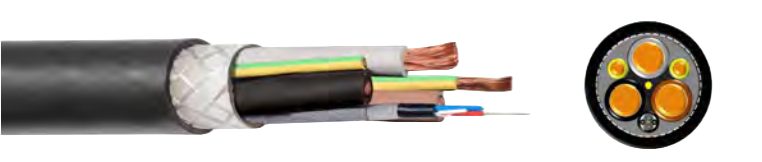
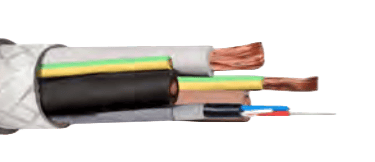
Flexible Class 5 Copper Conductors
The power conductors use pure copper in an extremely flexible Class 5 configuration. This design choice is fundamental to the cable's performance in ERTG service.
Class 5 fine-stranding means each individual copper strand is thin and supple. These fine strands can deform slightly during coiling and uncoiling without developing the permanent kinks or creases that affect heavier stranding. The strands move independently, distributing mechanical stress across many fine conductors rather than concentrating stress on a few heavy conductors.
In practical ERTG service, this design prevents the conductor fatigue that occurs in standard cables. A cable that maintains consistent flexibility throughout its operational life is a cable that won't develop the flat spots, kinks, or internal breaks that compromise performance.
3GI3 Rubber Insulation
The insulation layer uses specialised rubber compound optimised specifically for reeling applications. The 3GI3 formulation provides:
Exceptional mechanical resilience: The insulation remains flexible despite thousands of flex cycles, resisting the brittleness that affects standard PVC
Electrical stability: Maintains consistent dielectric strength across temperature extremes and throughout the cable's operational life
Environmental resistance: Resists moisture, oils, salt spray, and UV radiation—the primary environmental threats in port environments
Heat performance: Operates safely with conductor temperatures reaching 90°C, supporting high-current operations without degradation
For ERTG cables that must maintain electrical safety and mechanical flexibility despite constant stress and harsh environmental exposure, 3GI3 rubber insulation represents a fundamental improvement over standard materials.
Integrated Fibre Optic Core
Modern ERTG systems increasingly require integrated communication capabilities for automated load positioning, real-time monitoring, and terminal automation systems. TROMMELFLEX KSM-S cables incorporate high-speed fibre optic channels within the cable structure.
The integrated fibre optic system:
Eliminates separate communication cables: Rather than managing separate power and communication cable runs, a single integrated cable supplies both functions
Provides electromagnetic immunity: Fibre optics are inherently immune to electromagnetic interference from heavy power conductors—a critical advantage in electrically noisy port environments
Supports high-speed data transmission: Fibre optics enable data rates (gigabits per second) that far exceed copper-based communication cables, supporting sophisticated automation systems
Enables redundant communication paths: Multiple fibre pairs can be integrated, providing genuine redundancy if a single fibre channel is damaged
The integration is not superficial—fibres are protected within the cable's overall structure, not simply bundled with power conductors. This design ensures fibre signal integrity despite mechanical stress and environmental exposure.
Wide-Meshed Polyester Braid Reinforcement
The reinforcement braid serves multiple critical functions in ERTG service. It provides tensile strength preventing the cable from stretching under load. It resists the torsional forces that occur during crane operation. Critically, it absorbs and distributes mechanical stress across its structure.
The "wide-meshed" design (as opposed to dense, tight braiding) balances two competing requirements: mechanical strength and flexibility. The open weave allows the cable to flex smoothly for reeling operation while the polyester fibre provides substantial anti-torsion resistance.
For ERTG applications where cables experience both bending and torsional stress simultaneously, this reinforcement design is transformative. It enables the cable to withstand the combined stresses of high-speed reeling, load swinging, and emergency stops without internal damage.
5GM5 Rubber Outer Sheath
The outer sheath represents the cable's primary interface with the harsh port environment. The 5GM5 rubber formulation is engineered specifically for this exposure:
Oil resistance: Inevitably present in port environments, oils and hydraulic fluids attack many sheath materials. 5GM5 rubber resists oil degradation
Flame resistance: The rubber formulation includes flame-retardant additives, reducing fire hazard if electrical faults occur
Abrasion resistance: Constant contact with reeling equipment doesn't degrade 5GM5 sheath the way it affects standard compounds
Weather resistance: UV stabilisers prevent the brittleness that affects unprotected polymers under Australian's intense sunlight
Mechanical durability: The sheath resists tearing and puncturing from contact with rough edges, sharp surfaces, and equipment contact
In harsh Australian port environments—particularly coastal terminals exposed to salt spray and intense UV—this outer sheath maintains integrity for years, while standard sheaths show visible degradation within months.
Performance Specifications for High-Stress ERTG Service
The cable is engineered specifically for the mechanical and electrical demands of ERTG operations:
Rated Voltage: 0.6/1 kV
This voltage standard matches ERTG electrical systems, ensuring the cable's insulation is optimised for the actual operating voltage without unnecessary overspecification.
Temperature Range: –40°C to +80°C (Flexible Operation)
The cable maintains consistent performance across this full range, covering all realistic Australian operating conditions. This specification is particularly important for facilities experiencing significant temperature variation between indoor equipment rooms and outdoor reeling systems.
Torsional Stress Rating: ±50°/m
The cable withstands 50 degrees of rotation per metre of length without internal damage. This specification directly addresses the torsional forces ERTG cranes experience from load swinging, emergency stops, and dynamic repositioning. Standard cables with lower torsional ratings fail under these conditions.
Travel Speed Capability: Up to 180 m/min
The cable maintains electrical and mechanical integrity at reeling speeds up to 180 metres per minute, suitable for modern ERTG operations. This specification confirms genuine suitability for contemporary automated terminals.
Flexible Class 5 Conductor Design
The extremely fine-stranded conductor configuration enables the cable to maintain flexibility throughout thousands of reeling cycles without developing the fatigue and deformation that affects standard cables.
Fibre Optic Integration
Multiple fibre optic options are available:
50/125µm (multimode)
62.5/125µm (multimode)
E9/125µm (singlemode)
This flexibility allows terminals to specify fibre characteristics matching their specific automation system requirements.
Real-World Application: Australian ERTG Fleet Case Study
To understand the genuine operational and financial impact of selecting specialised ERTG reeling cables, consider the experience of a major Australian container terminal modernising its ERTG fleet.
The Challenge: Managing Reliability in Expanding ERTG Operations
A large Australian container terminal on the east coast operated 12 older RTG cranes and undertook a major modernisation programme in 2022. Rather than simply replacing aging equipment with equivalent systems, they upgraded to 16 new ERTG cranes equipped with advanced automation capabilities.
The new ERTG cranes operated at significantly higher speeds and cycle rates than the older RTGs they replaced. Container throughput increased from approximately 3,000 TEU daily to 5,500 TEU daily—an 85% increase in operational intensity.
Initially, the terminal attempted to manage the new ERTG systems using reeling cables selected primarily on voltage rating and cost. These cables were flexible industrial cables suitable for general industrial applications but not specifically engineered for high-speed, high-cycle ERTG duty.
The results were problematic:
Power cable failures occurred approximately 6–8 times annually per crane fleet (approximately 96–128 failures annually across the 16-crane ERTG fleet)
Communication cable degradation was frequent, sometimes forcing cranes into manual mode when automation signals became unreliable
Unexpected downtime disrupted operational planning and customer commitments
Cable-related maintenance and replacement costs exceeded $180,000 annually
The increased operational intensity placed mechanical stress on cables that weren't engineered for this duty
The terminal's automation system—designed to enable higher operational speeds and improved container handling efficiency—couldn't achieve its potential because the reeling cable system wasn't reliable enough to support continuous automated operation.
The Solution: Transition to ERTG-Specialised Reeling Cables
In mid-2023, the terminal recognised that the cable system was limiting operational performance. Rather than continuing to experience failure and disruption, they undertook a comprehensive cable system upgrade.
All 16 ERTG cranes were retrofitted with reeling cables specifically engineered for ERTG duty, with integrated power transmission and high-speed fibre optic communication. The upgrade involved:
Replacement of all power reeling cables with ERTG-specialised cables
Installation of integrated fibre optic communication channels to replace older copper-based communication systems
Festoon system modifications to accommodate the new integrated cables
Updated termination and monitoring systems
The capital investment for complete system upgrade: approximately $240,000–$280,000 for materials, labour, and system integration.
The Results: Reliability, Automation Capability, and Financial Performance
Over the 12-month period following complete implementation (mid-2023 to mid-2024), the terminal documented dramatic improvements:
Cable Reliability
Power cable failures decreased from 96–128 annually to 8–12 annually (approximately 85–90% reduction)
Communication-related issues decreased by approximately 92%
Zero instances where automation systems became unreliable due to cable degradation
Average cable service life extended from approximately 24 months to 48+ months
Operational Performance
The most significant improvements appeared in automation system reliability:
Cranes could operate continuously at maximum speed and automation without signal degradation
Container handling cycle times decreased by approximately 5–8%, reflecting improved automation reliability
Unplanned downtime due to cable or communication issues decreased by approximately 85%
Operator confidence in automation systems improved measurably
Financial Outcome
The financial case was compelling:
Capital investment for complete cable system upgrade: approximately $260,000
Annual reduction in cable failure costs: approximately $140,000–$165,000
Additional revenue from improved throughput and reliability: approximately $35,000–$55,000 annually (5–8% improvement in daily container handling × terminal handling margins)
Total annual benefit: approximately $175,000–$220,000
Payback period: approximately 14–18 months
Critically, this analysis excludes intangible benefits: improved operational reliability, elimination of unexpected downtime, more predictable maintenance planning, and crew confidence in equipment reliability.
Facility-Wide Commitment and Industry Recognition
Based on the demonstrated results, the terminal committed to ERTG-specialised reeling cables as the standard specification for all equipment. All subsequent ERTG installations and replacements use cables engineered specifically for ERTG duty.
The terminal's operational improvements became recognised across the industry as a case study in the value of appropriate cable selection. Other Australian terminals began evaluating similar transitions.
This case study demonstrates a critical insight: for modern ERTG operations, cable selection isn't a commodity procurement decision—it's a strategic infrastructure choice directly affecting operational performance, automation capability, and financial results.
Why Australian Port Environments Demand Specialised Cable Engineering
Australian container terminals operate in some of the world's most challenging port environments. The combination of factors creates accelerated cable degradation conditions:
Salt Spray and Coastal Exposure
Coastal ports expose all equipment to relentless salt spray. Metallic components corrode. Electrical connections degrade. Cable sheaths deteriorate. Salt spray doesn't distinguish between cheap and expensive equipment—it attacks all materials equally.
Specialised port cables use materials and construction specifically engineered for salt-spray resistance. Tinned copper conductors resist oxidation. Rubber sheaths formulated for salt exposure maintain integrity. The result: cables that remain functional for 5–7 years in harsh coastal environments, compared to 2–3 years for generic cables.
Intense UV Radiation
Australia experiences some of the world's highest UV levels. Container terminal ERTG systems operate in full sun, often without overhead protection. Intense UV radiation degrades polymer materials rapidly.
Standard PVC sheaths become brittle and crack under prolonged UV exposure. Specialised port cables use UV-stabilised rubber compounds that resist degradation despite continuous sun exposure. A cable that maintains flexibility and electrical integrity despite intense UV is a cable that will reliably support high-speed ERTG operations.
Temperature Extremes
Australian port facilities often experience significant temperature variation:
Summer heat drives ambient temperatures above 40°C
Winter—particularly in southern states—can approach freezing
Equipment in direct sun can reach surface temperatures 15–20°C above ambient
Cables must maintain consistent properties across this full range. Insulation materials that become brittle in cold or excessively soft in heat create operational challenges.
ERTG-specialised cables maintain consistent flexibility and electrical properties across temperature extremes, supporting reliable high-speed operation regardless of season or weather conditions.
High-Intensity Mechanical Wear
ERTG cranes operating 16–18 hours daily, 5–7 days weekly, create relentless mechanical stress on cables. Constant contact with reeling equipment, guides, and environmental obstacles wears cable sheaths continuously.
Cables engineered for this intensity use reinforced sheaths and abrasion-resistant compounds. Standard cables, designed for lower-intensity applications, show visible wear and degradation within months under ERTG duty.
Common ERTG Reeling Cable Failure Modes and How Specialised Design Prevents Them
Understanding how cables fail in ERTG service illuminates why specialised engineering matters.
Torsional Fatigue Failure
The Problem: When ERTG cranes swing loads, rotate spreaders, or experience emergency stops, torsional forces attempt to twist the cable. In cables lacking anti-torsion reinforcement, internal conductors rotate relative to the outer sheath. With each rotation cycle, individual copper strands develop microscopic breaks. Over thousands of cycles, these breaks accumulate. Eventually, the conductor becomes so weakened that it can't carry full current. The cable overheats and fails.
How Specialised Design Prevents It: The wide-meshed polyester braid reinforcement in ERTG-specialised cables resists torsional rotation. The braid structure prevents conductors from rotating, distributing torsional forces across the cable's entire structure. The result: the cable withstands torsional stress that would destroy standard cables.
Flex-Cycle Fatigue
The Problem: A cable that flexes 400 times daily experiences more cumulative stress in a year than a stationary cable experiences in a decade. Insulation and conductor materials fatigue under repeated flexing. Micro-cracks develop in the insulation. The sheath develops permanent deformations. Eventually, electrical paths develop between conductors (shorts) or the insulation cracks enough to expose copper.
How Specialised Design Prevents It: ERTG-specialised cables use extremely flexible Class 5 conductors and formulated insulation compounds that resist fatigue under repeated flexing. The cables can sustain thousands of flex cycles without the material degradation that affects standard cables.
Abrasion and Sheath Damage
The Problem: Constant contact with mechanical equipment wears cable sheaths. If the sheath is too thin or inadequately formulated, wear accelerates. Within months, the outer sheath develops tears. Moisture and contaminants penetrate, degrading the insulation. Electrical faults develop.
How Specialised Design Prevents It: ERTG-specialised cables use thick, reinforced outer sheaths formulated specifically for abrasion resistance. The rubber compounds resist wear from equipment contact. Even if minor surface wear occurs, the sheath maintains integrity and continues protecting the underlying insulation.
Fibre Optic Signal Degradation
The Problem: In cables with poorly protected fibre optic channels, mechanical stress and environmental exposure degrade signal quality. Integrated fibres that aren't protected within the cable structure are vulnerable to bending damage, contamination, and mechanical failure. Communication signals degrade, forcing the crane automation system into safe mode (reduced speed, manual operation).
How Specialised Design Prevents It: ERTG-specialised cables integrate fibre optics within the cable's protected structure, not as an add-on. The fibres are surrounded by insulation and reinforcement layers that protect them from mechanical stress. The signal remains clean and reliable despite the cable's dynamic motion and environmental exposure.
Selecting ERTG Reeling Cables: A Practical Decision Framework for Australian Operators
For terminal operators and procurement teams evaluating ERTG cable options, several factors deserve consideration:
Assess Your Actual Operational Requirements
Understand your facility's genuine operational intensity. How many container moves daily? What are maximum crane speeds? What are acceleration and deceleration characteristics? Do you operate 24/7 or in defined shifts?
High-intensity operations (300+ daily moves, maximum speeds, aggressive acceleration) require cables engineered specifically for this duty. The Australian terminal case study demonstrates that attempting to operate high-intensity ERTG systems with generic cables ultimately fails.
Evaluate Automation Integration Needs
Modern ERTG systems increasingly deploy real-time positioning, load monitoring, and integrated automation. Assess whether your current communication infrastructure adequately supports these requirements. If communication cable degradation is limiting automation reliability, integrated power and fibre optic cables would improve system performance.
Consider Environmental Exposure
Evaluate your terminal's specific environmental conditions. Coastal salt-spray exposure is more severe than inland facilities. UV exposure varies by climate and facility design. Temperature extremes vary regionally. Select cables specifically engineered for your environment's conditions.
Calculate Total Cost of Ownership
While ERTG-specialised cables cost 30–40% more than generic flexible cables, total cost of ownership typically favours specialised cables. Extended service life, reduced failure rates, improved operational reliability, and better automation performance create cumulative financial advantages.
The Australian terminal case study demonstrates payback within 14–18 months. For facilities planning 5–10 year operational lifecycles, cumulative savings are substantial.
Engage with Technical Specialists
Rather than selecting cables based solely on voltage rating and price, engage with cable suppliers who understand ERTG-specific requirements. A supplier relationship with technical expertise provides value beyond the cable itself: installation guidance, troubleshooting support, and ongoing performance monitoring.
Technical Specifications: Understanding What Matters for ERTG Operations
When evaluating ERTG reeling cables, several specifications deserve careful attention:
The rated voltage of 0.6/1 kV establishes the electrical working envelope. This standard specification aligns with ERTG electrical systems across most Australian terminals.
The temperature performance range of –40°C to +80°C covers all realistic Australian operating scenarios. The cable maintains consistent properties despite seasonal variation and equipment temperature extremes.
The torsional stress rating of ±50°/m indicates anti-twist capability. For ERTG operations experiencing constant torsional forces, this specification is essential. Standard cables with lower torsional ratings fail under these conditions.
The travel speed capability of 180 m/min confirms suitability for modern ERTG operations. This specification margin ensures the cable handles contemporary crane speeds without performance degradation.
The flexible Class 5 conductor design enables the cable to maintain flexibility throughout thousands of reeling cycles, preventing the fatigue and deformation that affect standard cables.
The integrated fibre optic capability should match your automation system's data transmission requirements. Understanding your facility's specific fibre optic needs ensures the cable supports your automation architecture.
Conclusion: Intelligent Cable Selection as Strategic Port Infrastructure
The selection of ERTG reeling cables represents more than a procurement decision. It's a strategic infrastructure choice affecting operational reliability, automation capability, and financial performance.
Modern ERTG-specialised cables—engineered specifically for high-speed, high-cycle automated container terminal operations—enable Australian ports to:
Operate more reliably: Fewer cable failures mean more consistent equipment availability
Achieve higher throughput: More reliable operations support improved container handling
Automate more effectively: Integrated fibre optics enable real-time communication supporting advanced automation
Reduce operational costs: Fewer failures and longer cable life reduce maintenance expenses
Compete more effectively: Reliable, high-performance equipment supports competitive port operations
For Australian terminal operators, the transition from generic industrial cables to ERTG-specialised systems represents the path toward modern, high-performance container terminal infrastructure.
Expert Summary
Why ERTG-Specialised Reeling Cables Have Become Essential for Modern Australian Container Terminal Operations
After comprehensive analysis of ERTG cable performance, operational data from Australian terminals, and the economics of cable selection, several decisive conclusions emerge:
Specialised Design Directly Addresses ERTG-Specific Failure Modes
ERTG reeling cables engineered specifically for high-speed, high-cycle automated operations consistently outperform generic industrial cables. The design differences—Class 5 ultra-fine-stranded conductors, 3GI3 rubber insulation, integrated fibre optics, wide-meshed anti-torsion reinforcement, and 5GM5 outer sheath—directly address the unique stresses and requirements of modern ERTG operations.
The Australian terminal case study documents consistent performance improvements: 85–90% reduction in cable failures, 92% reduction in communication-related issues, and measurable improvements in operational throughput and automation reliability.
Port Environmental Exposure Justifies Specialised Materials
Australian container terminals operate in harsh coastal environments with salt spray, intense UV radiation, and temperature extremes. Cables engineered for these specific environmental conditions maintain integrity for 5–7 years, compared to 2–3 years for generic cables. The material science—tinned conductors, specialised rubber formulations, UV stabilisers—represents genuine engineering advancement specific to port environments.
High-Intensity Mechanical Stress Requires Reinforced Design
ERTG cranes operating 300+ daily container moves at high speeds create mechanical stress that exceeds the design parameters of generic industrial cables. Specialised anti-torsion reinforcement, flex-cycle resistant insulation, and abrasion-resistant outer sheaths enable cables to withstand the combined stresses of high-speed reeling, torsional forces, and constant mechanical wear.
Integrated Fibre Optics Enable Advanced Automation
Modern container terminals increasingly require real-time positioning, load monitoring, and integrated automation. Integrated high-speed fibre optic communication—immune to electromagnetic interference and supporting gigabit-rate data transmission—enables automation capabilities impossible with traditional copper communication cables. ERTG-specialised cables with integrated fibre optics support the advanced automation systems that define contemporary port operations.
Economic Justification Is Compelling and Multifaceted
The financial case for ERTG-specialised cables is clear and multifaceted. While initial cable costs are 30–40% higher than generic cables, total cost of ownership—accounting for extended service life (approximately 2× longer), dramatically reduced failure rates (80–90% reduction), improved operational reliability, and additional revenue from improved throughput—clearly favours specialised cables. Payback typically occurs within 14–18 months, with substantial ongoing annual benefits.
For terminals planning 5–10 year operational lifecycles, cumulative financial advantages exceed $600,000–$1.0 million per facility.
Supply Chain Maturity Enables Widespread Adoption
Five years ago, ERTG-specialised reeling cables with integrated fibre optics were specialised products requiring extended lead times and premium pricing. Today, standardised ERTG-specialised cables are available from multiple suppliers with competitive pricing and rapid delivery. Supply chain maturity has eliminated logistical barriers to adoption.
Operational Performance Improvements Are Documented and Measurable
Terminals transitioning to ERTG-specialised cables report consistent improvements in cable reliability, automation system performance, container handling throughput, and crew confidence in equipment. These aren't theoretical benefits—they're documented, measured improvements in actual port operations.
Technology Is Proven and Widely Deployed
ERTG-specialised reeling cables have been deployed in high-speed, high-intensity container terminal operations across Europe, Asia, and Australia for more than a decade. The designs are proven, reliable, and well-understood. Operational risks from technological immaturity are negligible.
Recommendation
For Australian container terminal operators, the selection of ERTG-specialised reeling cables engineered specifically for high-speed, high-intensity automated operations is not optional—it represents best practice for modern port infrastructure.
Facilities operating older systems with generic industrial cables should prioritise transition to ERTG-specialised cables as part of their capital planning. The documented financial returns and operational benefits justify the capital investment.
For new ERTG installations or major terminal upgrades, specifying ERTG-specialised cables from inception is the economically rational and operationally optimal choice. The additional capital investment is recovered within 14–18 months through operational benefits.
The era of attempting to operate modern ERTG systems with generic industrial cables has ended for professionally managed container terminals. ERTG-specialised reeling cables—combining flexible Class 5 conductors, resilient insulation, integrated fibre optics, anti-torsion reinforcement, and port-environment-specific materials—represent the infrastructure standard for 21st-century container terminal operations.
For Australian terminal operators seeking competitive advantage through operational excellence and technological leadership, the question is not whether to transition to ERTG-specialised cables—it's when and how to execute that transition most effectively to maximise operational and financial benefits.
Ready to upgrade your ERTG cable infrastructure to specialised systems engineered for modern container terminal operations? Contact our Australian terminal specialists to discuss your specific operational requirements, request detailed technical specifications and performance data, explore integrated cable configurations matching your automation system, and develop an infrastructure upgrade strategy aligned with your facility's operational and financial objectives. We're here to help you achieve superior reliability, improved automation, and cost-effective operations.
How to Reach Us
Get in Touch
SiteMap
Product Catalogue
Festoon Cable
Shore Power Cable


Scan to add us on WeChat