
NSHTÖU Reelable Cable – VDE Certified, Oil-Resistant Rubber Design for Heavy-Duty Crane & Reeling Applications
Discover NSHTÖU reelable control cable: VDE 0250-814 certified, oil resistant rubber construction, ideal for cranes, mining, and heavy mobile equipment with high tensile & torsional stress.
hongjing.Wang@Feichun
2/9/20268 min read
In the demanding world of heavy industrial operations, cable failures can bring entire production lines to a halt, compromise worker safety, and result in costly downtime. Cranes, hoists, mining machinery, container handling systems, and mobile transport equipment all share a common challenge: they require electrical connections that can withstand relentless mechanical stress, harsh environmental conditions, and continuous movement. Standard cables simply aren't engineered for these extreme demands, often succumbing to oil degradation, torsional fatigue, or insulation breakdown within months of installation.
This is where specialized reelable control cables become essential. The NSHTÖU cable represents a proven German-standard solution engineered specifically for environments where ordinary cables fail. Combining a reelable design optimized for drum applications with excellent oil resistance and robust rubber construction, this cable type has become an industry benchmark for reliability in the most challenging industrial settings.


What is NSHTÖU Cable?
NSHTÖU is a heavy-duty, low-voltage reeling cable that complies with DIN VDE 0250-814, a rigorous German standard that defines performance requirements for control and connection cables in demanding applications. The designation itself provides insight into its construction: the "Ö" indicates a neoprene or polychloroprene outer sheath, while "H" signifies heavy-duty reeling applications. This naming convention, common in European cable standards, helps engineers quickly identify suitable cables for specific environments.
Within the European market, NSHTÖU has established itself as a widely recognized standard for drum-reeling and pendant applications. Its design addresses the unique stresses encountered when cables must be repeatedly wound and unwound on drums while simultaneously carrying electrical current and withstanding substantial tensile forces. The cable typically carries a voltage rating of 600/1000 V (U₀/U), making it suitable for control circuits and power distribution in industrial machinery.
Key Technical Specifications
Understanding the technical parameters of NSHTÖU cables is crucial for proper application selection and installation planning.
Temperature Performance
The cable demonstrates impressive temperature versatility, functioning reliably across a broad range:
Flexible applications: -25°C to +80°C
Fixed installations: -40°C to +80°C
This temperature range ensures performance in both Arctic mining operations and hot industrial environments, from outdoor winter construction sites to heated factory floors.
Voltage Ratings and Electrical Safety
The nominal voltage rating of AC 600/1000 V provides a solid foundation for most industrial control applications. However, the cable's electrical performance extends beyond these basic parameters:
Maximum permissible operating voltage (AC conductor to earth): 700 V
Three-phase AC (conductor to conductor): 1200 V
DC conductor to earth: 900 V
DC conductor to conductor: 1800 V
Core-to-core test voltage: 2500 V
These ratings demonstrate substantial safety margins, ensuring reliable operation even under voltage transients common in industrial power systems.
Mechanical Performance Characteristics
The mechanical specifications reveal why NSHTÖU excels in reeling applications:
Maximum tensile stress: 15 N/mm² during installation and operation
Minimum bending radius: 5× outer diameter (cables ≤20 mm) or 6× outer diameter (cables >20 mm)
Maximum acceleration: 0.4 m/s²
Maximum velocity: 120 m/min for horizontal reeling
These parameters define the operational envelope within which the cable can perform reliably over extended service life.
Construction Details
The cable's performance stems from its carefully engineered construction:
Conductors: Tinned copper, finely stranded to Class 5 according to DIN VDE 0295 and IEC 60228. This fine stranding provides the flexibility essential for repeated bending cycles while maintaining electrical conductivity. The tinning protects against corrosion in harsh environments.
Core Insulation: Rubber compound type 3GI3 according to DIN VDE 0207-20, providing excellent electrical insulation properties and mechanical resilience.
Core Identification: Cables with 3-5 cores use color-coded identification, while 7-50 core variants employ black cores with consecutive white numbering. The protective conductor, when present (indicated by "G"), features green-yellow coloring and is positioned in the outer layer.
Sheath System: The cable employs a multi-layer protective system consisting of:
Inner rubber sheath
Anti-torsion protective layer (critical for reeling applications)
Outer sheath of oil-, ozone-, and weather-resistant rubber (compound type 5GM3)
Black exterior color
This sophisticated construction creates a cable that can withstand mechanical abuse while maintaining electrical integrity.
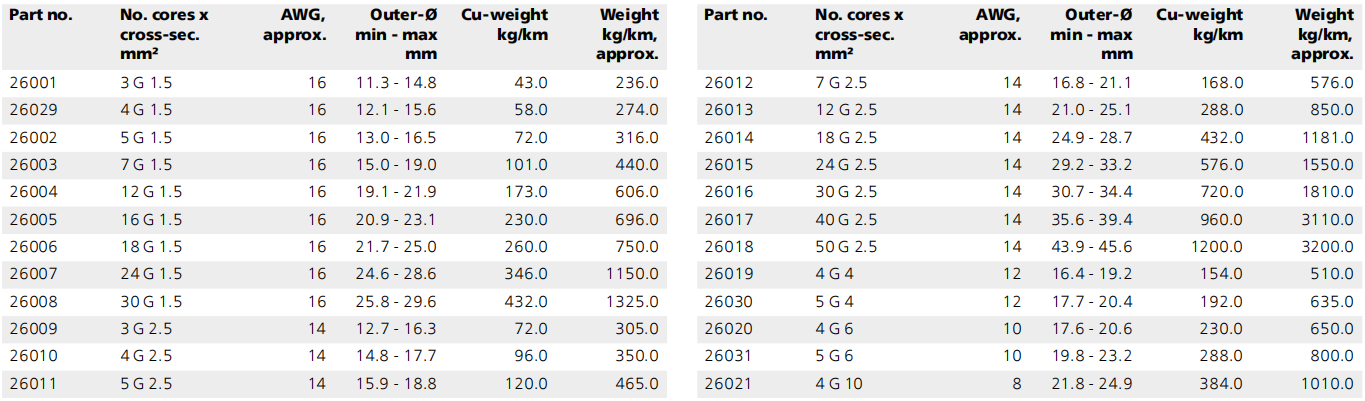
Standout Properties and Advantages
What truly distinguishes NSHTÖU from conventional control cables is its comprehensive resistance profile and mechanical robustness.
Chemical and Environmental Resistance
The cable demonstrates outstanding resistance to the harsh substances commonly encountered in industrial environments:
Oils and greases
Petroleum products
Acids and chemical agents
Solvents
Ozone and UV radiation
Mechanical abrasion
This resistance spectrum makes NSHTÖU particularly valuable in applications where cable contact with lubricants, hydraulic fluids, or cleaning agents is unavoidable. The oil-resistant sheath, specifically formulated to meet DIN VDE 0473-811-404 standards, prevents the degradation that rapidly destroys standard PVC-jacketed cables in oil-contaminated environments.
Mechanical Durability
The cable's ability to withstand frequent winding and unwinding operations, combined with simultaneous tensile and torsional stress, sets it apart from standard flexible cables. The anti-torsion protective layer and optimized conductor lay lengths work together to prevent the internal structural damage that typically limits the service life of cables in dynamic applications.
Weather Resistance and Outdoor Performance
Designed for outdoor use, NSHTÖU maintains performance in wet, damp, and fully exposed conditions. The weather-resistant rubber sheath resists UV degradation, ozone attack, and temperature cycling, ensuring long service life in outdoor crane installations, harbor equipment, and mobile machinery.
Safety Features
Many versions of NSHTÖU incorporate flame-retardant behavior according to DIN VDE 0482-332-1-2 / DIN EN 60332-1-2 / IEC 60332-1-2, with low smoke characteristics that enhance safety in enclosed spaces. The cable has also received EAC certification, demonstrating compliance with Eurasian Conformity requirements.
Typical Applications
The unique properties of NSHTÖU cables make them the preferred choice for numerous demanding applications:
Crane Systems
Tower cranes, gantry cranes, and harbor cranes all benefit from NSHTÖU's ability to handle continuous reeling operations. These installations subject cables to constant movement, weight loading, and exposure to weather and industrial atmospheres. The cable's torsion resistance prevents the twisting failures common in crane pendant applications.
Drum Reeling on Mobile Equipment
Construction machinery, mining vehicles, and material handling systems that incorporate cable drums find NSHTÖU ideally suited to their needs. The cable's flexibility combined with high tensile strength allows it to wind smoothly onto drums while resisting the crushing forces that develop in lower cable layers.
Mining Operations
Underground and surface mining equipment operates in some of the harshest environments imaginable—wet, dusty, subject to chemical exposure, and requiring absolute reliability. NSHTÖU's comprehensive resistance profile and mechanical robustness make it a natural choice for mining conveyors, drilling equipment, and mobile machinery.
Container Handling and Port Operations
Ship-to-shore cranes, container spreaders, and automated stacking cranes operate continuously in marine environments where salt spray, temperature extremes, and constant motion challenge cable integrity. NSHTÖU's weather resistance and reeling capability ensure reliable operation in these critical logistics operations.
Railway and Mobile Transport Systems
Railway maintenance vehicles, mobile cranes, and specialized transport equipment require cables that can move with the machinery while maintaining electrical integrity. The cable's design accommodates both horizontal reeling and the vibration inherent in mobile applications.
Why Choose NSHTÖU Over Other Reeling Cables?
When comparing reeling cable options, several factors distinguish NSHTÖU from alternatives:
Proven VDE Standard Versus Generic Solutions
The DIN VDE 0250-814 standard represents decades of engineering experience distilled into specific performance requirements. Cables meeting this standard have demonstrated reliability in real-world applications, whereas generic rubber cables may lack the optimized construction necessary for extended reeling service.
Balanced Price-Performance for Heavy-Duty Applications
While premium cables exist for extreme applications, NSHTÖU delivers robust performance at a price point suitable for medium-to-heavy reeling duty. This balance makes it economically viable for installations requiring reliable operation without the cost premium of specialized designs.
Superior Chemical Resistance
Many PVC-based alternatives suffer rapid degradation when exposed to oils, hydraulic fluids, and industrial chemicals. NSHTÖU's rubber compound maintains integrity in these environments, extending service life and reducing maintenance costs.
Enhanced Torsion Stability
The anti-torsion protective layer and carefully calculated conductor lay lengths provide superior resistance to twisting forces compared to standard flexible cables. This engineering detail significantly extends service life in pendant and drum applications where torsional stress would quickly damage ordinary cables.
Field-Proven Reliability
Decades of use throughout Europe in demanding industrial applications provide confidence in NSHTÖU's long-term performance. This operational history reduces risk compared to newer cable designs with limited field validation.

Common Cable Problems and Solutions
Understanding potential issues helps ensure successful NSHTÖU installations:
Problem: Premature Cable Failure in Reeling Applications
Question: Why do some cables fail after only weeks or months in reeling applications despite being rated as "flexible"?
Answer: Standard flexible cables lack the internal construction necessary for reeling service. They may have adequate flexibility for occasional movement but weren't engineered for the combined stresses of continuous winding, tensile loading, and torsion. NSHTÖU's layered conductor stranding with optimized lay lengths, anti-torsion layer, and reinforced sheath system specifically address these stresses. Proper cable selection based on the actual mechanical demands prevents premature failure.
Problem: Oil Contamination Damage
Question: What happens when standard cables are exposed to hydraulic oil or lubricants in crane and machinery applications?
Answer: Most PVC and basic rubber compounds swell, soften, or become brittle when exposed to oils, leading to insulation breakdown and eventual failure. NSHTÖU's compound type 5GM3 outer sheath resists oil penetration, maintaining mechanical and electrical properties even with continuous exposure. For installations where oil contact is inevitable, specifying oil-resistant cables prevents costly premature replacement.
Problem: Excessive Bending Radius Violations
Question: How do I determine the correct drum diameter for my application?
Answer: The minimum bending radius specification (5× or 6× outer diameter depending on cable size) defines the smallest radius the cable can tolerate without internal damage. For a cable with 20 mm outer diameter, the minimum bending radius is 100 mm, requiring a drum diameter of at least 200 mm. Installing on smaller drums causes conductor stress, insulation cracking, and shortened service life. Always verify that drum dimensions exceed minimum bending radius requirements.
Problem: Tensile Overload
Question: Can I use NSHTÖU in vertical reeling applications with heavy hanging loads?
Answer: The maximum tensile stress of 15 N/mm² limits vertical applications based on cable cross-section and load weight. Calculate total stress by dividing the suspended load (in Newtons) by the total conductor cross-sectional area (in mm²). If this exceeds 15 N/mm², either increase the cable size or incorporate mechanical strain relief. The cable is optimized for horizontal reeling where tensile stress remains within design limits.
Problem: Exceeding Speed or Acceleration Limits
Question: What happens if I operate above the specified maximum velocity of 120 m/min?
Answer: Exceeding velocity or acceleration limits (0.4 m/s²) generates heat through internal friction and increases mechanical stress on cable components. This accelerates wear, potentially leading to premature failure. High-speed applications may require specialized cables with enhanced construction. Always verify that actual operating parameters remain within cable specifications.
Installation and Handling Recommendations
Proper installation ensures NSHTÖU cables deliver their designed service life:
Minimum Bending Radius During Reeling
Never exceed the minimum bending radius during installation or operation. Select drum sizes that accommodate the cable's outer diameter with adequate margin. Violating bending radius specifications causes invisible internal damage that manifests as premature failure.
Tensile Force Limits
When pulling cables through conduit or onto drums, monitor pull force to remain below 15 N/mm². Use lubricants approved for rubber cables to reduce friction during installation pulls.
Horizontal Drum Reeling Best Practices
Position drums to minimize side loading and ensure even spooling. The cable performs optimally in horizontal reeling configurations where gravitational forces don't add to tensile stress. Maintain consistent winding tension to prevent loose layers that can cause crushing damage.
Installation Environment Considerations
While NSHTÖU is suitable for dry, damp, wet, and outdoor installations, protect cable ends during installation to prevent moisture ingress during the construction phase. Use appropriate glands and sealing to maintain the cable's environmental protection.
Conclusion
In applications where ordinary cables quickly succumb to mechanical stress, chemical exposure, or environmental conditions, NSHTÖU reelable cables deliver the reliable performance that industrial operations demand. The combination of VDE-certified quality standards, oil-resistant heavy-duty rubber construction, and proven field experience provides engineers with confidence in long-term reliability.
When your application involves constant reeling cycles, exposure to oils and chemicals, outdoor weather extremes, or high mechanical stress, the investment in properly specified reelable cables pays dividends through reduced downtime, extended service intervals, and enhanced operational safety. NSHTÖU represents an industry-proven choice backed by decades of successful installations across Europe's most demanding industrial sectors.
The cable's comprehensive resistance profile, mechanical robustness, and adherence to rigorous German standards make it worthy of consideration for any application where cable failure could compromise productivity or safety. By understanding the technical specifications, proper application parameters, and installation best practices, engineers can leverage NSHTÖU's capabilities to build reliable electrical infrastructure in even the most challenging environments.
How to Reach Us
Get in Touch
SiteMap
Product Catalogue
Festoon Cable
Shore Power Cable




Scan to add us on WeChat