
OS1 vs OS2 Single-Mode Fibre: What's the Difference and Which Should You Choose?
Learn the difference between OS1 and OS2 single-mode fibre. Compare attenuation, distance capability, indoor vs outdoor applications, and fibre selection for Australian industrial networks.
hongjing.Wang@Feichun
6/2/202619 min read
There is a question that comes up regularly in the early stages of industrial network design, and it is one that catches out more engineers than you might expect: if OS1 and OS2 are both single-mode fibres with the same 9/125 µm geometry, why does it matter which one you specify?
The short answer is that the geometry is where the similarity ends. The differences between OS1 and OS2 — in attenuation performance, construction, environmental suitability, and transmission distance capability — are significant enough to affect network reliability, scalability and long-term cost in ways that are not immediately obvious from a datasheet comparison. For Australian mining operations, port infrastructure and industrial communications networks, where fibre runs are long, environments are harsh, and the cost of network downtime is high, making the right call on fibre specification matters a great deal.
This guide works through what OS1 and OS2 actually are, how they differ in practice, and which one belongs in which application — with particular focus on the industrial, mining and port scenarios that are increasingly driving fibre optic network deployment across Australia.
What Are OS1 and OS2 Single-Mode Fibres?
OS1 and OS2 are both classifications of single-mode optical fibre, defined under the IEC 60793-2-50 standard. Both use the same physical fibre geometry — a 9 micrometre core surrounded by a 125 micrometre cladding — which means they are fundamentally compatible with the same connectors, transceivers and active equipment. But the classification reflects meaningful differences in fibre quality and performance that translate into very different real-world capabilities.
OS1 was the original single-mode fibre classification, intended primarily for indoor structured cabling applications — building backbones, data centre interconnects, equipment room links. It is typically deployed in tight-buffered cable constructions, where each fibre strand is individually coated and surrounded by a thermoplastic buffer layer that provides mechanical protection and makes the cable straightforward to handle and terminate inside buildings.
OS2 is the higher-performance classification, optimised for outdoor, long-distance and industrial applications. It typically appears in loose-tube cable constructions, where fibres sit in gel-filled or dry-blocked tubes that provide excellent environmental protection — moisture resistance, temperature performance, and protection against the mechanical stresses of outdoor installation. OS2's critical performance advantage over OS1 is its significantly lower attenuation specification, which is what enables the longer transmission distances that outdoor and industrial networks require.
Understanding these two classifications properly means understanding attenuation — because that is the number that determines how far a signal can travel before it degrades to a level that the receiving equipment can no longer reliably decode.
Understanding Single-Mode Fibre Technology
Before going further into the OS1 versus OS2 comparison, it is worth establishing what single-mode fibre actually does and why it is the technology of choice for industrial and long-distance communication networks.
Fibre optic cables transmit data as pulses of light travelling through the glass core of the fibre. The core diameter determines how many distinct paths — or modes — the light can travel. Multimode fibres, which have a larger core diameter of 50 or 62.5 micrometres, allow light to travel in multiple modes simultaneously. This works well over short distances but causes a phenomenon called modal dispersion — different modes of light arrive at the receiver at slightly different times, which limits both the bandwidth and the transmission distance of the link.
Single-mode fibre, with its much smaller 9 micrometre core, constrains the light to travel in a single mode — essentially a single path through the core. This eliminates modal dispersion, which means single-mode fibre can carry much higher bandwidth signals over much greater distances than multimode fibre. For industrial applications where network links may span hundreds of metres across a mine site or processing facility, or several kilometres between substations and control centres, single-mode fibre is the appropriate technology.
The trade-off is that single-mode fibre requires laser-based transceivers rather than the LEDs that can be used with multimode fibre, and the termination process for single-mode fibre demands tighter tolerances. But for any application where transmission distance exceeds a few hundred metres, or where bandwidth requirements are high, these are constraints well worth accepting.
Both OS1 and OS2 share the benefits of single-mode fibre technology. The distinction between them comes down to how well each performs that fundamental task of transmitting light with minimal loss.
The Biggest Difference Between OS1 and OS2: Attenuation
Attenuation is the technical term for the gradual reduction in optical signal power as light travels through the fibre. As photons travel down the glass core, they encounter impurities, microscopic variations in the glass structure, and geometric imperfections that cause some of the light to scatter or be absorbed. The result is that the optical signal at the far end of a fibre link is weaker than the signal that entered — and the longer the link, the weaker the received signal.
Every fibre optic link has a power budget: the difference in optical power level between what the transmitter puts into the fibre and the minimum level the receiver needs to correctly decode the signal. Attenuation consumes this power budget at a rate of so many decibels per kilometre, which means the attenuation specification of the fibre directly determines the maximum link length before the power budget is exhausted.
This is why the OS1 versus OS2 attenuation difference is the most important practical distinction between the two fibre types.
OS1 Attenuation
OS1 fibre is specified to a maximum attenuation of 1.0 dB per kilometre at the 1310 nanometre wavelength and 1.0 dB per kilometre at the 1550 nanometre wavelength. These are the two wavelengths most commonly used in single-mode fibre optic communications. For short indoor links — a few hundred metres within a building, or a kilometre or two across a campus — this attenuation level is manageable within the power budgets of standard transceivers.
For longer links, however, OS1's 1.0 dB/km attenuation starts to become a significant constraint. A 10 kilometre link at OS1 attenuation consumes 10 dB of power budget from attenuation alone, before accounting for connector losses, splice losses, and any margin required for future degradation. That is a substantial portion of the typical 20-30 dB power budget available from standard single-mode transceivers, and leaves limited headroom for a long installation life.
OS2 Attenuation
OS2 fibre is specified to a maximum attenuation of 0.4 dB per kilometre at 1310 nm and 0.4 dB per kilometre at 1550 nm — less than half the attenuation of OS1. This step change in performance is what separates OS2 from OS1 in practical terms and is what makes OS2 the appropriate specification for any link of meaningful length.
At OS2 attenuation, that same 10 kilometre link consumes only 4 dB of power budget from attenuation, rather than 10 dB. The remaining budget is available to accommodate connector losses, splice losses, and degradation over the life of the installation — providing a comfortable link margin that supports reliable long-term operation. For a 50 kilometre link — which is not unusual in remote mining or utility applications — OS2's lower attenuation is not just an advantage. It is what makes the link achievable with standard transceivers.
It is worth noting that OS2 fibre achieves its lower attenuation partly through tighter manufacturing tolerances and the use of ultra-low water peak fibre, which reduces a particular source of attenuation at the 1383 nm wavelength. This makes OS2 compatible with a broader range of wavelengths, which is relevant for dense wavelength division multiplexing (DWDM) applications where multiple data channels are transmitted simultaneously over a single fibre at different wavelengths.
OS1 vs OS2: Cable Construction and What It Means in Practice
One of the most common sources of confusion when comparing OS1 and OS2 is conflating the fibre classification with the cable construction. These are two related but distinct concepts, and understanding the difference is important for making correct procurement and specification decisions.
Tight-Buffered Construction: The Typical OS1 Format
Tight-buffered cable construction surrounds each individual fibre strand with a thermoplastic buffer layer applied directly to the fibre coating. This construction makes the cable more mechanically robust against crushing and impact, easier to handle and strip for termination, and well suited to indoor installation environments. The fibres in a tight-buffered cable can typically be terminated with standard fusion splicing or mechanical connector methods without the need for specialised fan-out kits.
Tight-buffered cables are well suited to indoor applications: structured cabling within data centres, building backbone links, control room interconnections, and short outdoor runs in protected conduit. They tend to be more flexible than loose-tube constructions of equivalent fibre count, which makes them practical for installation in the confined spaces of equipment rooms and cable trays inside buildings.
OS1 fibre is most commonly found in tight-buffered constructions, because the applications for which OS1 is appropriate — indoor, shorter-distance links — align naturally with the characteristics of this cable type. However, it is important to understand that tight-buffered construction is also available with OS2 fibre, and many indoor installations benefit from specifying OS2 fibre in a tight-buffered cable — gaining the performance headroom of OS2 while retaining the handling and termination advantages of tight-buffered construction.
Loose-Tube Construction: The Typical OS2 Format
Loose-tube cable construction takes a fundamentally different approach. Fibres are housed in loose tubes — typically twelve fibres per tube — and the space within the tubes is filled with water-blocking gel or dry water-blocking tape. The loose tubes themselves are stranded around a central strength member, and the whole assembly is enclosed in an outer jacket appropriate for the installation environment.
The key characteristics of loose-tube construction flow directly from this design. The gel or water-blocking filling provides excellent moisture resistance — the fibres are physically isolated from any water that penetrates the outer jacket, preventing the water ingress that can degrade fibre performance over time. The loose tube design also provides thermal buffering: as the cable expands and contracts with temperature changes, the fibres can move slightly within the loose tubes without being subjected to mechanical strain, which is critical for outdoor installations that experience large temperature swings.
Loose-tube cables are the standard choice for outdoor burial, aerial installation, and any environment where moisture, temperature variation or UV exposure is a consideration. Their slightly more complex termination process — the tubes need to be opened and fibres fanned out before splicing or connector attachment — is a manageable trade-off for the environmental protection they provide.
OS2 fibre in loose-tube construction is the appropriate specification for the majority of outdoor and industrial fibre installations: campus networks, outdoor conduit runs, direct buried cables, and the long-distance links that characterise mining and infrastructure applications.
Distance Capability: How Far Can OS1 and OS2 Actually Transmit?
The transmission distance achievable on a fibre optic link is not a fixed number — it depends on the interaction between the fibre's attenuation, the transceiver's power budget, connector and splice losses, and the margin required for reliable long-term operation. But in practical terms, the attenuation difference between OS1 and OS2 translates into a very significant difference in achievable link lengths.
For OS1 fibre used with standard single-mode transceivers, practical indoor link distances are typically in the range of a few kilometres — sufficient for building backbone applications, campus interconnections within a relatively compact site, and data centre interconnects. Beyond approximately five to ten kilometres, OS1's attenuation begins to exhaust the power budget of standard transceivers, and longer links require either optical amplification or higher-powered transceivers.
OS2 fibre, with its 0.4 dB/km maximum attenuation, can support link distances of tens to hundreds of kilometres depending on the transceiver type. Standard single-mode transceivers used with OS2 fibre can typically support links of 20 to 40 kilometres. Extended-reach transceivers designed for single-mode operation can push this to 80 kilometres or beyond. Coherent optical transmission systems used in telecommunications and major utility networks can operate over hundreds of kilometres on OS2 fibre without mid-span amplification.
For Australian industrial applications, these numbers are directly relevant. A mining operation in the Pilbara with a processing facility and remote substations spread across 30 kilometres of site infrastructure needs fibre that can handle those distances reliably. A port terminal with crane systems at both ends of a long wharf, connected to a central network room, may have fibre runs of several kilometres. A solar farm in regional Queensland with SCADA communication links spanning the full extent of the site will have similar requirements. In all of these scenarios, OS2 is not just a better choice — it is the specification that makes the network design viable.
OS1 vs OS2 for Australian Industrial Applications
The characteristics of Australian industrial, mining and port infrastructure make this a particularly important topic for the Australian market. The combination of large site footprints, remote locations, harsh environmental conditions and high dependence on reliable communications creates a set of requirements that consistently point toward OS2 as the appropriate fibre specification.
Mining Operations in Western Australia and Queensland
Underground and open-cut mining operations present some of the most demanding environments for fibre optic infrastructure anywhere in the world. Long cable runs from the surface to underground workings, or across the surface footprint of a large open-cut mine, are measured in kilometres rather than metres. The fibre network carries a wide range of critical functions: voice communications for the workforce, data links from production monitoring systems and sensors, video surveillance feeds, and increasingly the control communications for autonomous equipment including haul trucks, drills and loaders.
In underground mining environments, fibre cables must contend with water ingress from groundwater and process water, temperature variations between surface and underground workings, and the mechanical abuse of an active underground environment. OS2 fibre in a robust armoured loose-tube cable construction — with appropriate crush resistance and moisture protection — is the appropriate specification for these conditions. The low attenuation of OS2 is essential for achieving reliable links over the distances involved, and the environmental robustness of a quality loose-tube armoured cable design is essential for surviving the underground environment.
At a typical large iron ore operation in the Pilbara, for instance, the fibre network backbone might span 40 to 50 kilometres between the mine, the processing facility and the port loading facility. That network may carry operational communications for hundreds of workers, real-time data from hundreds of sensors and monitoring points, and the control links for autonomous equipment that operates continuously. OS2 is the only single-mode fibre specification that can support links of this length with standard transceivers, and the investment in quality OS2 fibre and robust cable construction pays for itself in network reliability across the life of the installation.
Port and Crane Infrastructure
Modern port facilities present a different but equally demanding set of requirements. Ship-to-shore cranes, rubber-tyred gantries and stacker reclaimers are increasingly network-connected — their control systems, diagnostic interfaces, camera systems and operational monitoring all depend on reliable communications infrastructure. As crane automation advances, with remote operation and semi-autonomous systems becoming more common at Australian ports, the communications network is no longer a convenience. It is a safety-critical operational system.
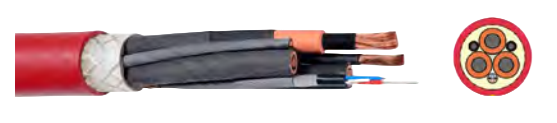
The specific challenge in crane infrastructure is that some of these communication links need to travel through or alongside the crane's power cable — through the reeling drum and along the cable run between the fixed infrastructure and the moving machine. This is where hybrid fibre optic crane cables come into the picture. These cables integrate optical fibre communication cores alongside the power conductors within a single cable construction designed for the mechanical demands of crane reeling applications.
A hybrid crane cable for a ship-to-shore crane might include, for instance, three medium-voltage power cores and a set of OS2 single-mode fibre cores within a single flexible construction engineered for high-cycle reeling service. The OS2 fibre within these hybrid cables provides the communication link between the crane's onboard systems and the terminal's network infrastructure, while the power cores carry the crane's drive power. Integrating both functions in a single cable simplifies the cable management, reduces the number of penetrations through the reel drum, and ensures that the communication link moves with the power cable as the crane traverses the wharf.
The choice of OS2 rather than OS1 fibre in these hybrid cable applications reflects the transmission distance requirements of port-scale fibre links and the importance of having adequate link margin in a demanding mechanical environment where connector and splice losses may be higher than in a controlled indoor installation.
For RTG cranes operating in a container yard, the communication infrastructure follows the crane as it moves between rows. Festoon cable systems on RTGs increasingly incorporate fibre optic elements alongside power and control conductors, and again OS2 is the appropriate fibre specification for the link lengths and environmental conditions involved.
Renewable Energy Projects
The rapid expansion of large-scale solar and wind energy projects across Australia has created a significant new demand for robust long-distance fibre optic infrastructure. A utility-scale solar farm — and there are many being built across Queensland, New South Wales, South Australia and Western Australia — might cover several hundred hectares, with SCADA monitoring points, inverter communication links and protection systems distributed across the full site area.
The fibre backbone of a large solar farm SCADA network can easily span 10 to 20 kilometres within the site boundary, with additional long-distance links to the utility's network for grid integration and remote monitoring. All of these links require outdoor-rated fibre with sufficient distance capability to serve the full site, and OS2 in a robust armoured or direct-burial cable construction is the standard specification for these applications.
Battery energy storage systems — which are increasingly co-located with solar farms or deployed as standalone grid assets — add communication requirements of their own, with battery management systems, protection relays and monitoring equipment all requiring network connectivity. As these assets move toward remote monitoring and operation, the reliability of the fibre communication infrastructure becomes directly linked to the safe and efficient operation of the storage system.
Can OS2 Replace OS1? And Why Most New Projects Are Choosing OS2 by Default
The practical answer to whether OS2 can replace OS1 is yes — OS2 can be used in any application where OS1 would be appropriate, and provides better performance in all of them. The connectors are the same, the transceivers are the same, and the active network equipment makes no distinction between OS1 and OS2 fibre.
The converse is not reliably true. OS1 cannot replace OS2 in applications that rely on OS2's lower attenuation for their link distance, and using OS1 in an outdoor or harsh environment application is inappropriate regardless of attenuation, because OS1 cable constructions are typically not rated for the environmental conditions involved.
This asymmetry is why many infrastructure projects and network designers have moved toward specifying OS2 as the default single-mode fibre for all new installations, regardless of whether the initial link distances strictly require OS2's lower attenuation. The reasoning is straightforward: a network built with OS2 fibre can be extended, upgraded and reconfigured in the future with confidence that the fibre infrastructure will support whatever the new requirements turn out to be. A network built with OS1 fibre may hit distance or performance constraints when future upgrades are planned, requiring fibre replacement rather than simply equipment upgrades.
In Australian industrial and infrastructure contexts, where installations are expected to operate for decades and network requirements will inevitably evolve, the additional cost of OS2 over OS1 — which is modest on a per-metre basis — is a sound investment in future flexibility.
Connector and Equipment Compatibility Between OS1 and OS2
Because OS1 and OS2 share the same 9/125 µm fibre geometry, they use the same connector types and are compatible with the same transceivers and active network equipment. The connector landscape for single-mode fibre in Australian industrial installations includes the LC connector — the dominant connector type in modern data centre and enterprise networking equipment, offering a compact duplex design suitable for high-density patch panels — and the SC connector, which is larger than the LC but widely used in older installations and some industrial equipment. ST and FC connectors are found in legacy installations and certain specialist applications.
When OS1 and OS2 fibres are joined in a link — either through a splice or through a mating connection at a patch panel — the performance of that portion of the link is governed by the higher-attenuation fibre. If a 500-metre OS1 patch cable is connected to a 20-kilometre OS2 outdoor run, the OS1 segment will introduce 0.5 dB of attenuation against the OS2 segment's contribution of 8 dB. The combined link will have a total fibre attenuation of 8.5 dB rather than the 8 dB that a pure OS2 link would deliver. This is a modest penalty in most cases, but it is worth understanding that mixing OS1 and OS2 in a single link is not cost-free.
For high-performance links where every decibel of link budget matters — or for links where future extension is anticipated — keeping the full link in OS2 is the cleaner specification approach.
Transceivers for single-mode fibre are specified for single-mode operation and will work with both OS1 and OS2 fibre. The limiting factor in most transceiver specifications is the maximum link attenuation the transceiver can support, which determines the maximum link length. Because OS2 fibre produces lower attenuation per kilometre, the same transceiver will support longer links on OS2 than on OS1 — a direct practical consequence of the attenuation difference.
Cost Comparison: Is OS2 Worth the Investment?
The cost difference between OS1 and OS2 fibre cable on a per-metre or per-kilometre basis is relatively modest — OS2 typically costs somewhat more than OS1, reflecting the tighter manufacturing tolerances and, in loose-tube outdoor constructions, the more complex cable design. However, the cable itself is rarely the dominant cost element in a fibre optic network installation. Civil works — conduit, trenching, cable bridges, junction boxes — typically dwarf the cable material cost, as does the labour for installation, splicing and commissioning.
Against these total project costs, the incremental cost of specifying OS2 over OS1 is small. Against the cost of replacing or augmenting fibre infrastructure because an OS1-specified network cannot support future requirements, it is extremely small.
For Australian industrial and infrastructure projects, where sites are often large, remote, and difficult and expensive to work on, the cost of revisiting fibre infrastructure is high. Trenching across an operating mine site or port terminal involves operational disruption, specialised contractors, and the logistical complexities of a live industrial environment. Installing the right fibre the first time is far cheaper than installing the wrong fibre and then needing to add or replace it later.
The total cost of ownership perspective consistently supports OS2 as the better long-term investment, particularly in any application involving outdoor installation, significant link distances, or anticipated network evolution.
Common Mistakes When Specifying Fibre Optic Cable
Choosing Based on Initial Cost Alone
The lower initial cost of OS1 fibre is not a saving if the fibre limits future network capability or requires early replacement. Lifecycle cost — including the cost of any future civil works, installation and downtime associated with upgrading the fibre infrastructure — is the correct economic basis for the specification decision.
Ignoring Future Capacity Requirements
Fibre optic infrastructure tends to be installed and then expected to serve a network for many years, during which the network's requirements evolve. Bandwidth demands increase. New services are added. Additional monitoring points are connected. A fibre specification that meets today's requirements but cannot support tomorrow's is a specification that will generate future cost. OS2's lower attenuation and compatibility with advanced transmission techniques including DWDM provides a more future-ready platform than OS1.
Using Indoor Fibre Outdoors
Tight-buffered indoor cable constructions are not rated for outdoor installation. They lack the moisture resistance, UV stability and temperature performance that outdoor environments demand. Using an indoor-rated cable in an outdoor conduit or trench — even with the intention of keeping the cable dry — is a practice that will result in premature cable degradation and network failures over the life of the installation. Outdoor installations require outdoor-rated cable constructions, and in most cases those will be OS2 loose-tube designs with appropriate environmental ratings.
Confusing Fibre Classification with Cable Construction
OS1 and OS2 are classifications of the optical fibre itself. Tight-buffered and loose-tube are cable construction types. These two axes of classification are independent — you can have OS2 fibre in a tight-buffered indoor cable, and the result is an indoor cable with the performance advantages of OS2. Confusing the two leads to incorrect specifications, such as assuming that OS2 automatically means a particular cable construction, or that indoor tight-buffered cables must contain OS1 fibre.
Frequently Asked Questions
Is OS2 faster than OS1?
Speed in the sense of data rate is determined by the transceivers and network equipment, not the fibre classification. Both OS1 and OS2 support the same data rates when used with compatible transceivers. What OS2 provides is lower attenuation, which enables longer link distances rather than higher speeds. At any given link length within OS1's range, the data rate achievable on OS1 and OS2 with the same transceivers will be identical.
Can OS1 and OS2 be connected together in a single link?
Yes, physically they can be connected using standard single-mode connectors or fusion splices. The 9/125 µm geometry is identical. The practical consideration is that the performance of the combined link is limited by the higher-attenuation segment, and the total link attenuation must still fall within the power budget of the transceivers. Mixing OS1 and OS2 in a single link is generally acceptable for short OS1 segments such as patch cables at each end of a longer OS2 outdoor run.
Is OS2 suitable for indoor installations?
OS2 fibre in a tight-buffered indoor cable construction is entirely suitable for indoor use, and is increasingly the preferred specification for indoor single-mode links that may need to support future extension or higher-performance equipment. OS2 fibre in an outdoor loose-tube construction can also be installed indoors, though it is less practical to handle and terminate than a tight-buffered design.
Which fibre is best for data centres?
Modern data centres typically use OS2 for single-mode links, along with OM3 or OM4 multimode for shorter intra-rack and inter-row links. OS2 in a tight-buffered construction is the appropriate specification for data centre single-mode backbone links and inter-building connections.
Which fibre should I specify for crane communication systems?
OS2 is the appropriate specification for fibre used in crane communication systems, whether in dedicated fibre cables or as part of hybrid power-and-fibre cable constructions. The link distances involved in crane and port infrastructure, the demanding outdoor environment, and the importance of adequate link margin in a mechanically demanding cable application all point to OS2. For hybrid crane cables that integrate fibre cores alongside power conductors in a single reeling cable construction, OS2 single-mode fibre provides the communication performance and link margin that crane automation and remote monitoring systems require.
OS1 vs OS2 — Which Single-Mode Fibre Should You Choose?
For a practical engineering decision, the selection can be resolved by working through the requirements of the specific application.
OS1 is appropriate when the installation is entirely indoor, the link distances are short — a few kilometres at most — and future extension beyond a compact site footprint is not anticipated. Building backbone links, control room interconnections, and data centre intra-building links are the applications where OS1 was designed to operate and where it continues to perform adequately.
OS2 is the appropriate specification for all outdoor installations, regardless of link distance. It is the right choice for any link that crosses the outdoor environment between buildings or structures. It is the right choice for industrial, mining and port applications where site footprints, cable lengths and future network evolution all argue for the performance headroom that OS2 provides. It is the right specification for hybrid crane cables and any fibre-integrated industrial cable designed for demanding mechanical environments. And it is increasingly the default specification for new infrastructure projects — indoor or outdoor — where network longevity and future flexibility are priorities.
For the majority of Australian industrial projects, the combination of site scale, environmental conditions and long-term investment perspective makes OS2 the straightforward first choice. The incremental cost over OS1 is modest. The performance advantage and future flexibility are substantial. And the cost of specifying OS1 where OS2 was needed — measured in future civil works, installation disruption and network downtime — is much higher than the saving that OS1 appeared to offer at the point of specification.
Final Thoughts: Getting Fibre Specification Right From the Start
The OS1 versus OS2 decision is one of those specification choices that has a disproportionate effect on the long-term performance of the installation relative to the apparent magnitude of the decision at the time it is made. A few additional dollars per metre on the cable specification can be the difference between a network infrastructure that serves the project for its full design life and one that constrains network capability or requires premature replacement.
Both OS1 and OS2 are single-mode fibres built on the same 9/125 µm geometry. Both work with the same connectors, transceivers and active equipment. But OS2's significantly lower attenuation — less than half that of OS1 — gives it the distance capability and link margin that outdoor, industrial and long-haul applications demand. In Australian mining, port and infrastructure contexts, those are the applications that dominate, and OS2 is the specification that serves them properly.
Specify the right fibre for the application, install it with quality cable products rated for the environment, and the fibre infrastructure becomes a reliable, long-lived asset that supports the network through its full design life. Start with the wrong specification, and the infrastructure becomes a constraint that the network will eventually outgrow.
Looking for Fibre Optic Crane and Industrial Cables for Australian Projects?
Modern port, mining and bulk handling infrastructure increasingly requires integrated power and fibre communication systems — cables that deliver electrical power and high-speed data communications through a single robust assembly designed for the demands of industrial service.
Whether you need hybrid fibre optic reeling cables for crane systems, medium-voltage crane cables with integrated fibre cores, fibre-integrated festoon cables for automated crane travel, mining communication cables rated for underground environments, or custom composite cables combining power conductors and OS2 single-mode fibre for specific industrial applications, the right cable specification starts with understanding the communication requirements alongside the electrical requirements — and ensuring both are met by a cable construction engineered for the full duty cycle of the application.

How to Reach Us
Get in Touch
SiteMap
Product Catalogue
Festoon Cable
Shore Power Cable




Scan to add us on WeChat