
Port Automation Trends Driving Cable Innovation in Australia: How Smart Terminals Are Transforming Crane Cable Requirements
Australia's ports are going automated — from VICT to Port Botany. See how ASC, AGV and remote STS cranes are reshaping crane cable requirements, and the cost-effective alternatives available.
hongjing.Wang@Feichun
6/9/202611 min read
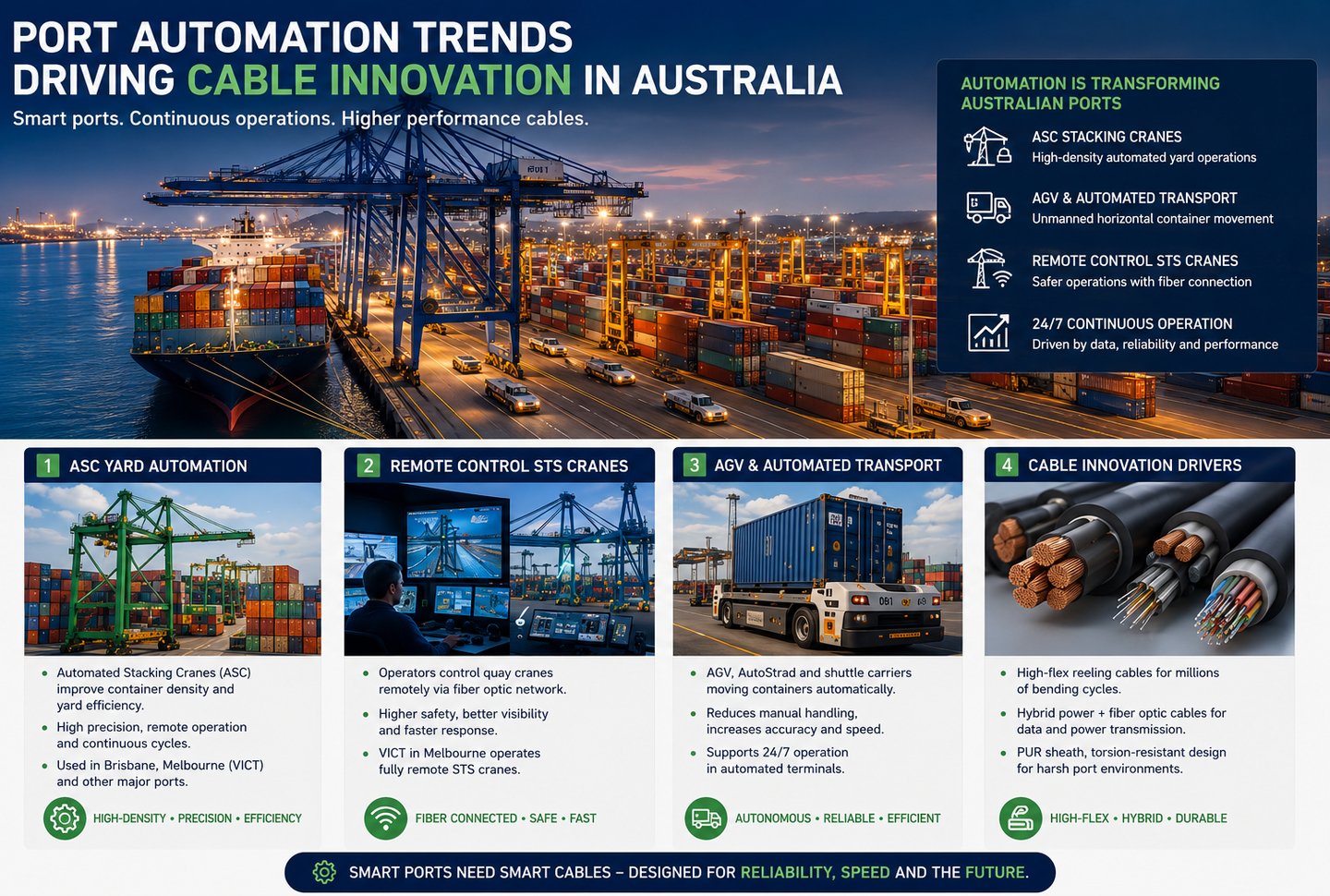
Australia's container ports have quietly become one of the most automated terminal landscapes in the Southern Hemisphere. What was experimental two decades ago is now everyday infrastructure — straddle carriers that drive themselves across a yard at Port Botany, stacking cranes that run through the night at Melbourne without a soul in the cab, and ship-to-shore cranes operated by someone sitting at a desk more than a kilometre from the quay.
That shift is reshaping a lot of things: labour models, throughput figures, safety records. But it's also quietly rewriting the specification for a component most people never think about — the cable. The reeling, festoon and lift cables feeding power and data into all this moving machinery are now being asked to survive duty cycles that would have destroyed a conventional cable a generation ago.
This is a look at where Australian port automation actually stands today, what equipment is driving the change, and how the demands on crane and reeling cable have shifted. Along the way we'll reference real terminals, real cable types, and where a cost-effective alternative to the premium European brands can make sense without compromising on the things that matter.
1. The Current State of Port Automation in Australia
Australia doesn't have a single national automation story. It has a patchwork — a few genuinely advanced terminals, a larger group of semi-automated yards, and a tail of conventional operations still running manned equipment. Understanding that spread matters, because the cable requirement at a fully automated terminal looks nothing like the one at a conventional berth.
1.1 Brisbane — Where Australian Automation Started
It's easy to forget that the country's automation journey began in Brisbane, not Melbourne. Patrick's Fisherman Islands terminal on Brisbane's Fisherman Island was converted to automated straddle carrier operation in the mid-2000s — at the time, one of only a handful of fully automated terminals anywhere in the world. The Kalmar AutoStrad system that runs there has been in continuous operation for roughly two decades, and the terminal recently celebrated its twentieth anniversary of automated straddle operations.
The numbers from that early deployment told the industry everything it needed to know. The three-berth operation handled around half a million TEU per year, and the AutoStrad system delivered labour cost savings on the order of AUD$30–40 per container lift compared with non-automated straddle handling. Lost-time injuries fell dramatically. Once those figures were public, the question for every other Australian operator stopped being "should we automate?" and became "when?"
Brisbane today is a mixed-mode picture. Alongside Patrick's AutoStrad operation, DP World and Hutchison Ports run semi-automated yard systems built around Automated Stacking Cranes (ASC), with automation concentrated in the stacking yard while horizontal transport and quay-side work remain partly manned. It's a hybrid human-plus-machine model — and it's representative of where most of the country sits.
1.2 Melbourne — Victoria International Container Terminal (VICT)
If Brisbane is where it started, the Victoria International Container Terminal at the Port of Melbourne is where it went furthest. Operated by ICTSI and live since 2017, VICT is Australia's first — and still only — fully automated container terminal, and it's frequently described as the only fully automated terminal in the Southern Hemisphere.
The scale of the automation here is the part that surprises people. The terminal runs a fleet that has grown to around seven ship-to-shore (STS) cranes, roughly 26 Automated Stacking Cranes, and a fleet of Automated Container Carriers (ACCs) — driverless transport vehicles that navigate using magnets embedded under the asphalt rather than a driver's eyes. The STS cranes are remotely operated from a control room more than a kilometre and a half from the waterline; operators complete delicate, fifty-metre-tall crane manoeuvres at the click of a mouse.
VICT's most recent STS cranes are the largest port equipment in Australia, with a 49-metre lift height and a 60-metre boom outreach that lets them work 22 containers across on a vessel — enough to handle the neo-Panamax giants now calling at Melbourne. The terminal's continued Phase 3 expansion has been adding ACCs, ASCs and storage blocks on a rolling basis, with further automated equipment scheduled through 2026.
For a cable supplier, VICT is the reference point for the most demanding end of the market: 24/7 operation, dense automated stacking, driverless horizontal transport, and a complete reliance on real-time digital communication between machines and the control room.
1.3 Port Botany and Fremantle — The Middle and the Tail
Sydney's Port Botany sits between the two. Patrick's Sydney AutoStrad Terminal, which opened in its current automated form around 2015–2016, became the world's second fully automated AutoStrad terminal when it went live, running a fleet of Kalmar automated straddle carriers — somewhere between 45 and 59 units operating across the yard depending on configuration and expansion stage. The conversion from manual operation was famously completed in only four days, and the projected savings ran to tens of millions of dollars per year. More recently, the adjacent Sydney AutoRail project — completed in 2024 — pushed rail capacity at the terminal from 250,000 TEU to over a million TEU annually, deepening the automation footprint further. Alongside Patrick, DP World and Hutchison operate ASC and semi-automated yard systems at Port Botany.
Fremantle, in Western Australia, represents the more conventional tail. Automation there is moderate; the terminals remain predominantly conventional crane operations with gradual upgrades rather than wholesale conversion. Patrick has been commissioning battery-electric internal transfer vehicles at Fremantle, which signals direction of travel, but full automation hasn't arrived at the scale seen in Melbourne or Sydney.
1.4 The Picture in One Paragraph
Put it together and Australia operates in a genuinely mixed automation landscape. Fully automated terminals are still rare — VICT being the standout. Semi-automated terminals, built around automated stacking in the yard, are now the dominant model in Brisbane and Sydney. Conventional terminals remain significant, particularly in the west. Globally, terminal automation penetration is still relatively low but growing steadily, and Australia — by virtue of its early Brisbane start and its high labour costs — sits ahead of the global average. Every one of those operating models places different demands on the cable, which is where the rest of this discussion goes.
2. The Equipment Driving the Transformation
Automation isn't one technology. It's a cluster of them, and each puts a distinct kind of stress on the cabling that feeds it.
2.1 Automated Stacking Cranes (ASC)
ASCs are the workhorses of yard automation — the rail-mounted or rubber-tyred cranes that stack and retrieve containers with no operator on board. They deliver high stacking density and precise, repeatable positioning, and they run continuously. At VICT that means roughly 26 of them operating around the clock.
The cable consequence is straightforward but unforgiving: high-flex fatigue resistance is non-negotiable, and the number of reeling and bending cycles over a cable's life climbs into the millions. A cable that's merely "flexible" isn't enough; it needs to be engineered for dynamic stress that never lets up.
2.2 Remotely Operated Ship-to-Shore Cranes
The remote STS crane is the showpiece of automation — the VICT control room operating fifty-metre cranes from a desk. Remote operation depends on fibre-optic communication carrying control signals and camera feeds with low latency, because the operator is reacting to a screen rather than a windscreen.
That changes the cable from a pure power cable into a power-plus-data system. Fibre-optic integration is required, and because these cables run alongside high-current power conductors and large motors in an electrically noisy environment, strong EMI shielding becomes essential to keep the data clean.
2.3 AGVs and Automated Straddle Carriers
The driverless horizontal transport layer — Kalmar AutoStrads at Patrick's Brisbane and Sydney terminals, ACCs at VICT — moves containers between quay and stack with no human aboard, navigating by radar, GPS, LiDAR and sensor fusion. These machines turn, reverse and reposition constantly.
For cable, the dominant stress is torsion. Cables on rotating and articulating systems get twisted, not just bent, and a cable that resists bending fatigue but not twisting will fail at the twist. High torsion resistance and mechanical durability under frequent, unpredictable movement are the priorities here.
2.4 AS/RS-Based Handling
Automated storage and retrieval systems push container handling toward warehouse-style density, integrating with ASC systems in the most modern terminals. The cabling demands overlap heavily with ASCs — continuous duty, high cycle counts — with the added wrinkle that the tighter the system, the smaller the bend radii the cable has to tolerate.
3. How Automation Is Changing the Cable Specification
Pull the equipment stories together and a clear pattern emerges. Four shifts are rewriting what a port operator should be asking for.
3.1 The Move to 24/7 Operation
A conventional terminal has natural gaps — shift changes, quiet periods, maintenance windows. An automated terminal does not. The whole economic case for automation rests on machines running continuously, which means the cable has to deliver long-term reliability with far fewer opportunities for inspection and replacement. A cable failure that would once have been an inconvenience is now an unplanned stoppage on a system designed never to stop. Reliability stops being a nice-to-have and becomes the core specification.
3.2 Higher Duty Cycles and Mechanical Fatigue
Continuous operation translates directly into cycle count. A reeling cable on an automated crane can accumulate millions of bending and reeling cycles over its service life, under sustained dynamic stress rather than the occasional movement of a manned machine. This is fundamentally a materials-and-construction problem: conductor stranding, the support element, and the jacket compound all determine whether a cable reaches its rated cycle life or fails early.
3.3 Faster Reeling Speeds
Modern automated cranes hoist and reel faster than their manned predecessors — figures in the range of 100 to 300 m/min are now common at the high end. Faster reeling means higher mechanical tension and greater acceleration forces on the cable every cycle. It's worth noting that cable installation guidance typically caps reeling speed and acceleration for good reason; LAPP's own crane cable installation instructions, for instance, specify a maximum permissible reeling speed of 2 m/s with a maximum acceleration of 0.4 m/s². The faster the system runs, the less margin the cable has, and the more the construction quality matters.
3.4 Real-Time Data Transmission
The last shift is the most modern. Automated terminals are increasingly instrumented — sensors, cameras, condition monitoring and AI-driven predictive maintenance systems all generating data that has to move in real time. Remote diagnostics and predictive maintenance need high-bandwidth, low-latency communication running right alongside power. That's why the hybrid power-plus-fibre cable has gone from exotic to expected.
4. Cable Technology Built for Automated Ports
So what does a cable that meets these demands actually look like? The market has moved through several distinct technologies, and the LAPP ÖLFLEX range is a useful reference frame because it spans the full stress spectrum — which means we can map each automated application to a known cable type, and then talk about equivalents.
4.1 PUR-Sheathed High-Performance Cables
Polyurethane (PUR) jacketed reeling cables have become the default for demanding port reeling because PUR offers excellent abrasion, oil and chemical resistance in a lighter, more flexible package than rubber. The LAPP ÖLFLEX CRANE PUR is the textbook example — a halogen-free pendant cable with a PUR jacket, a smaller outer diameter to save space and weight, and a central supporting element that absorbs tensile loads so the cable can reel, unreel and deflect freely even over long distances, with an integrated support braid that prevents the corkscrewing and twisting that kills cables on dynamic systems. Rated 600/1000V, flexible down to -40°C, and built on Class 6 super-fine-wire stranding for high flex life, it's a cable engineered specifically for low, medium and high mechanical stress reeling — exactly the profile of an automated stacking crane.
This is precisely the kind of cable we manufacture. A PUR reeling cable equivalent to the ÖLFLEX CRANE PUR — same halogen-free PUR jacket, same central support element and anti-twist braid, same fine-wire Class 6 stranding and voltage rating — is well within our production capability, and we can typically deliver it at a meaningfully better price point than the premium European brand without giving up the construction features that drive cycle life.
4.2 Hybrid Power + Fibre-Optic Cables
For remotely operated STS cranes and instrumented automated equipment, combining power transmission and fibre-optic data in a single cable simplifies the whole system architecture — one cable, one reel, one set of guides instead of two. Done properly, with correct screening and separation between power and fibre elements, it also reduces electromagnetic interference on the data path. This is the cable type that didn't really exist in the conventional-terminal era and is now central to remote operation. We can build hybrid power-plus-fibre constructions to match a terminal's specific control and bandwidth requirements.
4.3 High-Flex Reeling Cable Systems
For motorised reel and festoon systems, the priority is high-cycle bending performance. Within the ÖLFLEX family this maps to cables like the CRANE VS (N)SHTÖU — a reelable cable for medium-to-high mechanical stress with a yellow rubber jacket and an integrated support braid, rated for the multispiral, multilayer reeling and vertical reeling that heavy-duty automated drums demand — and the CRANE NSHTÖU for lower-to-medium stress reeling on pulleys, drums and rollers. The selection logic is well established: monospiral light reeling, multispiral moderate reeling, multilayer heavy reeling, and vertical reeling each have a recommended construction. We supply across this same range and can match the construction to the reeling configuration rather than over- or under-specifying.
4.4 Torsion-Resistant Designs
For AGVs, automated straddle carriers and rotating crane systems, the special structural design that prevents twisting damage is the differentiator. Torsion-resistant cable uses construction techniques — lay length, layer balancing, support elements — that let the cable absorb multi-axis movement without the conductors working against each other. For the AutoStrad and ACC fleets driving Australian yards, this is the relevant technology, and it's one where construction quality, not brand, determines field life.
5. Market Impact and the Supply-Chain Shift
5.1 From Commodity Cable to Engineered System
The biggest change in how ports buy cable is conceptual. A conventional terminal bought cable as a commodity — a power conductor with a jacket, specified by cross-section and voltage. An automated terminal buys an engineered system that integrates power, data and mechanical performance into one component with a predictable service life. The cable is now part of the automation system, not a consumable bolted on at the end.
5.2 Premium Brands Versus Engineered Alternatives
The premium end of this market has long been held by Prysmian, Nexans and LAPP, and they earned that position with genuinely good engineering and the test data to back it. But two things have changed the competitive picture. First, the relevant know-how — PUR compounds, support-element construction, fine-wire stranding, fibre integration — is now well understood and reproducible by capable manufacturers. Second, port operators have shifted from judging cable on purchase price to judging it on lifecycle cost: a cable that costs less but lasts as long is straightforwardly better value, and a cheaper cable that fails early is the most expensive option of all.
That's the space we occupy. We manufacture across the same application spectrum as the ÖLFLEX CRANE range — PUR reeling cable equivalent to CRANE PUR, support-braid reeling cable equivalent to CRANE VS, hybrid power-plus-fibre, and torsion-resistant designs — built to the same construction principles that drive cycle life, and offered at a more competitive price. The goal isn't to undercut on quality; it's to deliver equivalent engineered performance at better lifecycle value.
5.3 Cost Pressure in Australian Port Projects
This matters acutely in Australia because port infrastructure investment here is expensive, and the projects are large. VICT's expansion runs into the hundreds of millions of dollars; Patrick's automation programmes span multiple terminals and dozens of machines. When a terminal is commissioning 26 stacking cranes or a 45-to-59-unit straddle fleet, the cable bill is real money, and the appetite for a cost-optimised yet high-performance alternative — and for diversified, resilient supply chains rather than dependence on a single European source — is strong and growing.
6. Where This Leaves Australian Ports
Australia's ports are unambiguously moving toward semi- and fully automated operation. ASCs, automated straddle carriers and ACCs, and remotely operated STS cranes have gone from novelties to standard technology across Melbourne, Sydney and Brisbane, with Fremantle following at its own pace. That transformation has driven, and will keep driving, a genuine upgrade in what crane and reeling cable has to do.
The cable of the automated terminal has to be more flexible, more durable through millions of cycles, fibre-integrated for real-time data, and torsion-resistant for the machines that twist as well as bend. The good news for operators is that this is now well-understood engineering rather than proprietary magic — which means the performance that was once available only at premium-brand prices can be specified, manufactured and supplied at better value.
If you're specifying cable for an automated or semi-automated terminal project, the right starting point is to map each application to its stress profile — light, moderate or heavy reeling; vertical reeling; festoon; torsion; hybrid power-and-data — and then match the construction accordingly. We can supply equivalents across that entire range, built to the construction standards that determine field life, and at a price that makes lifecycle sense. If it's useful, we're happy to work through a specific terminal's application list and propose the matching constructions.
This article is intended as an industry overview. Cable selection for any specific installation should follow the manufacturer's installation instructions and the relevant electrical and safety standards. Product names referenced are trademarks of their respective owners and are used here for technical comparison only.
How to Reach Us
Get in Touch
SiteMap
Product Catalogue
Festoon Cable
Shore Power Cable




Scan to add us on WeChat