
PROTOLON(FL) LWL (N)TSFLCGEWOEU 6/10kV: The High-Performance Flat Fibre Optic Reeling Cable Built for Australia’s Ports and Heavy Industry
Discover why PROTOLON(FL) LWL (N)TSFLCGEWOEU 6/10kV is the preferred flat medium voltage fibre optic reeling cable for Australian ports, mining operations and high-stress crane systems. Engineered for extreme dynamic loads, harsh climates and high-speed automation.
hongjing.Wang@Feichun
5/29/20266 min read
Why Australia’s Heavy Industry Needs a Different Class of Crane Cable
Australia operates some of the harshest industrial environments in the world.
From the salt-laden coastal air of Port Botany and Fremantle to the abrasive red dust of the Pilbara, cable systems installed on cranes, reeling drums and mobile harbour equipment face constant punishment. Add extreme UV exposure, rapid temperature shifts, heavy dynamic movement and around-the-clock operating cycles, and conventional flexible cables often become the weakest link in mission-critical lifting systems.
For operators of container terminals, bulk material handling systems and large mobile mining equipment, cable failure is never a minor inconvenience.
It can mean:
Unplanned crane shutdowns during peak vessel turnaround windows.
Production bottlenecks costing tens of thousands of dollars per hour.
Data communication interruptions affecting automation and positioning systems.
Expensive emergency replacement works.
This is exactly why the PROTOLON(FL) LWL (N)TSFLCGEWOEU 6/10kV Flat Fibre Optic Reeling Cable was engineered.
Purpose-built for high mechanical stress in one plane, this advanced hybrid flat medium voltage cable integrates reliable power transmission and fibre optic communication into a single compact construction.
For Australian operators managing automated cranes and mobile heavy equipment, it delivers the durability, flexibility and long-term reliability needed to keep operations moving.
Understanding the Demands of Modern Australian Crane Systems
The industrial landscape across Australia has evolved rapidly over the past decade.
Ports are becoming increasingly automated.
Mining operations are deploying smarter mobile systems.
Container terminals are adopting remote diagnostics and real-time equipment monitoring.
All of these advancements require cable systems that can simultaneously handle:
Medium voltage power delivery
High-speed fibre optic data transfer
Repeated flexing
Continuous reeling
Mechanical tension
Outdoor environmental exposure
Directional bending over rollers
Traditional round cables can become problematic in installations where cable routing space is limited or repeated movement is constrained to a single plane.
This is where flat cable architecture provides a clear engineering advantage.
What Makes PROTOLON(FL) LWL Different?
The PROTOLON(FL) LWL (N)TSFLCGEWOEU 6/10kV is not simply a power cable with optical fibres added.
It is a purpose-engineered hybrid solution designed specifically for dynamic reeling applications.
Its flat profile allows it to move efficiently over rollers and through festoon systems while maintaining predictable bending behaviour.
Integrated fibre optic elements enable simultaneous data communication for:
Crane automation systems
Remote diagnostics
Position feedback systems
Real-time operational monitoring
PLC communication
Safety and control networks
This hybrid design eliminates the need for separate power and communication cable runs.
The result is:
Reduced installation complexity
Lower system weight
Improved cable management
Reduced wear points
Simplified maintenance
Higher long-term reliability
Built for Extreme Mechanical Stress
Australia’s port and mining cranes often operate under constant mechanical stress.
At terminals such as Patrick Terminals at Port Botany, ship-to-shore cranes can perform continuous container handling for extended periods under demanding operational schedules.
Similarly, at bulk export facilities in Port Hedland, mobile reeling systems endure heavy cyclic loading while exposed to coastal corrosion and intense solar radiation.
The PROTOLON(FL) LWL is specifically designed for these conditions.
Its mechanical performance includes:
A maximum tensile load of 15 N/mm²
Travel speeds up to 120 metres per minute
Optimised flat bending behaviour
Reduced stress concentration during roller movement
Controlled directional flexing in one plane
This construction ensures consistent performance during repeated motion cycles.
For high-speed crane systems, this translates directly into operational reliability.
Why Flat Cable Design Matters in Australian Port Installations
Space constraints are a major challenge in modern crane engineering.
In many Australian container terminals, cable routing systems must fit within compact drum assemblies, restricted troughs and narrow roller pathways.
Flat cable design provides measurable benefits.
Improved Roller Tracking
The cable maintains stable positioning across roller systems.
This reduces lateral movement and uneven wear.
Predictable Flex Performance
Repeated movement occurs in a controlled plane, reducing internal stress.
Reduced Installation Envelope
Less physical space is required compared to equivalent round cable assemblies.
Better Cable Management
Flat profile construction reduces crossover issues and twisting complications.
These characteristics make PROTOLON(FL) LWL particularly suitable for:
Ship-to-shore cranes
Rubber tyred gantry cranes
Rail mounted gantry cranes
Mobile harbour cranes
Stacker reclaimers
Heavy excavator systems
Thermal Performance for Australian Conditions
Australia’s environmental extremes demand exceptional thermal resilience.
A cable operating at the Port of Darwin may experience intense solar loading and high humidity.
Equipment in the Pilbara can face severe daytime heat followed by significant overnight cooling.
The PROTOLON(FL) LWL addresses these challenges with a robust thermal operating range:
Continuous conductor temperature up to 90°C
Short-circuit tolerance up to 250°C
Fixed installation operation from -50°C to +80°C
Flexible operation from -35°C to +80°C
This broad thermal window supports reliable performance in:
Northern tropical environments
Arid inland mining zones
Southern coastal winter exposure
Outdoor heavy industrial yards
The result is year-round operational consistency.
Hybrid Fibre Optic Integration for Automated Systems
Australian industrial infrastructure is increasingly data-driven.
Modern cranes depend on high-bandwidth communication for:
Remote diagnostics
Camera systems
Load monitoring
Automation controls
Collision avoidance systems
Position feedback
The integrated optical fibre system supports configurations including:
6 fibres
12 fibres
18 fibres
24 fibres
Available fibre types include:
G50/125μm
G62.5/125μm
E9/125μm monomode
This flexibility allows system designers to match communication capacity to operational requirements.
For automated terminals such as those operating in Brisbane’s Fisherman Islands precinct, where digital crane coordination is essential, integrated fibre architecture simplifies deployment while improving communication reliability.
Advanced Construction for Long Service Life
The cable’s internal construction is engineered for durability.
Finely Stranded Tinned Copper Conductors
Class F electrolytic copper provides superior flexibility and corrosion resistance.
This is particularly important in coastal Australian installations.
High-Grade PROTOLON EPR Insulation
Provides strong dielectric performance and mechanical resilience.
Semi-Conductive Field Control Layers
Ensure stable electrical performance under medium voltage operation.
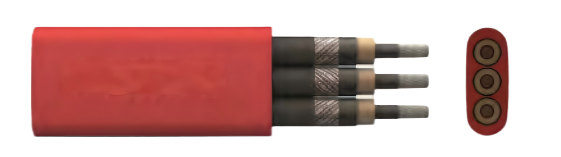
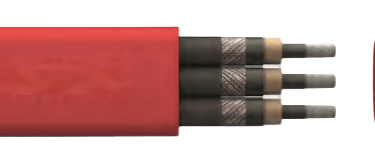
Parallel Flat Core Arrangement
Optimises cable geometry for repeated one-plane flexing.
Split Earth Conductors
Concentrically distributed for balanced performance.
PROTOFIRM CR Outer Sheath
The bright red outer sheath provides:
Exceptional abrasion resistance
Weather resistance
UV stability
Improved visibility on site
Enhanced safety identification
The bright red finish is particularly valuable in busy crane maintenance environments where rapid cable identification improves inspection efficiency.
Australian Case Study: Port Botany Container Terminal Upgrade
During a major crane automation upgrade at Sydney’s Port Botany, engineering teams faced challenges integrating power and fibre communication into constrained cable routing systems.
Existing round cable solutions created excessive mechanical wear due to lateral roller movement.
A flat hybrid reeling cable configuration provided the required solution.
The implementation delivered:
Improved roller alignment
Reduced mechanical fatigue
Simplified installation pathways
Integrated communication redundancy
Reduced maintenance intervention frequency
For high-throughput container operations, these improvements translated directly into uptime gains.
Australian Case Study: Pilbara Mobile Reclaimer Operations
At iron ore export operations in Western Australia’s Pilbara region, mobile reclaimers experience severe dynamic loading and environmental exposure.
Cable systems must tolerate:
Red dust ingress
Extreme UV exposure
Continuous cyclic movement
High ambient heat
Heavy vibration
Flat hybrid medium voltage cable systems proved particularly effective due to their predictable bending profile and superior sheath durability.
Operators reported improved service intervals and reduced cable replacement frequency compared with legacy round cable systems.
Why Australian Engineers Specify Hybrid MV Flat Cables
Engineering consultants across Australia increasingly specify hybrid flat medium voltage cable systems because they solve multiple operational challenges simultaneously.
Instead of separate installations for:
Power transmission
Data communication
Mechanical routing
Control signal infrastructure
A single integrated cable provides a streamlined solution.
This reduces:
Installation labour
Support structure complexity
Cable tray congestion
Potential failure points
Lifecycle maintenance cost
For procurement teams focused on total cost of ownership, this represents a significant advantage.
Installation Considerations for Maximum Performance
To achieve optimal service life, correct installation practices are essential.
Recommended considerations include:
Maintaining minimum bending radius of approximately 1.5 times cable height
Avoiding torsional loading
Allowing minimum 20 x D spacing for S-type directional changes
Ensuring smooth roller surfaces
Proper drum alignment
Controlled tension management
When correctly installed, service life can be significantly extended even under demanding duty cycles.
Supporting Australia’s Push Toward Smart Ports
Australia is investing heavily in smarter, more automated logistics infrastructure.
Projects across:
Port of Melbourne
Port of Newcastle
Fremantle Port
Port of Brisbane
Port Botany
are increasingly integrating advanced automation systems.
These systems require infrastructure components capable of handling both electrical power and digital communication seamlessly.
Hybrid flat medium voltage fibre optic cables are becoming essential infrastructure for this transformation.
Choosing the Right 6/10kV Flat Fibre Optic Reeling Cable
When evaluating cable solutions for Australian heavy industry, engineers should assess:
Mechanical tensile performance
Flex life
Thermal operating range
Environmental resistance
Optical transmission capability
Abrasion resistance
Installation footprint
Compliance with DIN VDE and international standards
The PROTOLON(FL) LWL platform consistently meets these requirements.
The Long-Term Cost Advantage
Initial cable procurement cost is only one part of the equation.
The true operational value comes from reduced:
Downtime
Maintenance intervention
Replacement frequency
Operational disruption
Labour costs
For large-scale crane systems operating continuously, the long-term financial advantage of selecting a high-performance cable can be substantial.
Future-Proofing Australian Industrial Infrastructure
As automation increases, cable infrastructure must support:
Higher data bandwidth
Greater operational speed
Longer duty cycles
Smarter monitoring systems
Remote maintenance diagnostics
Hybrid medium voltage flat fibre optic cable technology positions Australian operators for this future.
Expert Summary
The PROTOLON(FL) LWL (N)TSFLCGEWOEU 6/10kV Flat Fibre Optic Reeling Cable represents a specialised engineering solution for Australia’s most demanding dynamic cable applications.
Its flat architecture, hybrid power-and-data capability, exceptional thermal resilience and robust mechanical construction make it ideally suited to ship-to-shore cranes, mobile harbour systems, mining reclaimers and heavy-duty automated equipment operating in harsh Australian environments.
For engineering teams seeking to improve uptime, simplify infrastructure and future-proof automated crane systems, this cable offers a technically advanced, field-proven solution engineered for long-term reliability.
When performance, safety and operational continuity matter, specifying the right reeling cable is not just an engineering decision—it is a strategic investment in productivity.
How to Reach Us
Get in Touch
SiteMap
Product Catalogue
Festoon Cable
Shore Power Cable




Scan to add us on WeChat