PUR Drag Chain Cable – VDE Certified, Halogen-Free Polyurethane, Designed for Continuous Flex & Harsh Environments
PUR Continuous Flex Cable – VDE Certified, TMPU Polyurethane Outer Sheath, Built for Demanding Drag Chain Applications
hongjing.Wang@Feichun
2/6/20266 min read
Introduction
Modern automation, robotics, and machine tool applications demand cables that survive millions of flex cycles while resisting oils, coolants, abrasion, and outdoor conditions. Standard cables often fail prematurely in these environments, causing costly downtime and maintenance.
This article examines a high-performance PUR drag chain cable certified to DIN VDE 0285-525-1 and DIN EN 50525-1 standards. Featuring a premium TMPU polyurethane outer sheath and optimized construction, this cable delivers exceptional durability in challenging industrial applications, from robotic systems to CNC machines operating in harsh, contaminated environments.


Core Technical Specifications at a Glance
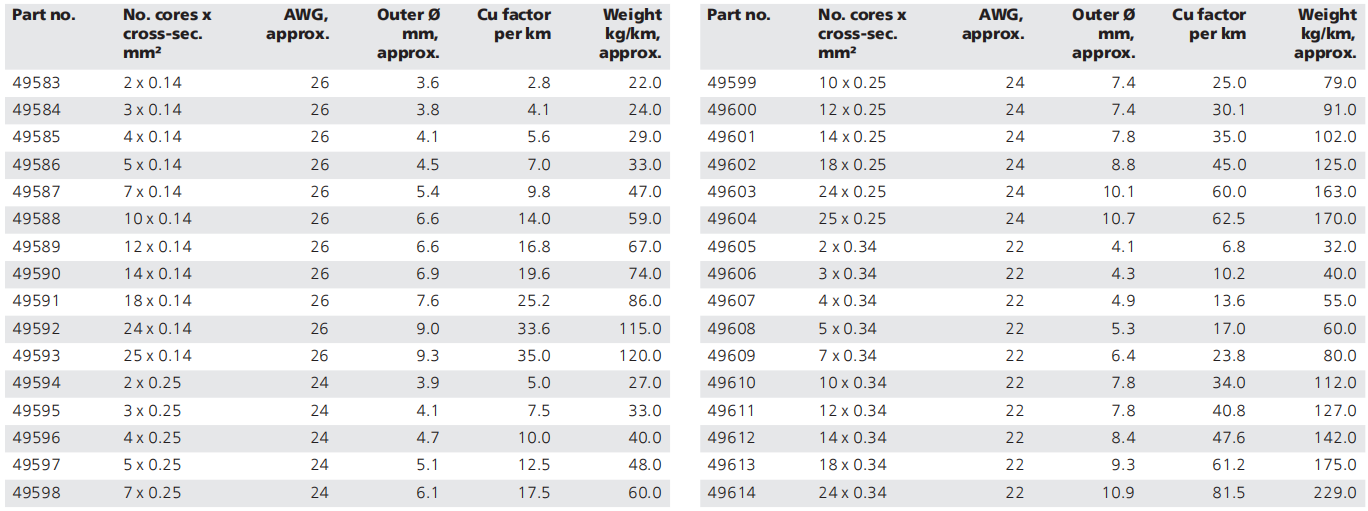
Understanding the technical parameters of a drag chain cable is crucial for proper system design and ensuring long-term reliability. This VDE-certified cable offers specifications that balance flexibility with robust performance:
Temperature Performance:
Flexible installation: -30°C to +90°C
Fixed installation: -40°C to +90°C
Electrical Characteristics:
Nominal voltage for 0.14 mm² conductors: AC 350V
Nominal voltage for 0.25-0.34 mm² conductors: AC 500V
Test voltage (core to core): 1500V
Mutual capacitance at 800 Hz: approximately 80 pF/m
Mechanical Design Parameters:
Minimum bending radius (flexible applications): 5× outer diameter
Minimum bending radius (fixed installation): 3× outer diameter
These specifications reflect a cable engineered for demanding applications where both electrical integrity and mechanical resilience are critical. The generous temperature range ensures reliable operation across diverse industrial environments, from cold storage facilities to heat-generating manufacturing equipment.
Key Performance Properties & Environmental Resistance
The halogen-free polyurethane cable distinguishes itself through comprehensive resistance to industrial environmental challenges:
Chemical Resistance:
Outstanding resistance to oils, coolants, hydraulic fluids, acids, alkalis, greases, seawater, and wastewater. This broad spectrum makes it suitable for installations encountering different substances, from water-based coolants in CNC machines to hydraulic oils in press applications.
Environmental Durability:
UV radiation resistance enables outdoor installations without sunlight degradation. The cable resists ozone, oxygen, weathering, hydrolysis, and microbial attack—ideal for systems transitioning between indoor and outdoor environments or coastal installations with salt spray exposure.
Mechanical Strengths:
Highly abrasion-resistant against guide surfaces and cable carriers
Notch-resistant, tear-resistant, and cut-resistant
Wear-resistant for extended service life
Low adhesion minimizes stick-slip behavior in drag chains
Material Safety:
Completely halogen-free per DIN VDE 0482-754-1, DIN EN 60754-1, and IEC 60754-1, eliminating toxic fumes in fire scenarios. Materials are cadmium-free, silicone-free, and compatible with lacquer-wetting processes.
Typical Applications & Real-World Benefits
This UV and oil resistant cable perfect for drag chains excels across numerous industrial applications where reliability and longevity are paramount:
Machine Tool Installations:
CNC milling machines, lathes, grinding centers, and machining centers require cables that survive constant exposure to metalworking fluids while flexing continuously as tool heads and tables move. The combination of coolant resistance and high flex life makes this cable ideal for these demanding applications. Typical installations include X-Y-Z axis movements on vertical machining centers, tool changer systems, and automatic pallet changers.
Robotics Systems:
Six-axis articulated robots, SCARA robots, gantry systems, and delta robots all impose severe flexing demands on their cable systems. The cable's optimized stranding and low minimum bending radius enable tight routing through robot arms and joints. Applications include welding robots, painting systems, pick-and-place automation, and assembly robots where cables must survive millions of repetitive movements.
Automated Production Lines:
Transfer systems, conveyor controls, automated guided vehicles (AGVs), and assembly automation all benefit from cables that combine electrical reliability with mechanical resilience. The cable supports both signal transmission and low-voltage power distribution in these applications.
Handling and Positioning Systems:
Overhead cranes, gantry systems, linear actuators, and multi-axis positioning tables create challenging cable routing scenarios. The cable's construction handles both the linear travel in drag chains and the dynamic bending at entry and exit points.
Outdoor and Wet Environment Applications:
Packaging machinery exposed to washdown procedures, outdoor material handling equipment, port automation systems, and agricultural machinery all require the weather resistance and moisture protection this cable provides.
Total Cost of Ownership Advantages:
While this certified to DIN VDE 0285-525-1 for robotics and machinery cable may have a higher initial cost than basic alternatives, the total cost of ownership calculation strongly favors quality. Extended service life means fewer replacements, reduced maintenance labor, and minimal unplanned downtime. In critical production environments, the cost of a single production stoppage often exceeds the price difference between premium and budget cables many times over.
Common Cable Challenges and Solutions
Challenge: Premature Cable Failure in Drag Chains
Many installations experience unexpected cable failures well before the expected service life. This typically results from one of several factors:
Solution: Proper cable selection and installation practices are essential. This cable's 5× outer diameter minimum bending radius must be respected during system design. Drag chain fill ratios should not exceed 50-60% to prevent excessive compression. Using cables specifically engineered for continuous flex, like this VDE-certified option, rather than repurposing fixed-installation cables dramatically extends service life.
Challenge: Oil and Coolant Penetration
In metalworking environments, coolant penetration into cable jackets leads to conductor corrosion and insulation degradation.
Solution: The special-grade TMPU polyurethane compound provides proven resistance to cutting fluids, hydraulic oils, and coolants. Oil resistance testing according to DIN EN 60811-404 verifies the cable's ability to maintain integrity even with continuous exposure. However, proper cable strain relief at equipment entry points prevents fluid migration along the cable.
Challenge: Inconsistent Performance in Extreme Temperatures
Cables may become stiff in cold environments or soften excessively in heat, affecting drag chain operation.
Solution: The -30°C to +90°C flexible temperature range covers most industrial applications. The polyurethane compound maintains consistent flexibility across this spectrum, unlike PVC alternatives that become brittle in cold conditions. For applications approaching the temperature limits, consult with cable suppliers about specific compound formulations.
Challenge: UV Degradation in Outdoor or Skylighted Facilities
Standard cable materials degrade when exposed to UV radiation, becoming brittle and cracked.
Solution: This cable includes UV-resistant formulation tested according to DIN EN ISO 4892-2, enabling reliable outdoor use or installation in facilities with extensive natural lighting. The weathering resistance testing confirms long-term stability under solar exposure.
Challenge: Electromagnetic Interference in Signal Cables
Unshielded cables may experience signal degradation in electrically noisy environments.
Solution: While this cable version features unshielded construction suitable for many applications, shielded variants are available when electromagnetic compatibility requirements demand them. The low mutual capacitance (approximately 80 pF/m) minimizes signal distortion even in unshielded configurations.
Why Choose This PUR Drag Chain Cable?
When evaluating cable options for critical automation systems, several factors distinguish this solution from alternatives:
Compared to Standard PVC Drag Chain Cables:
PVC cables offer lower initial costs but cannot match polyurethane's oil resistance, abrasion resistance, or low-temperature flexibility. PVC becomes brittle at temperatures below 0°C, while this PUR cable remains flexible to -30°C. The oil resistance alone justifies the upgrade in most manufacturing environments where cutting fluids or hydraulic systems are present.
Compared to Budget PUR Cables:
Not all polyurethane cables are equal. This cable uses special-grade TMPU compound with proven resistance profiles, while economy PUR cables may use lesser-grade materials that compromise durability. The extra-fine stranding and optimized lay lengths represent engineering refinements absent from basic PUR constructions. Certification to current European standards provides documentation and traceability essential for CE marking and export machinery.
Compliance and Confidence:
Alignment with DIN VDE 0285-525-1 and DIN EN 50525-1 standards gives design engineers confidence that the cable meets established safety and performance benchmarks. For equipment manufacturers serving European markets or exporting globally, this compliance simplifies documentation and regulatory approval processes.
Balanced Price-Performance Ratio:
This cable occupies the mid-to-high-end market segment, appropriate for professional machinery where reliability justifies quality investment. It provides industrial-grade performance without the premium pricing of ultra-specialized cables designed for extreme niche applications.
When Reliability Over Millions of Cycles Matters:
The defining selection criterion is simple: choose this cable when long-term reliability and minimized maintenance costs are more important than the lowest possible initial purchase price. For production machinery, robotic systems, and automated equipment where cable failures directly impact productivity and profitability, the investment in quality cables returns substantial value.
Conclusion
Industrial cables face intensifying demands as automation systems become more complex and operate in harsher environments. This high-flex PUR cable certified to DIN EN 50525-1 compliant standard delivers a comprehensive solution combining certified design, exceptional environmental resistance, and construction optimized for millions of flex cycles.
As Industry 4.0 drives greater automation and smart factory implementations, the infrastructure supporting these technologies must deliver equivalent reliability. Cables may represent a small percentage of total system cost, but their failure can halt production with costs far exceeding their value.
For detailed datasheets, specific core counts and cross-sections, or custom configurations including specialized colors or hybrid designs, contact qualified cable suppliers for application-specific guidance.
Specify once, forget about cable failures for years.
Frequently Asked Questions
What's the difference between TMPU and standard PUR?
TMPU (thermoplastic polyurethane) is a special-grade compound formulated for demanding cable applications. It offers superior resistance to oils, UV radiation, and chemicals compared to general-purpose polyurethane. The special-grade designation compliant with DIN EN 50363-10-2 indicates material tested specifically for drag chain service.
Can this cable be used in torsion applications?
This cable is optimized for linear drag chain movement and bending rather than continuous torsional stress. While it tolerates occasional twisting during installation or moderate torsion in robot arms, continuous rotation applications require cables specifically designed for torsional service.
Is it suitable for cleanroom environments?
The halogen-free, silicone-free construction and low-particulation polyurethane sheath make it compatible with many cleanroom applications. However, for ISO Class 5 or stricter cleanrooms, verify that the cable meets your specific particle generation limits. Specialized cleanroom cables may be necessary for the most stringent environments.
How to Reach Us
Get in Touch
SiteMap
Product Catalogue
Festoon Cable
Shore Power Cable


Scan to add us on WeChat