PURö-JZ-HF-YCP / PURö-OZ-HF-YCP: DIN VDE-Certified Oil-Resistant PUR Drag Chain Cable for EMC-Optimized Harsh Industrial Use
Discover the PURö-JZ-HF-YCP / PURö-OZ-HF-YCP oil-resistant PUR drag chain cable with polyurethane sheathing and tinned copper screening. Ideal high-flex EMC-screened industrial cable for drag chains in machine tools, steelworks, and coolant-heavy environments.
hongjing.Wang@Feichun
2/9/202618 min read


Why Choose Robust Drag Chain Cables for Demanding Applications
In automated manufacturing facilities and heavy industrial environments, standard cables face a brutal reality. Picture this: a CNC machining center running three shifts daily, its drag chain cable continuously flexing through thousands of cycles while bathed in coolant emulsions and metal chips. Within months, conventional cables develop cracks in their outer sheaths, allowing oil penetration that degrades the insulation and causes premature failure. The result? Unexpected downtime, costly emergency replacements, and production losses that far exceed the initial cable cost.
The PURö-JZ-HF-YCP and PURö-OZ-HF-YCP cables represent an engineered solution to these challenges. These high-performance drag chain cables combine oil-resistant PVC core insulation with a special-grade polyurethane outer sheath and electromagnetic compatibility screening. Certified to DIN VDE 0285-525-1 and DIN EN 50525-1 standards, they deliver exceptional durability in environments where lesser cables simply cannot survive.
What sets these cables apart? Full compliance with rigorous European electrical safety standards, extreme mechanical and chemical resistance that withstands the harshest industrial conditions, and interference-free signal transmission through optimized electromagnetic shielding. Whether you're specifying cables for a new rolling mill installation or replacing failed cables in an existing machine tool application, understanding the technical advantages of oil-resistant PUR drag chain cables can prevent costly failures and extend equipment service life.
Technical Specifications: Built for Extreme Performance
Voltage and Temperature Parameters
The PURö series operates at a nominal voltage of 300/500 V AC (Uo/U), making it suitable for standard industrial power and control applications. The electrical integrity is verified through rigorous testing: a 4000 V core-to-core test voltage and an impressive 8000 V breakdown voltage provide substantial safety margins against electrical failure even in contaminated conditions.
Temperature performance covers an exceptionally wide range. For flexible installations such as drag chain applications, the cable operates reliably from -20°C to +80°C. In fixed installations where flexing is not required, the lower limit extends to -40°C, making these cables suitable for outdoor installations in extreme climates or cold storage facilities. This temperature resilience stems from the carefully selected polyurethane compound used in the outer sheath, which maintains flexibility and mechanical properties across the entire operating range.
Mechanical Flexibility and Bending Performance
Bending radius requirements are critical for drag chain cable performance and longevity. The PURö-JZ-HF-YCP and PURö-OZ-HF-YCP cables specify a minimum bending radius of 10 times the outer diameter for flexible applications—a parameter that directly influences drag chain design and cable service life. For fixed installations, this reduces to 5 times the outer diameter. These specifications reflect the cable's internal construction, where cores are stranded in layers with optimally matched lay lengths to minimize mechanical stress during flexing.
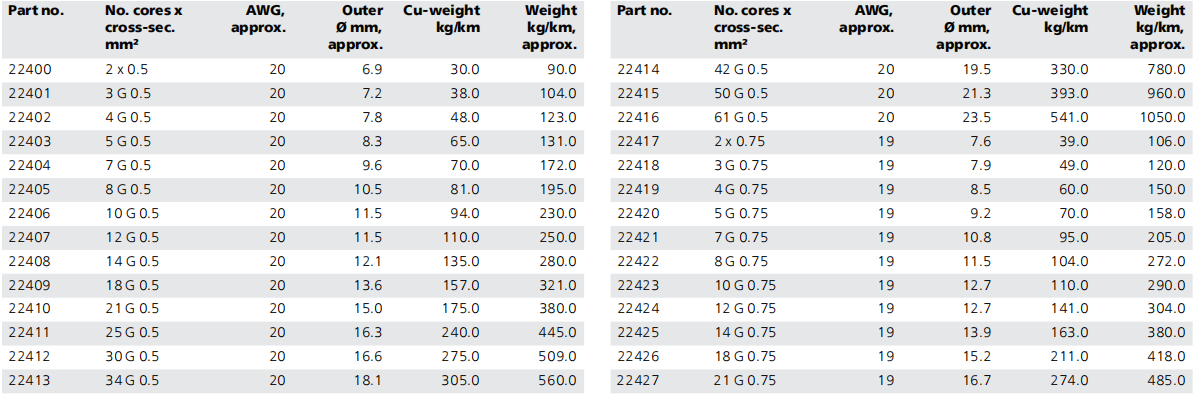
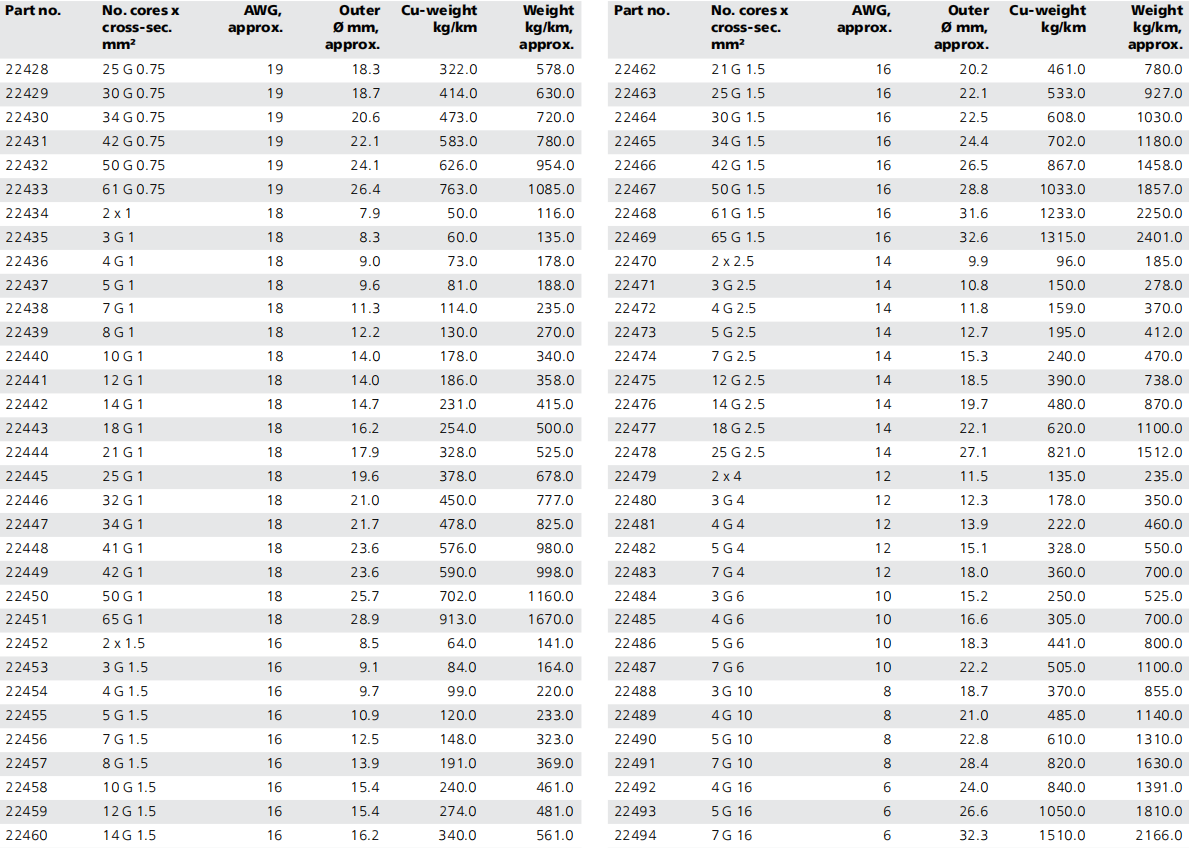
For practical application, consider a 12G1.5 configuration (part number 22459) with an outer diameter of 15.4 mm. In a drag chain system, this cable requires a minimum bending radius of 154 mm (10 × 15.4 mm). This relatively compact bending radius allows for space-efficient drag chain designs while ensuring the cable structure experiences minimal internal strain, even after millions of flex cycles.
EMC Shielding Characteristics
Electromagnetic compatibility represents a crucial performance parameter for modern industrial cables carrying both power and sensitive control signals. The PURö series incorporates a braided screen of tinned copper wire with approximately 85% coverage—a substantial shielding factor that effectively attenuates electromagnetic interference. The coupling resistance measures approximately 250 Ohm/km at 30 MHz, providing excellent high-frequency noise rejection.
The tinned copper construction serves dual purposes: preventing oxidation over the cable's service life and facilitating reliable electrical connections during installation. For optimal electromagnetic compatibility performance, proper screen termination is essential—the copper braiding should make large-area, 360-degree contact with shielding clamps at both cable ends, creating a continuous conductive path to ground.
Cable Structure: Layered Engineering for Reliability
Conductor Construction and Core Insulation
The foundation of any high-performance cable begins with its conductor. The PURö series utilizes bare copper wire constructed to DIN VDE 0295 Class 6 / IEC 60228 Class 6 specifications. This "extra finely stranded" classification means the conductor consists of numerous thin copper wires bundled together, providing maximum flexibility while maintaining excellent electrical conductivity. Class 6 stranding represents the finest standard classification, specifically designed for applications requiring frequent flexing.
Each conductor is insulated with oil-resistant PVC compound conforming to DIN VDE 0207-363-3 / DIN EN 50363-3 Type TI2 specifications. This specific compound formulation resists degradation from petroleum-based oils, coolants, and hydraulic fluids—substances commonly encountered in industrial environments. The oil resistance prevents the insulation from swelling, softening, or cracking when exposed to these chemicals, maintaining electrical integrity throughout the cable's service life.
Core Identification and Protective Conductors
Proper core identification is critical for installation safety and maintenance efficiency. Following DIN VDE 0293-334 standards, the cable uses black cores with consecutive labeling in white digits, ensuring clear identification even in low-light conditions or when cables are contaminated with oil or dust.
The designation system differentiates between two configurations:
PURö-JZ-HF-YCP (JZ designation): Includes a protective ground conductor (green-yellow) positioned in the outer layer for optimal accessibility
PURö-OZ-HF-YCP (OZ designation): Configured without a protective conductor for applications where separate grounding is provided
This flexibility allows engineers to specify the appropriate configuration based on system grounding requirements and local electrical codes.
Multi-Layer Protection System
The cable construction employs a sophisticated multi-layer approach to achieve its exceptional durability:
Core Assembly: Individual insulated cores are stranded in layers with precisely calculated lay lengths. This optimized stranding pattern ensures that during bending, individual cores follow helical paths rather than experiencing sharp kinks, dramatically extending flex life.
First Fleece Wrapping: A textile fleece layer separates the core assembly from the inner sheath, allowing cores to move independently during flexing while providing mechanical cushioning.
Inner PVC Sheath: This layer provides additional mechanical protection and serves as a barrier against moisture and contaminant ingress should the outer sheath experience damage.
Electromagnetic Screen: The tinned copper braided shield is applied over the inner sheath, providing 85% coverage for excellent EMC performance. The tinned coating prevents oxidation and ensures long-term shielding effectiveness.
Second Fleece Wrapping: Another fleece layer protects the delicate braided screen from mechanical damage during cable installation and operation.
Outer Polyurethane Sheath: The special-grade PUR compound (Type TMPU per DIN VDE 0207-363-10-2 / DIN EN 50363-10-2) forms the final protective barrier. Colored grey (RAL 7001) for easy visual identification, this sheath incorporates length markings in meters for precise installation and documentation.
Material Quality and Environmental Responsibility
The manufacturing process adheres to strict material purity standards. All components are cadmium-free, contain no silicone compounds, and are formulated to avoid substances that could interfere with the wetting properties of lacquers and coatings. This careful material selection is particularly important in automotive and aerospace manufacturing environments where painted surfaces are common and contamination control is critical.
The absence of silicone is especially noteworthy, as even trace amounts of silicone can migrate to nearby surfaces and create persistent contamination that prevents proper paint adhesion—a phenomenon known as "silicone poisoning" that can ruin expensive coating processes.
Key Properties: Unmatched Resistance in Harsh Conditions
Chemical and Environmental Resistance
The PURö drag chain cable's chemical resistance profile reads like a comprehensive list of industrial hazards:
Petroleum-Based Substances: Mineral oils, hydraulic fluids, coolant emulsions, and greases pose no threat to the cable's integrity. This oil-resistant drag chain cable maintains its mechanical and electrical properties even with continuous exposure—a characteristic verified through testing to DIN VDE 0473-811-404 / DIN EN 60811-404 / IEC 60811-404 standards.
Corrosive Chemicals: The cable withstands exposure to acids and alkalis, making it suitable for chemical processing facilities, metal treatment operations, and electroplating applications where chemical splashes are routine.
Aquatic Environments: Resistance to seawater and wastewater extends application possibilities to maritime installations, desalination plants, and wastewater treatment facilities. The cable structure prevents water ingress while the materials resist the corrosive effects of salt and other dissolved substances.
Atmospheric Degradation: UV radiation, ozone, and oxygen exposure—factors that rapidly degrade many polymer materials—have minimal effect on the polyurethane sheath. Testing to DIN EN ISO 4892-2 standards confirms both UV resistance and weather resistance, validating the cable's suitability for outdoor installations where solar radiation and ozone (particularly in coastal or high-altitude locations) accelerate material aging.
Biological Degradation: Resistance to microbes and hydrolysis prevents biological attack and water-induced chemical breakdown. In humid environments or installations where condensation occurs, this prevents the gradual deterioration that affects many cable types over years of service.
Mechanical Durability Characteristics
The mechanical performance specifications reflect design specifically for the severe duty cycles encountered in drag chain applications:
Abrasion Resistance: The polyurethane outer sheath exhibits exceptional resistance to abrasive wear. In drag chain systems where cables continuously rub against guide channels, support structures, and adjacent cables, this high abrasion resistance prevents the gradual wearing-through that eventually exposes inner layers to contamination and mechanical damage.
Notch Resistance: Unlike materials that propagate cracks from surface damage, the PUR compound resists notch propagation. Minor surface damage from impact with sharp edges or metal chips remains localized rather than developing into tears that compromise the cable.
Tear and Cut Resistance: The tough polyurethane formulation withstands cutting forces from sharp metal edges, providing protection in environments where cable routing brings it into contact with machine components, structural steel, or workpiece edges.
Wear Resistance: Over millions of flex cycles, the cable maintains its dimensional stability and surface integrity. The low adhesion properties minimize friction against drag chain components, reducing both cable wear and the mechanical load on drag chain drive systems.
Outdoor and Temperature Cycling Performance
Certification for outdoor use reflects performance under combined environmental stresses. The cable endures temperature cycling from freezing conditions to high heat, exposure to precipitation and humidity, UV radiation, and atmospheric pollutants—all simultaneously rather than individually. This real-world durability ensures reliable performance in outdoor gantry systems, port cranes, mobile equipment, and building façade maintenance systems.
The wide temperature operating range accommodates not just ambient conditions but also the internal heating from electrical current and the heat generation from mechanical flexing. In high-duty-cycle applications, cable temperature can rise significantly above ambient—a factor the -20°C to +80°C flexible rating accommodates with substantial margin.
Ideal Applications: From Machine Tools to Steelworks
CNC Machine Tools and Machining Centers
Computer numerical control machining represents perhaps the most demanding application for drag chain cables. The environment combines multiple challenges simultaneously:
High Flex Cycles: Modern machining centers operate at rapid traverse speeds, with drag chains flexing tens of thousands of times daily. Tool change operations, automatic pallet changers, and continuous contouring operations keep cables in constant motion.
Coolant Exposure: High-pressure coolant systems spray cutting fluid directly onto the work zone. The mist and splashes inevitably contact cables, with coolant emulsions—mixtures of oil and water with additives—being particularly aggressive toward cable materials. Oil-resistant drag chain cables prevent the swelling and degradation that causes standard cables to fail prematurely in these conditions.
Metal Chip Contamination: The machining process generates thousands of sharp metal chips that fall onto cables and accumulate in drag chain channels. The PURö cable's cut-resistant and abrasion-resistant sheath prevents these chips from penetrating the cable structure.
EMC Requirements: Modern CNC controls use sensitive encoder signals for precise position feedback. Electromagnetic interference from servo drives and spindle motors can corrupt these signals, causing positioning errors. The screened construction of the PURö-JZ-HF-YCP cable provides the shielding necessary for interference-free signal transmission, maintaining positioning accuracy even in electrically noisy environments.
Rolling Mills and Steel Processing
Steel production and processing facilities present extreme operating conditions that eliminate lesser cables within months:
Temperature Extremes: Areas near furnaces and hot rolling operations experience elevated ambient temperatures, while cooling zones can be cold. The cable's -20°C to +80°C rating accommodates these variations.
Scale and Debris: Steel processing generates scale (oxide flakes), metal dust, and sharp debris that accumulates on all surfaces. The notch-resistant and abrasion-resistant properties prevent this debris from damaging the cable.
Water and Steam: Cooling water and steam contact with hot metal creates a humid, corrosive environment. The cable's hydrolysis resistance and moisture barrier construction maintain integrity despite continuous exposure.
Heavy Mechanical Loading: Drag chain systems in rolling mills often support numerous heavy cables for hydraulic systems, motors, and controls. The PURö cable's robust construction withstands the weight and mechanical stress without deformation.
Industrial Robots and Automated Assembly
Robotic applications demand cables that deliver reliable performance through millions of motion cycles:
Multi-Axis Movement: Robot arms execute complex three-dimensional movements, creating challenging cable routing with compound bending and twisting. The flexible construction and optimized core stranding accommodate these motion patterns.
Precision Signal Transmission: Robot controllers rely on encoder feedback, force sensors, and vision systems that require noise-free signal transmission. The electromagnetic shielding ensures these sensitive signals remain uncorrupted by motor drive interference.
Confined Spaces: Robot installations often locate cables in tight spaces where compact bending radii are necessary. The 10× outer diameter bending specification allows for space-efficient routing without compromising cable life.
Outdoor and Mobile Equipment
Applications beyond factory floors also benefit from the PURö cable's outdoor-rated construction:
Gantry Cranes and Port Equipment: Container handling cranes operate outdoors in corrosive marine environments with exposure to salt spray, UV radiation, and temperature variations. The weather-resistant and seawater-resistant properties ensure reliable operation.
Mobile Construction Equipment: Concrete pumps, mobile cranes, and drilling rigs subject cables to severe flexing combined with exposure to diesel fuel, hydraulic oil, and environmental conditions. The multi-faceted chemical resistance handles this combination.
Building Maintenance Systems: Façade cleaning platforms and window washing equipment require outdoor-rated cables that endure UV exposure and weather while providing reliable power and control signal transmission through continuous motion cycles.
Measurement and Control Technology
The "EMC-preferred type" designation specifically addresses applications where electromagnetic interference could compromise system performance:
Precision Measurement Systems: Coordinate measuring machines, laser scanners, and quality control equipment generate or process low-level signals highly susceptible to noise. The high-coverage braided screen (approximately 85%) provides the shielding effectiveness necessary for accurate measurements in electrically noisy factory environments.
Process Control Networks: Industrial communication protocols like PROFIBUS, CANbus, and EtherCAT transmit critical control data that must arrive uncorrupted. Proper screen grounding creates a Faraday cage effect, protecting these communication signals from interference.
Servo Drive Systems: High-frequency switching in servo amplifiers generates substantial electromagnetic noise. When power and encoder cables run together in drag chains, screened cables prevent motor current harmonics from coupling into encoder signals and causing position errors or servo instabilities.
Why PURö Drag Chain Cables Outperform the Competition
Comparative Performance Analysis
When compared to standard PVC drag chain cables, the performance differences are substantial:
Flex Life: Standard PVC cables typically achieve 1-2 million flex cycles in moderate applications. The PURö polyurethane construction, combined with optimized core stranding and multi-layer cushioning, extends this to 5 million cycles or more in properly designed drag chain systems. This translates directly to reduced maintenance costs and fewer unexpected failures.
Chemical Resistance: PVC cables swell and soften when exposed to oils and hydraulic fluids, leading to dimensional changes that bind in drag chain channels and eventual insulation failure. The oil-resistant core insulation and PUR outer sheath maintain stable dimensions and electrical properties throughout continuous chemical exposure.
Temperature Range: Standard PVC becomes brittle below 0°C and softens above 60°C. The PURö cable's -20°C to +80°C flexible rating provides a 100°C operating window, accommodating applications where standard cables simply cannot function.
Mechanical Toughness: The combination of high abrasion resistance, notch resistance, and tear resistance means the PURö cable survives impacts, scrapes, and mechanical abuse that would damage or destroy PVC-sheathed alternatives. In contaminated environments with metal chips or rough surfaces, this durability difference becomes evident within weeks of operation.
Installation Best Practices for Optimal EMC Performance
Achieving the full electromagnetic compatibility benefits requires proper installation technique:
Screen Termination: The braided copper screen must make large-area, 360-degree contact with conductive cable glands or shielding clamps. Point contact or small-area connections create high resistance paths that degrade shielding effectiveness. Use of dedicated EMC cable glands ensures proper screen grounding.
Double-Sided Grounding: For optimal EMC performance, ground the screen at both cable ends. While single-ended grounding prevents ground loops at low frequencies, double-ended grounding provides superior high-frequency noise rejection—critical for the fast edge rates in modern digital control systems.
Ground Connection Integrity: The ground connection must provide low impedance at the interference frequencies being controlled. Use short, direct ground connections to equipment chassis or grounding busbars. Long, indirect ground paths create inductive impedance that defeats the shielding at high frequencies.
Physical Separation: When routing both screened signal cables and unscreened power cables in the same drag chain, physical separation reduces capacitive and inductive coupling. Some drag chain designs incorporate dividers that maintain separation throughout the cable run.
Environmental and Regulatory Compliance
The cadmium-free, silicone-free formulation addresses both environmental regulations and manufacturing process requirements:
RoHS Compliance: The absence of cadmium aligns with Restriction of Hazardous Substances directives, simplifying compliance for equipment manufacturers selling into European and many other markets.
Manufacturing Compatibility: The silicone-free construction prevents contamination issues in facilities with painting, coating, or adhesive bonding operations. Unlike cables containing silicone, the PURö series won't compromise surface preparation or coating adhesion on nearby equipment.
Recycling Considerations: The clearly separated material layers (copper, PVC insulation, PUR sheath) facilitate end-of-life recycling. The absence of harmful additives simplifies disposal and material recovery processes.
Common Cable Problems and Solutions
Problem: Premature Cable Failure in Coolant-Heavy Environments
Symptom: Cables operating in machining centers with aggressive coolant exposure develop cracks in the outer sheath within 6-12 months, followed by insulation failure and electrical breakdowns.
Root Cause: Standard cable sheaths swell when exposed to petroleum-based coolants and emulsions. This swelling creates mechanical stress, particularly in flex areas, leading to crack formation. Once the sheath cracks, coolant penetrates to the insulation layer, accelerating degradation.
Solution: The PURö cable's oil-resistant PVC core insulation and polyurethane outer sheath prevent swelling and maintain dimensional stability despite continuous coolant exposure. The oil resistance certification per DIN VDE 0473-811-404 validates performance in these exact conditions. When replacing failed standard cables, ensure the drag chain provides adequate space—cramped channels can prevent proper coolant drainage and accelerate even oil-resistant cable degradation.
Problem: Electromagnetic Interference Causing Control Signal Errors
Symptom: Position encoders report intermittent errors, communication networks experience data corruption, or measurement equipment shows noise-induced inaccuracies. Problems worsen when servo drives or spindle motors operate at high power levels.
Root Cause: Unscreened cables or cables with inadequate screening allow electromagnetic fields from power circuits to couple into signal circuits. High-frequency switching in variable frequency drives and servo amplifiers creates particularly problematic interference.
Solution: Replace unscreened cables with the PURö-JZ-HF-YCP or PURö-OZ-HF-YCP screened versions featuring 85% tinned copper braid coverage. Critical installation requirements include: terminate screens at both cable ends using EMC-rated cable glands, ensure 360-degree, large-area screen contact with conductive gland bodies, connect glands to equipment chassis or grounding busbar with short, direct paths, and verify continuity of the screen throughout the cable length. For severely noisy environments, consider segregating power and signal cables into separate drag chains.
Problem: Cable Binding or Jamming in Drag Chain
Symptom: Drag chain movement becomes stiff or jerky, motor current increases, or the chain completely jams. Inspection reveals cables that appear twisted, kinked, or deformed.
Root Cause: Several factors can cause this: incorrect bending radius (drag chain bend radius smaller than cable minimum specification), overfilling the drag chain (total cable cross-sectional area exceeds 50-60% of channel area), cables not properly separated or supported within the channel, or cable sheath swelling from chemical exposure creating dimensional changes.
Solution: Verify the drag chain bend radius meets the minimum 10× outer diameter specification for the largest cable. For a 25.7 mm diameter cable (part 22450, 50G1), this requires a 257 mm minimum bend radius. Calculate total cable fill: measure the cross-sectional area of all cables and ensure it does not exceed 50-60% of the drag chain internal channel area. Use separation dividers to prevent cables from crossing over each other. For applications with oil or coolant exposure, verify that the existing cables are oil-resistant types—if not, swelling may be reducing effective channel clearance.
Problem: Short Flex Life in High-Cycle Applications
Symptom: Cables fail after significantly fewer cycles than expected, often with conductor breakage inside the cable structure rather than obvious external damage.
Root Cause: High-cycle flex applications expose design limitations in standard cables: insufficient conductor stranding (Class 5 instead of Class 6), improper core lay lengths creating stress concentration during bending, inadequate cushioning between cores and sheath, or operation beyond rated bending radius specifications.
Solution: The PURö cable addresses these factors through Class 6 extra-fine conductor stranding, optimized multi-layer core stranding with matched lay lengths, dual fleece wrapping layers providing cushioning, and robust PUR sheath construction. When specifying for high-cycle applications (>1 million cycles), verify: drag chain bend radius meets minimum specifications with margin (use 12-15× outer diameter rather than minimum 10×), cable installation follows proper strain relief at both ends, cables are not subjected to twisting or torsional loading in addition to flexing, and drag chain alignment remains true throughout travel—misalignment creates additional cable stress.
Problem: Outdoor Cable Degradation
Symptom: Cables installed in outdoor applications show surface cracking, color fading, or loss of flexibility after 1-2 years of exposure. Eventually the sheath cracks deeply enough to expose inner layers to moisture.
Root Cause: Standard cable materials lack adequate UV resistance. Ultraviolet radiation breaks down polymer chains in PVC and some polyurethane formulations, causing embrittlement. Combined with temperature cycling (expansion/contraction stress) and ozone exposure, degradation accelerates.
Solution: The PURö cable's UV-resistant and weather-resistant certification per DIN EN ISO 4892-2 confirms suitability for outdoor use. The special-grade polyurethane compound (TMPU type) maintains flexibility and surface integrity through years of UV exposure. For maximum service life in outdoor installations: avoid unnecessary exposure by routing cables through protective channels where practical, ensure drainage prevents water pooling on cables, allow sufficient clearance in cable routing to accommodate thermal expansion/contraction, and consider the additional benefit of the grey RAL 7001 color, which reflects more UV radiation than black sheathing.
Problem: Coupling Between Power and Signal Circuits
Symptom: Sensitive analog signals show noise correlated with power circuit switching. Digital communication experiences errors during motor acceleration or deceleration. Problem severity increases with cable length.
Root Cause: When power and signal cables run parallel in drag chains, electromagnetic coupling occurs through two mechanisms: capacitive coupling (electric field interaction) and inductive coupling (magnetic field interaction). The problem worsens with higher voltages, higher frequencies, longer parallel runs, and closer spacing between cables.
Solution: Physical separation provides the first line of defense—use drag chains with dividers to separate power and signal cables. For critical signals requiring maximum noise immunity, use screened cables like the PURö-JZ-HF-YCP with proper screen grounding at both ends. The 85% braid coverage intercepts electromagnetic fields before they reach signal conductors. Where extreme noise immunity is required, consider using differential signaling (where signal and return currents flow in twisted pairs) in combination with screening—this combines common-mode noise rejection with shield attenuation.
Selecting the Right Configuration
Conductor Cross-Section Selection
Choosing appropriate conductor size requires consideration of current-carrying capacity, voltage drop, and mechanical durability:
Power Circuits: Calculate maximum current load including startup transients. For continuous motor loads, include a safety margin for insulation temperature rating. Voltage drop becomes critical in long runs—a 2% voltage drop limit is reasonable for motor circuits. For a 5-meter drag chain carrying 10 amps at 400V AC, 1.5 mm² conductors provide adequate current capacity while limiting voltage drop to acceptable levels.
Control Circuits: Signal integrity often matters more than current capacity. For encoder signals, communication buses, and low-level analog signals, mechanical flexibility and screening effectiveness drive selection. A 0.75 mm² or 1 mm² conductor provides excellent flex life while maintaining adequate current capacity for control loads.
Ground Conductors: Select ground conductor size based on fault current calculations and local electrical codes. As a general guideline, ground conductors should match phase conductor sizes up to 16 mm², with reduced sizing permitted for larger phase conductors per applicable codes.
Core Count Optimization
Available configurations range from 2 cores to 65 cores, accommodating diverse application requirements:
Minimizing Cable Count: Using multi-core cables instead of multiple single cables provides several advantages: reduced drag chain fill (shared outer sheath reduces total cross-sectional area), simplified installation and documentation, improved flex life (one cable flexing experiences less internal stress than multiple cables rubbing against each other), and lower total cost compared to equivalent individual cables.
Flexibility Considerations: However, very high core counts (>40 cores) create larger, stiffer cables. For applications requiring tight bending or frequent changes, multiple smaller cables may provide better overall flexibility than one large cable.
Growth Planning: When designing new installations, include spare cores for future expansion. Adding 20-30% extra cores costs little initially but provides valuable flexibility for system upgrades without drag chain modifications.
Screen Configuration: JZ vs. OZ
The choice between JZ (with ground conductor) and OZ (without ground conductor) depends on system grounding architecture:
JZ Configuration: Select when equipment requires integrated grounding with signal and power conductors. The protective ground conductor (green-yellow insulated) located in the outer core layer provides convenient grounding connections. This configuration simplifies installation and ensures ground continuity throughout the cable run.
OZ Configuration: Choose when separate grounding is provided externally, such as through drag chain structure or separate ground cables. This allows using all cores for signal and power, maximizing cable utilization. Verify that the alternative ground path provides adequate fault current capacity and remains reliable throughout the drag chain's motion range.
For EMC-critical applications, remember that the screen serves electromagnetic shielding while the ground conductor serves electrical safety—both functions are typically required, though they use separate connection points at equipment.
Conclusion: Upgrade to Reliable Performance Today
The PURö-JZ-HF-YCP and PURö-OZ-HF-YCP drag chain cables represent engineered solutions for demanding industrial environments where standard cables fail prematurely. Through the combination of oil-resistant core insulation, special-grade polyurethane outer sheath, and electromagnetic screening with 85% tinned copper braid coverage, these cables deliver reliable performance measured in years rather than months.
Key advantages include DIN VDE certification validating electrical safety and performance standards, comprehensive chemical resistance covering oils, coolants, acids, alkalis, and marine environments, mechanical durability through high abrasion, notch, tear, and cut resistance, wide temperature range from -20°C to +80°C in flexible applications, and interference-free signal transmission via effective electromagnetic shielding.
Application versatility spans CNC machine tools and machining centers with coolant exposure, rolling mills and steelworks with extreme conditions, industrial robots requiring millions of flex cycles, outdoor and mobile equipment facing environmental exposure, and measurement and control systems demanding EMC performance.
When specifying cables for drag chain applications, consider not just the initial purchase cost but the total cost of ownership. Premature cable failure causes production downtime, emergency maintenance costs, and lost production value that far exceed any savings from choosing inadequate cables. The PURö series' extended service life, reduced maintenance requirements, and reliable performance in harsh conditions deliver substantial economic value.
For new installations or replacement of failed standard cables, consult the technical specifications to select appropriate conductor size, core count, and configuration. Ensure drag chain designs provide adequate bending radius, fill capacity, and separation for optimal cable performance. Follow EMC installation best practices including proper screen termination and grounding to achieve full electromagnetic compatibility benefits.
The combination of rigorous German engineering standards, proven material technologies, and application-specific design makes these oil-resistant PUR drag chain cables the professional choice for critical industrial applications. Whether facing coolant exposure in machining centers, chemical contamination in processing facilities, or electromagnetic interference in precision control systems, the PURö-JZ-HF-YCP and PURö-OZ-HF-YCP cables provide the reliability modern automated systems demand.
For detailed technical specifications, custom cable configurations, or application engineering support, consult with cable specialists who can analyze your specific requirements and recommend optimal solutions. Sample cables for evaluation testing can verify performance in your actual operating conditions before committing to full installation quantities. Investing in proper cable selection today prevents the costly failures and downtime that result from inadequate cable specifications.
How to Reach Us
Get in Touch
SiteMap
Product Catalogue
Festoon Cable
Shore Power Cable


Scan to add us on WeChat