
Reeling Cable Requirements for Sydney Container Terminals
Discover the key reeling cable requirements for Sydney container terminals. Learn how UV exposure, salt corrosion, automation, and Australian standards shape crane cable selection at Port Botany and other coastal ports.
hongjing.Wang@Feichun
6/18/202619 min read

Introduction
Sydney runs some of the most advanced port infrastructure in the country. Walk along the waterfront at Port Botany and you're looking at a tightly choreographed operation — ship-to-shore cranes plucking containers off vessels, automated stacking cranes shuffling boxes around the yard, straddle carriers threading between stacks, all of it running to a schedule that doesn't pause for weather, weekends, or the small hours of the morning.
Underneath all that visible movement sits a less glamorous but absolutely critical layer: the power, control, and data systems that keep everything talking and working. And within that layer, one component takes more punishment than almost any other — the reeling cable.
Reeling cables face a brutal combination of conditions that few other cables ever see all at once:
Continuous winding and unwinding, cycle after cycle
High mechanical stress from tension, bending, and torsion
Salt-laden coastal air that's relentlessly corrosive
Some of the strongest UV exposure on the planet
Long travel distances across yards and quays
Round-the-clock operational cycles with little downtime for maintenance
Get the cable selection wrong and the consequences show up fast: nuisance faults, premature failures, and unplanned crane downtime that ripples straight through to vessel schedules and yard throughput. Get it right and you've removed one of the most common causes of disruption from a terminal's day-to-day operations.
This article works through the environmental, mechanical, and regulatory requirements that should drive reeling cable selection for Sydney's container terminals. Whether you're specifying cable for a new automated yard, troubleshooting recurring failures on an existing crane, or simply trying to squeeze more reliable service life out of your fleet, the aim is to give you something practical you can apply.
Sydney's Main Container Port: Port Botany
Why Port Botany matters
Port Botany is the largest container port in New South Wales and one of Australia's most important international trade gateways. It's the point where a huge share of the state's imported goods enters the country and where exporters send product out to the world — which means anything that slows it down has consequences well beyond the wharf.
The numbers tell the story. The port handles in the order of 2.8 million TEU (twenty-foot equivalent units) a year, and it operates around the clock to do it. That continuous, high-volume duty cycle is exactly the kind of environment that exposes any weakness in a cable system — there's simply no quiet period for a marginal cable to recover or for crews to catch a developing fault before it becomes a failure.
The terminal complex is shared across several major operators:
Patrick Terminal
DP World Port Botany
Hutchison Ports Sydney
Each of these relies heavily on crane systems, automated equipment, and extensive electrical infrastructure to move boxes efficiently. And every one of those systems depends, somewhere in the chain, on cables that can take the conditions.
Increasing automation creates new cable demands
The defining trend in modern container handling is automation, and Port Botany sits at the leading edge of it in Australia. Today's terminal operations lean heavily on:
Automated stacking cranes (ASCs)
Autonomous straddle carriers
Automated yard management systems
Rail-mounted container handling equipment
The scale is real, not theoretical. Hutchison Ports Sydney operates a fleet of automated stacking cranes, while Patrick Terminal is well known for its autonomous straddle carrier operation — one of the more advanced of its kind.
Automation changes what's expected of a cable system, and it raises the bar considerably. When a human operator is in the cab, a developing cable problem might be noticed and worked around. On an automated machine running unattended, there's no operator to feel that something's not right. A cable fault doesn't get nursed along — it stops the machine, and often a whole sequence of dependent movements with it. So as automation increases, cable systems are expected to deliver:
Higher reliability, because there's less tolerance for surprises
Longer service life, to fit planned maintenance windows rather than forcing unplanned ones
Greater flexibility, to handle the precise, repetitive motion automated equipment demands
Reduced maintenance requirements, because every intervention on an automated system is more disruptive to schedule
In short, automation doesn't just add more cables to the yard — it makes each one more consequential. That shift is a big part of why cable selection deserves more engineering attention than it has traditionally received.
Why "good enough" cable economics no longer add up
It's worth dwelling on the cost picture, because that's what ultimately gets a higher specification approved. There's an understandable temptation to treat reeling cable as a commodity — to buy on price and replace as needed. In a low-automation, lower-utilisation operation, that logic might just about hold. At a modern, automated, round-the-clock terminal, it falls apart.
Consider what's actually at stake when a reeling cable fails on a busy berth or in an automated yard. The cable itself is usually the cheapest part of the event. The real costs sit elsewhere:
Crane or machine downtime, which on a working berth can translate into thousands of dollars an hour in lost throughput
Labour to de-rig the failed cable and install a replacement, frequently at premium or after-hours rates
Schedule disruption — vessels that can't be worked to plan, with demurrage and rebooking costs flowing down the chain
Cascade effects in automated yards, where one machine stopping can stall a whole sequence of dependent movements
Collateral damage if a failure harms the reel, the drum, or adjacent equipment
Set against all that, the marginal cost of specifying a properly engineered cable — one rated for the UV, salt, and mechanical duty it'll actually face — is small. It's the classic false economy: a saving on the purchase order that's repaid many times over in operational losses. The terminals that get this right treat reeling cable as a reliability investment rather than a consumable, and they specify it accordingly.
Environmental Challenges for Reeling Cables in Sydney
If you designed a test chamber specifically to age a cable as fast as possible, you'd struggle to do much worse than a Sydney container terminal. Three environmental forces dominate — salt, UV, and wind — and they attack the cable in different ways at the same time.
Salt-laden coastal atmosphere
Port Botany sits directly on the coastline. There's no buffer of distance between the terminal and the sea, which means the cables there live in a permanently marine atmosphere. They're continuously exposed to:
Salt spray carried on the wind
Humid sea air
A generally corrosive marine environment
Salt is patient and persistent. It doesn't cause a dramatic failure overnight; it works away quietly, finding any path it can into the cable and its connections. Over time, salt contamination accelerates several degradation processes at once:
Copper conductor oxidation, which raises resistance and generates heat
Shield degradation, compromising electrical performance and EMC behaviour
Connector corrosion, often the first place a fault actually appears
Jacket ageing, as salt combines with moisture and UV to break down the outer material
The insidious part is that much of this damage is invisible until it produces a fault. A cable can look perfectly serviceable from the outside while corrosion is steadily building inside the conductors and at the terminations. This is why sealing, jacket quality, and connector protection matter so much in coastal applications — you're trying to keep salt and moisture out of the places where they do the most harm.
High UV exposure
Australia experiences some of the highest UV radiation levels anywhere on Earth, and Sydney is no exception. UV intensity climbs sharply through the late morning and stays high into the mid-afternoon during the summer months — exactly the conditions that punish polymer cable jackets.
UV is brutal on the outer jacket because it attacks the polymer chains directly. Continuous exposure leads to:
Jacket cracking, which opens a path for moisture and salt
Loss of flexibility, which matters enormously for a cable that's constantly being wound and unwound
Surface chalking, an early visible sign of degradation
Accelerated polymer breakdown overall
A cable jacket that's gone brittle and cracked has lost the very property that makes it useful for reeling duty. A reeling cable needs to flex through tens of thousands of cycles, and a stiff, cracked jacket can't do that without splitting. For any port application in Australia, a properly UV-resistant outer jacket isn't a nice-to-have — it's fundamental. A cable specified for a milder climate will age prematurely under the Australian sun, no matter how good it is in other respects.
Wind and mechanical movement
The third environmental factor is one that's easy to underestimate: wind. September and October are among Sydney's windiest months, and strong, gusty winds put dynamic loads on cable systems that calm-weather design assumptions don't account for.
Wind acting on a crane and its cable run can create:
Cable oscillation, as the wind buffets exposed cable runs
Additional tensile loading beyond the static design case
Increased torsional stress as the cable twists under varying load
Irregular spooling behaviour, where the cable doesn't lay neatly on the drum
These are dynamic, repetitive forces, and dynamic repetitive forces are exactly what cause fatigue. A reeling cable for a Sydney terminal has to be designed to absorb this kind of buffeting without the conductors working harden and breaking over time. Anti-torsion construction and robust, fatigue-resistant conductor design earn their place precisely because of conditions like these.
Put the three together — salt, UV, and wind — and you have an environment that finds and exploits any weakness in a cable's design or specification. The cables that survive it are the ones engineered for it from the outset.
Key Port Equipment Using Reeling Cables
Different machines impose different demands on their cables. Understanding what each one needs helps clarify why a single "good cable" isn't the answer — the cable has to suit the equipment and its duty.
Ship-to-shore (STS) cranes
STS cranes are the headline act of any container terminal — the towering machines that load and unload vessels at the quay. They're also among the most demanding cable applications on site, characterised by:
High lifting heights, and therefore long vertical cable runs
Long cable travel distances along the quay
Continuous operational cycles whenever a vessel is being worked
Typical design values for STS crane cable reel systems look like this:
Drum diameter: 700–1000 mm
Cable diameter: 31–38 mm
D/d ratio: 18.4–32.3
That D/d range is worth a careful look. At the lower end — around 18 — there's very little margin above the recommended minimum, which means everything else (cable selection, fleet angle, tension) has to be right to compensate. More on the D/d ratio shortly, because it's one of the most important numbers in the whole specification.
RTG cranes
Rubber-tyred gantry (RTG) cranes work throughout the container yard, moving and stacking boxes away from the quay. They're mobile, flexible, and heavily used, and their cables have to keep up. RTG systems demand:
High-flexibility reeling cables
Excellent tensile resistance
Reliable, consistent winding performance
Typical values:
Drum diameter: 600–900 mm
Cable diameter: 27–35 mm
D/d ratio: 17.1–33.3
Again, note that the bottom of the D/d range dips to around 17 — slightly below the commonly recommended baseline. A drum at that end of the range gives the cable a tight bend on every wrap, so cable bend tolerance and overall quality matter even more in those configurations.
Automated stacking cranes (ASCs)
Automated stacking cranes bring the demands of automation into sharp focus. They require:
Continuous operation, often unattended
Accurate, predictable cable management
Low maintenance requirements
The stakes here are different in kind, not just degree. On an ASC, a cable failure doesn't just stop one machine — it can disrupt an entire automated sequence, and because there's no operator on hand, the disruption tends to be more sudden and more complete. Cable reliability on automated systems isn't a maintenance detail; it's an operational one that affects the whole yard's productivity. This is exactly why automated terminals push so hard for cables with long, predictable service lives that fit neatly into planned maintenance windows.
Australian Standards and Compliance Requirements
Beyond the physical and mechanical demands, reeling cable selection in Australia operates within a regulatory framework. Compliance isn't bureaucratic box-ticking — it's about safety, and it's about ensuring the cable is genuinely fit for the conditions it'll face.
AS/NZS 3000 — Electrical installations
Port electrical systems must comply with AS/NZS 3000, the wiring rules that govern electrical installations across Australia and New Zealand. For port and crane applications, the relevant considerations include:
Electrical safety as the overarching priority
Hazard identification specific to the installation
Installation clearances
Risk minimisation throughout the system
For crane systems in particular, cable routing and protection have to be designed so that safe operation is maintained under continuous movement. A cable that's being wound, unwound, flexed, and dragged across a yard every day presents hazards that a static installation never does, and the design has to account for that movement rather than treat the cable as if it sits still.
AS/NZS 5000 — Cable standards
Reeling cables used in Australian ports should comply with the applicable parts of AS/NZS 5000, the standards covering electrical cables. The important considerations here include:
Insulation temperature ratings appropriate to the duty
Conductor construction suited to the application
Mechanical durability for the operating environment
Overall environmental suitability
The thread running through all of these is fitness for purpose. A cable can be perfectly good in a general sense and still be the wrong choice for a dynamic, coastal, high-UV reeling application. Compliance with the right standards is part of how you confirm the cable is genuinely matched to the job.
IP protection requirements
Coastal ports demand cable systems and accessories that can resist the environment they sit in. The key threats are:
Water ingress
Salt contamination
Dust exposure
High IP-rated cable accessories and connection systems are strongly recommended for these conditions. It's worth emphasising that the connections and terminations are often the weak point — the cable itself might be well sealed, but a poorly protected connector is an open door for salt and moisture. In a marine atmosphere, the protection of every junction matters as much as the protection of the cable run itself.
Technical Requirements for Dynamic Reeling Applications
With the environment and the regulations established, we can get specific about what the cable itself needs to deliver. Four technical areas matter most: conductor construction, jacket material, bend radius, and drum compatibility.
Fine-stranded conductors
Dynamic applications — anything that flexes repeatedly — need highly flexible conductors, and flexibility comes from fine stranding. The recommended conductor classes for reeling duty are:
Class 5 conductors
Class 6 conductors
These higher classes use a larger number of finer wires to make up the conductor, and the benefits for reeling applications are direct:
Improved flexibility, so the cable bends easily around the drum
Reduced conductor fatigue, because finer strands distribute bending stress better
Better resistance to repeated bending, which is the entire point of a reeling cable
A coarser, more rigid conductor simply won't survive the cycle count a reeling application puts it through. Specifying Class 5 or Class 6 is one of the most important decisions in the whole selection process.
High-performance jacket materials
The outer jacket is the cable's armour against the Sydney environment, and it has a long list of threats to defend against:
UV radiation
Salt exposure
Abrasion from contact with the drum, guides, and ground
Oil contamination, common around heavy machinery
Mechanical impact
For port crane applications, PUR (polyurethane) and specialised elastomer jackets are often the preferred choice. PUR in particular has earned its reputation in heavy reeling duty because it stands up well to abrasion, oil, and weathering all at once — exactly the combination a coastal terminal throws at it. The jacket is where the environmental battle is largely won or lost, so it deserves careful specification against the worst-case conditions of the actual site.
Bend radius requirements
Every cable has a minimum bend radius, and it has to be respected throughout both installation and operation — not just one or the other. Exceeding the bending limit, even occasionally, can cause real damage:
Core breakage
Shield damage
Premature cable failure
It's easy to respect bend radius on paper and then violate it in practice through a poorly positioned guide, a tight routing decision, or a drum that's simply too small. The bend radius limit is a hard physical constraint on the cable, and the whole installation — drum, guides, routing — has to be designed around it rather than forcing the cable to do something it can't sustain.
Drum design considerations
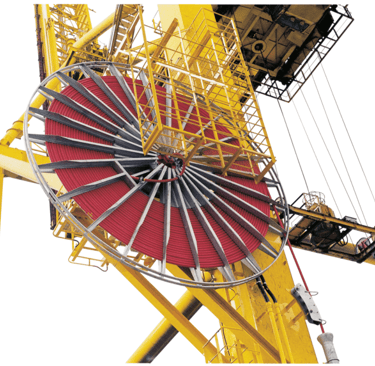
This is where reeling cable selection meets mechanical engineering, and it's so important that it deserves its own treatment. The cable reel system's geometry directly determines how long the cable lasts. The recommended parameters are:
D/d ratio ≥ 20 — where D is the drum diameter and d is the cable diameter
Groove radius = 0.53–0.55 × cable diameter
Groove depth ≥ 30% of cable diameter
Fleet angle ≤ 3.5°
Each of these reduces mechanical stress and extends cable life. The D/d ratio governs the bending stress on every wrap — a larger drum means a gentler bend and far less fatigue. The groove radius determines how well the cable is cradled and supported. The groove depth controls how securely each wrap is retained in its lane. And the fleet angle — the angle at which the cable runs onto the drum — keeps sidewall pressure in check; push it past 3.5° and you start dragging the cable sideways into its groove, accelerating jacket wear and flattening the cable.
The crucial point is that the best cable in the world can't compensate for a badly designed drum. The cable and the drum are a matched system, and both have to be right. A premium reeling cable running on a drum with the wrong groove geometry or an undersized D/d ratio will fail early no matter how good the cable is on its own.
Common Cable Failures in Sydney Port Applications
Understanding how cables fail in this environment helps you recognise problems early and trace them to their root cause. Four failure modes dominate at coastal terminals.
Copper conductor oxidation
Primary causes: salt-laden air, moisture ingress, and poor sealing systems.
Typical symptoms: green corrosion deposits, increased conductor resistance, and reduced current-carrying capacity.
This is the signature coastal failure. Salt and moisture find their way into the conductor, and oxidation sets in. The green deposits are the visible giveaway, but the functional problem is the rising resistance, which generates heat and gradually erodes the cable's performance. Good sealing and corrosion-resistant design are the front-line defences.
Outer jacket cracking
Primary causes: UV exposure, incorrect material selection, and general environmental ageing.
Typical symptoms: surface cracking, loss of flexibility, and water ingress.
This is the signature UV failure, and it's where specifying the wrong jacket material comes back to bite. Once the jacket cracks, it stops protecting the cable, and moisture and salt get into the structure — so jacket failure often leads on to conductor problems. A properly UV-resistant jacket is the single most effective defence against this mode in the Australian climate.
Conductor fatigue
Primary causes: repeated bending, excessive tension, and improper drum design.
Typical symptoms: intermittent faults, core breakage, and unexpected shutdowns.
Conductor fatigue is the mechanical failure mode, and it's directly tied to drum design and cable flexibility. The intermittent faults are the frustrating part — they come and go as broken strands make and lose contact, making the problem hard to pin down until it finally fails outright. A correct D/d ratio and fine-stranded Class 5 or 6 conductors are the best protection.
Reeling cable damage
Primary causes: incorrect D/d ratio, poor groove geometry, excessive fleet angle, and inadequate cable tension.
Consequences: cable crossover, crushing damage, sidewall abrasion, and reduced service life.
This category brings the drum-design discussion full circle. Every one of these causes traces back to the mechanical geometry of the reel system, and every one of the consequences is a direct, physical degradation of the cable. It's the clearest illustration of why the drum and the cable have to be designed together — almost all of this damage is preventable at the design stage.
Inspection and Maintenance in a Coastal Environment
Specifying the right cable is half the job. Keeping it in good condition through a Sydney winter and a Sydney summer is the other half — and in a marine atmosphere, a sensible inspection and maintenance routine pays for itself many times over. The cables that reach the end of their rated life rather than failing prematurely are almost always the ones that get looked after.
Inspect for the early visible signs. Much coastal degradation announces itself before it fails, if you know what to look for. Surface chalking and fine cracking on the jacket are early UV warnings. Green deposits at terminations or exposed conductors signal salt-driven oxidation. Polished or scored patches on the jacket point to mechanical contact or fleet-angle issues. Catching any of these early turns a planned replacement into a routine job rather than an emergency.
Don't forget the connections. In a salt atmosphere, the terminations and connectors are often where trouble starts, not the cable run. Periodically check that seals are intact, that IP-rated enclosures are properly closed, and that there's no corrosion creeping into the junctions. A well-sealed connection is one of the cheapest forms of insurance available against coastal failure.
Inspect the drum, not just the cable. It's easy to focus entirely on the cable and forget that the groove it runs in wears too. Over time, grooves can develop ridges, edge peening, or wear that opens the radius and roughens the surface — and a groove that's worn out of tolerance will start damaging good cables. Check the groove profile periodically against the original specification, and pay particular attention to the exit groove, where stresses concentrate.
Watch the winding in service. A healthy drum spools cleanly, with each wrap laying neatly beside the last. If gaps, climbing, or crossover start to appear during normal operation — often a sign of a tension or pitch issue — treat it as an early warning and correct it before it damages the cable.
Keep records and trend them. Log installations, inspection findings, faults, and service hours. Over a few cycles, the patterns in that data are what let a terminal move from reactive replacement to genuine predictive maintenance — swapping cables during planned downtime, on the terminal's schedule, rather than mid-shift on the cable's. For an operation running around the clock, that shift from reactive to planned is worth a great deal.
None of this is complex or costly. But in a busy terminal it's easy to let slide, and the difference between a cable that's maintained and one that's merely installed shows up clearly in service life and in the number of unwelcome surprises.
A Practical Procurement Checklist
When the time comes to actually specify and buy reeling cable for a Sydney terminal, it helps to have a single list to work through. Run a candidate cable and its installation against these points before committing:
✔ UV-resistant jacket rated for high-exposure Australian conditions
✔ Salt-corrosion protection appropriate to a coastal marine atmosphere
✔ PUR or specialised elastomer jacket for abrasion, oil, and weathering resistance
✔ Class 5 or Class 6 conductors for flexibility and fatigue resistance
✔ Anti-torsion construction suited to reeling duty
✔ High tensile strength for the mechanical and wind loads
✔ Minimum bend radius respected across the whole installation, not just on paper
✔ Drum compatibility — D/d ratio ≥ 20, correct groove geometry, fleet angle ≤ 3.5°
✔ Compliance with AS/NZS 3000 and the applicable parts of AS/NZS 5000
✔ High IP-rated accessories and connectors for water, salt, and dust resistance
✔ Correct installation and tension settings confirmed at commissioning
If you can tick every box with confidence, you've removed the great majority of preventable failure causes before the cable ever turns a cycle. The items most often overlooked are bend radius in practice (as opposed to on the drawing), fleet angle, and connector protection — so give those three a little extra scrutiny.
Industry Case References
A few external references reinforce the themes above and are worth a look for additional perspective.
A discussion on Heavy Equipment Forums covering wire rope damage illustrates how installation issues and drum-related problems can cause severe cable or rope damage shortly after replacement — a reminder that a fast failure usually points to setup or geometry rather than the cable itself. (heavyequipmentforums.com/threads/wire-rope-damage.97163/)
A guide on best practices for cable routing in port automation equipment discusses routing considerations for automated port systems and highlights the importance of proper mechanical protection. (cranecable.com.au)
And a port container terminal power cable guide offers useful insight into cable selection for outdoor port environments, crane applications, and long-distance yard installations. (jinchuancable.com)
The consistent message across these references is that cable reliability is a system property — it depends on the cable, the drum, the routing, and the installation all being right together.
Recommended Reeling Cable Characteristics for Sydney Container Terminals
Pulling all of this together, an ideal reeling cable for modern Port Botany operations should provide:
UV resistance, for the Australian sun
Salt corrosion resistance, for the coastal atmosphere
High tensile strength, for the mechanical loads
Excellent winding performance, for clean, reliable spooling
Anti-torsion construction, for the twisting loads of reeling duty
Class 5 or Class 6 conductors, for flexibility and fatigue resistance
Compliance with Australian requirements, including AS/NZS standards
Long service life under continuous duty, to fit planned maintenance
No single feature on that list is sufficient on its own. The cables that perform well at a Sydney terminal are the ones that bring all of these together, because the environment attacks on every front at once.
Feichun Reeling Cable Solutions for Australian Ports
Feichun manufactures heavy-duty crane and reeling cables built specifically for demanding port applications like those at Port Botany. The relevant product range includes:
NSHTOEU reeling cable
R-(N)TSCGEWOEU crane cable
N3GRDGOEU reeling cable
High-speed PUR reeling cable
These cables are designed for the full spread of terminal equipment:
STS cranes
RTG cranes
Automated stacking cranes
Ship loaders
Ship unloaders
Container terminals generally
The key features map directly onto the requirements this article has laid out:
Excellent UV resistance, for the Australian climate
Superior salt-corrosion protection, for coastal operation
High mechanical strength, for the tensile and dynamic loads
Anti-torsion design, for clean reeling behaviour
Reliable operation in coastal environments
Taken together, those characteristics are exactly what the demanding conditions at Port Botany and other Australian container terminals call for. Whichever supplier a terminal ultimately chooses, the discipline is the same — match the cable's UV resistance, corrosion protection, conductor class, anti-torsion construction, and compliance to both the equipment and the specific conditions of the site.
Frequently Asked Questions
What's the biggest single threat to reeling cables at a Sydney terminal?
There isn't one — that's the challenge. Salt, UV, and mechanical/wind loading all attack the cable simultaneously and in different ways. Salt drives conductor and connector corrosion, UV degrades the jacket, and dynamic loading causes fatigue. A cable for a Sydney terminal has to defend against all three at once, which is why a general-purpose cable rarely lasts.
Why does conductor class matter so much for reeling duty?
Reeling cables flex through enormous numbers of cycles, and flexibility comes from fine stranding. Class 5 and Class 6 conductors use many fine wires, which bend more easily and distribute bending stress better, dramatically reducing fatigue. A coarser conductor simply won't survive the cycle count a reeling application demands.
My cable's jacket is cracking — what went wrong?
Jacket cracking in the Australian climate is almost always UV-driven, often compounded by salt and heat, and sometimes by the wrong jacket material being chosen in the first place. The fix is a properly UV-resistant jacket — PUR or a specialised elastomer rated for high-exposure conditions. Once a jacket cracks it stops protecting the cable, so moisture and salt get in and conductor problems usually follow.
Can a good cable make up for a poorly designed drum?
No. The cable and the drum are a matched system. If the D/d ratio is too small, the groove geometry is wrong, or the fleet angle exceeds 3.5°, even a premium cable will fail early. You have to get both right — specify the cable and the drum together, not in isolation.
Does Australian UV really change the cable I should buy?
Yes, genuinely. Australia has some of the highest UV levels on Earth, and Sydney's summer intensity punishes polymer jackets hard. A cable specified for a milder climate will chalk, stiffen, and crack far sooner here. Always specify the jacket for your worst-case local conditions rather than relying on a generic catalogue rating.
How do I keep coastal corrosion under control?
Focus on sealing and connections as much as on the cable itself. Use high IP-rated accessories and connectors, keep seals and enclosures intact through regular inspection, and watch for the early green deposits that signal oxidation. Much of the worst salt damage starts at unprotected junctions, so protecting them is one of the highest-value things you can do.
Conclusion
Sydney's container terminals operate in one of the most demanding cable environments in Australia, and arguably one of the toughest anywhere. Constant movement, advancing automation, intense UV, marine corrosion, and genuinely continuous operation combine to place exceptional demands on reeling cables — demands that a generic cable simply won't meet for long.
The good news is that these challenges are well understood and entirely manageable. By selecting cables with the right conductor construction, the right jacket materials, proper drum-design compatibility, and compliance with Australian standards, terminal operators can dramatically cut downtime and extend cable service life. The cable and the drum work as a system, the standards exist to keep that system safe and fit for purpose, and the environmental defences — UV resistance, salt-corrosion protection, anti-torsion design — are all achievable with properly engineered cable.
For STS cranes, RTGs, automated stacking cranes, and the rest of the equipment that keeps boxes moving through Port Botany, a properly engineered reeling cable isn't a minor component. It's a critical part of reliable terminal operation — and treating it that way, from specification through to maintenance, is one of the most cost-effective reliability investments a terminal can make.
How to Reach Us
Get in Touch
SiteMap
Product Catalogue
Festoon Cable
Shore Power Cable




Scan to add us on WeChat