
Reeling Cable vs Festoon Cable: Which System is Right for Your Crane?
Learn the key differences between reeling and festoon cable systems. Discover which solution suits your Australian mining, port, or industrial operation with real case examples.
hongjing.Wang@Feichun
4/27/202620 min read
Introduction: Understanding Cable Movement Systems
Walk through an Australian industrial facility—whether it's a shipping terminal in Port Hedland, a warehouse in Melbourne, or an open-pit iron ore mine in the Pilbara—and you'll see cranes and hoists operating everywhere. But most people don't realise that the cables delivering power to these machines operate in fundamentally different ways depending on the application.
Two main systems dominate industrial cable applications: reeling cables and festoon cables. They look different, perform differently, and fail in different ways. Choosing the wrong system for your operation can lead to premature failures, costly downtime, and safety issues.
This guide walks you through both systems, explains the engineering behind each approach, and helps you determine which is right for your specific application.
What is a Reeling Cable System?
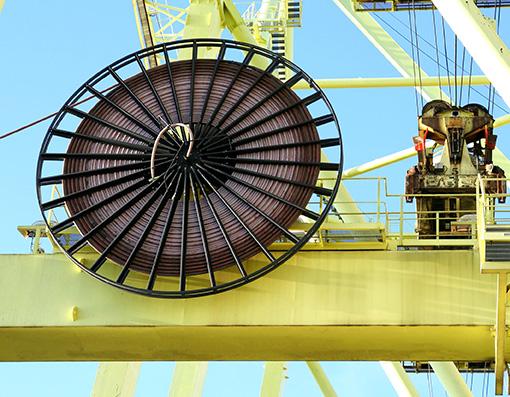
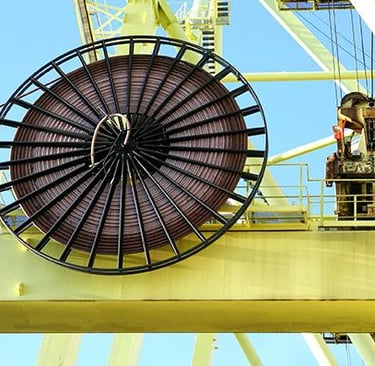
A reeling cable system is built around the concept of a rotating drum. As equipment moves away from the stationary drum, cable unwinds from the drum's surface. As equipment returns, the cable rewinds back onto the drum, layer upon layer, growing thicker with each cycle.
How It Works in Practice
Imagine a large bucket excavator at an Australian iron ore mine. At the start of the day, the cable sits fully wound on the drum, wrapped in a neat spiral. The operator moves the excavator bucket outward. As it moves, cable continuously unwinds from the drum, maintaining tension as the bucket travels. The cable might travel 50, 100, even 150 metres or more away from the stationary drum location.
When the bucket swings back toward the drum, the cable rewinds, being wound back onto the drum in a new layer. The tension in the cable remains constant throughout this cycle, thanks to sophisticated tension control systems that manage how quickly cable can be pulled from the drum.
Critical Characteristics
The reeling cable itself must withstand significant tensile (pulling) stress. As the cable unwinds from the drum, it's under constant pull from the weight and motion of the attached equipment. The cable may also experience torsional (twisting) stress if the equipment rotates while operating.
The hanging length of a reeling cable can be substantial. In some mining operations, cables hang 200 metres or more from the drum. This means the cable's own weight becomes a significant stressing factor—the cable at the bottom of the hang must support not just the equipment load but the weight of all the cable above it.
What is a Festoon Cable System?
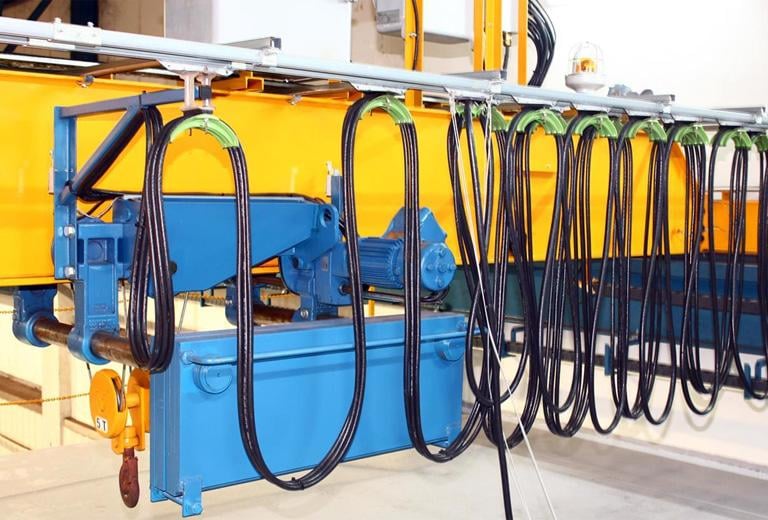
A festoon cable system operates on a completely different principle. Instead of a drum at a central location, a festoon system uses a trolley that travels along a fixed path—typically horizontal, along the length of a crane beam or gantry.
How It Works in Practice
Picture a overhead gantry crane in a modern Australian manufacturing facility or workshop. The crane beam runs along the length of the facility, perhaps 50 metres. A trolley travels along this beam, carrying a hoist hook that moves up and down.
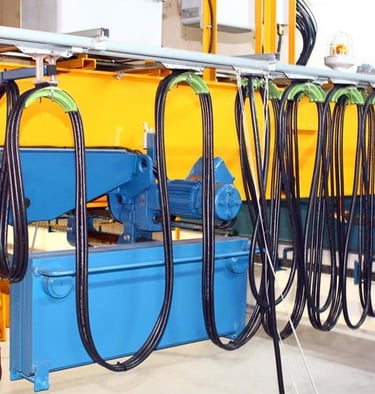
The cable doesn't unwind from a drum. Instead, it's supported in a series of sheaves (pulleys) that allow it to form a gentle curve, or "catenary," as the trolley moves. The cable hangs in a relaxed curve, dropping from the fixed support points and rising again as the trolley moves.
As the trolley travels along its path, the cable is carried with it. The cable forms loops and curves, bending around pulleys but never experiencing the intense pulling stress of a reeling system.
Critical Characteristics
In a festoon system, the cable's primary stress is bending, not tension. The cable bends repeatedly around pulleys and supporting structure, sometimes hundreds of times per day.
The cable length is typically fixed and measured to match the maximum travel distance the trolley requires. Unlike reeling systems where cable continuously winds and unwinds, festoon cables remain relatively stationary in terms of longitudinal movement—they move horizontally with the trolley but don't wind up onto a drum.
The hanging length is usually modest—often just a few metres from support points to the trolley—compared to the potentially vast hanging lengths in reeling systems.
Key Differences Between Reeling and Festoon Systems
Understanding where these two systems differ fundamentally will help you evaluate which is appropriate for your operation.
Primary Stress Type
In a reeling cable system, the dominant stress is tension—pulling force. The cable must withstand tremendous pulling loads from hanging equipment, from the acceleration and deceleration of loads, and from the cable's own weight. A reeling cable is engineered to resist these tensile stresses, with specially designed conductors and reinforced outer sheaths capable of handling continuous pulling.
In a festoon system, the dominant stress is bending. The cable curves around pulleys and support structures repeatedly. While festoon cables certainly experience some tensile stress from hanging, their engineering is primarily focused on surviving repeated bending cycles without insulation cracking or internal conductor damage.
Maximum Hanging Length
Reeling systems excel when you need to reach long distances. The mechanism of winding and unwinding cable from a drum allows the cable to extend very far from the stationary drum location. Many Australian mining operations use reeling systems with hanging lengths exceeding 150 metres.
Festoon systems are practical for moderate distances, typically up to 100 metres though the practical limit is usually less. Once you exceed the practical distance, the cable weight becomes excessive, and the system becomes unwieldy to install and operate.
Installation Complexity
Installing a reeling system requires careful alignment of the drum, proper tensioning mechanisms, and careful planning of the cable's path from the drum to the equipment. The installation is complex but, once completed, is quite durable.
Installing a festoon system requires proper support structure with numerous attachment points for the cable-carrying sheaves. You need to ensure the cable hangs in smooth curves without sharp bends. The installation process is straightforward but meticulous—every support point must be correctly positioned.
Maintenance Requirements
Reeling systems require periodic inspection of the drum condition, tension adjustment, and cable inspection as it emerges from the drum (where damage is most likely to occur).
Festoon systems require inspection of the cable condition along its entire length, as bending stress can damage insulation at any point. The supporting sheaves must be regularly inspected to ensure they're not causing excessive cable wear.
Cost Considerations
Reeling systems, particularly for very long-distance applications, involve significant upfront equipment costs for the drum, tension control systems, and supporting structure. However, they handle very long distances economically—once installed, extending the distance slightly doesn't require redesigning the entire system.
Festoon systems are generally less expensive to install initially, particularly for shorter to moderate distances. However, as you need to reach further distances, costs rise because you need more support structure and longer cable lengths.
Cable Design Differences: The Engineering Behind Each System
The cables used in reeling versus festoon systems look different, are built differently, and have different specifications. Understanding these differences is crucial to choosing the right system.
Reeling Cable Design and Characteristics
A reeling cable is engineered for tensile strength and torsion resistance. The conductor is exceptionally fine-stranded—sometimes called "FS" class or "exceptionally fine stranded"—which allows it to bend without fatigue while also being flexible enough to wind onto a drum without cracking. Premium reeling cables like the NTSCGEWOEU type use electrolytic copper tinned and very finely stranded conductors for maximum flexibility and corrosion resistance.
The insulation is typically a high-grade EPR (ethylene propylene rubber) compound, often with semiconductor layers for electrical field control. These semiconductor layers help distribute electrical stress uniformly throughout the insulation, preventing weak points. Advanced designs feature inner semiconducting layers of EPR with outer semiconducting layers capable of being stripped cold (Easy Strip design), simplifying field termination and cable preparation.
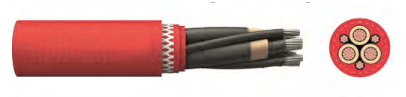
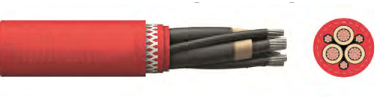
The outer sheath of a reeling cable is robust and often multi-layered. Premium cables use a PROTOFIRM sandwich system with double-layer sheaths: a special EPR inner sheath (quality 5GM3) that serves as a water barrier, combined with an abrasion and tear-proof outer sheath (quality 5GM5) in bright red colour. Between these sheaths sits anti-torsion braiding made of reinforced polyester threads bonded into the structure, creating a sheath system that resists twisting stresses of plus or minus 25 degrees per metre or more while maintaining exceptional flexibility.
Real-World Case: Long-Distance Container Crane Cable
Consider a large container handling facility at an Australian port. A modern container crane might need to reach 150 metres across the dock to load or unload containers from the most distant berth position. The cable must:
Deliver power to the hoisting mechanism while the load travels this 150-metre distance
Withstand constant tensile stress from the weight of loaded containers (often 20 tonnes or more)
Handle multiple cycles per day (perhaps 200 or 300 pick-and-place cycles in a working day)
Maintain electrical integrity over this extreme distance, with minimal voltage drop
Resist the salt-air environment of a coastal port
A proper reeling cable for this application would be a medium-voltage type such as the NTSCGEWOEU cable specification. This cable type offers:
Three-core design with split earth conductors positioned in the interstices (outer spaces) for excellent grounding
Voltage rating of 6 to 10 kilovolts, selected based on the specific equipment requirements
Exceptionally fine-stranded copper conductors (Class FS stranding) with cross-sections ranging from 25 to 300 square millimetres, capable of carrying 130 to 620+ amps depending on size
Maximum conductor temperatures rated to 90°C, with permitted outer cable temperatures from -50°C to +80°C for fixed installations and -35°C to +60°C for flexible operation
PROTOFIRM sandwich double-layer sheath system combining EPR inner sheath with abrasion and tear-proof outer compounds for maximum durability
Anti-torsion braiding made of reinforced polyester threads, capable of handling torsional stresses of plus or minus 25 degrees per metre
Tensile strength ratings up to 14,400 newtons depending on conductor size, ensuring the cable handles the dynamic loads of loaded container hoisting
Electrical conductivity optimized to minimize voltage drop over the 150-metre span
The NTSCGEWOEU cable configuration includes improved mechanical and electrical characteristics with inner and outer semiconducting layers for electrical field control, making it ideal for the extreme demands of port operations. The cable would likely cost $50,000 to $100,000+ per kilometre (depending on specific conductor size and market conditions), but installed properly, it would operate reliably for 10 or more years in continuous industrial use, even in corrosive coastal environments.
Festoon Cable Design and Characteristics
A festoon cable is engineered for repeated bending. The conductors are flexible but not necessarily as fine-stranded as reeling cable conductors—the primary stress isn't tensile fatigue from repeated pulling but rather bending damage from curves around pulleys. Industry-standard cables like the H07VVH6-F type use electrolytic annealed copper with Class 5 (flexible) stranding according to EN 60228, providing excellent bendability without excessive weight.
The insulation in festoon cables is typically flexible PVC (polyvinyl chloride) rather than EPR. Type TI2 flexible PVC insulation is perfectly adequate for the bending stresses festoon cables experience, and it's more cost-effective than EPR while still providing excellent repeated flexing capability. The insulation is designed to flex repeatedly without cracking at stress points, and standard colour identification (Brown, Black, Grey, Green/yellow for different conductors) allows operators to quickly identify individual circuits.
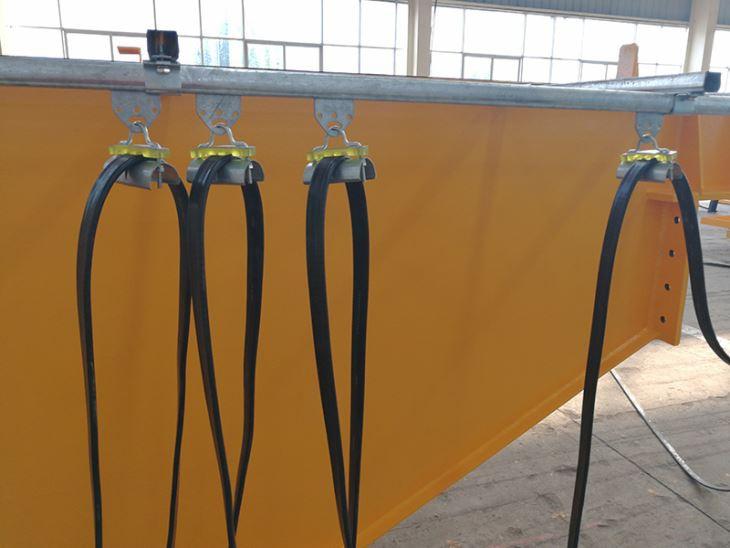
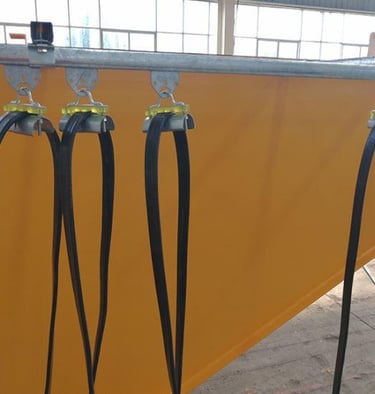
Notably, modern festoon cables like the H07VVH6-F are often flat, not round. The flat configuration has a strategic advantage: by arranging the conductors side-by-side in a parallel layout (4G, 6G, 8G, 10G, 12G configurations), the cable distributes bending stress more evenly. When a flat cable bends, it bends uniformly across its width rather than concentrating stress at certain points, as happens with round cables. This is why flat festoon cables have become the industry standard for cranes and hoists.
The outer sheath of a festoon cable is typically a single layer of flexible PVC (Type TM2 according to EN 50363-4-1), in black colour with a special ripcord that allows gentle tearing during installation. The material is selected for flexibility and repeated bending capability rather than the extreme environmental resistance required by reeling cables. The low halogen emission (chlorine less than 15%) meets modern fire safety requirements while maintaining the flexibility essential for festoon applications.
Real-World Case: Indoor Workshop Gantry Crane Cable
Consider a modern automotive manufacturing facility near Melbourne that operates overhead gantry cranes for moving parts and components along assembly lines. Each crane travels about 40 metres and needs to move frequently—perhaps carrying a relatively light load (5 tonnes or less) up to 30 times per hour.
A suitable festoon cable for this application would be the H07VVH6-F flat cable type, which is specifically engineered for lifts, cranes, hoists, and conveyor systems. This cable offers:
Four to six flat-arranged conductors in a parallel side-by-side configuration (4G 1.5, 6G 1.5, 8G 1.5, or higher cross-sections)
Voltage rating of 450/750V (the H07VVH6-F designation indicates 450V phase-to-neutral, 750V phase-to-phase)
Electrolytic annealed copper conductors, Class 5 (flexible) according to EN 60228, ensuring excellent bendability
Maximum conductor temperature of 70°C, appropriate for climate-controlled manufacturing environments
Flexible PVC insulation (Type TI2) with standard colour identification: Brown + Black + Grey + Green/yellow for 4-conductor versions
Flexible PVC outer sheath (Type TM2) in black colour with a special ripcord for easy installation
Flat configuration allowing hanging lengths up to 35 metres with minimal sag
Maximum pull-out speed capability of 1.6 metres per second, matching trolley acceleration profiles
Minimum bending radius for free movement of just 5 times the cable's smaller dimension, allowing smooth curves around pulleys
For a 4G 1.5 configuration: 12mm x 4.1mm dimensions, approximately 100 kg/km weight, carrying capacity of 14 amps in open air
For larger configurations like 12G 1.5: 39mm x 4.9mm dimensions, approximately 395 kg/km weight, carrying capacity of 22 amps in open air
Flame non-propagation according to EN 60332-1 with low halogen emission (chlorine content below 15%)
Chemical and oil resistance rated as acceptable, with water resistance at AD5 jets level
Impact resistance AG2 (medium severity), suitable for manufacturing environments
The H07VVH6-F flat design is particularly popular in manufacturing because the parallel arrangement of conductors makes installation simpler and allows the cable to bend smoothly around pulleys without stress concentration. The cable would cost approximately $20,000 to $40,000 per kilometre and would operate smoothly in the controlled indoor environment for 8-12 years or more with routine maintenance.
The flat configuration is a key advantage in festoon systems: by arranging the conductors side-by-side rather than in a round bundle, the cable distributes bending stress evenly across its width. When the cable bends around a pulley, it bends uniformly along its entire surface rather than concentrating stress at specific points, dramatically extending cable life in high-cycle-rate applications.

Typical Failure Issues: Why Cables Fail and How to Prevent It
Understanding failure modes helps you maintain your system and recognize when a cable is nearing the end of its serviceable life.
Reeling System Cable Failures
When a reeling cable fails prematurely, the causes usually relate to the extreme stresses these cables endure.
Cable twisting and torsion damage occurs when equipment rotates while the cable is under tension. If the cable doesn't have proper torsion protection, the twisting motion can cause the insulation and internal structure to separate. The cable appears intact externally but is actually compromised internally. When this happens, moisture eventually seeps into the internal damage, causing a complete failure within days or weeks.
Prevention requires ensuring the cable has proper torsion protection (usually aramid braiding) and that equipment rotation is controlled and monitored. If equipment must rotate, torsion-rated cables aren't optional—they're essential.
Incorrect tension control causes either excessive pulling stress (if tension is too tight) or cable slack (if tension is too loose). Excessive tension stresses the conductor beyond its rated capacity, causing internal microcracking. Cable slack allows the cable to develop loops and kinks that concentrate stress at specific points.
Prevention requires regular inspection and adjustment of the tension control system. Many modern systems use load cells to monitor actual tension and adjust automatically.
Fatigue at the drum exit occurs because the area where cable emerges from the drum is a stress concentration point. As the cable repeatedly winds and unwinds, this point experiences cyclic stress. If the cable has any flaws in insulation or construction, this is where they'll typically show up first.
Prevention requires regular inspection of cable at the drum exit and replacement of the cable section if signs of degradation appear.
Festoon System Cable Failures
Festoon cable failures typically relate to bending-induced damage rather than tensile failure.
Insulation cracking from excessive bending is the most common failure mode. If the cable bends around too tight a radius, the outer insulation cracks. Once cracking starts, moisture and contaminants seep into the insulation. The insulation's dielectric (electrical insulating) properties degrade, and eventually, the cable fails electrically.
Prevention requires ensuring that all supporting sheaves and pulleys have adequate radius—typically at least 5 to 10 times the cable's smaller dimension for bending, and possibly 10-20 times for long-term reliability in continuous-duty applications.
Cable sagging occurs when support structure deflects or when the supporting sheaves aren't properly maintained. Excessive sag causes the cable to hang in deeper curves, increasing bending stress. In extreme cases, the cable can sag into moving parts of the equipment below, causing mechanical damage.
Prevention requires regular inspection of the support structure for deflection and proper sheave maintenance. Sheaves must rotate freely without friction that would increase bending stress.
Sheath degradation from environmental exposure happens when cables are exposed to UV light, ozone, or extreme temperatures. Festoon cables in outdoor applications or in areas with significant UV exposure can see their outer sheath harden and crack.
Prevention requires choosing cables with UV-resistant outer sheaths for outdoor applications and ensuring cables are protected from direct sunlight when possible. Some applications benefit from additional protective conduit or sleeving.
How to Choose Between Reeling and Festoon: A Decision Framework
Selecting the right system requires understanding your specific requirements. Here's a practical framework:
Step 1: Determine Your Required Cable Travel Distance
How far does the cable need to extend from the power source or drum location to the equipment being powered? Measure this distance carefully, accounting for any slack the system requires.
If your required distance exceeds 100 metres, reeling systems become increasingly attractive. Festoon systems can technically span 100+ metres, but support structure costs escalate dramatically, and cable weight becomes a significant factor.
If your required distance is less than 50 metres, either system is feasible, but festoon systems typically offer simpler installation and lower cost.
If your distance is between 50 and 100 metres, both systems are viable, and the choice depends on other factors.
Step 2: Analyze Your Equipment Motion Characteristics
Does the equipment move in a single direction (longitudinal), or does it also rotate or move in multiple planes?
If equipment rotates significantly—such as a bucket excavator that must rotate to dump its load—a reeling system with torsion-rated cable is typically more appropriate. Festoon systems can handle some rotation, but equipment that twists while moving creates stresses that torsion-rated reeling cables handle more reliably.
If equipment moves smoothly in one or two directions without significant rotation, a festoon system is often adequate.
Step 3: Evaluate Your Operating Environment
Is your system indoors in a controlled environment, or outdoors exposed to weather?
Indoors in climate-controlled facilities, festoon systems excel. The moderate environmental stresses are well-matched to festoon cable capabilities, and the repeated smooth bending is manageable.
Outdoors in harsh environments—like Australian mining operations or coastal ports—reeling systems often prove more durable. The robust construction of reeling cables handles environmental stresses better, though they require more careful maintenance.
Step 4: Consider Your Maintenance Capability
Do you have experienced technicians who can regularly inspect and maintain complex reeling systems, or do you need a simpler system that requires less specialised maintenance?
Reeling systems require more sophisticated maintenance. The drum and tension control systems must be regularly inspected and adjusted. The cable must be carefully inspected where it exits the drum. This demands experienced personnel.
Festoon systems are simpler to maintain. You need to inspect the cable periodically and ensure the supporting sheaves are in good condition, but the maintenance is more routine and less technically demanding.
Step 5: Calculate Total Cost of Ownership
Don't just compare the upfront cable cost. Consider:
Installation labour and complexity. Reeling systems typically require more expensive installation but are one-time costs.
Maintenance costs over the cable lifespan. Reeling systems may have higher maintenance costs but potentially longer cable life in harsh environments.
Downtime costs when cables fail. This is often the largest cost factor. A cable failure that stops production might cost $10,000-$100,000+ per day in lost production. Choosing the wrong system can mean failures are more frequent, driving this cost up.
Cable replacement costs and frequency. Calculate how often you expect cable replacement and multiply by cable cost. A $50,000 cable that lasts 10 years is cheaper than a $20,000 cable that lasts only 3 years.
Recommended Cable Types by Application: Real-World Scenarios
Long-Distance Mining and Heavy Industry Applications
For Australian mining operations requiring cables to extend 150+ metres in harsh conditions, medium-voltage reeling cables such as the NTSCGEWOEU type with voltage ratings of 6 to 20 kilovolts are typically specified. These cables feature exceptionally fine-stranded copper conductors (Class FS), EPR insulation with semiconductor control layers, and multi-layer outer sheaths with aramid or polyester torsion protection.
The NTSCGEWOEU cable is designed specifically for applications under high to extreme mechanical stress, such as:
High travel speeds in container crane operations
Dynamic tensile loads from heavy-load hoisting
Multiple changes of direction into different planes
Torsional stresses from equipment rotation
Rapid acceleration and deceleration cycles
These cables are sized to carry current loads from 100 to 600+ amps depending on conductor cross-section, with sizes ranging from 3x25+3x25/3 (131 amps) to 3x300+3x150/3 (620 amps). Maximum conductor temperatures are rated to 90°C, with permitted outer cable temperatures from -50°C to +80°C for fixed installations and -35°C to +60°C for flexible operation.
These cables handle torsional stresses of plus or minus 25 degrees per metre, tensile loads up to 14,400 newtons depending on size, and have been specifically engineered for the extreme mechanical stresses of large bucket excavators, mobile crushers, container cranes, and similar equipment operating in the Australian mining and port sectors.
Port and Container Handling Operations
Large port facilities operating container cranes typically use NTSCGEWOEU type medium-voltage reeling cables for ultra-long-distance applications (container cranes reaching 150+ metres). Voltage ratings typically run from 6 to 12 kilovolts, with ampacity requirements often exceeding 200 amps.
These cables must handle salt-air environments, requiring excellent oil and ozone resistance—a key characteristic of the NTSCGEWOEU specification. The PROTOFIRM sandwich sheath system (double-layer inner and outer sheaths) provides maximum protection from the corrosive coastal environment.
For smaller port equipment operating over shorter distances (under 80 metres), some operators use flexible festoon-type systems, though the harsh coastal environment typically demands reeling cable specifications.
Manufacturing and Warehouse Applications
Most indoor manufacturing facilities use flat festoon cable systems, particularly the H07VVH6-F type, which has become the industry standard for indoor crane systems. These cables operate at standard industrial voltages (300/500V or 450/750V), with ampacity requirements from 14 to 40+ amps depending on crane size.
The H07VVH6-F flat configuration is particularly popular because:
The parallel side-by-side arrangement of conductors (4G, 6G, 8G, 10G, 12G configurations available) makes installation simpler and faster
The flat design allows the cable to bend smoothly around pulleys without the stress concentration that occurs with round cables
Conductor sizes range from 0.75mm² to 4mm² cross-section per conductor
The cable is rated for pulling speeds up to 1.6 m/s, matching modern gantry crane acceleration profiles
Hanging lengths up to 35 metres are practical with proper support structure
The cable operates reliably in climate-controlled environments for 8-12+ years with routine maintenance
The H07VVH6-F designation (H07 = 450/750V; VVH6 = 6-core flat; F = flat configuration) is found worldwide in manufacturing, warehousing, and industrial facilities because the flat design's fundamental advantage—even stress distribution during bending—extends cable life dramatically compared to round cable alternatives in high-cycle-rate festoon applications.
The Engineering of Long-Distance Power Delivery
When designing either a reeling or festoon system, one critical consideration is often overlooked: voltage drop over long cable runs.
In a reeling system where cable extends 150 metres, the electrical resistance of the copper conductors over this distance means significant voltage drop occurs. For a 150-metre cable run carrying 200 amps, voltage drop might reach 5-10 volts, depending on conductor size. This is why reeling cable specifications typically include large conductor cross-sections (often 150 square millimetres or larger) for long-distance applications.
In a festoon system, even though the cable is only 35-50 metres long, if the equipment draws significant current, voltage drop still becomes relevant. This is why festoon cables for higher-current applications specify relatively large conductors compared to the cable's overall size.
Understanding voltage drop helps explain why cable costs can seem high for certain applications—the large conductors required to manage voltage drop over long distances or with high current draw are a significant cost factor, but they're essential for proper equipment operation.
Installation Considerations: Getting It Right from the Start
Reeling System Installation
Proper reeling system installation starts with careful drum alignment. The drum must be perpendicular to the direction the cable will travel, and the cable's path from the drum to the equipment must be planned to minimise unnecessary bends.
The tension control system is critical. Most modern systems use automatic tensioning that adjusts as the cable winds and unwinds, accounting for the changing geometry as layers accumulate on the drum. Proper tension is typically in the range of 100-200 newtons per metre of cable width, but this varies by application.
Cable dressing—the way the cable is wound onto the drum—matters for longevity. Neat, parallel layers minimise stress concentrations. Some systems use specially designed drum heads that guide the cable into proper position as it winds.
Festoon System Installation
Festoon system installation requires careful calculation of support point spacing. If support points are too far apart, the cable sags excessively and bending stress increases. Typical support spacing is 5-10 metres, though this varies based on cable weight and load.
Sheave installation is critical. Each pulley or sheave must be properly aligned, and the radius of the sheave must be adequate for the cable size—typically at least 5 times the cable's smaller dimension.
Cable tension in a festoon system is typically light—just enough to keep the cable from sagging excessively. Unlike reeling systems, festoon systems don't rely on active tension management; the geometry of the support structure determines cable position.
Real-World Maintenance: What You Need to Know
Reeling System Maintenance Schedule
Weekly: Visual inspection of cable where it emerges from the drum for signs of damage, cuts, or insulation degradation.
Monthly: Inspection of the tension control system and any pressure gauges. Verification that tension is within specification. Visual inspection of the drum for debris or damaged flanges.
Quarterly: Full-length inspection of the cable at the drum exit. Check for any signs of torsion-related damage (cable appearing twisted or wrung out).
Annually: Complete inspection of all cable routing. Verify that cable routing hasn't changed due to equipment vibration or settling. Test the automatic tension system to ensure it's functioning correctly.
Every 3-5 years: Consider cable replacement if the system has seen heavy use. Even well-maintained cables degrade over time, and a preventive replacement is usually cheaper than dealing with a failure.
Festoon System Maintenance Schedule
Weekly: Visual inspection of accessible cable portions for cuts or insulation damage.
Monthly: Inspection and cleaning of all supporting sheaves. Ensure sheaves rotate freely without friction.
Quarterly: Full-length inspection of the entire cable. Check for insulation cracks, especially where the cable bends most tightly.
Annually: Structural inspection of the support system for deflection or corrosion. Verify that sheaves haven't worn or deformed.
Every 5-7 years: Consider cable replacement. Festoon cables typically have slightly longer service life than reeling cables in ideal conditions, but outdoor systems may need replacement sooner.
Emerging Cable Technologies: What's Changing
The cable industry is advancing in several areas that affect reeling and festoon systems:
High-Capacity Flat Cables
New flat cable designs now accommodate much higher voltage and amperage than earlier generations. Some modern flat cables can handle 450/750V and 100+ amps in a flat format, making them competitive with round cables for some applications previously dominated by reeling systems.
Improved Insulation Materials
New insulation formulations offer better resistance to oil, ozone, and extreme temperatures. These improvements extend cable life, particularly in harsh outdoor environments.
Enhanced Torsion Protection
Advances in braiding techniques and protective materials have made torsion-rated cables more flexible and easier to install while maintaining or improving their resistance to twisting stresses.
Integrated Sensing
Some emerging cable designs include embedded sensors that monitor temperature, tension, or insulation integrity, providing early warning of cable degradation before failure occurs.
These technological advances are gradually blurring the boundaries between what reeling and festoon systems can accomplish, but the fundamental principles—reeling cables excel at long distances with high tensile stress; festoon cables excel at moderate distances with repeated bending—remain valid.
Decision-Making Summary: Reeling vs Festoon
Choose a Reeling System if:
Your required cable travel distance exceeds 80-100 metres and you need reliable operation for many years. The upfront investment in a reeling system pays dividends in long-distance applications.
Your equipment experiences significant rotation or dynamic tensile loading. Reeling cables with proper torsion protection handle these stresses reliably.
You operate in harsh outdoor environments—mining, coastal ports, extreme heat or cold. Reeling cables' robust construction handles environmental stresses better.
You can commit to regular, professional maintenance. Reeling systems demand more maintenance but repay that attention with reliability.
Your production process is so critical that cable failure downtime is prohibitively expensive. The extra investment in a proper reeling system is justified by reliability.
Choose a Festoon System if:
Your required cable travel distance is less than 60-80 metres. Festoon systems are simpler and more economical for moderate distances.
Your equipment moves smoothly in one or two directions without significant rotation. The cable doesn't need torsion protection.
You operate in a controlled indoor environment—manufacturing, warehousing, climate-controlled facilities. Festoon cables excel in these conditions.
You have limited maintenance resources or prefer a system that requires less specialised maintenance. Festoon systems are simpler to maintain.
Your budget for upfront installation is limited. Festoon systems typically have lower initial costs.
Getting Expert Guidance
Ultimately, the choice between reeling and festoon systems depends on your specific application, environment, and operational requirements. Every facility has unique characteristics that influence this decision.
If you're uncertain which approach suits your operation, consulting with cable and system engineers who understand your specific application will help ensure you make the right choice. They can assess your hanging length requirements, environmental stresses, operational characteristics, and maintenance capabilities, then recommend the system most likely to deliver reliable, cost-effective service.
The difference between choosing the right system and the wrong system can be tens of thousands of dollars in premature cable failures and production downtime—a small investment in proper engineering consultation often pays for itself many times over.
Conclusion: Matching System to Requirement
Reeling and festoon cable systems represent two fundamentally different engineering approaches to the same problem: delivering power to moving equipment. Neither is universally "better"—each is optimized for different requirements.
Understanding where your operation falls in the spectrum between short-distance controlled movement and long-distance harsh-environment operation will guide you toward the system most likely to deliver years of reliable service.
Take the time to assess your actual requirements carefully, consult with experienced engineers, and invest in the system that matches your needs. The reliability and cost savings over the cable system's lifespan will vindicate the thoroughness of your initial decision-making.
How to Reach Us
Get in Touch
SiteMap
Product Catalogue
Festoon Cable
Shore Power Cable




Scan to add us on WeChat