RONDOFLEX (N)GRDGOEU Low Voltage Round Cable for Festoon Systems and High-Stress Movable Machine Connections
Discover the RONDOFLEX (N)GRDGOEU low voltage round cable for festoon application, engineered as a flexible power and control cable for gantry cranes, material handling systems, and movable parts of machine tools under high mechanical stresses and frequent bending. Ideal for low voltage festoon systems, crane festoon power supply, and industrial control circuits requiring durable rubber-sheathed round cables with excellent oil, weather, and torsion resistance.
hongjing.Wang@Feichun
12/2/202516 min read
Overview of RONDOFLEX (N)GRDGOEU Low Voltage Round Cable
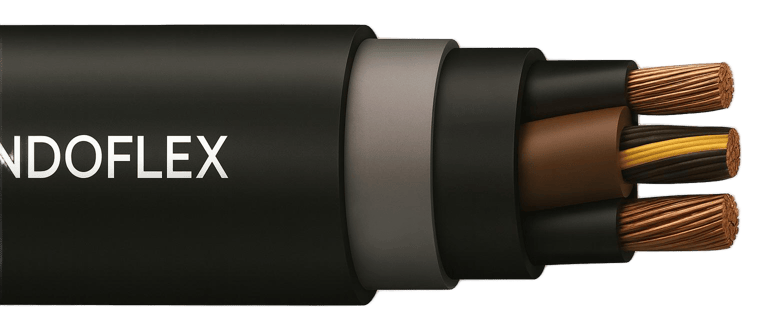
The RONDOFLEX (N)GRDGOEU is a specialized flexible low voltage round cable engineered for demanding industrial applications where power and control circuits must withstand high mechanical stress and frequent bending. This cable is primarily designed for festoon systems, which are cable guidance mechanisms commonly used on gantry cranes, hall cranes, warehouse material handling equipment, and movable machine tool installations. The festoon application requires cables to travel horizontally along rail-mounted trolleys, repeatedly flexing as the machinery moves back and forth.
The cable's construction follows a design based on DIN VDE 0250-814, incorporating finely stranded bare copper conductors, high-performance EPR-based insulation, and robust rubber sheaths optimized for oil, weather, and abrasion resistance. With a rated voltage of 0.6/1 kV (600/1000V), the RONDOFLEX (N)GRDGOEU is suitable for low voltage power distribution and control signal transmission in industrial environments. The maximum permissible operating voltage reaches 0.7/1.2 kV for AC systems and 0.9/1.8 kV for DC systems, providing a safety margin for voltage fluctuations in crane and material handling installations.
One of the key performance benefits of this rubber-sheathed festoon power cable is its ability to maintain structural integrity and electrical reliability under continuous dynamic loading. Unlike cables designed solely for fixed installation, the RONDOFLEX (N)GRDGOEU is built to endure repeated bending cycles, torsional stresses, and mechanical vibrations that occur during trolley travel. The cable's flexibility and durability stem from its fine-stranded conductor design (class 5 according to DIN EN 60228), which distributes mechanical stress evenly across numerous small wires rather than concentrating it in a few thick strands.
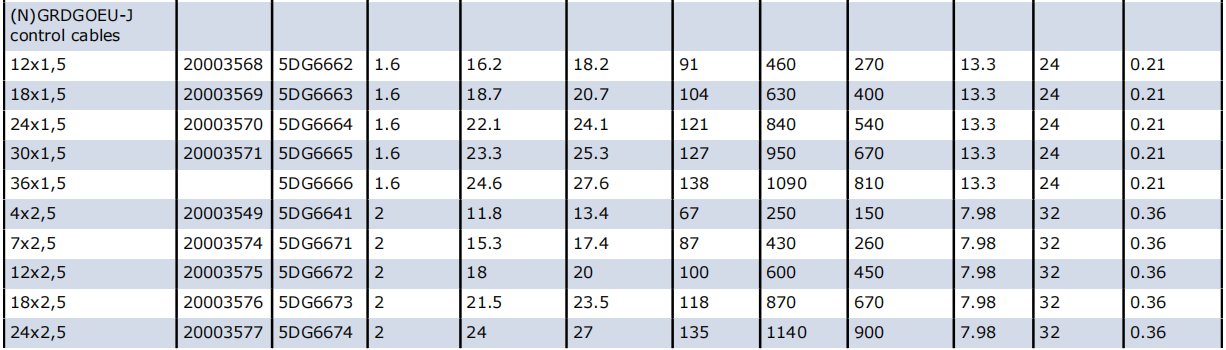
The RONDOFLEX (N)GRDGOEU flexible power and control cable for cranes is available in both single-core and multicore configurations. Single-core designs range from 25 mm² to 240 mm² for heavy power transmission, while multicore options include 3-core plus split earth (3C+3G), 4-core, and 5-core arrangements for combined power and earthing requirements. Control cable versions offer 12 to 56 cores in smaller cross-sections (typically 1.5 mm² to 2.5 mm²), enabling centralized control of crane functions such as motor drives, limit switches, and safety interlocks.
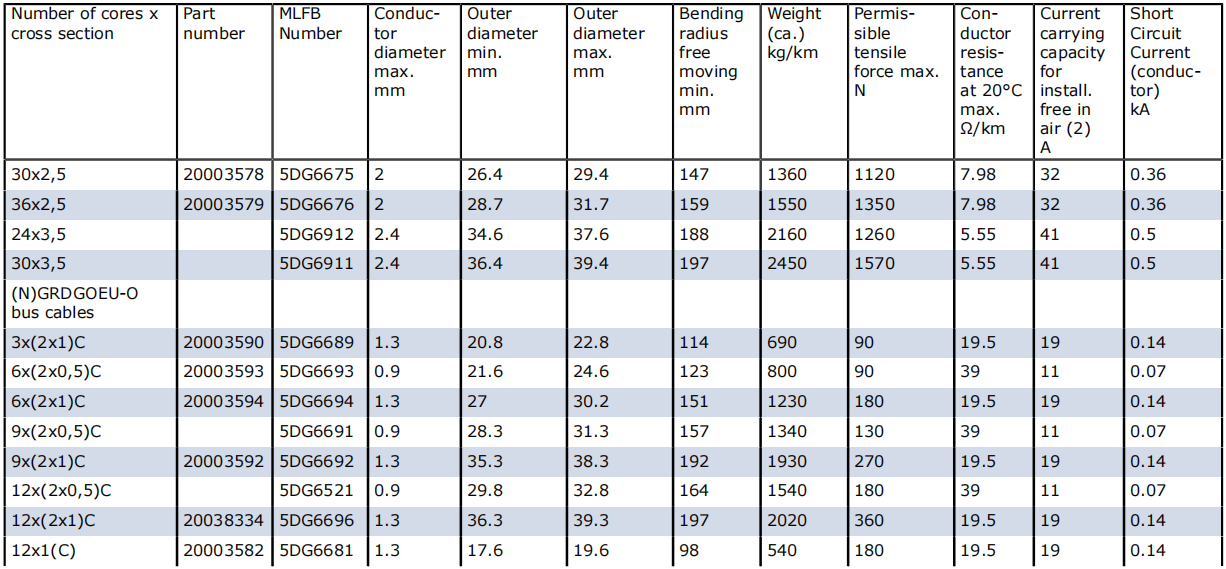
The cable also incorporates special bus cable variants with twisted and shielded pairs, designated with the suffix "-O" and core configurations like 3x(2x1)C or 6x(2x1)C. These bus cables support industrial communication protocols such as ASI-Bus, Profibus, and CAN-Bus, which are increasingly common in modern automated material handling systems. By integrating power and data transmission in a single festoon cable run, system designers can simplify wiring and reduce the number of festoon loops required.
Mechanical Performance in Festoon Systems
Tensile Load and Flexibility
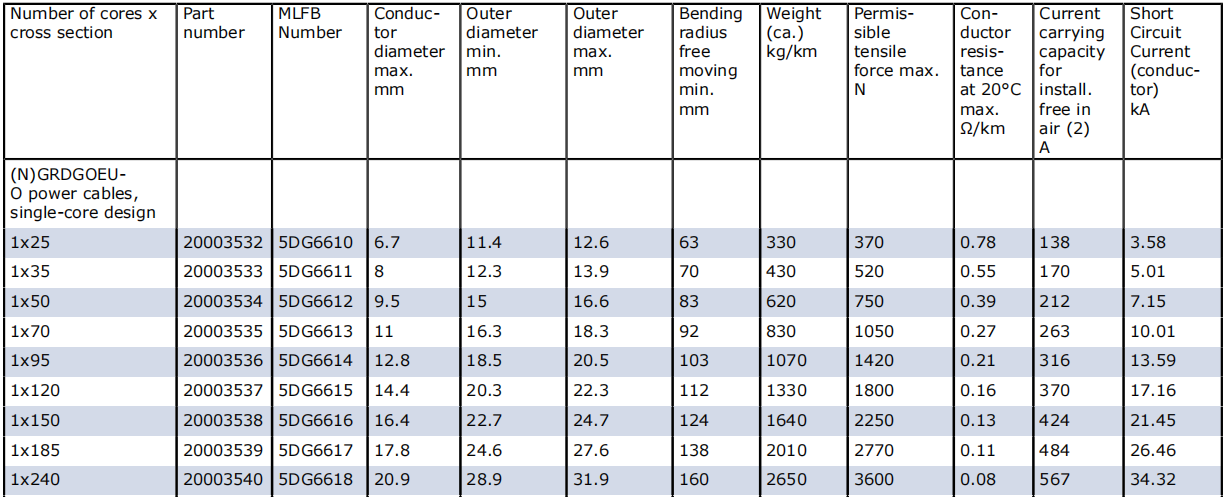
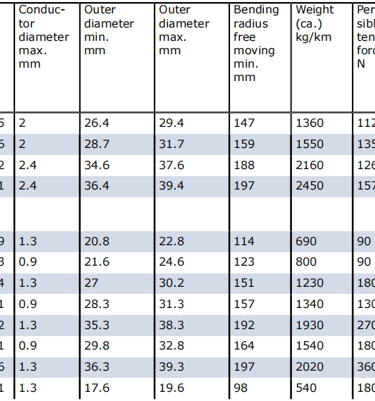
One of the critical mechanical parameters for any flexible low voltage control cable for movable machine tool parts is the maximum permissible tensile load during operation. For the RONDOFLEX (N)GRDGOEU, this limit is set at 15 N/mm² of conductor cross-section, which is the standard value for flexible cables according to DIN VDE 0298 Part 3. This means a cable with a total conductor cross-section of 25 mm² can safely withstand a continuous tensile force of 375 N (approximately 38 kg), while a 70 mm² conductor can handle up to 1050 N (around 107 kg).
In festoon systems, the cable is typically suspended in loops between trolley and fixed mounting points, with the weight of the cable itself and any additional forces from acceleration or deceleration contributing to the total tensile load. Proper calculation of the maximum loop length and the number of loops is essential to keep tensile stress within safe limits and avoid premature conductor breakage. For very long spans or heavy cables, it may be necessary to increase the number of festoon loops or use intermediate support carriers to distribute the weight.
Bending Radius and Torsional Stress
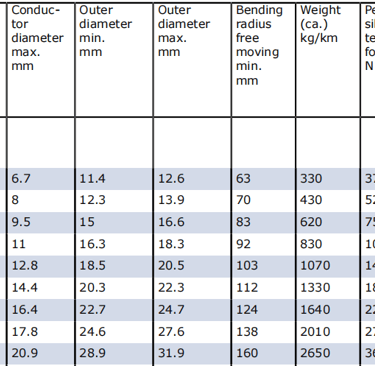
The minimum bending radius for the RONDOFLEX (N)GRDGOEU low voltage round crane cable is defined according to DIN VDE 0298 Part 3, which provides specific multipliers based on the cable's overall diameter (d). For fixed installation, the minimum bending radius is typically 3 × d, while for fully flexible operation in festoon systems, it increases to 4 × d or 5 × d depending on the cable diameter range. Adhering to these minimum bending radii is crucial to prevent internal core damage, conductor fatigue, and insulation cracking.
Torsional stress is another important consideration. The RONDOFLEX (N)GRDGOEU is designed to tolerate moderate torsional loads of up to ±25 degrees per meter of cable length. This tolerance accounts for unavoidable twisting that occurs when the festoon trolley moves, especially if the cable entry points are not perfectly aligned or if the trolley path involves slight curves. However, the cable is not intended for continuous torsional operation, and excessive twisting should be minimized through proper festoon carrier design and cable entry arrangement.
For applications with higher torsional demands—such as rotating machinery or swivel-mounted equipment—alternative cable designs with anti-torsion braids or specialized core lays should be considered. The RONDOFLEX standard version is optimized for linear festoon travel with controlled bending in a single plane.
Travel Speed and Service Life
The maximum recommended travel speed for the RONDOFLEX (N)GRDGOEU in festoon systems is up to 240 meters per minute. This speed is suitable for most gantry crane and material handling applications, including fast-moving container cranes in ports and automated storage and retrieval systems in warehouses. For speeds exceeding 240 m/min, consultation with the cable manufacturer is advised to ensure the cable construction and installation parameters are optimized for the specific duty cycle.
The cable can also be used for light reeling applications at speeds up to 60 m/min, though it is primarily optimized for festoon operation. In reeling applications, the cable is wound onto a cylindrical or spiral drum, subjecting it to repeated bending in multiple planes and potentially higher mechanical stress. The reduced speed recommendation for reeling reflects the more severe operating conditions compared to festoon travel.
Service life in festoon systems depends on several factors: the frequency and amplitude of bending cycles, the environmental conditions, the quality of installation, and adherence to recommended tensile loads and bending radii. With proper design and maintenance, a well-installed RONDOFLEX (N)GRDGOEU can achieve several years of continuous operation, with some installations lasting over a decade in moderate-duty applications.

Electrical Characteristics and Low Voltage Operation
Voltage Ratings and Insulation Performance
The RONDOFLEX (N)GRDGOEU is rated for a nominal voltage (U₀/U) of 0.6/1 kV, meaning 600 volts between any conductor and earth (U₀) and 1000 volts between any two phase conductors (U) in a three-phase system. This rating makes it suitable for standard industrial low voltage distribution networks operating at 400V three-phase or 230V single-phase, with adequate safety margin for transient overvoltages and voltage drops under load.
The maximum permissible operating voltage is 0.7/1.2 kV for AC systems, representing a 20% increase over the nominal rating to account for normal voltage variations in industrial power systems. For DC systems, the maximum permissible voltage is 0.9/1.8 kV, reflecting the different stress mechanisms on insulation under direct current compared to alternating current. These margins ensure reliable operation even in installations with less-than-ideal voltage regulation or where motors and drives create voltage spikes.
The AC test voltage for the complete cable is 3.5 kV applied for five minutes, as specified in DIN VDE 0250-814. This test is performed "core against core" in appropriate combinations since the RONDOFLEX (N)GRDGOEU does not have a metallic shield or semiconductive layer (unlike medium voltage cables). For twisted and shielded pairs used in bus cable variants, separate test voltages of 2.5 kV apply between core and shield and between the two cores within a pair.
Current-Carrying Capacity
The current-carrying capacity of the RONDOFLEX (N)GRDGOEU flexible power and control cable for cranes depends on several factors: the conductor cross-section, the number of loaded cores, the installation method, the ambient temperature, and the cable grouping. Reference tables in DIN VDE 0298-4 provide baseline values for single-core and multicore rubber-insulated cables laid on a surface or installed free in air at 30°C ambient temperature.
For example, a 4-core cable with 25 mm² conductors has a nominal current-carrying capacity of approximately 131 A when installed free in air with three cores loaded simultaneously. If the cable is bundled with other cables or installed in a more restrictive environment, derating factors must be applied to prevent overheating. Similarly, if the ambient temperature exceeds 30°C—common in hot industrial environments or near furnaces—additional derating is necessary to maintain safe conductor temperatures below the maximum 90°C limit.
For control cables with smaller conductor cross-sections (1.5 mm² or 2.5 mm²), current-carrying capacity is typically in the range of 20-30 A per core, which is more than adequate for control circuits, sensor wiring, and low-power motor controls. The main consideration in control cable sizing is often voltage drop over long distances rather than current capacity, so cable runs should be calculated to ensure signal integrity and sufficient voltage at the load.
Applications in Material Handling and Machine Tools
Festoon Systems on Gantry Cranes
The primary application of the RONDOFLEX (N)GRDGOEU low voltage round cable for festoon systems is on gantry cranes, which are large overhead traveling cranes used in shipyards, container terminals, steel mills, and heavy manufacturing plants. In these installations, the crane bridge travels along elevated runways, and a festoon system supplies power and control signals from a fixed point to the moving crane trolley.
A typical festoon setup consists of a horizontal rail or cable track, along which multiple C-shaped or saddle-shaped carriers roll on wheels. The cable is suspended in loops between adjacent carriers, forming a series of catenary curves. As the crane trolley moves, the carriers reposition themselves to maintain relatively uniform loop sizes and minimize tensile stress. The RONDOFLEX (N)GRDGOEU's flexibility and resistance to frequent bending make it ideal for this duty cycle, where thousands of bending cycles may occur daily over years of operation.
In container terminals, for example, rail-mounted gantry cranes (RMGs) and rubber-tired gantry cranes (RTGs) use festoon cables to power hoisting mechanisms, trolley drives, and crane control systems. The cables must withstand outdoor weather conditions, including rain, wind, salt spray (in coastal locations), and temperature extremes. The rubber-sheathed construction and oil/weather resistance of the RONDOFLEX (N)GRDGOEU ensure reliable operation in these harsh environments.
Hall Cranes and Warehouse Material Handling
Indoors, hall cranes and overhead traveling cranes in factories and warehouses also commonly use festoon systems with the RONDOFLEX (N)GRDGOEU. These cranes handle raw materials, work-in-process, and finished goods, supporting manufacturing operations in industries such as automotive, aerospace, metalworking, and logistics. The festoon cables provide power to the crane's hoist motor, bridge drive motors, and trolley drive, while control cores carry signals from pendant controllers or radio remote controls to motor starters and brakes.
Automated storage and retrieval systems (AS/RS) in modern warehouses represent another growing application for flexible low voltage festoon cables. These systems use computer-controlled cranes or shuttles to move pallets and containers between storage racks and picking stations at high speed. The festoon cables must be highly reliable and capable of millions of cycles over the system's lifespan, making the mechanical robustness of the RONDOFLEX (N)GRDGOEU a critical factor in system uptime and maintenance costs.
Movable Machine Tool Connections
Beyond cranes and material handling, the RONDOFLEX (N)GRDGOEU is also used to connect movable parts of machine tools, such as traveling gantries on CNC machining centers, plasma cutting tables, and laser cutting systems. In these applications, the machine tool's cutting head or worktable travels along linear axes, and the power and control cables must flex repeatedly without failure.
For example, on a large CNC gantry mill, the RONDOFLEX (N)GRDGOEU may supply power to the spindle motor and axis drive motors, while control cores carry encoder signals, limit switch inputs, and communication data to the machine controller. The cable is typically routed through a cable carrier (drag chain) or a festoon system, depending on the machine's design and travel distance. The cable's oil resistance is particularly valuable in machine tool environments, where cutting fluids and lubricants are routinely present.
Environmental and Chemical Resistance
Oil and Lubricant Resistance
Industrial environments often expose cables to hydraulic oils, cutting fluids, lubricating greases, and other petroleum-based substances. The RONDOFLEX (N)GRDGOEU's outer sheath is formulated to resist these chemicals, as verified by testing according to DIN EN 60811-404 and DIN VDE 0473-811-404, paragraph 10. The standard test involves immersing the cable in ASTM Oil No. 2 at 100°C for 24 hours, then measuring changes in tensile strength, elongation, and visual appearance.
This oil resistance ensures the rubber sheath does not swell, soften, or crack when exposed to common industrial fluids. In machine tool applications, where cutting oils are continuously sprayed onto workpieces, and in hydraulic press installations, where leaks may drip onto cables, this resistance is essential for long-term reliability. Without adequate oil resistance, the sheath would degrade over time, leading to cracking, moisture ingress, and eventual electrical failure.
It's worth noting that oil resistance varies with the type of oil, its concentration, and the exposure duration. For applications involving aggressive solvents, strong acids, or specialized chemicals, a detailed chemical resistance analysis should be conducted, and alternative cable constructions (such as fluoropolymer-sheathed cables) may be required.
Weather and UV Resistance
For outdoor installations—such as port cranes, shipyard gantries, and outdoor material handling equipment—the RONDOFLEX (N)GRDGOEU must withstand continuous exposure to sunlight, rain, temperature cycles, and atmospheric pollutants. The polychloroprene (PCP) outer sheath provides excellent weather resistance, including ozone and UV protection. Ozone, a reactive form of oxygen present in the atmosphere (especially near electrical equipment), can cause rubber materials to crack unless they are properly formulated with ozone-resistant additives.
The cable is rated for unrestricted outdoor use, with an operating temperature range of -35°C to +80°C in fully flexible operation and -50°C to +80°C for fixed installations. This wide temperature range accommodates cold winter climates in northern Europe or Canada as well as hot summer conditions in the Middle East or tropical regions. The low-temperature flexibility is particularly important, as many rubber compounds become stiff and brittle in freezing conditions, leading to cracking during bending. The RONDOFLEX (N)GRDGOEU's compound formulation maintains flexibility down to -35°C, ensuring reliable festoon operation even in cold storage facilities or winter outdoor use.
Moisture and Water Resistance
While the RONDOFLEX (N)GRDGOEU is not a submersible cable, it is highly resistant to moisture and can be used in damp or wet environments. The rubber sheathing prevents water ingress into the core assembly under normal conditions, and the insulation maintains its dielectric properties even when the cable surface is wet. This is important for outdoor crane applications, where rain, snow, or humidity exposure is routine.
Long-term exposure to moisture can still pose risks, particularly at cable terminations and entry points where water may wick along the conductor strands. Proper cable termination with sealed glands, appropriate sealing compounds, and periodic inspection for water ingress are recommended practices. In applications with extreme moisture exposure—such as spray wash areas or coastal installations with heavy salt spray—additional protective measures, such as protective conduits or enhanced sealing, may be beneficial.
Available Core Configurations and Sections
Power Cable Variants
The RONDOFLEX (N)GRDGOEU is available in a wide range of single-core and multicore power configurations to suit different application requirements:
Single-core cables (suffix -O): Sizes from 1x25 mm² to 1x240 mm² are available for high-current single-phase or DC power transmission. These cables are often used in parallel sets of three (for three-phase systems) or paired for DC supply and return. The single-core construction offers the highest flexibility and current capacity per unit weight but requires careful installation to prevent magnetic imbalance and inductive heating in AC systems.
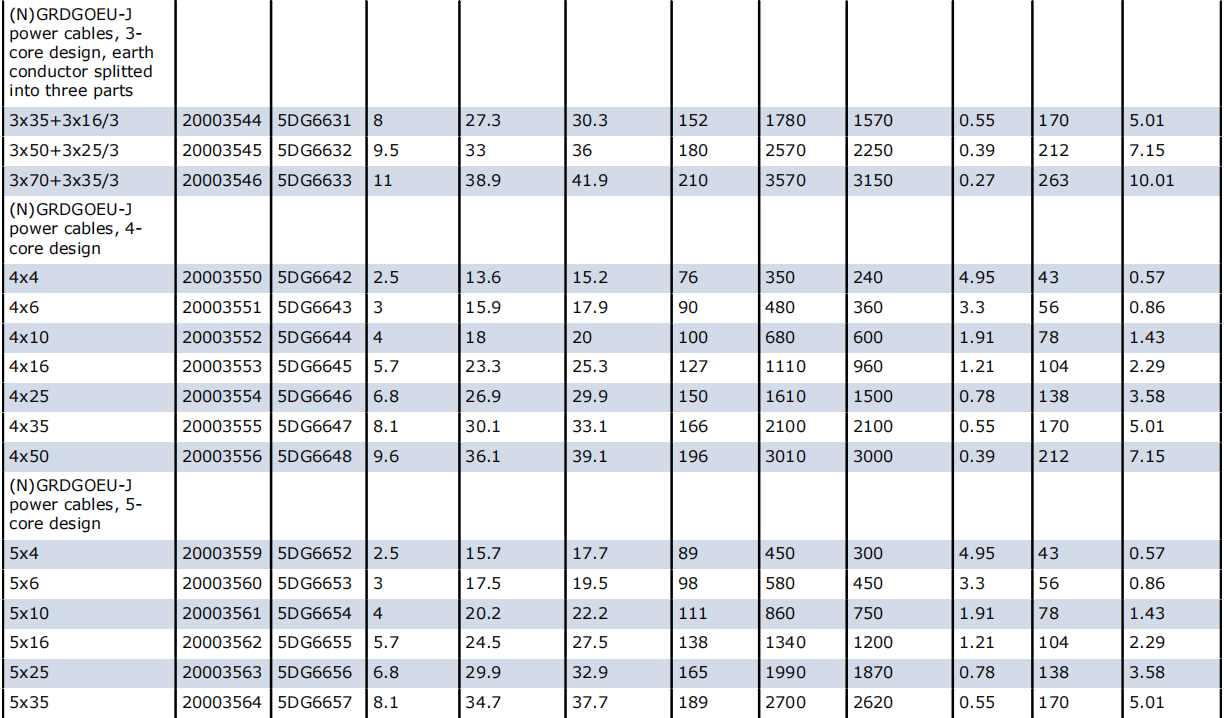
Three-core cables with split earth (3C+3G): This configuration includes three power conductors and a protective earth conductor split into three parts positioned in the interstices between the power cores. Available sizes include 3x35+3x16/3, 3x50+3x25/3, and 3x70+3x35/3 mm². The split earth design provides a symmetrical core arrangement, which reduces electromagnetic interference and improves mechanical stability during flexing.
Four-core cables (4C): Standard four-core designs are available in cross-sections from 4x4 mm² to 4x50 mm², suitable for three-phase power with a separate neutral or earth conductor. These cables are commonly used in 400V distribution systems supplying motors and other three-phase loads.
Five-core cables (5C): Five-core variants (e.g., 5x4 mm² to 5x35 mm²) provide three phases, neutral, and protective earth in a single cable, enabling complete three-phase distribution with a common earth return. This configuration simplifies wiring in applications where both power and earthing must be distributed to multiple loads along the festoon path.
Control Cable Options
For control and signal applications, the RONDOFLEX (N)GRDGOEU offers multicore control cables with conductor cross-sections of 1.5 mm² or 2.5 mm². Available core counts include:
12, 18, 24, 30, and 36 cores for general control circuits
7-core designs for smaller installations
Higher core counts (up to 56 cores) for complex control panels and integrated automation systems
These control cables are used for motor control circuits, relay and contactor coils, limit switches, proximity sensors, emergency stop circuits, and other low-power signals. The numbered core identification simplifies wiring and troubleshooting in systems with many control points.
Bus and Communication Cables
For modern automated systems requiring industrial data communication, the RONDOFLEX (N)GRDGOEU is available with twisted and shielded pairs (TSP). These bus cable variants are designated with the suffix "-O" and core configurations such as:
3x(2x1)C: Three twisted pairs, each individually shielded, for ASI-Bus or similar fieldbus protocols
6x(2x1)C: Six twisted pairs for redundant communication or multiple bus segments
12x1(C): Twelve individually shielded 1 mm² cores for complex control or data signals
The shielding on each pair provides electromagnetic compatibility (EMC) protection, reducing susceptibility to interference from adjacent power cables, motor drives, and other sources of electrical noise common in industrial environments. The twisted pair geometry further improves noise immunity by ensuring any induced voltages affect both conductors equally and cancel out in differential signaling schemes.
Common Problems and Solutions
Problem: Premature Conductor Breakage
Question: What causes conductor breakage in festoon cables, and how can it be prevented?
Answer: Conductor breakage is typically caused by exceeding the maximum permissible tensile load, using bending radii smaller than the minimum specified, or repeated flexing beyond the cable's design limits. In festoon systems, common contributing factors include:
Excessive loop length: If the festoon loops are too long, the cable weight creates high tensile stress, especially at the loop apex. Calculate the maximum safe loop length based on the cable weight and the 15 N/mm² tensile limit.
Incorrect festoon carrier spacing: Carriers that are too far apart increase loop sag and tensile stress. Adjust carrier spacing to distribute the cable weight evenly.
Sharp bending at entry points: Cable entries into junction boxes or festoon carriers with inadequate bend radius protection can cause localized conductor fatigue. Install bend radius protectors or use larger-radius entry fittings.
Torsional stress from misalignment: If the festoon track is not perfectly straight or the cable entry points are offset, the cable experiences torsional twisting in addition to bending. Ensure proper track alignment and consider using swivel entry fittings where necessary.
Regular inspection of the cable for kinks, sharp bends, or visible damage can identify problems before complete conductor failure occurs. Replacing cables proactively based on visual inspection or after a certain number of operating cycles is a recommended preventive maintenance strategy.
Problem: Sheath Cracking and Degradation
Question: Why does the cable sheath crack over time, and what can be done to extend sheath life?
Answer: Sheath cracking can result from several factors:
UV exposure: Prolonged outdoor exposure to sunlight causes photodegradation of rubber compounds. While the RONDOFLEX (N)GRDGOEU is formulated for UV resistance, extreme conditions (such as desert climates with intense sunlight) may accelerate aging. Consider installing protective conduits or covers in areas of intense UV exposure.
Ozone attack: Electrical equipment generates ozone, which is highly reactive with rubber. Ensure adequate ventilation around electrical equipment and avoid routing cables near ozone sources such as arc welders or high-voltage switchgear.
Temperature extremes: Operating the cable near its maximum temperature limit (80°C surface temperature) or exposing it to freezing temperatures below -35°C repeatedly can reduce sheath life. Verify that the cable is appropriately rated for the actual environmental conditions and consider thermal insulation or heating in extreme cold climates.
Mechanical abrasion: Contact with sharp edges, rough surfaces, or other moving equipment can abrade the sheath. Inspect festoon carriers and cable routing for sharp edges and install protective wear strips or sleeves where contact is unavoidable.
Periodic inspection for surface cracks, discoloration, or softening of the sheath can identify early signs of degradation. Replacing cables showing significant sheath damage prevents progression to insulation failure or electrical faults.
Problem: Voltage Drop and Control Signal Issues
Question: What causes excessive voltage drop in festoon power cables, and how can it be corrected?
Answer: Voltage drop is a function of the conductor resistance, the current load, and the cable length. For a given conductor cross-section, longer festoon cable runs or higher current loads result in greater voltage drop, which can cause motors to run inefficiently, undervoltage faults, or unreliable control signals.
To minimize voltage drop:
Increase conductor cross-section: Larger conductors have lower resistance. If voltage drop calculations exceed acceptable limits (typically 3-5% of system voltage), specify a larger cross-section.
Shorten cable runs: If feasible, relocate power supply points to reduce the distance from the fixed supply to the moving load.
Use higher supply voltage: In some cases, stepping up the distribution voltage (e.g., from 400V to 690V) and using a local transformer near the load can reduce conductor size and voltage drop. This approach is common in large crane installations.
For control signals: Use separate control cables with appropriate cross-sections. Control signals are often more sensitive to voltage drop than power circuits. Consider using 2.5 mm² control cores instead of 1.5 mm² for long runs or high-current relay coils.
For bus communication cables, signal integrity issues are usually related to electromagnetic interference rather than voltage drop. Ensure that twisted and shielded pairs are used for data signals and that shields are properly grounded at one end to drain induced noise currents.
Problem: Frequent Cable Replacement in High-Duty Cycles
Question: Why do festoon cables fail prematurely in high-duty-cycle applications, and what design changes can improve service life?
Answer: High-duty-cycle applications—such as automated warehouse cranes operating 24/7 or container terminal cranes with hundreds of load cycles per day—subject festoon cables to millions of bending cycles over a few years. Even well-designed cables have finite fatigue life, and premature failures may indicate that the cable or installation does not match the duty requirements.
Strategies to improve service life in high-duty applications:
Upgrade to a higher-specification cable: Consider using a reeling cable design (such as CORDAFLEX or TROMMELFLEX) with enhanced mechanical performance if the application involves very high cycle counts or severe mechanical stress.
Optimize installation parameters: Ensure bending radii are generously above the minimum, reduce tensile loads by adding festoon loops or intermediate supports, and eliminate sources of torsional stress.
Implement condition monitoring: Use cable monitoring systems that detect partial conductor failures or insulation degradation before complete failure. Early detection allows scheduled maintenance instead of unplanned downtime.
Planned replacement schedule: Based on the manufacturer's test data and field experience, establish a preventive replacement interval (e.g., every three years or after X million cycles). Proactive replacement before failure can be more cost-effective than emergency repairs.
Consider alternative cable guidance: In extreme cases, festoon systems may not be the optimal solution. Cable reeling drums, cable chains, or motorized cable reels might offer longer service life depending on the application geometry and duty cycle.
Conclusion
The RONDOFLEX (N)GRDGOEU low voltage round cable for festoon systems represents a robust and versatile solution for industrial power and control distribution in demanding movable equipment applications. Its flexible construction, high-quality rubber insulation and sheathing, and proven mechanical performance make it the cable of choice for gantry cranes, hall cranes, warehouse material handling systems, and movable machine tool connections.
By understanding the cable's design features—fine-stranded copper conductors, EPR insulation, PCP rubber sheath, and core identification scheme—engineers and maintenance personnel can select the appropriate configurations for specific applications. The cable's ability to withstand high mechanical stress and frequent bending, combined with resistance to oil, weather, and temperature extremes, ensures reliable operation in the harsh environments typical of industrial facilities.
Proper installation practices, including adherence to minimum bending radii, tensile load limits, and travel speed recommendations, are essential to achieving the cable's full service life potential. When problems such as premature conductor breakage, sheath degradation, voltage drop, or frequent failures occur, systematic troubleshooting and corrective actions—such as adjusting installation parameters, upgrading to higher-specification cables, or implementing condition monitoring—can restore reliable operation and reduce maintenance costs.
As industrial automation continues to advance, with faster crane speeds, more complex control systems, and higher reliability expectations, the role of high-quality flexible cables like the RONDOFLEX (N)GRDGOEU becomes increasingly critical. By combining proven mechanical design with modern materials and manufacturing techniques, this cable family continues to meet the evolving needs of material handling and machine tool industries worldwide.
How to Reach Us
Get in Touch
SiteMap
Product Catalogue
Festoon Cable
Shore Power Cable


Scan to add us on WeChat