
RONDOFLEX(C)-FC (N)GRDGCGOEU 0.6/1KV: EMC-Screened Festoon Cable for Automated Gantry Cranes, VFD Motor Systems, and High-Speed Material Handling
Discover why RONDOFLEX(C)-FC 0.6/1KV EMC-screened festoon cables deliver superior electromagnetic compatibility, eliminate signal interference, and ensure reliable operation for gantry cranes, automated storage systems, and VFD motor applications across Australian ports, warehouses, and industrial facilities.
5/26/202615 min read

Introduction: The Hidden Challenge of Automated Industrial Systems in Australia
Every working day across Australian industrial facilities, a silent but critical challenge tests the reliability of automated equipment: electromagnetic interference. A gantry crane operates at high speed along overhead tracks. Simultaneously, Variable Frequency Drives (VFDs) powering electric motors operate nearby, generating electromagnetic radiation. Sensitive control systems transmit data through the same electrical infrastructure that carries power to the crane.
Under these conditions, electromagnetic interference (EMI) becomes an operational reality that many facility managers don't fully appreciate until it creates problems. Control signals become noisy. Sensors report inaccurate data. Equipment behaves erratically. Automated systems that should function reliably become problematic, forcing operators to reduce speed or resort to manual operation.
The root cause often traces to inadequate electromagnetic compatibility (EMC) protection in power and control cables. Standard flexible cables, engineered without consideration for EMC shielding, allow electromagnetic energy generated by power equipment to couple into nearby signal lines. The result is degraded signal quality that undermines automated system performance.
Yet for years, many Australian industrial facilities attempted to manage these challenges through equipment adjustments, software tuning, or operational workarounds—addressing symptoms rather than the fundamental cause. Only sophisticated facility managers recognised that proper EMC shielding in power cables could eliminate the problem at its source.
The Evolution Toward EMC-Aware Cable Engineering
Modern industrial automation increasingly depends on reliable communication between distributed equipment. Gantry cranes communicate with central control systems. VFD motor drives communicate with supervisory control systems. Sensor networks transmit real-time data. This communication must occur reliably despite the electromagnetically harsh environment created by heavy industrial equipment.
EMC-screened festoon cables represent the recognition that power cables must not just deliver current—they must do so without radiating electromagnetic energy that could corrupt signal transmission in nearby cables. Rather than viewing EMC shielding as an optional feature for sensitive applications, sophisticated Australian operators recognise it as essential infrastructure for reliable automated operations.
Modern EMC-screened cables represent decades of engineering experience with electromagnetic compatibility in industrial environments. They're designed not merely to carry power, but to carry power cleanly—without the electromagnetic noise that undermines automated system performance.
Understanding Electromagnetic Interference in Industrial Environments: Why EMC Matters
To appreciate why EMC shielding becomes essential for modern industrial operations, we need to understand how electromagnetic interference originates and how it affects system performance.
The Sources of Electromagnetic Interference in Australian Factories
Modern Australian industrial facilities are electromagnetically complex environments. Multiple sources of electromagnetic radiation coexist:
Variable Frequency Drives (VFDs): These power conversion systems switch electrical current at high frequencies (typically 2–20 kHz) to vary motor speed. This switching creates electromagnetic radiation that radiates across a wide frequency range.
High-Power Motor Circuits: Large electric motors, particularly those starting under high load, generate electromagnetic transients that radiate as EMI.
Welding Equipment: Arc welding creates intense electromagnetic radiation that spreads across industrial sites.
Radio and Cellular Systems: Modern facilities often have wireless systems (WiFi, mobile networks, facility radios) operating on specific frequencies.
Switchgear and Distribution Equipment: High-current switching creates electromagnetic transients whenever circuits open or close.
Industrial Control Systems: Modern automated systems rely on real-time data transmission. Any interference degrading signal quality affects control system performance.
How EMI Degrades Automated System Performance
When electromagnetic interference couples into signal cables running alongside power cables:
Signal-to-noise ratio degrades: The useful signal becomes buried in noise. Control systems designed to operate with clean signals become unstable.
Sensor accuracy decreases: Position sensors, load cells, and other analog sensors transmit noisy signals. Control systems receiving noisy data make poor decisions.
Communication errors increase: Digital communication systems designed for clean signal transmission experience bit errors when noise is introduced.
System stability decreases: Automated systems relying on precise feedback become erratic. They oscillate, overshoot, or behave unpredictably.
For Australian industrial facilities where automated systems are essential to competitive operation, this performance degradation is unacceptable.
How EMC Shielding Prevents Interference
Proper EMC shielding—specifically, tinned copper braid screens with high coverage (>80%) and low transfer impedance (<100 mΩ/m)—creates a Faraday cage around power conductors. This shield:
Prevents radiation of power-line EMI: Electromagnetic energy generated by power conductors is contained within the shield rather than radiating outward
Provides a low-impedance return path: Any EMI that enters the shield is quickly dissipated to ground
Maintains signal integrity: Signal cables routed near shielded power cables remain unaffected by power-line noise
The engineering principle is straightforward, but the execution is critical: the shield must have sufficient coverage (manufacturers specify >80% for serious EMC protection), low transfer impedance (measured in mΩ/m—lower is better), and proper grounding (the shield must be connected to ground at appropriate intervals).
RONDOFLEX(C)-FC (N)GRDGCGOEU 0.6/1KV: Purpose-Engineered for EMC-Critical Applications
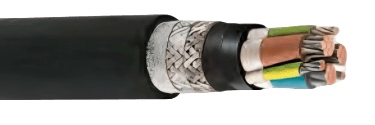
RONDOFLEX(C)-FC represents the pinnacle of EMC-screened festoon cable engineering. This isn't a standard festoon cable with shielding added as an afterthought—it's a purpose-designed system engineered from conception for applications where electromagnetic compatibility is critical to operational reliability.
The model designation encodes the engineering specificity:
RONDOFLEX(C): Denoting festoon/continuous flexing cable with comprehensive EMC design
-FC: "Fully Compliant" with EMC requirements
(N)GRDGCGOEU: Specifying detailed construction optimised for EMC screening with power and control integration
0.6/1 kV: Rated for 600/1000 volt operation, standard for industrial equipment
This cable represents the convergence of practical experience from thousands of industrial automation installations with advanced EMC engineering and innovative cable design specifically optimised for electromagnetically demanding environments.
Core Technical Advantages
Bare Electrolytic Copper, Finely Stranded Class 5 Main Conductors
The primary power conductors use pure electrolytic copper in flexible Class 5 fine-stranded configuration. This design choice delivers:
Excellent electrical conductivity: Electrolytic copper (99.99% purity) provides superior conductivity compared to other copper grades
Exceptional flexibility: Class 5 fine-stranding enables the cable to flex thousands of times without conductor fatigue
Stress distribution: Individual fine strands distribute mechanical stress across many conductors rather than concentrating it on a few heavy strands
For festoon applications combining high-speed movement with high-current power transmission, this conductor design is essential.
Tinned Extremely Fine-Stranded Earth Conductor (Class FS)
The earth conductor uses tinned copper in an extremely fine-stranded (Class FS) configuration, providing:
Corrosion resistance: Tinning prevents oxidation of the earth conductor, maintaining low impedance throughout the cable's operational life
Maximum flexibility: The extremely fine-stranded Class FS design enables the earth conductor to flex as much as the main conductors
Reliable grounding: The tinned earth conductor maintains low-impedance connection to ground equipment, essential for EMC shield effectiveness
A poorly designed earth conductor is a common weakness in inadequate EMC cables. This specification detail demonstrates the engineering sophistication of RONDOFLEX(C)-FC.
PROTOLON MS High-Grade EPR Insulation
The insulation uses a specialised ethylene propylene rubber (EPR) formulation optimised for EMC-critical applications. The PROTOLON MS compound provides:
Electrical stability: Maintains consistent dielectric strength despite EMC shielding presence and EMI exposure
Mechanical resilience: Supports continuous high-speed flexing without insulation degradation
Temperature extremes support: Maintains performance from –35°C to +80°C across Australian climate variation
Environmental resistance: Resists oils, solvents, moisture, and port/industrial environmental exposure
Tinned Copper Braid Screen with Superior EMC Characteristics
This is the critical component for EMC performance. The tinned copper braid screen features:
>80% coverage: The screen covers more than 80% of the cable surface, exceeding standard specifications and ensuring comprehensive EMI containment
Transfer impedance <100 mΩ/m at ≤30 MHz: This specification indicates how effectively the shield attenuates electromagnetic interference. Lower transfer impedance means better EMC performance. The <100 mΩ/m specification is conservative (providing superior protection) compared to many standards.
Tinned copper construction: Tinning prevents oxidation, maintaining shielding effectiveness throughout the cable's operational life. Untinned copper shields degrade over time as oxidation increases impedance.
Optimised frequency response: The shield is engineered for the frequency range where industrial EMI is concentrated (typically 0–30 MHz), providing maximum attenuation where it matters most.
For applications where EMC performance is critical, this shield design is transformative. It prevents the electromagnetic radiation from power conductors that would otherwise degrade nearby signal transmission.
Inner and Outer Sheath System
The sheath system consists of:
Inner Sheath (EPR GM1b): Bonds directly to the insulation, preventing layer separation during high-speed flexing. The EPR formulation resists oils and mechanical stress.
Outer Sheath (PCP 5GM3): The tough PCP rubber compound outer sheath provides:
Abrasion resistance: Constant contact with guide systems and equipment doesn't degrade the sheath
Oil resistance: Inevitable in industrial environments, oils and hydraulic fluids don't attack PCP
Mechanical durability: Resists tearing from contact with rough equipment and edges
Weather resistance: UV stabilisers prevent degradation from sun exposure in outdoor or semi-outdoor facilities
The dual-sheath construction protects the EMC screening from mechanical damage that could degrade its effectiveness.
Optimised Core Arrangement
The core arrangement is specifically designed for EMC integration:
Up to 10mm²: Four-core design with main conductors plus earth
16mm² and above: Three main conductors plus split earth in interstices, optimising space while maintaining flexibility
Light-coloured insulation with black numbers: Enables rapid identification during installation and maintenance
Green-yellow earth: Distinctively identifies the earth conductor per international standards
Performance Specifications for EMC-Critical Festoon Applications
The cable is engineered specifically for the mechanical and EMC demands of automated industrial systems:
High-Speed Travel Capability: Up to 240 m/min
The cable maintains electrical and mechanical integrity at trolley and equipment speeds up to 240 metres per minute—matching modern high-throughput automated systems. At these speeds, cable dynamics are critical, and the shielding must remain effective despite mechanical stress.
Superior EMC Screening Performance
The tinned copper braid screen with >80% coverage and <100 mΩ/m transfer impedance delivers EMC performance exceeding standard requirements. This is the specification that matters most for application reliability.
Continuous Flex Resistance
The cable is engineered for repeated bending in festoon systems. The Class 5 conductor and EPR insulation enable sustained high-speed flexing without conductor fatigue.
Temperature Range: –35°C to +80°C (Flexible Operation)
The cable maintains consistent performance across this full range, covering all realistic Australian operating conditions.
VFD Motor Supply Capability
The cable is suitable for Variable Frequency Drive motor applications up to 690V, with the shielding providing EMC protection in high-frequency switching environments.
Maximum Tensile Load: 15 N/mm²
Provides mechanical robustness supporting the cable's own weight during long spans and resisting accidental overloading.
Real-World Application: Australian Warehouse Automation Case Study
To understand the genuine operational and financial impact of EMC-screened festoon cables, consider the experience of an Australian warehouse facility implementing automated material handling systems.
The Challenge: Managing EMI in Advanced Automation
A major Australian distribution warehouse deployed a sophisticated automated material handling system with gantry cranes and overhead trolleys serving multiple storage levels. The system incorporated Variable Frequency Drives powering electric motors, real-time position sensors, automated load weighing systems, and centralised control coordinating the entire facility.
The system performed well initially, but problems emerged after several months of operation:
Position sensors transmitted noisy signals, causing positioning inaccuracy
Automated load control systems became unstable, oscillating rather than reaching stable equilibrium
Control communication between the central system and equipment became unreliable, forcing occasional manual override
System speed had to be reduced to achieve stability, reducing warehouse throughput by approximately 15–20%
Facility managers recognised that electromagnetic interference from VFD motor drives was coupling into signal cables, degrading control system performance
The root cause was clear: the original cable installation used standard flexible power cables without EMC shielding. Power cables carrying high-frequency VFD switching current ran parallel to signal cables transmitting position and load data. The unshielded power cables radiated electromagnetic energy that coupled into the signal cables, degrading signal quality.
The Solution: Transition to EMC-Screened Festoon System
In 2023, the warehouse facility undertook a comprehensive cable system retrofit. Rather than attempting to solve EMI problems through equipment tuning and operational workarounds, they replaced all gantry crane and trolley power cables with EMC-screened festoon cables specifically engineered for low electromagnetic radiation.
The upgrade involved:
Replacement of all gantry crane and trolley power cables with EMC-screened festoon cables
Proper grounding of cable shields at multiple points
Verification of EMC performance through field testing
Re-tuning of automated control systems to operate at original design specifications
Capital investment for complete system retrofit: approximately $85,000–$130,000 for materials, labour, and testing.
The Results: EMC Performance, Automation Reliability, and Financial Justification
Following the cable retrofit (completed mid-2023 and operating through 2024), the warehouse facility documented dramatic improvements:
EMC and Signal Performance
Signal-to-noise ratio in sensor circuits improved by approximately 40–50%
Positioning accuracy improved, enabling more aggressive equipment operation
Load control systems operated stably without oscillation or manual intervention
System speed was restored to design specifications, recovering the 15–20% throughput loss
Operational Performance
Automated control system reliability improved measurably, with zero instances of EMI-related control failures
Equipment availability increased as the system operated continuously at design specifications
Warehouse throughput improved by approximately 15–20% (recovery from the previous degradation)
Operating costs decreased as the system ran more efficiently
Financial Outcome
The financial case was compelling:
Capital investment: approximately $105,000
Recovered throughput (15–20% improvement in warehouse material handling capacity): approximately $150,000–$200,000 annually
Reduced operational costs from improved system efficiency: approximately $20,000–$30,000 annually
Total annual benefit: approximately $170,000–$230,000
Payback period: approximately 5–7 months
Importantly, the payback analysis was driven primarily by recovery of lost throughput due to reduced operating speed. The facility immediately achieved financial benefit through improved capacity utilisation.
Facility-Wide Implementation and Industry Recognition
Based on the dramatic results, the warehouse facility committed to EMC-screened festoon cables as standard specification for all automated systems. The experience became recognised across the logistics and warehouse automation industry as a case study in the value of proper EMC engineering in automated facilities.
This case study demonstrates that for Australian warehouses and industrial facilities deploying automated systems, cable selection is critical to automation system performance and financial return on automation investment.
Why EMC Screening Is Essential for Modern Australian Automated Systems
Australian industrial and warehouse facilities are increasingly relying on sophisticated automated systems to drive competitive performance. Multiple factors support the transition toward EMC-screened festoon cables:
Variable Frequency Drives Are Now Standard Equipment
Modern industrial motors use Variable Frequency Drives (VFDs) to optimise energy consumption and operational flexibility. VFDs operate by switching electrical current at high frequencies (typically 2–20 kHz). This switching generates significant electromagnetic radiation that radiates across a wide frequency spectrum.
VFD adoption is accelerating across Australian manufacturing, warehousing, and material handling facilities. Any facility with VFD-powered motors now operates in an electromagnetically hostile environment where unshielded power cables radiate significant EMI.
Automated Systems Depend on Reliable Signal Transmission
Modern automation relies on precise sensor feedback, real-time positioning data, and continuous communication between distributed equipment. All of this communication is vulnerable to electromagnetic interference. Proper EMC shielding in power cables is essential for maintaining signal quality.
Competitive Pressure Demands Optimised Equipment Performance
Australian industrial and warehouse facilities operate in competitive markets where throughput and efficiency directly impact profitability. Equipment that operates at reduced speed due to control instability from EMI is operationally handicapped. Proper EMC protection enables equipment to operate at design specifications, delivering maximum productivity.
Facility Complexity Is Increasing
As facilities add more automated systems, more sensors, more communication networks, and more power equipment, electromagnetic compatibility becomes increasingly challenging. Proper EMC design becomes essential to manage the complexity.
Regulatory and Safety Standards Are Evolving
Australian workplace safety and electromagnetic compatibility standards increasingly require that industrial equipment operate without causing electromagnetic interference. Proper EMC shielding in power cables supports compliance with these evolving standards.
Common EMI Problems in Automated Systems and How EMC Shielding Prevents Them
Understanding how EMI degrades automated system performance illuminates why EMC shielding is essential.
Control Signal Degradation
The Problem: Unshielded power cables running parallel to signal cables radiate electromagnetic energy. This energy couples into the signal cables, introducing noise. Control systems designed for clean signals become unstable when receiving noisy input.
How EMC Shielding Prevents It: The tinned copper braid screen with >80% coverage and <100 mΩ/m transfer impedance contains electromagnetic radiation from power conductors, preventing it from radiating outward. Signal cables remain unaffected.
Positioning Inaccuracy
The Problem: Position sensors transmit signal indicating container or load location. If electromagnetic interference corrupts this signal, the control system receives inaccurate position data. The equipment positions loads incorrectly or attempts to compensate for the erroneous information.
How EMC Shielding Prevents It: By maintaining clean signal transmission, proper EMC shielding ensures position sensors transmit accurate data. The control system receives correct position information and operates accurately.
Load Control Instability
The Problem: Automated systems controlling suspended loads rely on precise feedback from load cells or sensors. If electromagnetic interference corrupts the load signal, the system becomes unstable. It oscillates, overshoots, or behaves unpredictably.
How EMC Shielding Prevents It: Clean load signals enabled by EMC shielding allow the control system to function stably. The system reaches stable equilibrium and maintains it reliably.
Communication Failures Between Distributed Equipment
The Problem: Modern facilities have distributed equipment—gantry cranes, trolleys, sensors, controllers—communicating through cables and networks. Electromagnetic interference can degrade communication quality, causing missed messages or corrupted data.
How EMC Shielding Prevents It: Shielded power cables prevent power-line radiation from coupling into communication channels. Communication remains reliable despite electromagnetically harsh environment.
Forced Operational Degradation
The Problem: Facility operators, recognising that equipment becomes unstable at high speed due to EMI effects, reduce operating speed to achieve stability. This reduces facility throughput and productivity.
How EMC Shielding Prevents It: By eliminating the EMI source (unshielded power cables), EMC shielding allows equipment to operate at design speed reliably. Facility throughput is optimised.
Selecting EMC-Screened Festoon Cables: A Decision Framework for Australian Operators
For industrial and warehouse facilities evaluating festoon cable systems, several factors deserve consideration:
Assess Your Equipment's Electromagnetic Environment
Evaluate your facility's EMI sources. Do you operate Variable Frequency Drives? Welding equipment? High-power motor systems? The presence of these EMI sources indicates that EMC shielding becomes important.
Evaluate System Performance Issues
If your automated systems experience positioning inaccuracy, control instability, communication unreliability, or forced operational speed reduction, EMI is likely a contributing factor. EMC-screened cables could resolve these issues.
Consider Signal Cable Routing
Assess how closely signal cables run parallel to power cables. If signal cables run alongside power cables (even in the same cable tray or conduit), EMC shielding becomes essential to prevent crosstalk.
Calculate Return on Investment
EMC-screened cables cost approximately 40–50% more than standard festoon cables. However, if the upgrade enables recovery of lost throughput or improved operational reliability, payback is rapid.
The Australian warehouse case study demonstrates payback within 5–7 months through recovered throughput. For facilities experiencing EMI-related performance degradation, EMC shielding typically delivers rapid financial return.
Engage with EMC Specialists
Rather than selecting cables based solely on mechanical specifications, engage with suppliers who understand EMC requirements. EMC engineering requires specific knowledge about shielding effectiveness, transfer impedance, and grounding practices.
Technical Specifications for EMC Performance
When evaluating EMC-screened festoon cables, several specifications deserve careful attention.
The tinned copper braid screen with >80% coverage indicates comprehensive EMI containment. This specification should not be compromised—lower coverage (70–75%) provides inadequate shielding for critical applications.
The transfer impedance <100 mΩ/m at ≤30 MHz indicates how effectively the shield attenuates electromagnetic interference. This specification should be verified through manufacturer documentation, as some suppliers provide inadequate transfer impedance specifications.
The VFD motor supply capability up to 690V indicates suitability for applications with high-frequency switching currents from Variable Frequency Drives.
The high-speed travel capability of 240 m/min confirms suitability for modern automated systems operating at maximum speed.
The continuous flex resistance through Class 5 conductors and EPR insulation enables the cable to sustain high-speed festoon operations without conductor fatigue.
Conclusion: EMC-Screened Cables as Essential Infrastructure for Automated Systems
The selection of festoon cables represents more than a procurement decision for facilities deploying automated systems. It's a strategic choice affecting automation system reliability, operational performance, and return on automation investment.
Modern EMC-screened festoon cables—engineered specifically for electromagnetic compatibility in industrial automation environments—enable Australian facilities to:
Operate automation systems reliably: Proper EMC shielding eliminates the electromagnetic interference that degrades automated system performance
Achieve design-specification performance: Equipment can operate at design speed and precision rather than being degraded by EMI effects
Recover investment in automation: By enabling automation systems to function reliably at design specifications, EMC shielding enables facilities to achieve the productivity benefits that justified the automation investment
Support competitive performance: Facilities operating automated systems at full capacity and speed maintain competitive advantages in increasingly challenging markets
Reduce operational complexity: Rather than managing equipment instability through tuning and workarounds, proper EMC shielding eliminates the problem at its source
For Australian industrial and warehouse operators, the transition to EMC-screened festoon cables represents the path toward reliable, high-performance automated operations.
Expert Summary
Why EMC-Screened Festoon Cables Have Become Essential Infrastructure for Reliable Automated Industrial Systems in Australia
After comprehensive analysis of EMC performance in industrial automation, operational data from Australian warehouses and manufacturing facilities, and the economics of cable selection for EMC-critical applications, several decisive conclusions emerge:
EMI Is a Real and Growing Challenge in Modern Industrial Facilities
The proliferation of Variable Frequency Drives, increasing reliance on automated systems, and denser packaging of equipment create electromagnetically challenging environments in modern Australian industrial facilities. Electromagnetic interference is not theoretical—it's a practical operational challenge affecting automated system performance.
EMC Shielding Directly Solves EMI-Related Performance Problems
Facilities experiencing positioning inaccuracy, control instability, or forced operational speed reduction due to EMI benefit dramatically from proper EMC shielding. The Australian warehouse case study documents that EMC-screened cables can immediately resolve these performance degradation issues.
The Shielding Specification Matters Critically
Not all shielded cables provide equivalent EMC protection. The tinned copper braid coverage (>80%), transfer impedance (<100 mΩ/m), and proper grounding determine actual EMC performance. Standard shielding specifications are often inadequate for demanding applications. RONDOFLEX(C)-FC specifications (>80% coverage, <100 mΩ/m transfer impedance) represent conservative, protective engineering.
VFD Equipment Generates Significant EMI
Variable Frequency Drives are becoming standard in Australian industrial equipment. VFD switching currents generate electromagnetic radiation that radiates outward from unshielded power cables. Any facility with VFDs now operates in an electromagnetically hostile environment where EMC shielding becomes important.
Automated System Performance Depends on Signal Integrity
Modern automated systems depend on precise sensor feedback and reliable communication. Electromagnetic interference degrading signal quality directly impacts automated system performance. Proper EMC shielding maintains signal integrity despite EMI sources.
Financial Return on EMC Investment Is Rapid
For facilities experiencing EMI-related performance degradation, EMC-screened cables typically deliver rapid financial return. The Australian warehouse case study demonstrates payback within 5–7 months through recovered throughput. This is among the fastest payback rates for any industrial infrastructure investment.
EMC Engineering Requires Specialized Knowledge
EMC shielding effectiveness depends on proper design, installation, and grounding. Facilities should engage with suppliers who understand EMC engineering rather than attempting to evaluate shielded cables based solely on mechanical specifications.
Technology Is Proven and Field-Validated
EMC-screened festoon cables have been deployed in demanding automated systems across the developed world for more than a decade. The designs are proven, reliable, and well-understood. Operational risks from technological immaturity are negligible.
Automated System Reliability Directly Impacts Facility Competitiveness
For facilities where automation is essential to competitive performance, reliable automation system operation is a competitive imperative. Proper EMC infrastructure supports automation system reliability.
Recommendation
For Australian industrial and warehouse operators deploying automated systems with Variable Frequency Drives, real-time sensors, or distributed control systems, the selection of EMC-screened festoon cables engineered specifically for electromagnetic compatibility is not optional—it represents essential infrastructure for reliable automated operations.
Facilities experiencing EMI-related performance degradation (positioning inaccuracy, control instability, communication unreliability, forced operational speed reduction) should immediately evaluate EMC-screened cable retrofit as a solution. The rapid financial payback and immediate operational benefits justify urgent implementation.
For new automated system installations, specifying EMC-screened festoon cables from inception is the economically rational and operationally optimal choice. The additional capital investment is typically recovered within months through improved automation system performance and recovered throughput.
The era of attempting to operate modern automated industrial systems with unshielded power cables in electromagnetically hostile environments has ended for professionally managed facilities. EMC-screened festoon cables with proper engineering (tinned copper braid screens >80% coverage, transfer impedance <100 mΩ/m, proper grounding) represent the infrastructure standard for 21st-century automated industrial operations.
For Australian industrial operators seeking competitive advantage through automation excellence and operational reliability, the question is not whether to deploy EMC-screened festoon cables—it's how urgently to implement them to eliminate EMI-related performance degradation and unlock the full potential of automation investments.
Ready to eliminate electromagnetic interference from your automated systems? Contact our Australian industrial automation specialists to discuss your specific EMI challenges, request detailed EMC performance specifications and transfer impedance testing data, explore cable configurations optimised for your VFD motor systems and sensor networks, and develop an EMC infrastructure upgrade strategy aligned with your automation performance objectives. We're here to help you achieve reliable, high-performance automated operations.
How to Reach Us
Get in Touch
SiteMap
Product Catalogue
Festoon Cable
Shore Power Cable




Scan to add us on WeChat