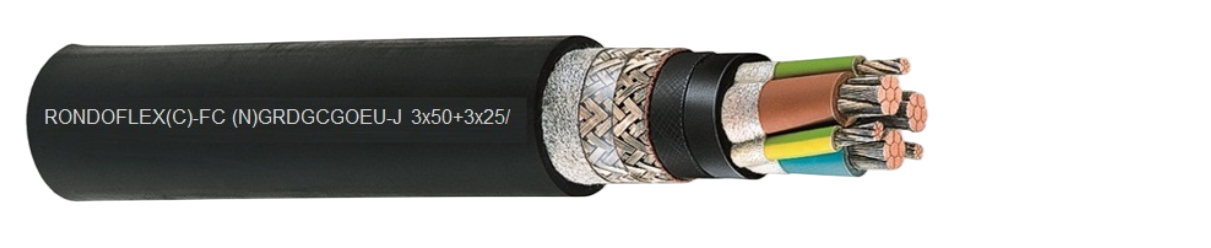
RONDOFLEX(C)-FC (N)GRDGCGOEU Low Voltage Screened Round Cable for Festoon Systems
RONDOFLEX(C)-FC (N)GRDGCGOEU low voltage screened round cable for festoon application, designed for gantry cranes, hall cranes and material handling systems with EMC‑safe power supply
hongjing.Wang@Feichun
12/3/202517 min read
Overview of RONDOFLEX(C)-FC (N)GRDGCGOEU Low Voltage Screened Round Cable
Product Description and Function in Festoon Application
The RONDOFLEX(C)-FC (N)GRDGCGOEU represents a specialized low voltage screened round cable engineered specifically for demanding festoon applications. This cable serves as a critical component in mobile power supply systems where continuous movement, frequent bending, and reliable electrical performance are essential. In festoon systems, the cable travels along horizontal or vertical paths, suspended from trolleys that move with machinery such as gantry cranes, overhead cranes, and automated material handling equipment.
The primary function of this screened festoon cable is to deliver consistent electrical power to moving equipment while maintaining electromagnetic compatibility. The integrated screening system ensures that electromagnetic emissions remain within acceptable limits, preventing interference with sensitive control and data cables that often share the same installation environment. This makes the cable particularly valuable in modern industrial facilities where power and signal cables coexist in close proximity.
Advantages of Screened Round Cables Over Unscreened Types
The EMC screened power cable design offers significant advantages compared to unscreened alternatives. The copper wire braid or metallic screen provides a Faraday cage effect that contains electromagnetic fields generated by power conductors. This containment reduces radiated emissions that could otherwise interfere with nearby communication systems, programmable logic controllers, and precision instrumentation.
In environments with variable frequency drives and high-power switching equipment, electromagnetic interference becomes a critical concern. Unscreened cables can act as antennas, both radiating noise and picking up external interference. The screening layer in the RONDOFLEX(C)-FC (N)GRDGCGOEU prevents these issues, ensuring stable operation of all connected systems. Additionally, the screen provides an effective path for fault currents and contributes to personal safety by reducing touch voltages during ground fault conditions.
Typical Operating Environments and Duty Cycles
This low voltage festoon cable operates in industrial environments characterized by high mechanical stress and frequent bending cycles. Typical installations include indoor manufacturing halls, outdoor container terminals, warehouse automation systems, and steel processing facilities. The cable must withstand continuous flexing as festoon trolleys traverse their full travel distance multiple times per hour, accumulating millions of bending cycles over its service life.
Operating duty cycles vary from intermittent service in manually operated cranes to continuous operation in fully automated systems running multiple shifts. The cable design accounts for these demanding conditions through optimized conductor construction, flexible insulation materials, and robust outer sheath protection. Temperature fluctuations, exposure to industrial lubricants, and mechanical impact from adjacent equipment represent additional environmental challenges that this cable addresses through its material selection and construction methodology.
Key Features of the RONDOFLEX(C)-FC (N)GRDGCGOEU Festoon Cable
Low Voltage Screened Round Design for EMC-Critical Installations
The round cable geometry provides uniform stress distribution during bending and twisting movements inherent to festoon operation. Unlike flat cables that exhibit preferential bending planes, the round configuration allows multidirectional flexibility while maintaining consistent electrical properties. The integrated screen completely surrounds all power conductors, providing 360-degree electromagnetic shielding that remains effective regardless of cable orientation.
This EMC compliant festoon cable for hall gantry cranes meets stringent industrial emission standards, enabling compliance with facility-wide electromagnetic compatibility requirements. The screening effectiveness remains high across a broad frequency spectrum, addressing both low-frequency magnetic fields from power conductors and high-frequency emissions from fast-switching electronic loads.
High Mechanical Strength for Frequent Bending and Travel
Mechanical durability stands as a defining characteristic of this screened round festoon cable for material handling equipment. The conductor design employs fine wire stranding that provides exceptional flexibility while maintaining adequate current-carrying capacity. Each conductor flexes independently within the cable assembly, distributing mechanical stress and preventing fatigue concentration points.
The cable construction withstands tensile forces encountered during acceleration and deceleration of festoon trolleys. Proper strain relief design ensures that mechanical loads distribute across the cable structure rather than concentrating at conductor terminations. This engineering approach extends service life significantly compared to cables designed primarily for fixed installation.
Optimized for Long Service Life in Festoon Systems
Service life optimization incorporates multiple design elements working synergistically. The conductor stranding pattern balances flexibility against electrical resistance, using sufficient wire count to prevent individual strand breakage while maintaining compact overall dimensions. Insulation materials resist compression set, maintaining their protective properties through countless bending cycles.
The outer sheath formulation resists abrasion from contact with festoon trolley guides and adjacent cables. Material selection considers the cumulative effects of flexing, thermal cycling, and environmental exposure. Quality manufacturing processes ensure consistent concentricity of all cable layers, preventing eccentric loading that could accelerate wear on one side of the cable.
Flexible Motor Power Supply Capability
As a low voltage flexible motor power supply cable for festoon systems, this product delivers reliable power to AC and DC motors driving crane movements. The cable handles inrush currents associated with motor starting while maintaining voltage regulation within acceptable limits. Low conductor resistance minimizes voltage drop over extended festoon travel distances, ensuring motors receive adequate voltage for full torque development.
The cable accommodates both continuous and intermittent motor loads, with thermal design that prevents excessive temperature rise during normal operation. Conductor sizing considers both steady-state current requirements and short-duration overload conditions typical of crane and hoist applications.
Construction and Materials of the Low Voltage Screened Round Cable
Conductor Design and Flexibility Class
Conductors consist of finely stranded bare copper wires configured to meet flexibility class 5 or 6 requirements per IEC 60228. This stranding provides the mechanical flexibility essential for festoon applications while maintaining good electrical conductivity. Typical conductor sizes range from 1.5 mm² to 25 mm², with larger cross-sections employing even finer wire stranding to preserve flexibility.
The stranding pattern follows optimized geometries that prevent wire bunching or separation during repeated bending. Each strand contributes to the overall current-carrying capacity while remaining thin enough to flex without fatigue. Manufacturing quality control ensures consistent strand count and uniform wire diameter throughout the cable length.
Insulation Materials and Core Identification
Individual conductors receive insulation using specialized elastomeric or thermoplastic compounds selected for flexibility retention over wide temperature ranges. Common insulation materials include EPR (ethylene propylene rubber) or flexible PVC formulations that resist cold-flow and maintain dielectric strength through continuous flexing.
Core identification follows standardized color coding systems, typically using distinct colors for phase conductors, green-yellow for protective earth, and blue for neutral conductors. Color stability throughout the cable's service life ensures safe identification during maintenance and troubleshooting activities.
Copper Wire Braid or Screen Design for EMC Protection
The electromagnetic screen consists of tinned or bare copper wires woven into a tubular braid surrounding the insulated cores. Braid coverage typically exceeds 80%, providing effective shielding while maintaining cable flexibility. The screen design allows radial compression and expansion during bending without compromising electrical continuity.
Alternative screen designs may employ helically wound copper tapes with overlapping edges, though braided screens generally offer superior flexibility for festoon applications. The screen connects to protective earth at both cable ends, providing a low-impedance path for screening currents and ensuring effective EMC performance.
Outer Sheath Material, Abrasion and Oil Resistance
The outer sheath employs robust thermoplastic or elastomeric compounds engineered for abrasion resistance, oil tolerance, and environmental durability. Common materials include specially formulated PUR (polyurethane) or chloroprene rubber that combines flexibility with toughness. The sheath thickness provides mechanical protection without excessive stiffness that would impair cable flexibility.
Surface finish may incorporate a smooth or slightly textured profile optimized for sliding contact with festoon system components. The sheath compound resists common industrial lubricants, hydraulic fluids, and cleaning agents without softening or degradation.
Flame Retardant and Halogen-Free Properties
Safety requirements often mandate flame retardant characteristics that prevent fire propagation along cable installations. The cable may incorporate halogen-free flame retardant compounds that release minimal smoke and no corrosive gases during fire exposure. This feature proves particularly important in enclosed spaces where smoke toxicity and visibility represent significant hazards.
Flame retardance testing typically follows IEC 60332 standards, with performance validated through standardized vertical flame tests. The certification ensures the cable meets building code and insurance requirements for industrial installations.
Electrical Characteristics of RONDOFLEX(C)-FC (N)GRDGCGOEU
Rated Voltage and Permissible Operating Voltages
The cable operates at low voltage levels, typically rated for 300/500V or 450/750V systems depending on specific configuration. The voltage designation follows the format Uo/U, where Uo represents voltage to earth and U indicates voltage between conductors. These ratings accommodate standard industrial power distribution voltages while maintaining adequate safety margins.
The cable handles both AC and DC applications, with frequency ratings extending to 400 Hz for specialized systems. Voltage regulation remains stable across the cable length, with conductor resistance and reactance values that minimize power loss during transmission.
Test Voltage and Dielectric Performance
Dielectric testing validates insulation integrity through high-voltage stress testing significantly exceeding normal operating voltages. Typical test voltages reach 2000V to 3500V AC applied for specified durations, verifying that insulation withstands transient overvoltages without breakdown.
Insulation resistance measurements exceed minimum values of 5 MΩ·km at operating temperature, confirming effective electrical separation between conductors. This performance persists throughout the cable's service life, even after millions of bending cycles.
Current-Carrying Capacity and Conductor Resistance
Current ratings depend on conductor cross-section, installation method, and ambient temperature conditions. Conservative derating factors account for bundling effects when multiple cables share the same festoon system. Thermal calculations ensure conductor temperature remains within safe limits during maximum continuous load.
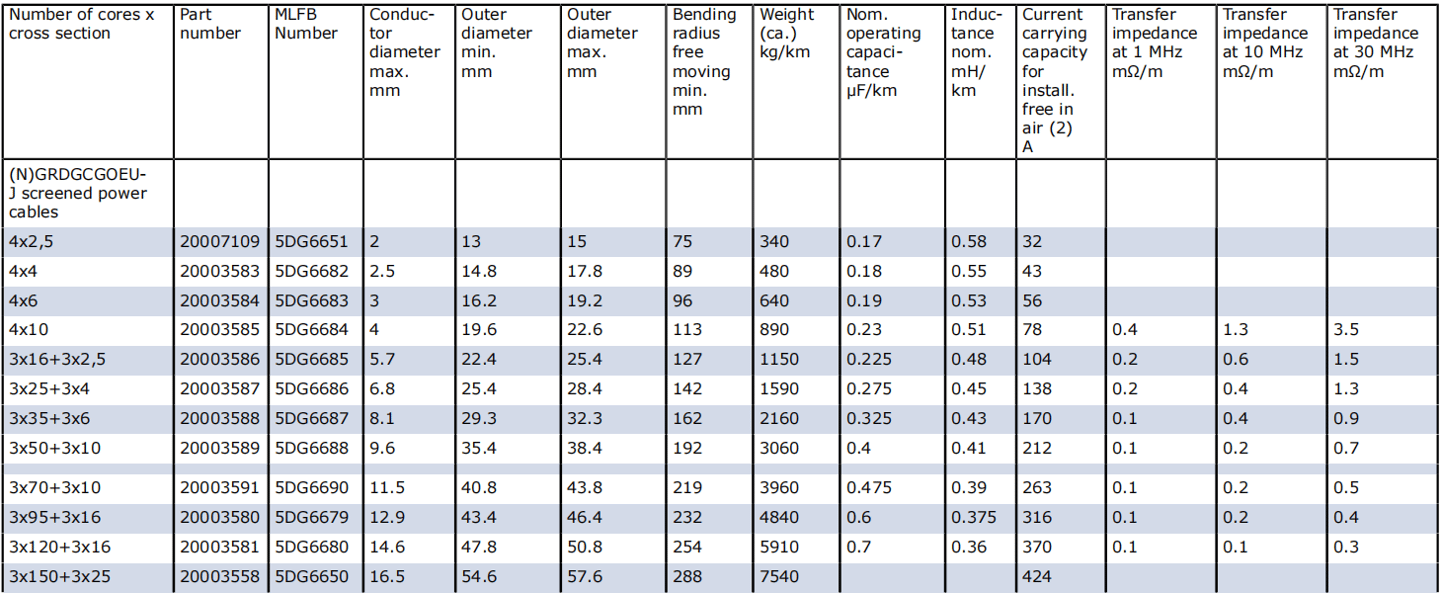
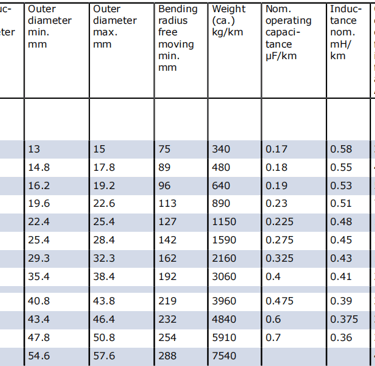
Conductor resistance values follow standard tables for copper conductors, with typical values ranging from approximately 12 Ω/km for 1.5 mm² conductors to less than 1 Ω/km for 25 mm² sizes. Low resistance minimizes voltage drop and improves energy efficiency.
Short-Circuit Withstand Capability
The cable withstands short-circuit currents for duration sufficient to allow protective devices to clear the fault. Maximum short-circuit temperature limits for copper conductors and insulation materials define the allowable fault current magnitude and duration. Typical designs permit conductor temperatures reaching 160°C to 250°C for short periods during fault conditions.
Mechanical forces during short-circuits create significant stress on cable construction. The design ensures that electromagnetic forces between conductors do not cause permanent deformation or insulation damage during fault events.
EMC Performance and Compliance with EN 55011 / EN 55022
Screen Design to Reduce Emissions and Interference on Data Cables
The screening system attenuates electromagnetic emissions generated by power currents flowing through the cable conductors. The screen intercepts electric and magnetic fields, conducting induced currents back to the earthing point rather than allowing them to radiate into the surrounding environment. This containment prevents interference with nearby data cables carrying sensitive control signals.
Transfer impedance measurements quantify screening effectiveness, with lower values indicating superior performance. The braided copper screen achieves transfer impedance values suitable for installations where power and signal cables run in parallel for extended distances.
Meeting Maximum Emission Limits in Industrial Environments
Industrial electromagnetic compatibility standards such as EN 55011 and EN 55022 establish maximum permissible emission levels for equipment and installations. The screened cable design ensures that installations comply with Class A (industrial) or Class B (residential) emission limits depending on application requirements.
Proper screen termination and earthing practices prove essential for achieving specified EMC performance. Installation guidelines detail bonding methods that maintain screen continuity and provide low-impedance connection to the facility earthing system.
Use in Mixed Power and Signal Cable Installations
Modern industrial facilities commonly route power cables alongside data networks, fieldbus systems, and instrumentation circuits. The screened festoon cable for rack material handling and transport systems enables this mixed installation approach without causing interference issues. The screening reduces coupling between power and signal circuits, maintaining signal integrity for communication systems.
Separation distance requirements between screened power cables and unscreened signal cables can be reduced compared to unscreened power cables, offering installation flexibility and space savings in crowded cable routing paths.
Mechanical Performance for Festoon Systems and Moving Machinery
Bending Radius for Festoon Operation and Chain Guidance
Minimum bending radius specifications prevent excessive mechanical stress on cable components during normal operation. Typical requirements specify minimum bending radii between 10× and 15× the cable outer diameter for moving applications. This radius ensures that conductors and screen elements flex smoothly without kinking or permanent deformation.
Festoon trolley design incorporates sheaves or guide channels dimensioned to maintain adequate bending radius throughout the travel range. Proper radius compliance extends cable service life by preventing premature fatigue failures.
Maximum Tensile Load on the Conductor
Tensile load limits prevent conductor elongation and insulation damage during cable handling and operation. Maximum permissible tensile forces typically range from 15 N/mm² to 50 N/mm² of conductor cross-section, depending on cable construction and installation conditions.
In vertical festoon applications or long horizontal runs, cable weight contributes to tensile loading. Intermediate support points distribute the load, preventing excessive stress at the fixed termination point. Proper strain relief design at terminations ensures mechanical loads transfer to cable armor or strength members rather than conductors.
Travel Speed and Acceleration Limits in Festoon Applications
Operating speeds in festoon systems range from slow manual operation (0.1 m/s) to high-speed automated systems (5 m/s or more). The cable construction accommodates these speeds while accounting for acceleration forces during starting and stopping. Dynamic loading from rapid acceleration creates additional mechanical stress beyond static cable weight.
Festoon system design considers cable mass and inertia when specifying trolley motors and drive systems. Proper acceleration profiles prevent shock loading that could damage cable construction or terminations.
Resistance to Vibration, Abrasion and Impact
Industrial environments subject cables to continuous vibration from machinery operation and impact from material handling activities. The outer sheath resists abrasion from sliding contact with festoon components and occasional impact from adjacent equipment or transported materials.
Vibration resistance depends on proper cable support that prevents resonance amplification. Fixed support points use cushioned clamps that secure the cable without excessive compression. This approach prevents vibration-induced fatigue while allowing thermal expansion and contraction.
Thermal and Environmental Performance
Maximum Conductor Operating Temperature and Short-Circuit Temperature
Normal operating temperature limits typically reach 70°C to 90°C for the conductor, depending on insulation material properties. These limits ensure long-term insulation life and maintain adequate safety margins. Temperature monitoring in critical applications provides early warning of overload conditions or inadequate ventilation.
During short-circuit events, conductor temperatures may briefly reach 160°C to 250°C depending on insulation type and cable design. These elevated temperatures remain below the thermal damage threshold for insulation and conductor materials.
Ambient Temperature Ranges for Fixed and Flexible Installation
The cable operates across ambient temperature ranges from -25°C to +60°C or wider depending on material selection. Low temperature performance ensures insulation remains flexible and conductors maintain adequate mechanical properties in cold environments. High temperature capability accommodates outdoor installations in hot climates and indoor environments near heat sources.
Temperature cycling between day and night or operating and idle periods creates thermal expansion and contraction. The cable design accommodates these dimensional changes without creating excessive mechanical stress.
Resistance to Oils, Chemicals, Ozone, UV and Weather
The outer sheath formulation resists common industrial oils including mineral and synthetic lubricants, hydraulic fluids, and cutting oils. Chemical resistance extends to weak acids, alkalis, and cleaning agents typically encountered in industrial facilities.
Outdoor installations require resistance to ozone, ultraviolet radiation, and weather exposure. UV-stabilized compounds prevent surface degradation and color fading during prolonged sun exposure. Weather resistance ensures the sheath maintains mechanical properties through rain, snow, and temperature extremes.
Suitability for Indoor and Outdoor Installation
The cable construction adapts to both indoor and outdoor environments. Indoor installations benefit from controlled ambient conditions but may encounter oil mists, dust, and chemical exposures. Outdoor installations face weather extremes but often operate at lower duty cycles.
Installation planning considers local climate conditions, selecting cable variants with appropriate environmental protection. Outdoor cables may incorporate additional UV protection or enhanced oil resistance compared to indoor-only variants.
Typical Applications of RONDOFLEX(C)-FC (N)GRDGCGOEU Screened Festoon Cable
Gantry Cranes and Hall Gantry Cranes
This low voltage screened round cable for gantry crane festoon systems provides reliable power to bridge cranes that traverse building lengths in manufacturing and warehouse facilities. Hall gantry cranes rely on festoon systems for both power supply and control circuits, demanding cables that withstand millions of bending cycles while maintaining EMC compliance.
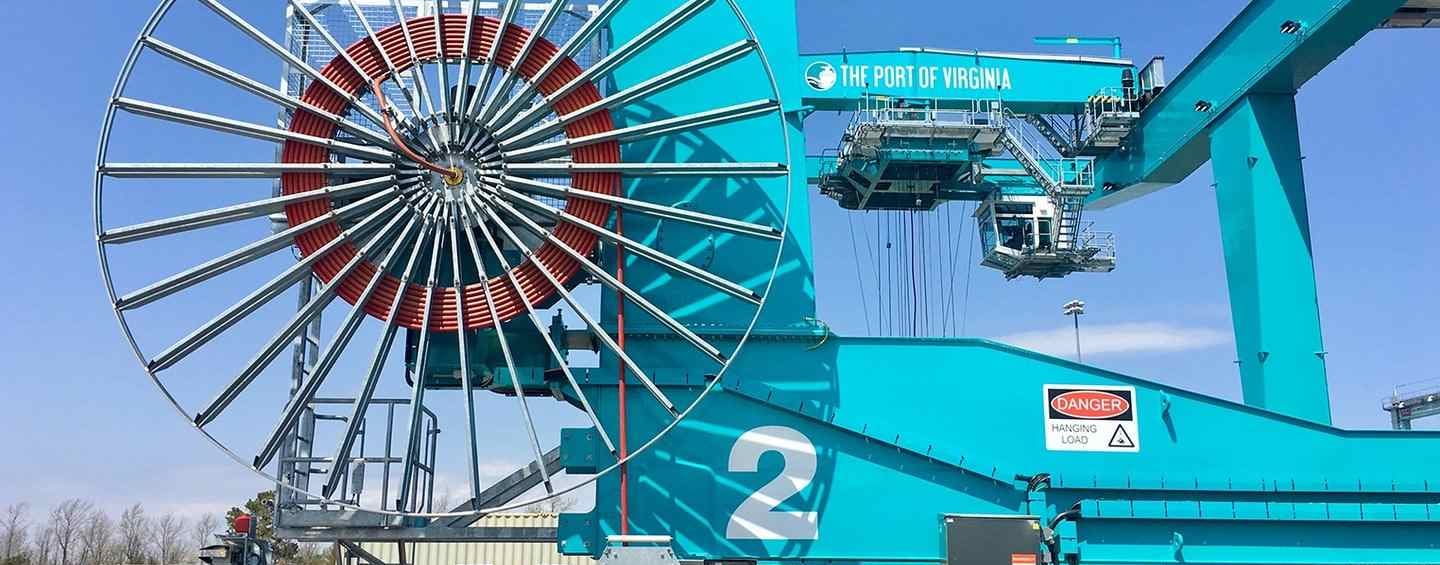
Container gantry cranes at ports and intermodal terminals represent another major application. These massive structures require robust festoon cables that operate reliably despite outdoor exposure, high duty cycles, and extended travel distances exceeding 100 meters.
Rack Material Handling and Storage Systems
Automated storage and retrieval systems employ festoon cables to power stacker cranes that access high-density storage racks. These systems operate continuously with rapid acceleration and precise positioning requirements. The cable provides consistent electrical performance supporting servo motor drives and control networks.
High-bay warehouses utilize vertical festoon systems where cables travel alongside lifting masts. Proper cable selection ensures reliable operation despite the mechanical stress of vertical travel and the need for compact cable routing in space-constrained installations.
Transport Systems and Conveyor Lines
Material transport systems including overhead conveyors, monorail systems, and floor-based guided vehicles use festoon cables where continuous power supply must follow moving equipment. The cable flexibility accommodates the routing geometry while the screening prevents interference with automated guidance systems.
Cross-transfer systems that move materials between parallel conveyor lines require festoon cables that operate reliably despite frequent directional changes and varying travel speeds. Robust construction ensures minimal downtime in high-throughput facilities.
Machine Tools with Moving Power and Control Circuits
Large machine tools including gantry mills, plasma cutting tables, and waterjet systems incorporate festoon cables to supply power and signals to moving tool carriages. These applications demand precise EMC performance to prevent interference with position encoders and numerical control systems.
Robotic welding cells and automated assembly stations use festoon systems where multiple axes of motion require flexible cable connections. The screening ensures electromagnetic compatibility in environments with high-frequency welding currents and servo drive switching.
Use as Flexible Motor Power Supply Cable in Festoon Systems
Electric motor power supply represents the primary application for this cable type. Three-phase AC motors driving crane hoists, traverse motions, and auxiliary equipment receive reliable power through festoon cable installations. The cable handles motor starting currents and load variations without excessive voltage drop.
DC motor applications including legacy crane systems and specialized variable-speed drives also benefit from the cable's current-carrying capacity and flexibility. The screening provides clean power delivery, supporting precise motor speed control.
Installation Guidelines for Low Voltage Screened Round Cables in Festoon Systems
Selection of Cross-Section and Number of Cores
Conductor cross-section selection balances current-carrying requirements against voltage drop limits and mechanical flexibility. Calculations consider maximum motor loads, cable length, and permissible voltage drop percentages. Typical installations use 1.5 mm² to 4 mm² conductors for control circuits and 6 mm² to 25 mm² for power distribution.
Core count depends on the electrical system configuration. Three-phase motor supplies require three phase conductors plus protective earth, totaling four cores. Systems with neutral conductors or separate control circuits may require five or more cores.
Recommended Cable Arrangement in Festoon Trolleys and Chains
Festoon trolley design must accommodate cable routing without imposing excessive bending or creating abrasion points. Cables pass through smooth channels or over sheaves with adequate radius. Multiple cables in the same festoon system require sufficient spacing to prevent mutual abrasion and allow independent flexing.
Cable support points occur at regular intervals matching the festoon trolley spacing. This arrangement prevents cable sagging between supports while avoiding excessive constraint that would impair flexibility.
Minimum Bending Radius and Support Spacing
Installation practices must respect minimum bending radius specifications throughout the festoon system. Trolley entry and exit points represent critical locations where inadequate radius could concentrate stress. Fixed cable terminations incorporate strain relief devices dimensioned for the cable diameter.
Support spacing typically ranges from 1 to 3 meters depending on cable weight and orientation. Vertical installations require closer spacing to prevent excessive tensile loading at upper support points. Horizontal installations balance support frequency against system cost and complexity.
Earthing and Termination of the Screen for Optimal EMC Performance
Screen earthing at both cable ends provides optimal EMC performance by creating a low-impedance path for screening currents. Termination methods employ cable glands with integral screen connection or separate earthing clamps that ensure 360-degree screen contact with the earthing point.
Single-point earthing may be employed in specific circumstances to avoid earth loop currents, though both-ends earthing generally provides superior interference suppression. Installation documentation specifies earthing configuration and validates proper implementation during commissioning.
Considerations for Long Travel Distances and High Speeds
Extended festoon travel distances increase cable weight, requiring careful analysis of tensile loading and support requirements. Long systems may incorporate intermediate cable slack storage to reduce loading at fixed termination points. Cable weight distribution across multiple support trolleys prevents excessive stress concentration.
High-speed operation creates dynamic loading from cable inertia during acceleration and deceleration. Festoon system design must limit acceleration rates to values compatible with cable mechanical properties. Proper trolley spacing and guidance prevent cable whipping or interference with adjacent structures.
Selection Checklist for RONDOFLEX(C)-FC (N)GRDGCGOEU in Festoon Applications
Defining Electrical Load, System Voltage and Inrush Currents
Complete load analysis identifies all powered equipment including motors, lighting, and control systems. Peak current requirements account for motor starting inrush, typically five to eight times rated current for brief periods. Cable sizing ensures adequate capacity for simultaneous starting of multiple motors.
System voltage verification confirms compatibility between cable rating and actual operating voltage. Voltage drop calculations consider cable length and load current, ensuring adequate voltage reaches connected equipment throughout the travel range.
Evaluating Mechanical Stress: Travel Path, Speed and Cycles
Mechanical duty assessment quantifies the bending cycles, travel distance, and operating speed characteristic of the application. Annual cycle counts may reach millions in continuously operating automated systems. This data guides cable selection toward constructions proven for the required service life.
Travel path geometry including horizontal runs, vertical lifts, and directional changes influences cable stress patterns. Complex paths with multiple bending planes may require enhanced flexibility specifications or alternative cable routing approaches.
Environmental Conditions: Indoor/Outdoor, Oil, UV, Moisture
Environmental audit documents all exposure conditions including temperature extremes, chemical contact, and outdoor weather exposure. Oil presence from hydraulic systems or lubricants requires oil-resistant sheath compounds. UV exposure in outdoor installations demands UV-stabilized materials.
Moisture exposure from rain, humidity, or wash-down cleaning necessitates water-resistant construction. Ingress protection ratings for cable terminations and junction boxes complement the cable's inherent environmental resistance.
Matching Cable Design to Crane or Handling System Requirements
System integration ensures cable specifications align with crane manufacturer requirements and industry standards. Mechanical interface dimensions must suit the festoon trolley design. Electrical parameters match the motor drive and control system specifications.
Standardization across facility installations simplifies maintenance and spare parts inventory. Where possible, selecting common cable types for multiple similar applications reduces complexity and improves long-term supportability.

Common Cable Issues and Solutions in Festoon Applications
Problem: Premature Cable Failure from Excessive Bending Stress
Issue: Cables failing before expected service life often result from bending radii smaller than specification, particularly at festoon trolley entry points or fixed terminations. Visual inspection reveals cracking in the outer sheath or conductor breakage near sharp bends.
Solution: Verify all bending radii meet or exceed minimum specifications throughout the installation. Replace undersized trolley components with properly dimensioned alternatives. Install radius control devices at terminations that enforce adequate bending geometry. Consider upgrading to cables with enhanced flexibility specifications if space constraints limit achievable radii.
Problem: Electromagnetic Interference Affecting Control Systems
Issue: Data communication errors, erratic sensor readings, or control system malfunctions may indicate EMC problems from inadequate screening or improper screen termination.
Solution: Verify screen connections provide 360-degree contact with earthing points at both cable ends. Check screen continuity throughout cable length using low-resistance measurements. Ensure earthing system provides low-impedance path to facility earth. Increase separation distance between power and signal cables where practical. Consider adding supplementary screening to signal cables or relocating sensitive equipment away from power cable routes.
Problem: Excessive Voltage Drop Affecting Motor Performance
Issue: Motors fail to develop full torque or experience starting difficulties, particularly near the end of long festoon travel distances.
Solution: Measure actual voltage at motor terminals under load conditions. Calculate voltage drop based on cable length, conductor resistance, and actual current draw. If voltage drop exceeds acceptable limits (typically 3-5% for motor circuits), upgrade to larger conductor cross-section or review load distribution to reduce current requirements. Verify connection integrity at all termination points as high resistance joints exacerbate voltage drop issues.
Problem: Cable Abrasion from Contact with Festoon Components
Issue: Outer sheath wear from rubbing against trolley guides, adjacent cables, or structural elements leads to insulation exposure and eventual electrical failure.
Solution: Inspect festoon trolley guide surfaces for rough edges or misalignment. Install protective liners in areas of frequent cable contact. Ensure adequate clearance between cables and structural elements throughout travel range. Replace worn trolley components that create excessive friction. Consider cables with enhanced abrasion-resistant sheaths for particularly demanding applications.
Summary and Benefits of Using RONDOFLEX(C)-FC (N)GRDGCGOEU in Festoon Systems
Key Performance Benefits for Gantry and Hall Cranes
The RONDOFLEX(C)-FC (N)GRDGCGOEU low voltage screened round cable for festoon application delivers reliable electrical performance specifically engineered for demanding crane installations. The optimized construction balances flexibility, durability, and electrical characteristics essential for millions of bending cycles. Operators benefit from reduced maintenance requirements and extended service intervals compared to general-purpose cables adapted for festoon use.
The round geometry provides consistent bending characteristics regardless of cable orientation, simplifying installation and ensuring predictable performance. High-quality materials and precision manufacturing deliver consistent cable properties along the entire length, eliminating weak points that could cause premature failure.
Reduced Electromagnetic Interference on Adjacent Data Cables
Electromagnetic screening enables close proximity installation of power and data cables without mutual interference. Modern automated systems increasingly integrate power distribution with communication networks, making EMC performance essential. The screened design meets industrial emission standards while protecting sensitive control circuits from power-related interference.
This EMC capability supports facility-wide digital transformation initiatives where power infrastructure must coexist with industrial IoT sensors, wireless networks, and real-time control systems. Reduced interference improves system reliability and eliminates difficult-to-diagnose performance issues.
Reliable Power Supply Under High Mechanical and Thermal Stress
The cable construction withstands harsh industrial environments where temperature extremes, chemical exposure, and mechanical stress would rapidly degrade inferior products. Robust sheath materials resist abrasion, oils, and environmental factors while maintaining flexibility. Thermal design ensures safe operation across wide ambient temperature ranges without excessive conductor heating.
This reliability translates directly to improved equipment uptime and reduced total cost of ownership. Fewer cable failures mean less unplanned downtime and lower emergency repair costs. Predictable service life enables planned maintenance scheduling rather than reactive responses to failures.
Suitability for Modern Automated Material Handling Solutions
Contemporary warehousing and manufacturing increasingly rely on automated material handling systems operating continuously at high speeds. These systems demand cables that match their performance requirements and operational intensity. The low voltage round cable for high mechanical stress and frequent bending meets these demands through engineering specifically targeting festoon applications rather than adapting fixed-installation cables.
Integration with automated systems benefits from consistent electrical properties that support precise motor control and reliable sensor operation. The cable's mechanical endurance matches the duty cycles of modern automated equipment, ensuring infrastructure keeps pace with operational demands.
The RONDOFLEX(C)-FC (N)GRDGCGOEU represents a specialized solution for festoon applications where generic cables prove inadequate. Its combination of electrical performance, mechanical durability, and EMC compliance addresses the specific challenges of mobile power supply in demanding industrial environments.
How to Reach Us
Get in Touch
SiteMap
Product Catalogue
Festoon Cable
Shore Power Cable


Scan to add us on WeChat