
SHD-GC Three-Conductor Round Portable Power Cable: The Ultimate Heavy Duty Mining Solution
Discover the SHD-GC three-conductor round portable power cable with TPU jacket 8kV for heavy mobile equipment like drag lines and shovels. EPR insulated, ICEA S-75-381 compliant, +90°C rated. Ideal heavy duty mining cable with ground check.
hongjing.Wang@Feichun
1/16/20268 min read
In the demanding world of heavy industrial operations, selecting the right power cable can mean the difference between seamless productivity and costly downtime. The SHD-GC three-conductor round portable power cable with TPU jacket 8kV represents a pinnacle of engineering excellence designed specifically for the harshest environments. This heavy duty mining cable delivers reliable power to critical equipment while withstanding the mechanical stresses, environmental extremes, and electrical demands that would compromise lesser cables.
Understanding the SHD-GC Cable Design Philosophy
The SHD-GC designation refers to a specialized category of portable power cables engineered for heavy mobile equipment in mining, dredging, and construction applications. The "GC" component stands for "Ground Check," a critical safety feature that enables continuous monitoring of the grounding system's integrity. This three-conductor round construction combines power delivery, equipment grounding, and ground continuity verification in a single, robust assembly.
What sets this reliable SHD-GC cable for mining and dredging applications apart is its comprehensive approach to power delivery challenges. Unlike standard industrial cables, the SHD-GC design addresses the unique requirements of equipment that must move frequently, operate in abrasive environments, and maintain absolute electrical safety in potentially hazardous conditions.
Primary Applications: Where Heavy Duty Performance Matters Most
The SHD-GC three-conductor cable for heavy mobile equipment in harsh environments excels in applications where conventional cables fail. Drag lines, those massive excavation machines used in surface mining operations, require cables that can flex repeatedly while dragging across rough terrain. The constant movement, combined with exposure to rocks, minerals, and weather extremes, demands exceptional abrasion resistance and mechanical durability.
Electric shovels present similar challenges, with the added complication of high-amperage power delivery during heavy digging operations. These machines often operate continuously in surface mines, where cable failure can halt production and create dangerous situations. The SHD-GC cable's robust construction ensures consistent performance even when subjected to the crushing forces and sharp edges common in mining environments.
Dredging operations introduce additional environmental factors, including moisture exposure, potential submersion, and the corrosive effects of water-borne minerals. The TPU jacket provides exceptional water resistance while maintaining flexibility in cold conditions, making this cable ideal for dredging equipment that operates in marine or freshwater environments.
Large drilling rigs, whether used for mineral exploration or blast hole preparation, require cables that can withstand constant repositioning and the vibration inherent to drilling operations. The SHD-GC cable's construction absorbs these stresses without compromising electrical integrity or developing internal damage that could lead to premature failure.
Power feeders for mobile substations and distribution systems benefit from the cable's combination of voltage rating, current-carrying capacity, and portability. These applications often require rapid deployment and reconfiguration as mining operations progress, making the cable's flexibility and durability essential features.
Compliance Standards: Engineering to Rigorous Specifications
The ICEA S-75-381 compliant SHD-GC portable power cable with ASTM certifications meets or exceeds multiple industry standards that ensure safety, performance, and reliability. The ICEA S-75-381/NEMA WC 58 standard specifically addresses portable and power feeder cables for mining applications, establishing requirements for construction, materials, and electrical performance.
ASTM B 172 governs the specifications for rope-lay stranded copper conductors, ensuring that the cable's conductors provide optimal flexibility while maintaining excellent electrical conductivity. This standard is crucial for portable applications where the conductor must withstand repeated flexing without work-hardening or breaking individual strands.
ASTM B 33 establishes requirements for tinned soft or annealed copper wire, a critical specification for cables operating in environments where moisture or chemical exposure could cause corrosion. The tinning process creates a protective barrier that extends conductor life and maintains low-resistance connections.
CAN/CSA C22.2 No. 96 provides Canadian standards for portable power cables, ensuring that the SHD-GC cable meets North American safety and performance requirements. This dual compliance enables use across international mining operations without requiring different cable specifications for different regions.
These standards aren't merely bureaucratic checkboxes—they represent decades of field experience translated into engineering requirements that prevent failures, protect workers, and ensure reliable operation in the world's most challenging industrial environments.
Advanced Construction: Layer by Layer Excellence
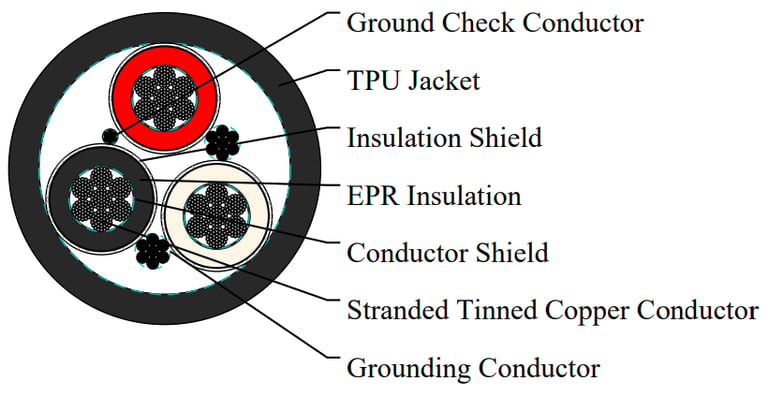
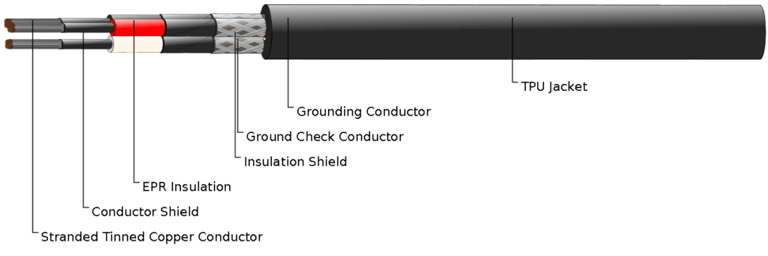
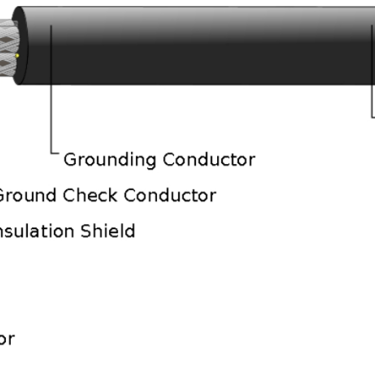
The foundation of this heavy duty 8kV TPU jacket three-conductor power cable begins with stranded annealed tinned copper conductors. The stranding provides flexibility essential for portable applications, while annealing ensures the copper remains soft and pliable even after repeated bending cycles. Tinning protects against corrosion and facilitates superior electrical connections at terminations.
A conducting layer shields each conductor, providing a smooth, semiconductive interface between the conductor and insulation. This shield eliminates air gaps that could cause corona discharge and ensures uniform voltage stress distribution across the insulation system.
Ethylene Propylene Rubber (EPR) insulation surrounds each conductor, offering exceptional dielectric strength, thermal stability, and resistance to environmental degradation. EPR maintains its properties across a wide temperature range and resists damage from ozone, weathering, and chemical exposure—critical attributes for cables operating in outdoor industrial environments.
The insulation shield consists of conducting tape complemented by a tinned copper or textile braid. This shield serves multiple functions: it confines the electric field within the insulation system, provides mechanical protection, and creates a low-resistance path for fault currents that ensures rapid protective device operation during ground faults.
The ground check conductor—a tinned copper wire with distinctive yellow polypropylene insulation—enables continuous monitoring of the grounding system. This feature allows safety systems to detect ground path deterioration before it becomes a hazard, providing an additional layer of protection beyond the primary grounding conductor.
A dedicated grounding conductor, constructed from tinned copper, provides the low-impedance path necessary for safe fault current flow. This conductor must maintain its integrity even during fault conditions, when thousands of amperes may flow momentarily until protective devices isolate the fault.
The black thermoplastic polyurethane (TPU) jacket serves as the cable's armor against the external world. TPU combines the toughness of thermoset rubbers with the processing advantages and performance characteristics of thermoplastics. It offers outstanding abrasion resistance, tear strength, and flexibility across temperature extremes while resisting oils, greases, and the chemicals commonly encountered in mining environments.
Customization: Tailoring Performance to Application Requirements
While the standard TPU jacket configuration suits most applications, the custom heavy duty SHD-GC cable options for mining and industrial use include several alternative constructions. CSP (Chlorosulfonated Polyethylene) jackets provide enhanced resistance to ozone and weathering, making them ideal for cables exposed to direct sunlight or high-ozone industrial environments.
PCP (Polychloroprene) jackets, commonly known by the trade name Neoprene, offer excellent flame resistance and maintain flexibility across a broad temperature range. Applications requiring enhanced fire safety or operation in extremely cold conditions may benefit from PCP jacket construction.
NBR (Nitrile Butadiene Rubber) jackets excel in applications with heavy oil and fuel exposure. Mining equipment that operates near fueling stations or experiences frequent hydraulic fluid contact benefits from NBR's superior resistance to petroleum-based products.
PVC (Polyvinyl Chloride) jackets provide an economical alternative with good general-purpose performance. While not matching TPU's abrasion resistance, PVC offers adequate protection for applications with less severe mechanical stress.
Two-layer jacket constructions with reinforcing fiber between layers address applications requiring maximum mechanical protection. The inner jacket provides electrical insulation and basic environmental protection, while the fiber reinforcement layer absorbs impact and abrasion forces. The outer jacket then shields the reinforcement from environmental degradation, creating a three-layer defense system.
Common Cable Challenges and Practical Solutions
Problem: Premature jacket wear in high-abrasion environments
Surface mining operations often subject cables to constant abrasion from rocks, minerals, and equipment movement. Even TPU jackets can show excessive wear if cables drag repeatedly across sharp rocks or abrasive surfaces.
Solution: Implement cable protection systems such as cable trays, guide rollers, or festoon systems that minimize direct contact with abrasive surfaces. Where direct ground contact is unavoidable, consider routing cables through protective hose or conduit in high-wear areas. Regular inspection programs that identify wear patterns enable proactive cable repositioning or protection enhancement before jacket damage exposes insulation.
Problem: Water ingress at terminations and connectors
Mining and dredging applications expose cable terminations to moisture, water spray, and occasional submersion. Even with proper connector selection, water can wick along conductor strands into the cable core, causing insulation degradation and corrosion.
Solution: Use only connectors rated for the environment, ensuring they provide adequate sealing and strain relief. Apply cable sealant or potting compounds at termination points to prevent water migration. Install termination enclosures with proper drainage to prevent water accumulation. For particularly wet environments, specify cables with water-blocking tapes or compounds that prevent longitudinal water migration.
Problem: Ground check system false alarms or failures
The ground check conductor provides valuable safety monitoring, but false alarms can lead to unnecessary shutdowns, while undetected failures compromise safety.
Solution: Establish baseline ground check readings during cable commissioning and monitor trends over time rather than relying on absolute threshold values. False alarms often indicate deteriorating conditions that require investigation even if immediate failure hasn't occurred. Implement redundant monitoring systems for critical equipment. Train maintenance personnel to distinguish between ground check system failures and actual grounding system degradation.
Problem: Reduced flexibility in cold weather operation
Mining operations in cold climates may experience increased cable stiffness, making equipment operation difficult and increasing the risk of cold-temperature cracking.
Solution: The TPU jacket maintains good low-temperature flexibility, but extremely cold conditions may still affect performance. Pre-warm cables before deployment when possible, or select jacket materials specifically rated for the minimum expected ambient temperature. Avoid manipulating cables when frozen, as this dramatically increases fracture risk. Consider insulated cable storage facilities for extreme cold environments.
Problem: Electrical failures during high-current startup transients
Large mining equipment often draws several times rated current during startup, creating thermal and mechanical stresses that can lead to premature cable failure.
Solution: Ensure cable sizing accounts for startup currents, not just running loads. Soft-start systems or variable frequency drives can reduce startup current magnitude. Monitor cable temperatures during startup sequences to verify that thermal limits aren't exceeded. Consider oversizing cables for applications with frequent starts or high inrush currents.
Why Superior Engineering Delivers Long-Term Value
The heavy duty three-conductor SHD-GC cable in shovels and drills represents a significant investment, but its advanced construction delivers compelling economic advantages. Reduced downtime from cable failures directly translates to increased production and revenue. A single cable failure on a critical excavator can cost hundreds of thousands of dollars in lost production, far exceeding the price difference between premium and economy cables.
Enhanced safety protections reduce accident risk and the associated costs of injuries, investigations, and potential regulatory actions. The ground check system provides early warning of developing problems, enabling scheduled repairs rather than emergency responses to catastrophic failures.
Extended service life means fewer replacement cycles, reducing both material costs and the labor expenses associated with cable changeouts. In remote mining locations, logistics challenges make cable replacement particularly expensive and time-consuming, amplifying the value of cables that achieve their full design life.
Superior flexibility reduces installation labor and equipment stress. Cables that route easily require less installation time and create less mechanical stress on equipment cable entry points and strain reliefs, preventing secondary damage to connected equipment.
Conclusion: Powering Critical Operations With Confidence
The SHD-GC three-conductor round portable power cable with TPU jacket 8kV combines advanced materials, rigorous engineering, and proven design principles to deliver reliable power in the world's most demanding industrial environments. From the tinned copper conductors to the abrasion-resistant TPU jacket, every component serves a specific purpose in ensuring safe, reliable operation across the cable's design life.
For operators of drag lines, shovels, dredges, drills, and mobile power distribution systems, this cable provides the performance foundation that enables productive operations. Its compliance with ICEA S-75-381 and related standards ensures that it meets industry safety requirements while delivering the electrical and mechanical performance that real-world applications demand.
Selecting the right portable power cable involves understanding application requirements, environmental conditions, and performance expectations. The SHD-GC cable's proven design, combined with available customization options, enables precise matching of cable specifications to operational needs. For operations where power delivery cannot fail, where safety cannot be compromised, and where performance must endure despite harsh conditions, the SHD-GC three-conductor round portable power cable delivers the reliability that keeps critical equipment operating productively.
Contact qualified cable specialists to discuss your specific application requirements, obtain detailed technical specifications, and explore customization options that optimize performance for your unique operational conditions.
How to Reach Us
Get in Touch
SiteMap
Product Catalogue
Festoon Cable
Shore Power Cable


Scan to add us on WeChat