SHD-GC Three-Conductor Round Portable Power Cable, TPU Jacket 25kV | Heavy Duty EPR Insulated Cable for Mining Shovels & Dredges
Discover SHD-GC three-conductor round portable power cable with TPU jacket 25kV for heavy mobile equipment like draglines, shovels & dredges. EPR insulation, ground check conductor, ICEA S-75-381 compliant. +90°C rated, 8x OD bend radius.
hongjing.Wang@Feichun
1/20/202610 min read
Introduction & Key Features
The SHD-GC three-conductor round portable power cable with TPU jacket 25kV represents a pinnacle of engineering for heavy-duty industrial applications. This specialized cable is designed to deliver reliable power to the most demanding mobile equipment in mining, dredging, and construction environments where conventional cables would quickly fail.
At its core, this heavy duty three-conductor round portable power cable for mining equipment and power feeders combines advanced materials with proven design principles. The cable features a 25kV voltage rating, making it suitable for high-voltage distribution networks that power massive machinery. Each conductor is manufactured from stranded annealed tinned copper, providing excellent electrical conductivity while resisting corrosion in harsh environments.
The EPR (Ethylene Propylene Rubber) insulation system offers superior dielectric strength and thermal stability, maintaining performance across a wide temperature range. What sets this cable apart is its integrated ground check conductor—a critical safety feature that enables continuous monitoring of the grounding system integrity. The outer jacket utilizes premium Thermoplastic Polyurethane (TPU), chosen specifically for its exceptional abrasion resistance, flexibility, and durability in extreme conditions.
Key specifications include a maximum conductor operating temperature of +90°C, a minimum bending radius of 8 times the overall cable diameter, and full compliance with ICEA S-75-381/NEMA WC 58 standards. These features combine to create a portable power cable for drills and power feeders that can withstand the punishing duty cycles of modern mining operations.
Applications in Heavy Mobile Equipment
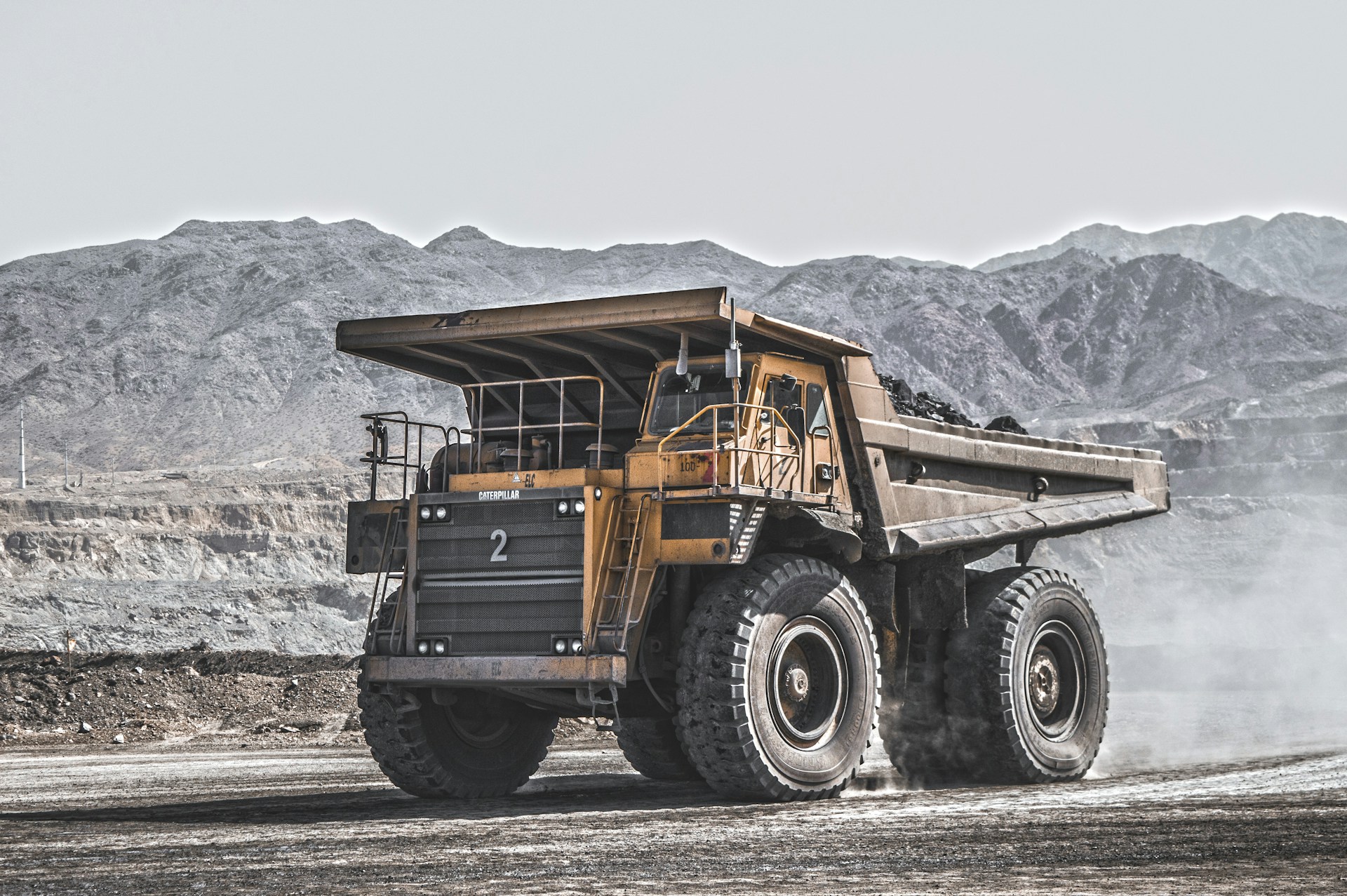
The versatility of the 25kV portable power cable for shovels and dredges makes it indispensable across multiple industrial sectors. In surface mining operations, draglines—among the largest mobile land machines ever built—rely on these cables to receive power while moving millions of cubic yards of overburden. The cable must flex continuously as the dragline repositions, all while maintaining electrical integrity under mechanical stress that would destroy lesser cables.
Electric mining shovels present similar challenges. These machines load hundreds of tons of material per hour, requiring constant repositioning and creating severe cable flexing. The SHD-GC cable's construction accommodates these repetitive bending cycles without insulation cracking or conductor fatigue. The TPU jacket resists cuts from sharp rock fragments and abrasion from dragging across rough terrain—common failure modes for cables with conventional jackets.
Dredging operations introduce additional environmental stressors. While the cable isn't designed for continuous submersion, it must tolerate splash zones, high humidity, and occasional contact with water. The tinned copper conductors resist corrosion, while the TPU jacket provides a moisture barrier superior to traditional rubber compounds. Cutter suction dredges, bucket dredges, and mining dredges all benefit from this cable's robust construction.
In drilling applications, the cable feeds power to rotary drills, blast hole drills, and exploration rigs. These operations often occur in remote locations with minimal infrastructure, where cable failure could halt operations for days. The reliability of this EPR insulated 25kV SHD-GC cable with ground check conductor reduces downtime and maintenance costs significantly.
Power feeders represent another critical application. When extending electrical distribution across a mine site, construction zone, or temporary facility, these cables serve as the arterial system delivering power from substations to local distribution points. The 25kV rating allows efficient power transmission over considerable distances with minimal voltage drop, while the portable design permits rapid deployment and reconfiguration as work zones shift.
Standards Compliance and Certifications
Compliance with recognized industry standards isn't merely a regulatory checkbox—it's fundamental to ensuring safe, reliable operation in hazardous environments. This ICEA S-75-381 compliant TPU jacket power feeder cable meets the rigorous requirements set forth by the Insulated Cable Engineers Association and the National Electrical Manufacturers Association under NEMA WC 58.
ICEA S-75-381 specifically addresses portable and mine (power) cables, establishing construction requirements, testing protocols, and performance criteria. Compliance with this standard ensures the cable can withstand the electrical, mechanical, and environmental stresses typical of mining applications. The standard specifies insulation thickness, shield construction, jacket properties, and testing procedures including high-voltage breakdown tests and flame resistance evaluations.
Material standards are equally important. ASTM B 172 governs the tinned copper conductors, ensuring appropriate conductivity and corrosion resistance. ASTM B 33 addresses the tinned soft or annealed copper wire used in the grounding and shielding components. These specifications guarantee consistency in material properties, critical for predictable cable performance.
For Canadian markets and international projects, CAN/CSA C22.2 No. 96 compliance is essential. This Canadian Standards Association specification covers portable power cables and ensures compatibility with Canadian electrical codes and safety requirements. Having both ICEA and CSA certifications expands the cable's applicability across North American projects and provides confidence to international buyers seeking recognized quality standards.
Construction Details and Engineering
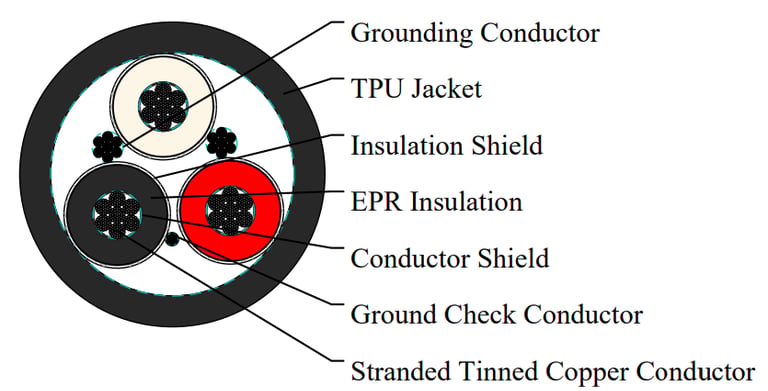
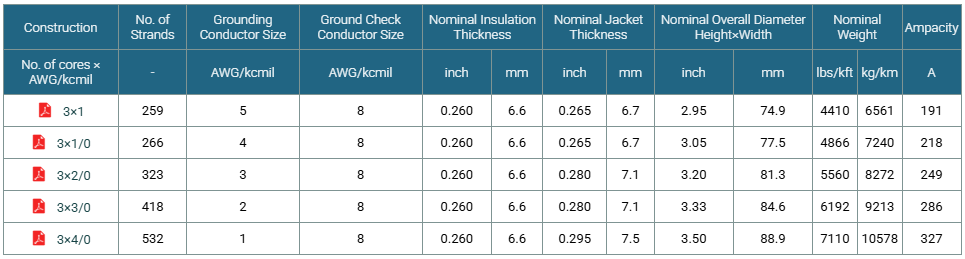
Understanding the layered construction of this cable reveals why it excels in demanding applications. Starting from the center, each of the three main conductors consists of multiple strands of annealed tinned copper wire. Stranding provides flexibility while maintaining conductivity, and the annealing process ensures the copper remains pliable through countless bending cycles. Tinning—coating the copper with a thin layer of tin—provides oxidation resistance, particularly valuable in humid or chemically aggressive environments.
Each conductor is surrounded by a semiconducting layer that ensures uniform electrical stress distribution across the insulation. This conducting layer eliminates air gaps and prevents corona discharge, which could lead to insulation degradation. The EPR insulation layer follows, precisely extruded to provide the necessary dielectric strength for 25kV operation. EPR is chosen for its excellent electrical properties, resistance to heat aging, and superior flexibility compared to cross-linked polyethylene or other alternatives.
Over the EPR insulation, another semiconducting layer (conducting tape) provides a smooth interface and shields the insulation from electrical stress. A tinned copper braid or textile braid with integrated copper elements forms the insulation shield, serving both as a grounding path and as protection against electromagnetic interference. This shield is critical for safety—it ensures any insulation failure immediately results in a ground fault that protective devices can detect and interrupt.
The ground check conductor represents a sophisticated safety feature. This smaller tinned copper conductor, identified by yellow polypropylene insulation, runs alongside the main conductors but serves a specialized monitoring function. By creating a deliberate low-impedance path to ground, the ground check conductor enables continuous verification that the grounding system remains intact. If the main grounding conductor becomes damaged or disconnected, the ground check system can detect the change and alert operators before a dangerous condition develops.
A separate, full-size grounding conductor provides the primary safety ground path. Unlike cables that rely solely on metallic shielding for grounding, this dedicated conductor ensures a robust, low-resistance connection that can safely carry fault currents without degradation.
The outer jacket is where the TPU technology truly shines. Thermoplastic Polyurethane offers a remarkable combination of properties: the abrasion resistance of hard plastics with the flexibility of rubber. In standardized abrasion tests, TPU typically outlasts conventional rubber jackets by factors of three to five. This translates directly to extended cable life in applications where the cable drags across rock, concrete, or steel surfaces.
TPU also exhibits excellent resistance to oils, greases, and many industrial chemicals encountered in mining environments. Its low-temperature flexibility remains superior to PVC, maintaining pliability in cold conditions where other materials become stiff and crack-prone. The black coloration provides UV resistance for cables exposed to sunlight during storage or outdoor routing.
Customization Options for Specific Requirements
Recognizing that different applications impose unique demands, the SHD-GC cable platform offers several customization possibilities. While the standard TPU jacket suits most applications, alternatives include CSP (Chlorosulfonated Polyethylene), PCP (Polychloroprene/Neoprene), NBR (Nitrile Butadiene Rubber), and PVC (Polyvinyl Chloride).
CSP jackets provide enhanced resistance to ozone, weathering, and certain chemicals, making them appropriate for cables experiencing prolonged outdoor exposure in chemically aggressive environments. PCP offers good flame resistance and performs well across a broad temperature range, though with somewhat less abrasion resistance than TPU. NBR excels in oil resistance, beneficial in applications involving hydraulic fluids or petroleum products. PVC provides an economical alternative where the extreme abrasion resistance of TPU isn't required.
For particularly severe applications, a two-layer jacket configuration with reinforcing fiber can be specified. This construction interposes a fabric reinforcement layer between inner and outer jacket layers, dramatically increasing tensile strength and cut resistance. Mining operations involving exceptionally sharp rock or applications where the cable might contact moving machinery components benefit from this additional protection.
Conductor sizes can be tailored to match specific voltage drop requirements and current carrying capacity needs. Larger conductor cross-sections reduce resistance, enabling longer cable runs without excessive voltage drop—important when the distance from the power source to the equipment extends beyond typical ranges.
Mechanical & Thermal Properties
The minimum bending radius of 8 times the overall cable diameter represents a critical specification for installation and operation. This relatively generous bend radius protects the internal components from excessive stress. For example, a cable with a 50mm overall diameter requires a minimum bend radius of 400mm (approximately 16 inches). Tighter bends risk damaging the conductor strands, compromising the insulation system, or creating stress concentrations in the jacket that lead to premature failure.
In mobile equipment applications, the cable rarely experiences static installation. Instead, it undergoes continuous flexing as equipment moves. The 8×OD specification ensures the cable can handle this dynamic service without accelerated fatigue. Cable reels, festoon systems, and cable handling equipment must be designed to respect this minimum radius.
The maximum conductor temperature of +90°C defines the cable's continuous operating limit. This rating reflects the thermal capabilities of the EPR insulation system, which maintains its properties up to this temperature without degradation. In practice, actual conductor temperatures depend on ambient conditions, installation method (free air versus bundled), and loading. Proper cable sizing ensures conductors remain well below the maximum rating under normal operating conditions, preserving the insulation life.
Temperature cycling—the repeated heating and cooling as loads vary—represents a significant aging mechanism. EPR's thermal stability minimizes degradation from these cycles, contributing to the cable's long service life. In contrast, some insulation materials become brittle or lose flexibility after extended thermal cycling, particularly if exposed to temperatures near their limits.
Common Cable Issues and Solutions
Problem: Premature jacket wear in high-abrasion environments
Even with TPU's superior abrasion resistance, cables dragged repeatedly across extremely rough surfaces or sharp aggregate can experience accelerated jacket wear.
Solution: Implement cable management systems including drag chains, cable saddles, or festoon systems that minimize ground contact. For unavoidable ground contact scenarios, specify the two-layer jacket with reinforcing fiber option. Regular inspection and rotation of cable sections can distribute wear more evenly. In extreme cases, consider protective conduit for stationary sections or high-wear zones.
Problem: Insulation degradation from moisture ingress
While the cable is designed for industrial environments, damaged jackets or improperly terminated ends can allow moisture penetration, gradually degrading the insulation system.
Solution: Ensure all terminations use appropriate sealing methods with heat-shrink or cold-shrink sealing systems rated for the voltage class. Inspect cables regularly for jacket damage and repair minor cuts promptly using manufacturer-approved repair kits before moisture penetration occurs. Store spare cable in dry conditions, protected from direct ground contact. The ground check conductor system provides early warning of grounding system degradation that might indicate moisture issues.
Problem: Conductor overheating due to undersizing
Selecting cable based solely on voltage rating without proper ampacity calculations can result in conductors operating above safe temperatures, accelerating insulation aging.
Solution: Perform detailed load calculations accounting for actual operating currents, duty cycles, ambient temperatures, and installation conditions. Consult ampacity tables specific to this cable construction, adjusting for factors like bundling, elevated ambient temperatures, or restricted ventilation. When in doubt, choose the next larger conductor size—the marginal cost increase is far less than premature cable replacement or equipment downtime from cable failure.
Problem: Cable damage during handling and installation
The robust construction doesn't make the cable immune to damage from improper handling, such as kinked cables, excessive pulling tension, or impact damage during installation.
Solution: Train installation crews on proper cable handling techniques. Use appropriate cable pulling equipment with swivels to prevent twisting. Never exceed manufacturer-specified pulling tensions. Support cables adequately during installation to prevent drooping that creates excessive bending. Inspect the full cable length after installation for any signs of damage before energizing.
Problem: Ground check conductor false alarms or failure to detect issues
Ground monitoring systems connected to the ground check conductor may occasionally indicate faults when none exist, or conversely, fail to detect actual grounding problems.
Solution: Ensure the ground check monitoring system is properly calibrated for the cable's specific construction and installation conditions. Verify all connections are clean, tight, and corrosion-free. Understand that the ground check system detects changes in ground resistance—sudden environmental changes (like rainfall changing soil resistivity) can temporarily affect readings. Implement trending analysis that triggers alarms based on resistance changes rather than absolute values. For critical applications, periodic megohmmeter testing of insulation resistance provides an independent verification of cable condition.
Benefits & Why Choose This Cable
The EPR insulated SHD-GC 25kV cable with TPU jacket and ground check conductor delivers tangible advantages that translate to lower total cost of ownership despite a potentially higher initial investment compared to standard cables.
The TPU jacket's extreme abrasion resistance directly extends cable life in the punishing environments typical of mining and heavy construction. Field experience demonstrates these cables often outlast conventional rubber-jacketed alternatives by 50-100% in high-abrasion applications. This longevity reduces replacement frequency, minimizing both material costs and the operational disruptions associated with cable changeouts.
The ground check conductor enhances safety beyond simple regulatory compliance. By enabling continuous monitoring of grounding integrity, it allows detection of degraded ground connections before they create hazardous conditions. In large mobile equipment, where personnel may work near energized cables, this proactive safety approach is invaluable.
EPR insulation provides reliability across temperature extremes and maintains flexibility in cold conditions where PVC or some rubber compounds become stiff. This cold-weather performance is particularly valuable in northern mining operations or applications involving cold storage facilities.
The cable's portability—enabled by its flexibility despite the robust construction—allows rapid deployment and reconfiguration. Mining operations frequently relocate equipment as ore bodies are depleted or new areas are developed. A cable that can be quickly disconnected, reeled up, moved, and reinstalled reduces the capital investment in cable inventory and accelerates operational changes.
Request a Quote and Technical Support
Selecting the optimal cable configuration for your specific application requires careful consideration of electrical requirements, environmental conditions, mechanical stresses, and installation constraints. Technical specialists can assist with conductor sizing calculations, jacket material selection for your particular chemical exposures, and customization options that address unique project requirements.
For detailed specifications, certification documentation, and technical data sheets, consult the comprehensive product literature. When requesting a quote for SHD-GC three-conductor 25kV power cable, provide information about your application including equipment power requirements, cable length needed, environmental conditions, and any special requirements for terminations or accessories.
Conclusion
The SHD-GC three-conductor round portable power cable with TPU jacket 25kV represents a sophisticated solution for powering heavy mobile equipment in demanding industrial environments. Its combination of high-voltage capability, robust mechanical construction, advanced safety features, and exceptional durability makes it the cable of choice for draglines, shovels, dredges, drills, and power distribution systems in mining, construction, and industrial applications worldwide.
By understanding the cable's construction, properly sizing it for the application, implementing appropriate handling and installation practices, and maintaining it according to manufacturer recommendations, operators can achieve years of reliable service in conditions that would quickly destroy lesser cables. The investment in quality cable technology pays dividends through reduced downtime, enhanced safety, and lower total ownership costs across the equipment's operational life.
How to Reach Us
Get in Touch
SiteMap
Product Catalogue
Festoon Cable
Shore Power Cable


Scan to add us on WeChat