
SHD-GC Three-Conductor Round Portable Power Cable with CPE Jacket 25kV: The Ultimate Heavy-Duty Mining Cable Solution
Discover SHD-GC three-conductor round portable power cable, CPE jacket 25kV for mining equipment like shearers & drills. EPR insulated, 90°C rated, ICEA S-75-381 compliant heavy-duty 25kV power cable with ground check
hongjing.Wang@Feichun
1/20/202612 min read
Introduction to SHD-GC Three-Conductor Round Portable Power Cable 25kV CPE Jacket
In the demanding world of mining and heavy industrial operations, power distribution systems face extreme challenges that standard cables simply cannot withstand. The SHD-GC three-conductor round portable power cable with reinforced CPE jacket represents a specialized engineering solution designed specifically for the harshest underground and surface mining environments. This heavy-duty mining power cable delivers reliable 25kV power transmission to mobile equipment including longwall shearers, continuous miners, dragline excavators, mobile shovels, dredges, and heavy-duty drilling rigs.
What sets the SHD-GC 25kV portable power cable apart is its unique combination of mechanical durability and electrical performance. The cable's retractable design accommodates the constant movement of mining equipment, while the reinforced construction withstands abrasion, crushing forces, and exposure to harsh chemicals commonly encountered in mining operations. The integrated ground check conductor provides an additional safety layer, enabling continuous monitoring of grounding system integrity—a critical feature in environments where electrical faults can have catastrophic consequences.
The heavy-duty mining power cable with ground check functionality has become indispensable in modern mining operations where equipment mobility, operator safety, and operational uptime are paramount concerns. Unlike stationary installation cables, this portable power cable must endure repeated flexing, dragging across rough surfaces, and exposure to water, mud, and mineral particulates, all while maintaining consistent electrical performance at 25 kilovolts.
Standards and Compliance
The SHD-GC CPE jacket 25kV cable is manufactured in strict accordance with multiple international standards, ensuring quality, safety, and interoperability across diverse mining operations. The primary standard governing this cable type is ICEA S-75-381 (Insulated Cable Engineers Association) and its equivalent NEMA WC 58 (National Electrical Manufacturers Association), which specifically address portable and power feeder cables for mining applications.
Conductor materials comply with ASTM B 172 standards for rope-lay stranded copper conductors and ASTM B 33 for tinned soft or annealed copper wire. The tinning process, governed by these standards, provides superior corrosion resistance in the wet, chemically aggressive environments typical of mining operations. This attention to conductor quality ensures the 25kV CPE jacket cable in harsh mining environments maintains low resistance connections and reliable current-carrying capacity throughout its service life.
For operations in Canadian jurisdictions, the cable meets CAN/CSA C22.2 No. 96 requirements, facilitating cross-border equipment deployment and ensuring compliance with Canadian electrical safety codes. This multi-standard compliance demonstrates the cable's suitability for international mining projects and provides procurement departments with confidence in regulatory acceptance.
These certifications aren't merely bureaucratic formalities—they represent rigorous testing protocols covering electrical performance, mechanical strength, flame resistance, and environmental durability. The EPR insulated 25kV mining equipment cable must pass high-voltage breakdown tests, cold bend tests, heat aging tests, and abrasion resistance evaluations before earning these certifications.
Construction Details: Engineering for Extreme Environments
Conductor System
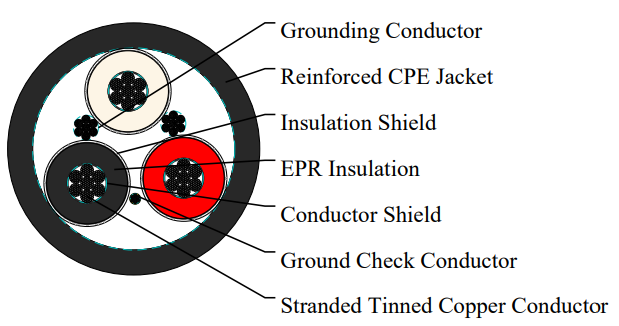
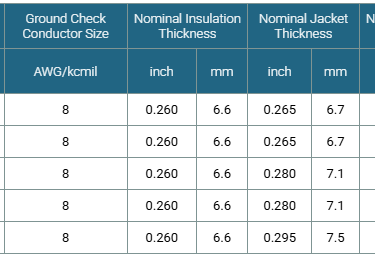
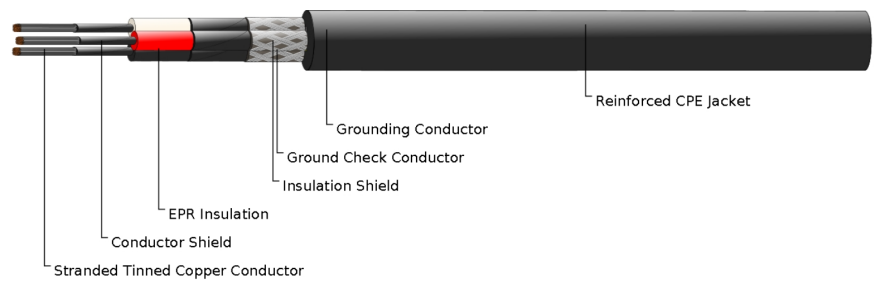
At the heart of the SHD-GC cable lies a conductor system engineered for both electrical efficiency and mechanical flexibility. The phase conductors utilize stranded annealed tinned copper construction, where multiple fine copper wires are stranded together in concentric layers. This stranding pattern, typically rope-lay or compressed round, provides the flexibility necessary for retractable cable applications while maintaining excellent current-carrying capacity.
The tinning process—applying a thin layer of tin to each copper strand—serves multiple critical functions. First, it prevents oxidation of the copper, which would increase resistance and generate heat. Second, it facilitates superior termination quality by preventing copper oxide formation at connection points. Third, it provides additional corrosion resistance when the cable is exposed to moisture or chemical contaminants.
Insulation and Shielding System
Each conductor is surrounded by a conducting layer that serves as the conductor shield. This semiconducting material ensures uniform electric field distribution around the conductor, eliminating potential stress concentration points that could initiate insulation breakdown. The shield maintains intimate contact with both the conductor and the insulation layer, a critical factor in high-voltage cable performance.
The insulation itself consists of Ethylene Propylene Rubber (EPR), selected specifically for its exceptional electrical properties and temperature performance. EPR insulated 25kV mining equipment cable offers superior resistance to electrical treeing—a degradation mechanism where microscopic channels form in the insulation under electrical stress. EPR also maintains flexibility across a wide temperature range, from extreme cold in surface mining operations to the elevated temperatures generated by high current loads.
Over the insulation, an insulation shield consisting of conducting tape and a tinned copper or textile braid provides several functions: it confines the electric field within the insulation, provides a path for charging currents, and facilitates detection of insulation deterioration through partial discharge testing.
Ground Check and Grounding Conductors
The heavy-duty mining power cable with ground check includes two distinct grounding elements. The primary grounding conductor, constructed from tinned copper strands, provides the fault current return path and equipment grounding required by electrical codes. Its size is calculated to safely carry fault currents without overheating during the time required for protective devices to operate.
The ground check conductor represents an additional safety innovation. This smaller tinned copper conductor, insulated with distinctive yellow polypropylene, runs parallel to the main grounding conductor. It enables continuous monitoring of grounding system integrity through specialized ground check monitors. If the grounding connection is compromised—perhaps due to a damaged termination or broken ground wire—the monitoring system detects the condition and can automatically de-energize the circuit before a dangerous fault occurs.
This dual-grounding arrangement provides defense-in-depth safety, particularly valuable in underground mines where atmospheric conditions may create explosive gas mixtures. The ground check system ensures that grounding remains intact before any potential fault could generate sparks.
Jacket Construction
The outermost layer—the reinforced extra-heavy-duty Chlorinated Polyethylene (CPE) jacket in black—serves as the cable's armor against mechanical abuse and environmental attack. CPE was selected for this application due to its outstanding abrasion resistance, exceptional resistance to oils and chemicals, flame retardant properties, and good flexibility even at low temperatures.
The "reinforced" designation indicates that the CPE jacket incorporates strengthening fibers or fabrics within its thickness, dramatically improving tear resistance and puncture strength. This reinforcement prevents small cuts or gouges from propagating through the entire jacket thickness, maintaining environmental protection even after surface damage.
The black coloration isn't merely aesthetic—carbon black pigmentation provides UV resistance for cables used in surface applications and aids in heat dissipation. The extra-heavy-duty wall thickness ensures adequate mechanical protection while maintaining the flexibility necessary for retractable cable service on mobile equipment.
Customization Options: Tailoring the Cable to Specific Applications
Recognizing that mining operations vary dramatically in their environmental conditions and mechanical requirements, the SHD-GC three-conductor 25kV cable options for mobile equipment include several customization possibilities.
Alternative Jacket Materials
While CPE represents the standard jacket material offering excellent all-around performance, specific applications may benefit from alternative compounds:
CSP (Chlorosulfonated Polyethylene): Offers enhanced resistance to ozone and weathering, beneficial for cables with significant outdoor exposure in tropical or high-altitude environments where UV radiation is intense.
PCP (Polychloroprene): Provides superior oil resistance and excellent flame resistance, valuable in applications where hydraulic fluid exposure is frequent or fire safety requirements are particularly stringent.
NBR (Nitrile Butadiene Rubber): Delivers exceptional resistance to petroleum-based products and maintains flexibility at very low temperatures, ideal for Arctic mining operations or applications with extreme oil exposure.
PVC (Polyvinyl Chloride): Although less common for 25kV applications, PVC jackets may be specified where flame resistance is the paramount concern and flexibility requirements are less demanding.
Two-Layer Jacket Construction
For the most severe applications, a two-layer jacket system can be specified. This construction incorporates a reinforcing fiber layer between inner and outer jacket compounds, creating a composite structure with exceptional tear resistance and mechanical protection. The fiber reinforcement—typically aramid, polyester, or fiberglass—prevents rip propagation and provides additional crush resistance without significantly increasing cable stiffness.
This customization is particularly valuable for SHD-GC CPE jacket 25kV cable for heavy-duty mining and excavation applications where cables are dragged across sharp rocks, run over by equipment, or subjected to pinch points between moving machinery components.
Mechanical and Thermal Properties: Performance Parameters
Understanding the mechanical and thermal limitations of the 25kV portable power cable for drills and dredges ensures proper installation and prevents premature cable failure.
Minimum Bending Radius
The specified minimum bending radius of 8 times the overall cable diameter (8×OD) represents the tightest curve the cable can safely negotiate without risking conductor damage or insulation cracking. For example, if the cable has an overall diameter of 50mm, the minimum bending radius would be 400mm (approximately 16 inches).
This parameter is critical when designing cable storage reels, routing cables around equipment frames, and determining clearances needed for cable movement. Exceeding this limitation by bending the cable too sharply can cause conductor strand breakage, insulation compression that creates stress concentration points, and jacket cracking that compromises environmental protection.
In practice, installation should target bending radii significantly larger than the minimum specification whenever possible, as this extends cable service life and reduces mechanical stress during repeated flexing cycles.
Maximum Conductor Operating Temperature
The +90°C maximum conductor operating temperature represents the continuous temperature rating of the EPR insulation system. This rating assumes the cable is carrying its full rated current in typical ambient conditions. At this temperature, the insulation maintains its electrical properties and mechanical strength throughout the cable's design life.
This thermal rating provides considerable margin above typical ambient temperatures in most mining operations, allowing the cable to carry high currents without thermal degradation. However, several factors can reduce effective current-carrying capacity: high ambient temperatures in deep mines, poor ventilation around cable reels, cables bundled together or coiled tightly on reels (which reduces heat dissipation), and dirty cable surfaces that insulate heat.
Thermal management is particularly important because insulation aging accelerates exponentially with temperature. Operating consistently above rated temperature—even by 10-15°C—can halve the expected service life of the cable.
Applications and Use Cases: Where SHD-GC Cable Excels
Longwall Mining Systems
Longwall shearers represent one of the most demanding applications for portable power cables. These massive machines traverse back and forth across coal faces hundreds of meters long, with the power cable constantly retracting and extending from a cable reel mounted on the shearer. The cable must flex thousands of times per day while transmitting hundreds of kilowatts at 25kV, all in an environment filled with coal dust, water spray, and occasional rock impacts.
The SHD-GC 25kV portable power cable with reinforced CPE jacket excels in this application due to its flexible construction, abrasion-resistant jacket, and robust grounding system. The ground check conductor provides critical safety monitoring, automatically de-energizing the system if grounding integrity is compromised—essential in the potentially explosive atmosphere of underground coal mines.
Continuous Miners
Continuous mining machines cut coal or soft rock from the mine face and load it onto conveyors in a single operation. Like shearers, these machines are highly mobile within their working area, requiring retractable power cables that can withstand constant movement, abrasion from coal and rock particles, and occasional crushing between the machine and mine walls.
The heavy-duty construction of the SHD-GC cable, with its reinforced jacket and flexible conductor design, delivers the durability these applications demand. The EPR insulation maintains performance in the wet conditions common in continuous mining operations, while the CPE jacket resists the coal tars and oils that contaminate underground mining environments.
Mobile Shovels and Excavators
Large electric shovels and excavators used in surface mining operations present different challenges. While these machines move more slowly than underground equipment, they generate enormous mechanical forces, and their power cables must often stretch across rough, rocky ground surfaces. Cables may be dragged over sharp rocks, temporarily buried under falling material, or crushed beneath the machine's own tracks.
The SHD-GC three-conductor round portable power cable addresses these challenges through its extra-heavy-duty jacket construction and reinforcement layers. The cable's flexibility allows it to conform to irregular terrain without kinking, while the robust jacket prevents penetration by sharp objects and resists tearing when snagged on obstacles.
Dredging Operations
Dredges operating in marine or freshwater environments subject power cables to continuous immersion, abrasive sand or gravel slurries, and corrosive saltwater. The tinned copper conductors resist corrosion, while the CPE jacket provides excellent water resistance and won't degrade from continuous immersion as some materials would.
The ground check system proves particularly valuable in dredging applications, where deteriorating grounding connections might otherwise go undetected until a fault occurs. Given that dredging equipment operates in or around water, maintaining grounding integrity is essential for personnel safety.
Heavy-Duty Drilling Rigs
Rotary drilling rigs for mineral exploration, blast hole drilling, or oil and gas applications require mobile power distribution systems that keep pace with the drilling operation. As the drill advances, the rig may relocate frequently, requiring the power cable to be moved, reeled up, and deployed repeatedly.
The 25kV portable power cable for drills must maintain electrical performance through these handling cycles while resisting the oils, drilling muds, and harsh chemicals common around drilling sites. The robust construction and chemical-resistant jacket of the SHD-GC cable make it well-suited to these demanding applications.
Common Cable Issues and Solutions: Troubleshooting Guide
Problem: Premature Jacket Wear or Abrasion
Symptoms: Visible jacket damage, exposed reinforcement or inner layers, rough or torn outer surface.
Causes: Excessive dragging over abrasive surfaces, inadequate cable support, sharp edges on equipment or terrain, operation beyond designed service parameters.
Solutions: Evaluate cable routing to minimize ground contact and sharp bends. Install protective cable guides or ramps at points where the cable crosses edges or obstacles. Consider upgrading to a two-layer jacket or alternative jacket material with superior abrasion resistance. Implement regular inspection schedules to identify developing wear before jacket integrity is compromised. Ensure cable reels have adequate capacity and proper fleet angle to prevent cable rubbing against reel flanges.
Problem: Insulation Failure or Electrical Breakdown
Symptoms: Ground fault alarms, circuit breaker trips, visible tracking or carbonization on cable surface, failed high-potential testing.
Causes: Moisture ingress through damaged jacket, exceeding voltage rating, thermal degradation from overcurrent or poor heat dissipation, mechanical damage to insulation, installation damage during termination.
Solutions: Perform regular visual inspections and document any jacket damage—repair minor damage immediately with approved jacketing repair kits to prevent moisture ingress. Verify that the cable voltage rating matches the system voltage and that terminations are properly installed with appropriate stress control. Monitor conductor temperatures to ensure they remain within rated limits—consider thermal imaging surveys during peak load periods. Review load currents to ensure they don't exceed cable ampacity, accounting for ambient temperature, ventilation, and installation conditions. Replace cables showing evidence of electrical treeing or tracking rather than attempting repair.
Problem: Excessive Cable Stiffness or Difficulty Reeling
Symptoms: Cable won't flex smoothly, permanent set or memory in cable shape, difficulty reeling or unreeling, increased force required for cable movement.
Causes: Operation below minimum temperature rating, incorrect cable size for application, damage to internal components, improper storage allowing cable to take a set.
Solutions: Verify that ambient temperatures remain within the cable's operating range—EPR typically performs well to -40°C, but jacket materials may stiffen at extreme cold. If operating in Arctic conditions, consider alternative jacket compounds. Ensure the cable diameter and construction are appropriate for the reel diameter and application—cables designed for fixed installation aren't suitable for retractable service. Store cable properly when not in use, preferably on reels rather than coiled on the ground where it can take a permanent set. If cable has been stored for extended periods, unreel completely and allow it to relax before putting into service.
Problem: Ground Check System Alarms
Symptoms: Ground check monitor indicates fault condition, unexpected circuit de-energization, intermittent alarms during equipment operation.
Causes: Damaged ground check conductor, poor termination connection, water in connector, damaged ground check monitor, actual loss of equipment grounding.
Solutions: Before assuming a nuisance alarm, always verify actual equipment grounding integrity—this system is designed to protect lives. Inspect terminations at both ends for proper connections, corrosion, or moisture. Test ground check conductor continuity with an ohmmeter. Examine the cable along its length for visible damage that might have severed the ground check conductor. If the cable and connections test properly, evaluate the ground check monitor itself for proper operation. Intermittent alarms that occur during specific machine movements may indicate a conductor strand breaking inside the cable—this requires cable replacement.
Problem: Connector or Termination Failures
Symptoms: Overheating at connections, arcing or flashover at connectors, difficulty mating or separating connectors, moisture inside connectors.
Causes: Incorrect connector rating or type, improper installation, inadequate stress control, environmental contamination, mechanical damage to connector.
Solutions: Verify that connectors are rated for 25kV service and are approved for mining applications. Ensure terminations include proper stress control—the high electric field concentration at the termination point requires stress cones or cold-shrink terminations specifically designed for the cable voltage. Follow manufacturer installation instructions precisely, particularly regarding insulation removal dimensions and stress control positioning. Inspect sealing systems and replace O-rings or gaskets showing wear. Consider upgrading to higher-quality connectors with better environmental sealing if moisture intrusion is recurring. Train personnel on proper connector handling—forcing misaligned connectors can damage critical sealing and stress control features.
Conclusion: Investing in Reliability
The SHD-GC three-conductor round portable power cable with CPE jacket 25kV represents a significant investment in operational reliability, safety, and productivity for demanding mining and heavy industrial applications. Its specialized construction—from tinned copper conductors through EPR insulation to reinforced CPE jacketing—addresses the unique challenges of mobile equipment power distribution in harsh environments.
For operations managers weighing cable options, the key consideration extends beyond initial cost to total cost of ownership. A premium cable that delivers years of reliable service with minimal downtime represents far better value than a marginally cheaper alternative that fails prematurely, causing production losses that dwarf the cable cost itself. The integrated ground check system alone can prevent accidents that would otherwise result in catastrophic consequences.
Call to Action
For detailed specifications, custom cable configurations, or technical support in selecting the optimal SHD-GC 25kV power cable for your specific application, contact qualified cable suppliers with expertise in mining and heavy industrial power distribution. Provide information about your equipment type, operating environment, voltage requirements, current loads, and any special challenges your application presents. This enables engineering teams to recommend the ideal conductor size, jacket material, and construction options to maximize performance and service life in your unique operating conditions.
Don't compromise on the power distribution system that keeps your operation running—specify cables engineered specifically for the demanding world of mobile mining equipment.
How to Reach Us
Get in Touch
SiteMap
Product Catalogue
Festoon Cable
Shore Power Cable


Scan to add us on WeChat