
The Real Cause of Premature Cable Jacket Cracking in Port Cranes: Mechanical, Environmental and Design Failures Explained
Meta description: Why do port crane cable jackets crack early? This guide explains the real causes — mechanical stress, UV and salt-fog exposure, and thermal cycling — with real failure cases, the bend-radius, fleet-angle and tension rules that prevent it, and how to choose a marine-grade cable that lasts.
hongjing.Wang@Feichun
6/5/202613 min read
Why a cracked jacket is a problem worth taking seriously
Walk the quay at any container terminal and look closely at the reeling and festoon cables feeding the cranes, and sooner or later you will find one that has started to go. The surface has lost its gloss. There is a fine network of cracks across it that looks unmistakably like the skin of a crocodile. Somewhere along its length it may have started to twist into a lazy spiral. A flat, scuffed patch shows where it has been rubbing against a reel edge. None of this looks dramatic. All of it is the early warning of a failure that, left alone, will eventually stop the crane.
That is the uncomfortable truth about cable jacket cracking. It is rarely sudden and rarely glamorous, but it is one of the most common and most expensive failure modes in port crane systems, on RTGs, on ship-to-shore cranes, and across reeling and festoon installations alike. And the cost is not the cable. Industry forensic guidance puts the replacement of a single STS crane reeling cable somewhere in the order of USD 25,000 to 80,000 depending on length, voltage class and configuration, and then adds eight to twenty-four hours of crane downtime at terminal opportunity costs that can run past USD 5,000 an hour. The drum of cable is the small number. The stopped crane is the big one.
This guide explains what actually causes premature jacket cracking, grounded in real field-failure patterns, supplier forensic case studies and the maintenance guidance that terminal engineers actually use. It is deliberately practical, written for the people who specify, install, inspect and replace these cables in Australian conditions, where coastal salt and harsh sun stack the odds against any jacket that was not chosen for the job. It walks through the failure types you will see with your own eyes, the mechanical, environmental and thermal mechanisms underneath them, the engineering parameters that prevent them, and the early warning signs that let you act before a crane goes down. And it is honest, at the end, about the commercial reality: the cable engineering that resists all of this is well-understood, everything the famous brands deliver is reproducible, and a capable manufacturer can match it at a better price and a shorter lead time. We say that plainly, then we tell you how to verify it, because you should never take a performance claim on trust.
Part one: the failure types you can actually see
Before the causes, the symptoms, because diagnosis starts with the eye. There are four patterns that show up again and again on port crane cables, and learning to read them is the first skill worth having.
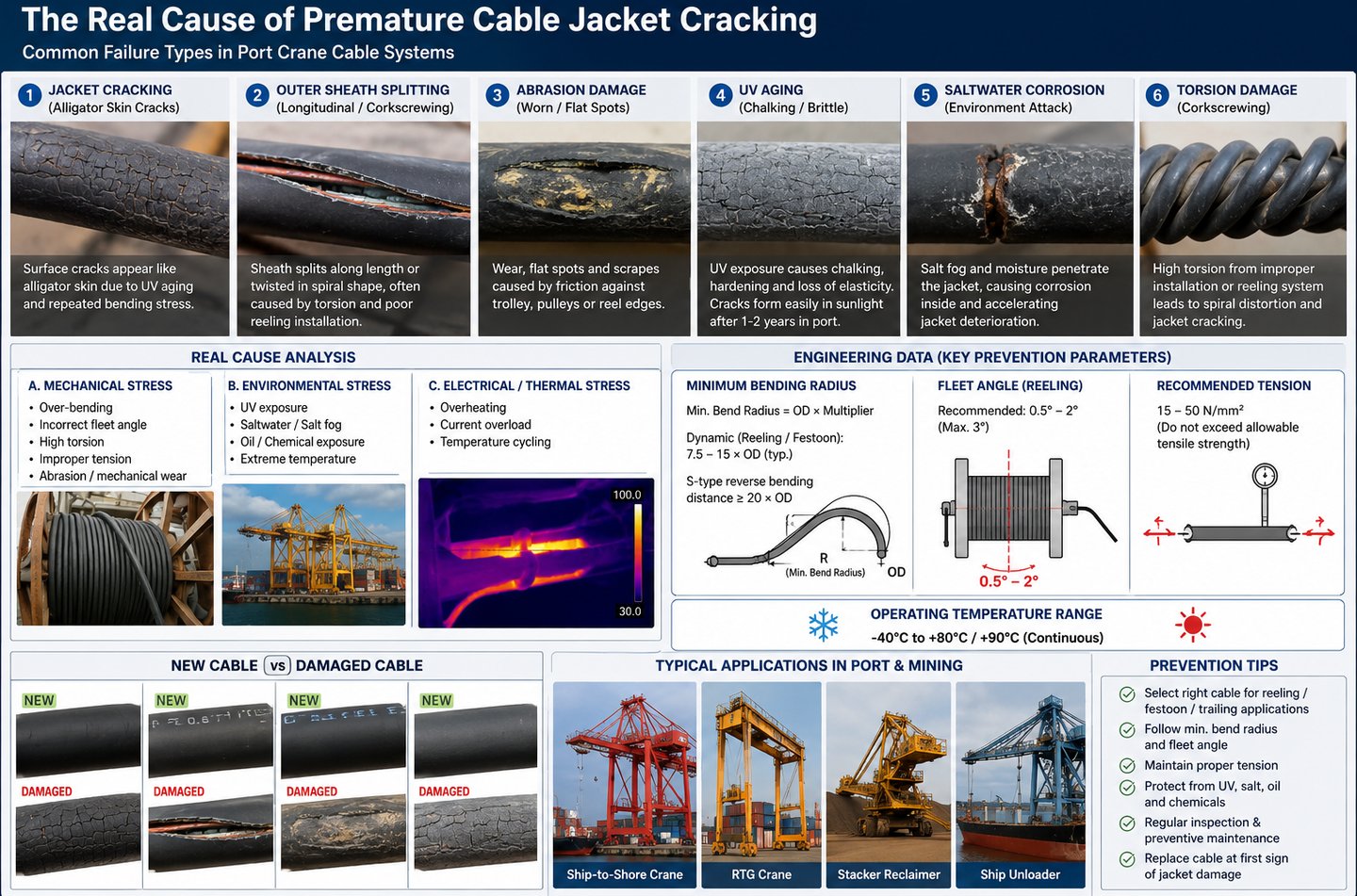
The first and most recognisable is jacket cracking itself, the so-called alligator or crocodile skin effect. It presents as a network of fine surface cracks, an interlaced pattern that genuinely does resemble reptile hide. It is the classic signature of ultraviolet ageing combined with mechanical fatigue, the polymer hardening and losing its elasticity until the surface can no longer flex without splitting. In outdoor port environments it commonly appears after just one to two years of exposure, and once the cracks form they open a path for moisture into the cable, putting the insulation underneath at risk.
The second is outer sheath splitting, a linear tear running either along the length of the cable or around it at a bend point. This one is frequently associated with corkscrewing, the helical twisting that develops in a reeling cable when torsional stress is not properly managed. Sheath splitting is a louder symptom than alligator cracking; it indicates severe mechanical fatigue or an installation error, and it usually means the cable is already on borrowed time.
The third is abrasion damage, the surface thinning, scraping and flat spots that come from friction. You see it where the cable rubs against trays, pulleys and reel edges, and in festoon systems where the cable contacts its trolleys. Suppliers describe the same mechanism repeatedly: a misaligned trolley or a clamp that is too loose or too tight causes the cable to slide and wear, or to be crushed and split. Pushed far enough, abrasion thins the jacket until the inner reinforcement or even the conductors are exposed.
The fourth is UV ageing and broader environmental degradation, which shows as discolouration, a chalky powdered surface and a general loss of elasticity. It is accelerated dramatically in tropical and coastal port environments, and it very often travels together with salt-spray exposure, the two attacking the polymer from different angles at once. One industry source notes the blunt reality that an ordinary sheath under direct sunlight can become brittle and crack within one to two years, while a properly UV-stabilised sheath can hold stable performance for decades. That gap, one to two years versus decades, is almost entirely a question of jacket material choice.
Part two: real-world failure evidence
The user who commissioned this guide gathered failure cases from forums and supplier sources, and it is worth being candid about what that search turns up, because the honesty is part of the value.
If you go looking on heavy-equipment forums for detailed, photographed RTG or STS cable failures, you will be slightly disappointed. The forum communities, the heavy-equipment subreddits and the trade boards, are dominated by mobile cranes, construction and mining machinery and wire-rope discussions. The most directly comparable failures people post about tend to be hydraulic hoses and general outdoor equipment cabling, where users describe pilot hoses whose jackets crack and peel off, hardening under sun and oil exposure until they fail. That sounds like a digression, but it is not: the mechanism is the same one that attacks crane cable jackets, UV plus oil plus repeated bending, and it is highly transferable. The forum evidence confirms the physics even when it does not show a labelled photo of a Fremantle reeling cable.
Where the real, detailed evidence lives is in the supplier forensic literature and the maintenance guidance, and that is where the consistent failure picture emerges. Cable forensic analysis describes reeling cables developing a permanent helical corkscrew along their length when the anti-torsion structure fails to redistribute the torsional load applied during drum reeling; each winding pass introduces a small twist, and in a properly engineered cable an anti-torsion braid absorbs it, but when that braid is undersized, displaced or hydrolysed, the stress accumulates as plastic deformation. The corkscrew is not merely cosmetic; it concentrates mechanical stress at the points of greatest deformation, accelerating fatigue at the conductor-strand level and cracking the sheath from the inside out. One supplier note is stark about the safety consequence: a visibly corkscrew-deformed cable must be taken out of service immediately regardless of its electrical test results, because the distorted geometry can bring conductors into proximity with the sheath or earth and create an arc-flash hazard.
Maintenance guidance from major port crane builders reinforces the same triad. It calls out UV cracking explicitly as alligator skin, chemical damage from oils and fertiliser residue that softens or embrittles the jacket, and mechanical wear from misalignment. Igus, a major dynamic-cable maker, frames the whole problem with refreshing clarity in its own guidance: jacket cracking is caused by one of two things, an improper bend radius or an out-of-range operating temperature, and jacket swelling comes from chemical or oil exposure the jacket was not formulated to resist. They are confident enough in that analysis to guarantee their dynamic cables for thirty-six months or ten million bend cycles. The point for a port operator is not the brand; it is that the failure mechanisms are completely understood and therefore completely preventable.
Part three: the root causes, in order of how much damage they do
Put the field evidence together and the causes sort into three families. The order matters, because in port crane systems mechanical stress is the dominant cause, environmental stress is the accelerant, and thermal and electrical stress finish the job.
Mechanical stress, the primary cause
The biggest single driver of jacket cracking in ports is mechanical, and it usually traces back to one of three installation or design faults.
Over-bending is first. Every cable has a minimum bending radius below which the stress through the wall of the jacket becomes uneven, the outer fibres stretching while the inner ones compress. Bend it tighter than its rating, repeatedly, and the jacket fatigues and cracks, the material effectively work-hardening until it loses the flexibility it was built with. This is, by igus's own account, one of only two causes of jacket cracking, and it is entirely within the installer's control.
Incorrect fleet angle is second, and it is specific to reeling systems. The fleet angle is the angle at which the cable approaches the drum, and the accepted window is narrow: ideally 0.5 to 2 degrees, with about 3 degrees as the practical maximum. Exceed it and the cable suffers sidewall friction, winds onto the drum unevenly, develops localised wear zones and can bird-cage, the strands splaying apart. Too small an angle causes the cable to pile up and take impact damage. Getting the fleet angle right is one of the cheapest and most effective things a terminal can do to extend cable life.
High torsion is third, and it produces the corkscrew. Poor installation alignment or accumulated twist in a reeling system loads the cable in torsion, and without a dedicated anti-torsion structure that load winds itself into the cable as a permanent spiral. The relevant standard, VDE 0250-813, actually quantifies the limit: a properly engineered reeling cable should tolerate a torsional rotation of around plus or minus 25 degrees per metre without permanent jacket deformation. Beyond that, the spiral forms, and as the forensic literature notes, torsion amplifies bending fatigue rather than simply adding to it.
Environmental stress, the coastal accelerant
In an Australian coastal port, the environment does not start the failure so much as speed it up, often by a factor of two or three.
UV exposure breaks the polymer chains in the sheath, driving the brittleness and surface cracking that becomes alligator skin. A black jacket with UV stabiliser slows it, but under relentless direct sun it still degrades. Saltwater and salt fog are the coastal signature: chloride penetrates the jacket, promotes hydrolysis and corrosion, accelerates crack propagation, and once a crack or a pinhole exists, salt and moisture wick inward to attack the conductors out of sight. Suppliers are explicit that once a jacket shows flaking or pitting the cable must be replaced, precisely because that wicking and internal corrosion is hidden and progressive. Oil and chemical exposure rounds out the trio: hydraulic oil, fuel and industrial chemicals cause certain jacket materials to swell, soften or embrittle, and a swollen, softened jacket then cracks far more readily under the mechanical loads it was coping with before.
Electrical and thermal stress, the finisher
The last family is thermal and electrical. Overheating, from current overload or poor ventilation, softens the jacket material during operation, and then as the cable cools it shrinks and cracks. Thermal cycling does the same thing more slowly: the daily swing between a baking afternoon and a cool night expands and contracts the jacket through endless cycles, driving micro-crack formation through simple fatigue. Current overload feeds this directly, the conductor heat conducting outward until the jacket is pushed past its rated temperature and ages prematurely.
The reason it is worth separating these three families is that they almost never act alone. In a real port failure, a slightly-too-tight bend radius is fatiguing the jacket, the salt and sun are embrittling it, and the daily thermal cycle is opening and closing the micro-cracks, all at once. The jacket fails because of the combination, which is exactly why the prevention has to address all three.
Part four: the engineering parameters that prevent cracking
The good news is that the parameters that prevent jacket cracking are well-defined. Get these right and you design most of the problem out.
The first is minimum bending radius, and it is the single most violated rule in the field. The formula is simple: the minimum bend radius equals the cable's outer diameter multiplied by a factor. For festoon systems that factor typically runs from about 7.5 to 12 times the outer diameter; for reeling systems it is higher, commonly 10 to 15 times; and for an S-bend or reverse-bending situation it should be at least 20 times. To make that concrete, a cable with a 50-millimetre outer diameter may need a dynamic minimum bend radius somewhere between 375 and 750 millimetres depending on the application. The relevant reeling standard also caps the bend radius at around 10 times the outer diameter and requires the cable to survive a million complete bend cycles without insulation failure. Always work from the specific cable's data sheet, and never let a system design push the cable below its rated radius, because that single error is one of the most common roots of early failure.
The second is tension control. The cable should run within its safe mechanical load range, which is system-specific but generally well below the cable's permitted tensile strength. Too much tension causes abrasion and stretching; too little leaves the cable slack so it takes impact damage and piles up. The ideal in a reeling application is a constant-tension control system that holds the cable in its sweet spot throughout the travel, avoiding the hotspots where localised stress concentrates.
The third is operating temperature range and the material choice that delivers it. Typical port crane cables are rated roughly minus 40 to plus 80 or 90 degrees. Run them too cold and the jacket goes brittle and cracks; run them too hot and the polymer degrades and ages fast. The material does the work here: polyurethane for high abrasion resistance, neoprene for the combination of flexibility and weather resistance, and EPR for thermal stability. Choosing the right compound for the actual environment, marine, dusty, hot, cold, is what keeps the jacket inside its happy range across the whole duty cycle.
Part five: catching it early
Because jacket cracking is progressive, regular inspection genuinely pays for itself, and the warning signs are visible to anyone who knows what to look for.
Watch for small surface cracks, the earliest stage of jacket cracking before it becomes a full alligator network. Watch for loss of sheath gloss, which is the first visible indicator of UV ageing. Look for flat spots on the cable body, the fingerprint of abrasion against a reel or pulley. Feel for unusual stiffness during movement, a sign the jacket is losing its flexibility. Look for any visible twisting or spiralling, the start of corkscrewing. And inspect the contact points near reels and pulleys closely, because that is where abrasion concentrates. Catching any of these early, and acting on them, is the difference between a planned cable change during a maintenance window and an unplanned crane outage at the worst possible moment.
Part six: the preventive engineering checklist
Pulling the prevention together, the measures that actually extend jacket life are straightforward and mutually reinforcing. Use cables that are genuinely designed for reeling or festoon duty rather than general-purpose cables pressed into a job they were never built for. Set and maintain the correct fleet angle and reel alignment. Run a proper tension-control system so the cable lives within its load range. Specify UV-resistant and salt-resistant sheath materials chosen for the actual coastal environment, not a generic compound. Inspect on a regular cycle and clean the cables to stop salt and oil accumulating and wicking inward. And never, under any operating condition, exceed the cable's bending-radius limits. None of this is exotic. All of it is the difference between a cable that lasts its design life and one that cracks within two years.
Part seven: the manufacturer's role, stated plainly
There is a layer of prevention that sits upstream of installation and maintenance, and that is the cable itself. A jacket only resists alligator cracking, salt-fog hydrolysis, abrasion and thermal fatigue if it was engineered and tested to do so. This is where the choice of supplier matters, and where we will be direct about the commercial reality.
The engineering that makes a premium crane cable resist jacket cracking is well-understood and documented. Fine-stranded class 5 or class 6 copper to international standard so the cable flexes without fatiguing. EPR or HEPR insulation to reduce micro-cracking under continuous flexing. A vulcanised anti-torsion braid, or an aramid reinforcement system, to absorb the torsional load that would otherwise corkscrew the cable. And the right outer sheath, a 5GM5-grade polychloroprene neoprene for maximum ozone, UV and saltwater resistance, or a polyurethane for extreme abrasion environments, all built and proven to recognised VDE, IEC and equivalent standards, including the million-cycle bend-fatigue and the plus-or-minus-25-degrees-per-metre torsion requirements. The materials are commodities. The standards are public. None of it is secret physics locked inside a brand.
So we will state the claim directly: everything the global brands deliver against jacket cracking, a capable alternative manufacturer can deliver too. The same anti-torsion structure, the same marine-grade salt-and-UV-resistant sheath, the same abrasion resistance, the same thermal range, the same fatigue life, engineered to the same standards and proven with the same tests. On top of matching the performance, a direct-factory model adds a more competitive cost structure and a shorter production and delivery cycle, which together mean a lower total lifecycle cost, reduced downtime risk and a faster replacement turnaround when a jacket finally does need changing. When a cracked reeling cable has to come off an STS crane, the number that decides the size of your loss is the crane downtime, not the price of the drum, so a supplier who can ship the right, correctly specified, properly jacketed cable quickly is worth more than a famous name on a longer lead.
We would never ask you to take that on faith. Verify it the same way you would verify any cracking-resistance claim. Ask for the sheath material datasheet and confirm it is a marine-grade UV-and-salt-resistant compound rather than a generic jacket. Ask for the bend-fatigue and torsion test data to the relevant standard. Ask for the ozone, UV and oil-resistance certificates to the recognised EN and IEC methods. Ask for a track record in comparable coastal port and mining applications. Then compare any candidate, brand or alternative, head to head on those criteria plus delivered price and lead time. A capable supplier is confident in where that comparison lands, which is exactly why it should welcome the scrutiny.
The bottom line
Premature cable jacket cracking is never one thing. It is the combination of mechanical stress, which is the dominant cause in ports, environmental exposure to UV, salt and chemicals, which accelerates it, and thermal cycling and overload, which finish it off, all stacked on top of whatever installation and design errors crept in at the start. In a real port crane application, the jacket almost always fails from the combined effect of the system design and the operating environment working together, which the forum chatter, the supplier forensics and the maintenance manuals all independently confirm.
The way to beat it is equally clear: select cables that are properly engineered for the duty and the environment, with the right anti-torsion structure and the right marine-grade sheath; install them within the correct bending-radius, fleet-angle and tension parameters; and inspect them on a cycle so you catch the early signs before they become an outage. Do that, and you turn a one-to-two-year failure into a cable that lasts its full design life.
And when you choose the cable, remember that the cracking resistance you are paying for is reproducible engineering, not brand magic. Everything the premium names can do against jacket cracking, a capable alternative can do, to the same standards, proven with the same tests, and typically at a better price with a shorter lead time. Get the datasheets, get the test data, get the price and the delivery commitment, and compare them properly. That is the conversation worth having before your next reeling or festoon cable goes on order.
How to Reach Us
Get in Touch
SiteMap
Product Catalogue
Festoon Cable
Shore Power Cable




Scan to add us on WeChat