
TKD Crane Cable Replacement Options: How to Choose an Equivalent Alternative for Reeling, Festoon and Crane Applications
Spot flat cable delamination early. A diagnostic guide to layer separation, jacket cracking and edge splitting in crane and festoon cables—causes, inspection and prevention.
hongjing.Wang@Feichun
6/11/202610 min read
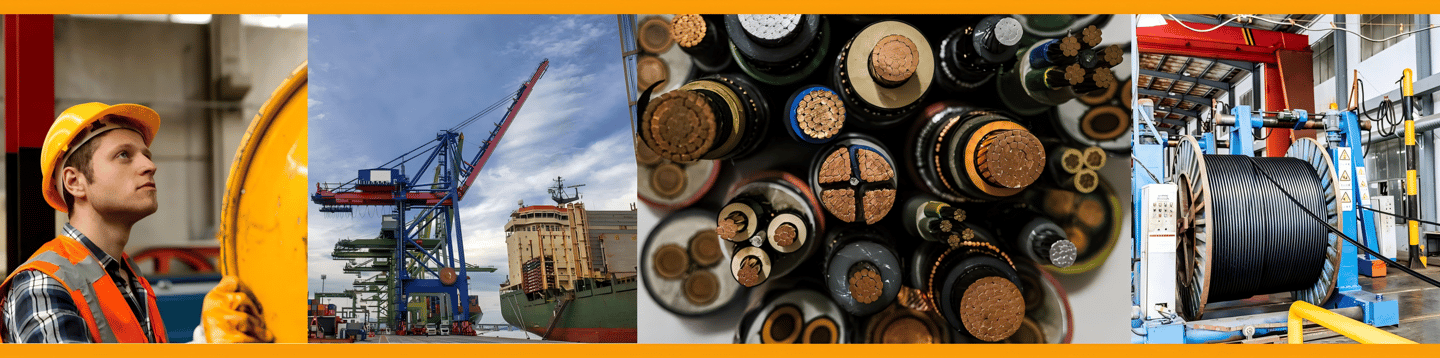
If you've gone looking for a TKD crane cable replacement, you're almost certainly not browsing out of curiosity. TKD cables are well established in ports, mining operations, material handling systems and industrial cranes across Australia, and the reason buyers start hunting for alternatives usually comes down to something concrete: a lead time that's blown out, a budget that won't stretch, or a cable that's failed and a machine that's sitting idle right now.
Here's the catch that trips a lot of teams up, though. Replacing a crane cable isn't a matter of finding something that looks similar and ordering a drum. A crane cable lives a hard, dynamic life, and a successful replacement has to match the application, the mechanical performance and the operating conditions—not just the voltage on the label.
This guide walks through how to do that properly. We'll cover the common TKD product families, why companies look elsewhere, the critical parameters you have to match before you swap anything, replacement strategies for each application, a real-world scenario, and the questions worth asking any supplier before you commit.
Understanding TKD crane cable product families
TKD's crane cable range is generally organised around the kind of dynamic duty the cable does. Three families cover most of what you'll encounter.
TKD REELTEC – designed for reeling systems
REELTEC cables are built for reeling duty—motorised cable reels, long-travel systems and applications carrying high tensile loads as the cable continuously winds on and off a drum.
That duty brings a specific set of operating challenges. The cable faces repeated flexing through every wind-and-unwind cycle, dynamic tension that fluctuates constantly as the reel pays in and out, and high travel speeds on faster drum systems. Any replacement for a REELTEC cable has to be engineered for exactly that combination, because reeling is one of the most demanding things you can ask a cable to do.
TKD FESTOONTEC – designed for festoon systems
FESTOONTEC cables are made for festoon systems—the gather-and-spread cable arrangements used on overhead cranes and material handling equipment, where the cable hangs in loops and moves continuously along a track.
The priorities here shift towards bending endurance, mechanical durability and flex-life requirements. A festoon cable folds and unfolds in a controlled plane over and over, so its ability to survive that repeated bending without fatigue is what determines its service life. Match a festoon cable on flex life and durability and you're on the right track.
TKD CRANEFLEX – designed for general crane applications
CRANEFLEX cables cover the broader crane requirements—crane power supply, control circuits and general dynamic-movement applications.
The focus for this family is flexibility, durability and long service life across the everyday motion a crane puts a cable through. It's the workhorse category, and replacements need to hold up to continuous movement without going stiff, cracking or failing early.
Why companies look for alternatives to TKD crane cables
There's rarely a single reason. Usually it's a combination of pressures that pushes a procurement team to evaluate alternatives.
Long lead times
This is the big one. International supply chains can mean long waits, and when a project schedule is already tight, a multi-week or multi-month lead time on a cable becomes a serious problem. In an emergency replacement situation—a failed cable on a live crane—that wait is even harder to swallow.
The brutal arithmetic here is simple: downtime is often far more expensive than the cable itself. A stopped crane in a working port or mine burns money by the hour, which means a faster-available alternative can be worth far more than the saving on the cable's sticker price.
Budget constraints
Project costs keep rising, and crane cable is a meaningful line item. In a competitive tendering environment, every component is under cost-optimisation pressure, and buyers are increasingly willing to consider technically comparable alternatives that ease the budget without giving up performance.
Limited local inventory
Availability is a real issue, particularly in Australia. Specialised crane cable isn't always sitting on a shelf nearby, and many projects are in remote locations—mine sites and regional ports a long way from any major supply hub. When a maintenance team needs cable and the nearest stock is interstate or overseas, alternatives that can be produced and shipped quickly become very attractive.
Greater procurement flexibility
Finally, there's flexibility. Many buyers want custom lengths matched to the actual installation, small batch quantities rather than fixed standard drums, and project-specific manufacturing. Standard stocked programs don't always offer that, and the waste and planning hassle of rounding up to a fixed length adds up across a project.
Why direct brand substitution can be risky
Before we get into matching, a word of caution—because the most common replacement mistake is treating crane cable like a commodity.
Not all crane cables are designed for the same duty cycle
Dynamic applications vary enormously. A cable that's perfect for a slow festoon run can be hopelessly out of its depth on a high-speed vertical spreader reel. Crucially, two cables with similar voltage ratings can perform very differently in service, because voltage rating says almost nothing about flex life, tensile capacity or torsion handling.
Pick a replacement on voltage alone and you can easily end up with a cable that's technically "rated" for the job but fails in a fraction of the cycles. The duty cycle is what matters.
Application matching is more important than brand matching
This is the principle to carry through the whole process: functional equivalence matters more than brand equivalence. Experienced engineers don't chase logos—they chase performance requirements. They ask "does this cable meet the mechanical, electrical and environmental demands of my specific application?" and the answer to that question is what determines whether a replacement succeeds, regardless of whose name is on the drum.
The critical parameters that must be matched before replacing a TKD cable
Here's the heart of it. Before you replace any TKD crane cable, work through these parameters and confirm the alternative meets each one.
Voltage rating. Match the operating voltage, with safety and compliance front of mind. The replacement's rated voltage must suit the system it's going into—this is the non-negotiable baseline.
Conductor size and current capacity. Match the conductor cross-section so the cable's ampacity and electrical performance carry the required load without overheating. Undersize this and you've got a thermal problem.
Core count and circuit configuration. Account for every core—power cores, control cores and any signal circuits. A replacement has to replicate the full circuit configuration, not just the power conductors, or you'll be short a control or signal path.
Tensile load capacity. This is critical for reeling systems, vertical-movement applications and long-travel cranes, where the cable carries real mechanical load. Insufficient tensile strength is a direct path to premature failure—the cable literally can't take the pulling forces and starts breaking down internally.
Minimum bending radius. One of the most overlooked replacement criteria, and one of the most important. If the replacement's minimum bending radius is larger than the system's geometry allows, you'll be over-bending it on every cycle, concentrating stress and slashing flex life. Match this carefully.
Reeling speed. For drum systems, the replacement has to be rated for the actual reeling speed. High-speed drums subject the cable to rapid acceleration and dynamic behaviour, and a cable not built for that speed fatigues fast. Matching reeling speed is essential, not optional.
Drum diameter and pulley diameter. The hardware the cable runs on directly affects mechanical stress and cable longevity. Confirm the replacement is compatible with the existing drum and pulley diameters—get this wrong and even a good cable wears out early.
Environmental resistance requirements. Match UV resistance, oil resistance, moisture resistance and ozone resistance to the operating environment. This is especially important for outdoor crane systems exposed to sun, hydraulics, salt and weather.
Shielding and data transmission requirements. Where the original handles control and automation, the replacement must too—including EMC considerations and any hybrid power-and-data construction. If the TKD cable carries fibre or screened data cores, the alternative needs the equivalent.
Replacement strategies for different TKD product families
With the parameters understood, here's how the strategy shifts by family.
Replacing TKD REELTEC cables
For reeling replacements, the focus is on high-flex reeling cables with proper tensile reinforcement built for drum reeling applications. Before committing, engineers should verify the tensile load rating, the minimum bending radius, the reeling speed rating and the drum diameter compatibility. Reeling is unforgiving, so these mechanical checks carry the most weight here.
Replacing TKD FESTOONTEC cables
For festoon replacements, centre the assessment on the festoon cable system as a whole—the travel distance, the suspension loads the cable carries, and the demands of continuous movement. A common mistake is matching only the electrical spec while ignoring the suspension and bending demands, which leaves the replacement under-built for the actual festoon duty. Confirm the flex-life and bending performance suit the travel distance and loop arrangement.
Replacing TKD CRANEFLEX cables
For general crane replacements, the emphasis is on crane-motion applications, mechanical durability and flex-life performance. These cables need to tolerate continuous everyday movement, so a replacement should be confirmed against the real duty cycle rather than assumed to be fine because the electrical spec lines up.
Application-based replacement recommendations
Different environments load these requirements differently. Here's what to prioritise by application.
Port crane applications
Port cranes—STS, RTG and RMG—are demanding on every front. Replacement cables here need to handle high-speed movement, UV exposure from constant outdoor operation, salt spray environments from the coastal setting, and continuous operation through long duty cycles. For an Australian port, the salt and sun resistance are just as important as the mechanical rating.
Stacker reclaimer applications
Stacker reclaimers run long travel distances under heavy mechanical loads, with significant abrasion exposure and continuous duty cycles. The replacement needs robust tensile capacity and a tough, abrasion-resistant sheath to survive the distance and the grind.
Mining equipment applications
Mining throws the harshest conditions at a cable—dust, mechanical impact and generally harsh operating conditions. Replacements for mining duty need to be built for genuine abuse, with durable construction that tolerates impact and contamination without breaking down.
Automated material handling systems
Automated systems involve frequent movement cycles, precision control requirements and often hybrid power and signal transmission. Here the replacement has to nail both the high-cycle flex life and the data integrity, since the automation depends on clean signal transmission alongside reliable power.
Real-world replacement scenario
Example: replacing a TKD reeling cable in a port-style reeling application
Consider a common situation. An operator running a reeling cable on a port or bulk-handling machine finds the existing cable approaching the end of its service life. The replacement lead time through the original channel is long, and the operator needs minimal downtime—the machine can't sit idle waiting weeks for a drum to arrive.
The sound replacement process looks like this. First, review the original specifications in full—voltage, conductor configuration, cores and ratings. Then match the mechanical performance requirements: tensile load, bending radius and flex life. Next, verify the reeling speed and drum diameter so the replacement is genuinely compatible with the installed hardware. Finally, select an equivalent high-flex crane cable that satisfies all of the above.
To make this concrete: a customer previously using TKD-style reeling cables moved to an equivalent high-flex reeling cable for a nickel-mining reeling application—a 3.6/6 kV power-plus-fibre reeling cable (a 3×50 + 2×25/2 earth, with a 6-fibre 9/125 µm single-mode optical element) supplied in a project-specific length of just over 300 metres. The result was comparable mechanical performance with a significantly shorter lead time, supplied as a custom length matched to the actual installation rather than a fixed standard drum. That combination—equivalent performance, faster availability and the right length—is exactly what a replacement is supposed to deliver.
What to ask a supplier before choosing a TKD alternative
Not every supplier offering an "equivalent" cable can actually back it up. These four questions sort the credible from the rest.
Can the supplier match the mechanical requirements?
Ask for the hard numbers: flex-life data, tensile load ratings and bending performance. If a supplier can't produce mechanical data and only wants to talk about voltage and price, that's a warning sign for a dynamic application.
Can the supplier provide technical documentation?
Request datasheets, test reports and compliance certificates. Proper documentation is the difference between a claim and a verified specification—and on a crane or port project, you'll likely need that paperwork for sign-off anyway.
Can the supplier support custom lengths?
Confirm whether they can produce project-specific lengths. The payoff is reduced installation waste, easier project planning and faster deployment, since you're not forced to over-order to the nearest standard drum.
What is the actual lead time?
Pin down the real production schedule and, importantly, whether the supplier has genuine emergency replacement capability. For a failed cable on a live machine, lead time often matters more than anything else on the list.
FeiChun crane cable solutions as an alternative to TKD
Designed for reeling, festoon and crane applications
FeiChun's crane cable range is built for exactly the dynamic duties covered here—high-flex crane cables, reeling cables and festoon flat cables for port and mining applications. The breadth means there's usually a cable that maps onto your existing TKD spec rather than forcing a compromise.
Equivalent performance for dynamic applications
FeiChun cables are positioned as a technically comparable alternative rather than an identical drop-in—an equivalent, application-specific solution with comparable mechanical characteristics, designed for continuous movement and suited to demanding industrial environments. The emphasis is on matching the performance your application needs, which, as we've covered, is the thing that actually determines whether a replacement works.
Faster lead times
With shorter manufacturing cycles, FeiChun can respond faster to urgent projects—which directly reduces downtime risk. When a failed cable is holding up a port or mine, that speed is often the deciding factor.
Competitive pricing
For budget-sensitive and competitively tendered projects, FeiChun offers cost optimisation and lower total procurement costs without sacrificing the technical performance the application requires.
Flexible production lengths
This is a genuine differentiator, and it matters because many European brands ship only in fixed standard lengths. FeiChun can supply custom lengths, project-specific production, reduced waste and easier installation planning. Whether a job needs a few hundred metres or several kilometres, the cable can be matched to the installation rather than the installation being forced to fit the cable.
How to evaluate whether a TKD alternative is right for your project
Bringing it together, here's a practical decision process to run before you commit to any alternative:
Review the application type — reeling, festoon, general crane, port, stacker reclaimer, mining or automated handling?
Verify the electrical requirements — voltage, conductor size, ampacity, core count and circuit configuration.
Confirm the mechanical requirements — tensile load, bending radius, reeling speed, drum and pulley compatibility, flex life.
Check the environmental conditions — UV, oil, moisture, ozone, salt and temperature for the actual site.
Review the supplier documentation — datasheets, test reports and compliance certificates.
Confirm lead time and support capability — real production timeline and emergency capability.
Work through all six and you'll know whether an alternative is genuinely fit for your project—not just whether it looks similar on paper.
Key takeaways
Successful TKD cable replacement comes down to one core principle: match the application requirements, not just the brand. A cable that replicates the voltage but misses on tensile load, reeling speed, bending radius or environmental resistance isn't an equivalent—it's a future failure.
Parameters like tensile load, reeling speed, bending radius and environmental resistance are the ones that decide whether a replacement lasts. Ports, mining operations and crane systems each demand specialised cable built for their particular conditions, so there's no universal substitute—only the right cable for the specific duty.
Above all, the procurement teams that get this right evaluate performance, documentation, lead time and cost together, as a single picture. That's how you replace a TKD cable without compromising on what made the original work.
Looking for a technically comparable alternative to TKD crane cables? FeiChun offers high-flex reeling, festoon and crane cable solutions with competitive pricing, flexible production lengths and shorter lead times for port, mining and industrial applications. Get in touch with your existing specification and we'll help you match it.
How to Reach Us
Get in Touch
SiteMap
Product Catalogue
Festoon Cable
Shore Power Cable




Scan to add us on WeChat