

Type 260 1.1-11KV Mining Armoured Feeder Cable for Power Supply and Substation Applications
Discover the robust Type 260 1.1-11KV mining armoured cable engineered for reliable power supply, mechanical protection, and strength in demanding mining and industrial environments. Ideal for feeder cables, machinery, and transportable mining substations.
hongjing.Wang@Feichun
11/5/202510 min read
Introduction
In the demanding world of mining and heavy industrial operations, the reliability of electrical infrastructure can mean the difference between continuous productivity and costly downdowns. The Type 260 1.1-11KV mining armoured feeder cable represents a critical component in power distribution systems designed specifically for environments where standard cables simply cannot withstand the rigorous mechanical stresses, environmental challenges, and safety requirements inherent to mining operations.
Mining environments present unique challenges that ordinary electrical cables are ill-equipped to handle. From the constant movement of heavy machinery and the abrasive conditions of underground tunnels to the dynamic requirements of transportable mining substations and the corrosive atmospheres of sand mining operations, power supply infrastructure must deliver exceptional durability alongside reliable electrical performance. The Type 260 mining cable for power supply addresses these challenges through sophisticated engineering that combines multiple layers of protection with flexible construction, enabling it to serve as a dependable armored feeder cable across voltage ranges from 1.1KV to 11KV.
This article explores the comprehensive features, applications, and technical specifications of this specialized mining cable, providing insights into why it has become an essential choice for engineers and project managers tasked with ensuring safe, continuous power delivery in some of the world's most challenging industrial environments.


Key Features of Type 260 Mining Armoured Cable
Voltage Range and Electrical Performance
The Type 260 mining feeder cable is engineered to operate across a broad voltage spectrum, from 1.1KV through to 11KV, making it suitable for various power distribution applications within mining sites. This voltage flexibility allows a single cable type to serve multiple purposes within an operation, from lower-voltage machinery connections to medium-voltage feeder systems that supply entire work areas or transportable mining substation cable installations.
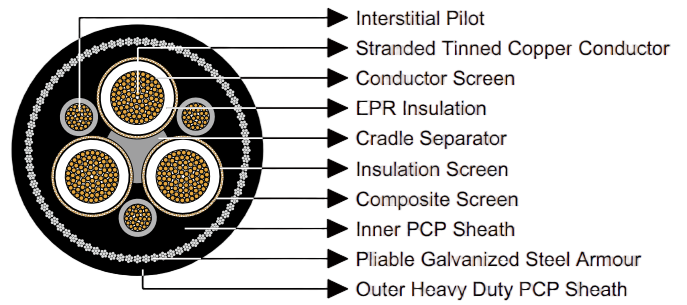
The cable employs flexible stranded tinned annealed copper conductors, which provide excellent electrical conductivity while maintaining the flexibility necessary for reeling and trailing applications. The tinning process enhances corrosion resistance, a critical feature in mining environments where moisture, chemical exposure, and ground conditions can rapidly degrade untreated copper.
Advanced Armouring and Mechanical Protection
What distinguishes the Type 260 as a true mechanical protection cable is its pliable galvanized steel armour construction. Unlike rigid armoured cables that can fail under repeated flexing, this design utilizes galvanized low carbon steel strands that provide robust protection against mechanical impacts, crushing forces, and penetration damage while retaining sufficient flexibility for installation around equipment and through cable handling systems.
The galvanization process adds a protective zinc coating to the steel strands, significantly enhancing resistance to corrosion—a persistent threat in mining environments where water ingress, chemical exposure, and ground moisture are constant concerns. This armored cable for substation applications can withstand the rough handling associated with mobile mining equipment and the physical stresses of underground installation where cables may contact rock surfaces, support structures, or moving machinery.
Design for Harsh Environmental Conditions
Mining operations rarely provide ideal cable operating conditions. The Type 260 heavy-duty mining power cable incorporates multiple design features specifically addressing these challenges. The outer heavy-duty PCP (Polychloroprene) sheath provides exceptional resistance to oils, chemicals, abrasion, and weathering. This industrial feeder cable construction ensures that whether the cable is deployed in the dusty conditions of open-pit mining, the wet environment of sand mining operations, or the confined spaces of underground tunnels, it maintains its protective integrity.
The cable's construction includes EPR (Ethylene Propylene Rubber) insulation, which offers superior electrical properties alongside excellent resistance to heat aging, ozone, and weathering. For cables operating at 3.3KV and above, semiconductor screens are incorporated around both the conductor and insulation, ensuring uniform electric field distribution and preventing partial discharge that could lead to premature insulation failure.
Main Applications in Mining and Industrial Environments
Feeder Cable for Power Supply in Mining Operations
The primary application for this Type 260 mining armoured cable for feeder supply involves delivering electrical power from main distribution points to various operational areas within mining sites. In underground mining, these cables form the backbone of the electrical distribution system, running through main access tunnels to supply power to ventilation systems, lighting networks, pumping stations, and equipment charging areas.
Surface mining operations utilize these cables to connect main power substations to mobile equipment staging areas, processing facilities, and remote work zones. The cable's robust construction allows it to be deployed directly buried, laid in trenches, or suspended from support structures, adapting to the evolving geography of an active mining site where constant excavation and earthmoving reshape the terrain.
Transportable Mining Substation Applications
One of the most demanding applications for the 1.1KV to 11KV armored cable for mining substation use involves connecting mobile or transportable substations to both upstream power sources and downstream distribution points. Mining operations frequently relocate substations as work progresses to new areas, requiring cables that can be repeatedly deployed, moved, and redeployed without degradation.
The armored cable for transportable substation installations must handle both the electrical demands of transformer connections and the mechanical stresses of being coiled, transported, and reinstalled multiple times throughout its service life. The Type 260's pliable armour and flexible conductor construction make it ideally suited for this application, maintaining electrical integrity even after numerous handling cycles.
Machinery and Equipment Connections
Heavy mining machinery represents another critical application area for this mining cable with mechanical protection. Equipment such as continuous miners, longwall shearers, draglines, and large excavators require reliable power connections that can withstand the constant vibration, movement, and mechanical stresses inherent to their operation. The cable's flexible construction allows it to follow equipment movement without developing stress points that could lead to failure.
In sand mining operations, where equipment operates in particularly abrasive and wet conditions, the robust outer sheath and armoured construction provide essential protection. The sand mining cable must resist not only the abrasive action of sand particles but also the corrosive effects of water and minerals present in these environments.

Benefits of Type 260 Mining Armoured Feeder Cable
Enhanced Safety and Electrical Reliability
Safety remains paramount in mining operations, where electrical failures can have catastrophic consequences. The comprehensive protection system employed in this power supply cable minimizes the risk of electrical faults caused by mechanical damage. The composite screen, consisting of tinned copper braiding interwoven with polyester yarn, provides effective earthing and electromagnetic shielding while offering an additional layer of mechanical protection beneath the armour.
The inclusion of three interstitial pilot conductors, each with EPR covering, enables sophisticated monitoring and control functions. These pilots can be used for ground fault detection, communication systems, or equipment control circuits, allowing operators to implement safety interlocks and monitoring systems that enhance overall installation safety.
Superior Resistance to Mechanical Stress and Damage
Mining environments subject cables to mechanical stresses that would quickly destroy standard industrial cables. The Type 260's multi-layer protection system distributes these stresses across several independent barriers. When the cable encounters sharp objects, crushing forces, or impact damage, the outer sheath absorbs initial damage, the steel armour prevents penetration, and the inner sheath provides a secondary barrier protecting the insulated conductors.
This layered approach to mechanical protection mining feeder cable design means that minor damage does not immediately compromise electrical safety or performance. The cable can sustain superficial sheath damage while continuing operation, allowing planned replacement during scheduled maintenance rather than requiring emergency intervention.
Long-Term Performance in Outdoor and Underground Installations
The materials selected for this industrial feeder cable are specifically chosen for long-term stability in challenging environments. EPR insulation maintains its electrical and mechanical properties across a wide temperature range and resists degradation from moisture, chemicals, and thermal cycling. The PCP sheathing compounds resist hardening and cracking even after years of exposure to ultraviolet radiation, temperature extremes, and chemical exposure.
Underground installations benefit particularly from the cable's moisture resistance and mechanical protection. In tunnel environments where water seepage is common and cables may be exposed to falling rocks, scraping against tunnel walls, or damage from moving equipment, the robust construction provides reliability measured in decades rather than years.
Technical Specifications and Construction Details
Cable Core and Conductor Design
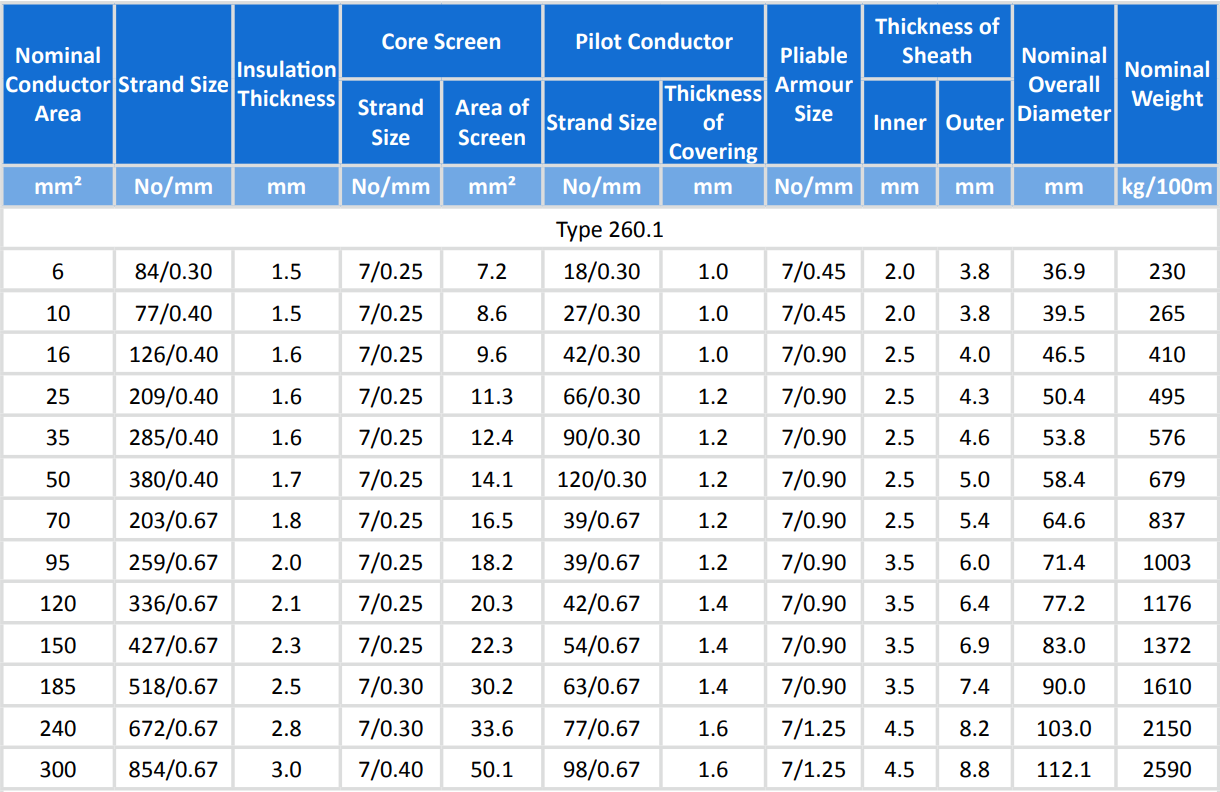
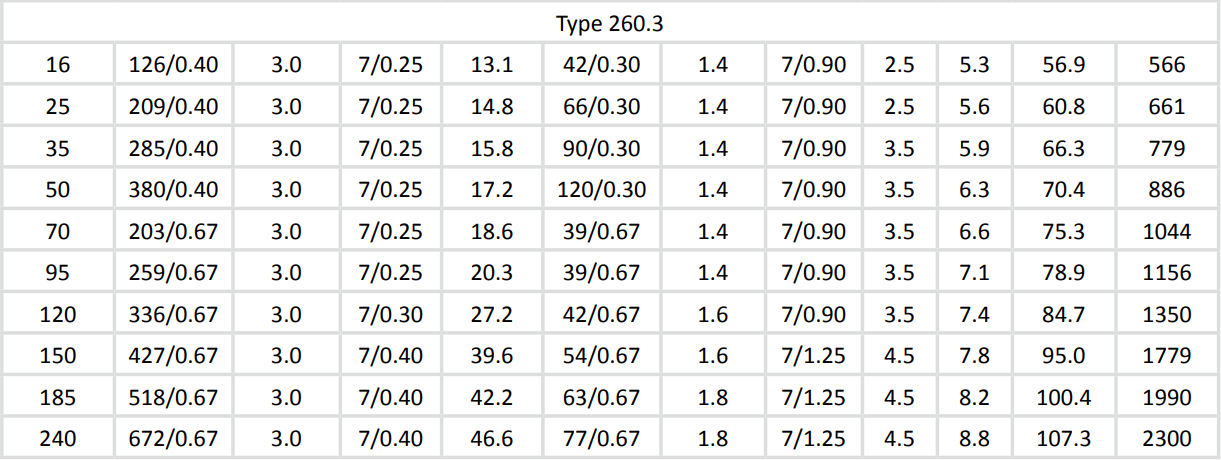
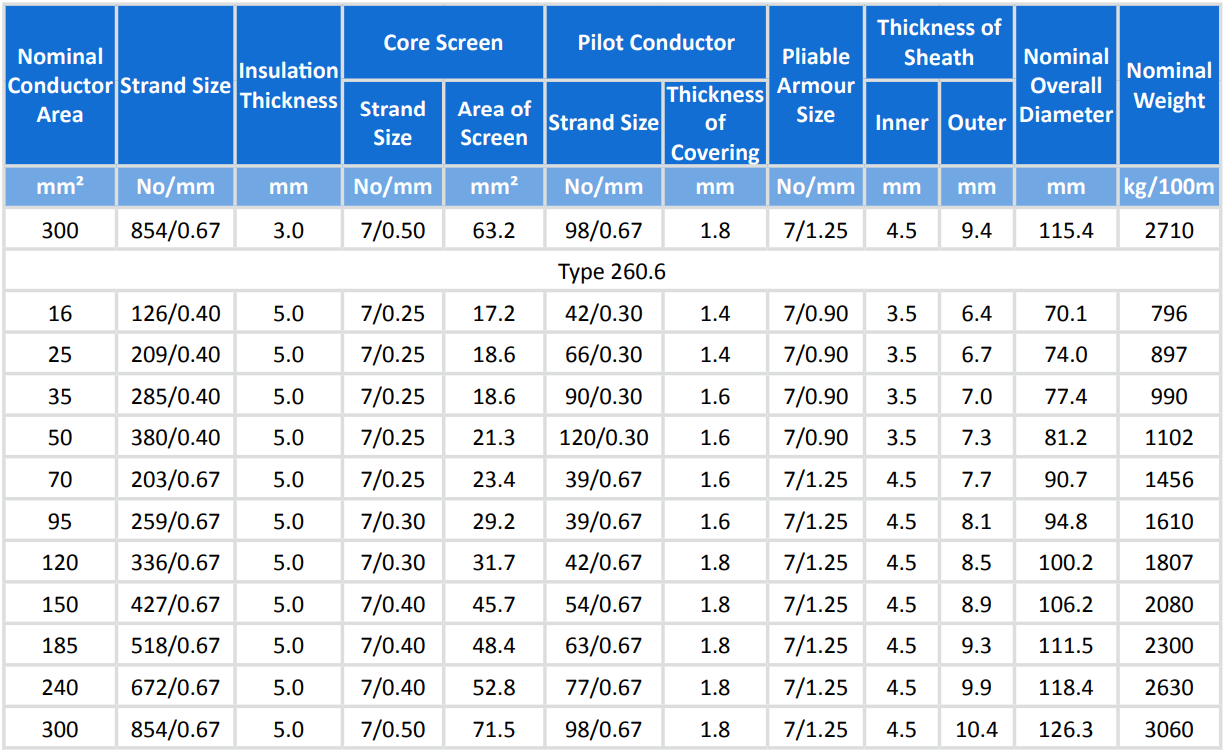
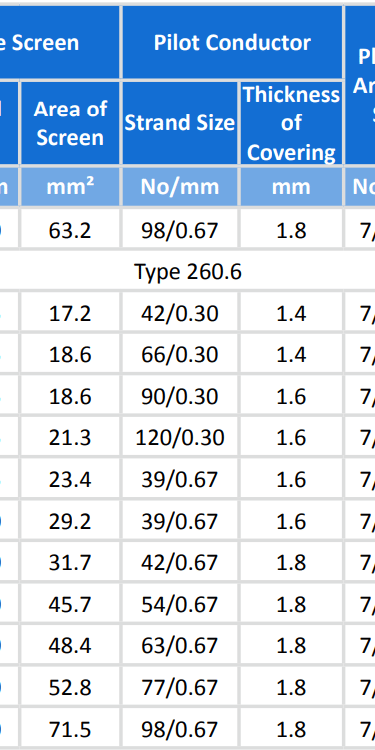
The electrical core of the Type 260 consists of three main power conductors, each built from flexible stranded tinned copper. Conductor sizes range from 6mm² to 300mm², accommodating current requirements from relatively modest equipment circuits up to high-capacity feeder applications. The stranding configuration varies with conductor size but maintains flexibility appropriate for reeling and trailing applications throughout the range.
For medium-voltage applications (3.3KV and above), each conductor is surrounded by a semiconductive compound screen that ensures uniform electric field distribution at the conductor surface. This prevents localized electric field concentrations that could initiate partial discharge and lead to insulation breakdown over time.
Insulation and Screening System
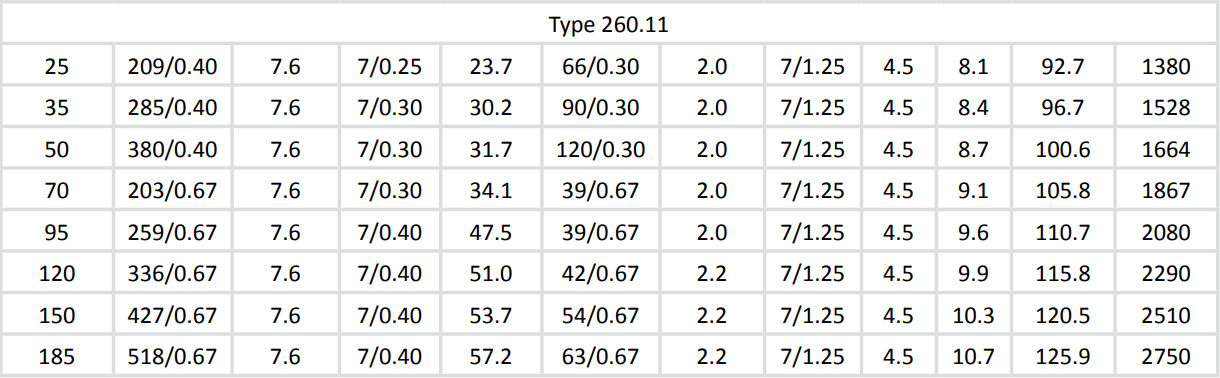
EPR insulation surrounds each conductor, with thickness increasing proportionally to voltage rating. At 1.1KV, insulation thickness begins at 1.5mm for smaller conductors, increasing to 7.6mm for 11KV applications. This insulation provides excellent dielectric properties alongside mechanical flexibility and resistance to environmental degradation.
Over the EPR insulation, a semiconductive elastomer screen maintains electrical contact with the insulation surface while providing a smooth outer surface for the composite screening layer. This construction ensures that any partial discharge activity occurs in controlled locations rather than at irregular points where imperfections might exist.
Composite Screen and Earthing Conductor
The composite screen serves multiple critical functions within the cable assembly. Consisting of tinned copper braiding interwoven with polyester yarn, it provides the primary earthing conductor for the cable while offering electromagnetic shielding and an additional layer of mechanical protection. The area of screening conductor varies from 7.2mm² on smaller cables to over 70mm² on the largest conductors, ensuring adequate fault current capacity.
The cradle separator, made from semiconductive PCP, maintains the geometric arrangement of the three power cores while providing a semiconductive path between phases. This component is essential for maintaining the electrical balance and mechanical stability of the cable assembly.
Interstitial Pilot Conductors and Sheaths
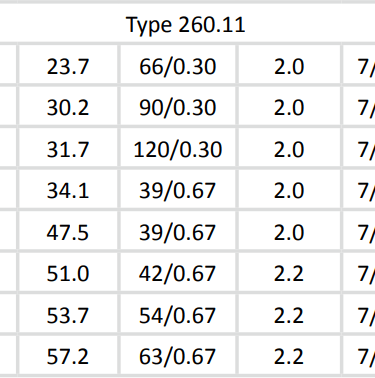
Three interstitial pilot conductors occupy the spaces between the main power cores. These flexible stranded tinned copper pilots, typically ranging from 1.0mm² to 2.2mm², each have their own EPR covering. Their positioning between the main cores makes efficient use of cable space while keeping them protected within the cable's mechanical armor envelope.
The inner PCP sheath binds all internal components into a cohesive assembly, providing the base layer upon which the armour is applied. This sheath also serves as a critical moisture barrier, preventing water ingress into the cable core even if the outer sheath becomes damaged. Alternative CPE (Chlorinated Polyethylene) or CSP (Chlorosulfonated Polyethylene) sheaths can be specified for applications requiring enhanced chemical resistance.
Armour and Outer Protection
The pliable steel armour consists of galvanized low carbon steel strands applied over the inner sheath. Strand sizing varies from 7/0.45mm on smaller cables to 7/1.25mm on larger constructions, providing mechanical protection proportional to the cable's size and weight. The galvanization significantly extends armour life in corrosive environments.
The outer heavy-duty PCP sheath completes the cable construction, providing the final barrier against environmental hazards. With thickness ranging from 2.0mm to 10.4mm depending on cable size, this robust covering resists abrasion, impact, chemical attack, and ultraviolet degradation.
Standards Compliance
The Type 260 mining operations robust armored cable is manufactured in accordance with AS/NZS 1802:2003 for reeling and trailing cables, ensuring it meets rigorous performance standards specific to mining applications. Additional compliance with AS/NZS 1125, AS/NZS 3808, and AS/NZS 5000.1 provides assurance regarding conductor materials, construction quality, and electrical performance.
Installation Guidelines and Considerations
Recommended Use Cases and Deployment Methods
When deploying this mining cable with mechanical protection, careful consideration of the specific application environment ensures optimal performance. For permanent feeder installations, direct burial or installation in trenches provides protection from surface hazards while maintaining accessibility for future maintenance or reconfiguration. The cable's robust construction tolerates direct earth contact without requiring additional mechanical protection in most soil conditions.
Reeling applications, such as connections to mobile equipment, benefit from the cable's flexibility but require careful attention to minimum bending radius specifications. While the pliable armour allows considerably tighter bends than rigid armoured cables, excessive bending can damage the armour strands or stress the insulation. Generally, maintaining bending radii of at least 12 times the cable diameter during installation and 8 times during service ensures long-term reliability.
Points to Consider for Optimal Performance
Temperature considerations affect both current-carrying capacity and mechanical handling. While the EPR insulation and PCP sheaths function across a wide temperature range, installation in extremely cold conditions requires special care as the materials become less flexible at low temperatures. Allowing cables to reach ambient temperature before installation prevents stress damage during handling.
Proper termination practices are essential for realizing the full capabilities of these cables. Each layer—outer sheath, armour, inner sheath, screens, and insulation—requires appropriate treatment and stress relief. The armour must be securely terminated with adequate mechanical clamping to prevent movement under cable tension, while earthing connections should ensure low-resistance contact with the composite screen.
Common Installation Scenarios and Problem Prevention
Underground mining installations frequently encounter challenges related to water management and cable support. Even with the cable's excellent moisture resistance, providing adequate drainage and avoiding areas where cables will be submerged for extended periods extends service life. Supporting cables at appropriate intervals prevents excessive mechanical stress from the cable's own weight, particularly important for larger conductor sizes that can exceed 30kg per meter.
What happens when cables are subjected to unexpected mechanical damage during mining operations? The multi-layer construction provides resilience, but damage assessment is critical. Surface damage to the outer sheath may not require immediate cable replacement if the armour remains intact. However, any indication of armour damage or penetration through to the inner sheath requires careful evaluation and likely cable section replacement to maintain safety standards.
How can mining operations maximize the service life of their power supply cable investments? Regular inspection programs that identify and address minor damage before it progresses, proper cable handling practices that avoid excessive bending or tension, and maintaining accurate records of cable routes and splice locations all contribute to extended cable life. Protection of cable trenches from vehicle traffic and marking of buried cable routes prevents accidental damage during ongoing mining activities.
Conclusion
The Type 260 1.1-11KV mining armoured feeder cable represents sophisticated engineering applied to one of mining's most fundamental challenges: delivering reliable electrical power in environments hostile to ordinary cable construction. Through its comprehensive protection system combining pliable steel armour, dual sheaths, and robust insulation, this heavy-duty industrial power supply cable provides the mechanical resilience and electrical reliability essential for mining operations.
From powering underground ventilation systems to connecting transportable substations in sand mining operations, from feeding mobile heavy equipment to establishing permanent power distribution networks, this versatile cable design adapts to diverse applications while maintaining consistent performance. Its compliance with international standards, combined with construction details optimized for mining environments, makes it a dependable choice for engineers and project managers who cannot afford electrical infrastructure failures.
As mining operations continue pushing into more remote locations and deeper underground, the importance of robust, reliable power supply infrastructure only increases. The Type 260 mining cable, with its proven combination of mechanical protection, electrical performance, and environmental resistance, stands ready to meet these evolving challenges, ensuring that critical mining operations maintain the continuous, safe power supply upon which productivity and safety ultimately depend.
How to Reach Us
Get in Touch
SiteMap
Product Catalogue
Festoon Cable
Shore Power Cable




Scan to add us on WeChat