

Type SHD-GC Three-Conductor Round Portable Power Cable, CPE Jacket 15kV | Heavy-Duty 15kV Mining Cable for Shearers & Drills
Discover Type SHD-GC three-conductor round portable power cable, CPE jacket 15kV for mining shearers, drills & shovels. EPR insulated, ground check conductor. ICEA S-75-381 compliant heavy-duty 15kV cable.
hongjing.Wang@Feichun
1/19/20268 min read
Introduction to Type SHD-GC 15kV Portable Power Cable
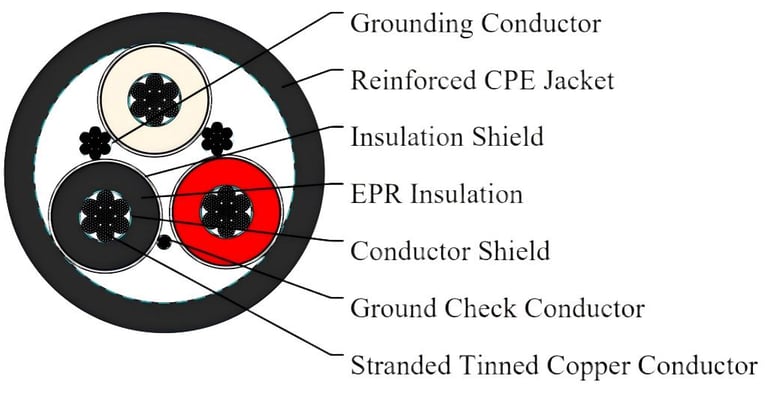
In the demanding world of mining and heavy industrial operations, electrical power distribution must meet extraordinary standards of durability, safety, and performance. The Type SHD-GC three-conductor round portable power cable represents a pinnacle of engineering excellence designed specifically for high-voltage applications in the harshest environments imaginable. This heavy-duty cable, rated at 15kV and featuring a robust Chlorinated Polyethylene (CPE) jacket, serves as the critical lifeline delivering reliable power to mobile mining equipment operating in conditions that would quickly destroy conventional electrical cables.
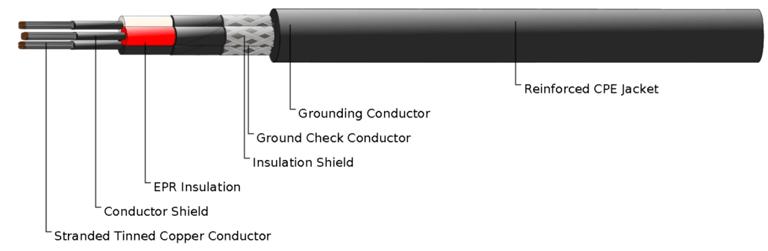
The SHD-GC designation indicates "Super Heavy Duty - Ground Check," a classification that immediately communicates this cable's enhanced construction and integrated safety features. Unlike standard industrial cables, this three-conductor round portable power cable incorporates multiple protective layers, specialized insulation materials, and redundant grounding systems specifically engineered to withstand the mechanical stresses, chemical exposures, and environmental extremes encountered in underground coal mines, surface mining operations, and other industrial settings where equipment mobility and operational reliability are non-negotiable requirements.
Key Applications in Mining and Heavy Industry
The Type SHD-GC three-conductor round cable for shearers and continuous miners has become an industry standard for powering the most demanding mobile equipment in modern mining operations. Longwall shearers, which cut coal from the face in underground mines, require portable power cables that can flex thousands of times daily while maintaining electrical integrity under constant tension and movement. The SHD-GC cable's construction specifically addresses these challenges, providing consistent power delivery to equipment that may draw hundreds of amperes while simultaneously enduring dragging across rough mine floors, compression from rockfall, and exposure to coal dust and moisture.
Continuous miners, which cut and gather coal in a single operation, similarly depend on heavy-duty mining portable power cable 15kV for rugged industrial environments. These machines operate in confined spaces where cables must navigate tight curves and frequent repositioning. The round configuration of the SHD-GC cable provides uniform flexibility in all directions, preventing the preferential bending and stress concentration that can occur with flat cable designs.
Beyond coal mining, this versatile cable serves mobile equipment like shovels, dredges, and drills across various industrial sectors. Electric rope shovels in surface mining operations require trailing cables that can handle extreme mechanical abuse while delivering the substantial power needed for excavation. Dredging equipment operating in marine or freshwater environments benefits from the CPE jacket's excellent resistance to water, oils, and chemicals. Drilling rigs, whether for mineral exploration or geotechnical investigation, rely on portable power cables that maintain electrical performance despite repeated coiling, uncoiling, and dragging across irregular terrain.
The cable's 15kV voltage rating provides an optimal balance for medium-voltage distribution systems common in mining operations. This voltage level allows efficient power transmission over considerable distances while maintaining practical cable sizes and manageable installation requirements. The heavy-duty construction ensures long service life even in applications involving frequent cable movement, reducing downtime and replacement costs that can significantly impact operational profitability.
Compliance Standards Ensuring Safety and Reliability
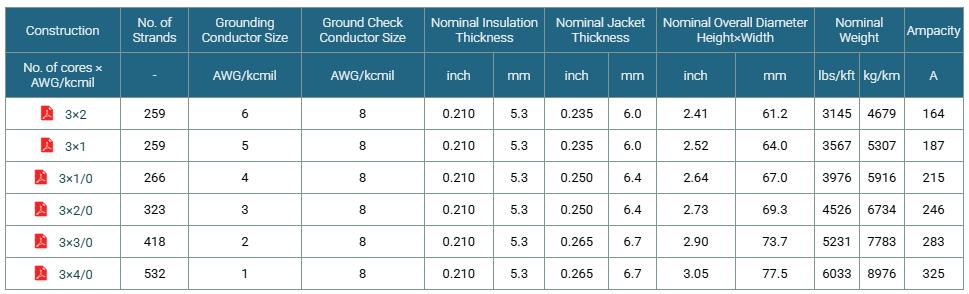
The Type SHD-GC three-conductor round cable standards are governed by multiple rigorous specifications that ensure consistent quality and performance across manufacturers. Compliance with ICEA S-75-381/NEMA WC 58 establishes the fundamental design parameters for portable and power feeder cables rated 5 through 46kV. These standards specify conductor sizes, insulation thicknesses, jacket requirements, and testing protocols that verify cable performance under both normal operating conditions and fault scenarios.
ASTM B 172 governs the rope-lay stranded copper conductors used in flexible cables, defining the stranding configurations that provide the necessary flexibility while maintaining excellent electrical conductivity. The use of annealed copper ensures the conductor remains pliable even after extended service, while tinning prevents oxidation that could increase resistance or create hot spots. ASTM B 33 establishes specifications for the tinned soft or annealed copper wire used throughout the cable construction, ensuring material consistency and long-term reliability.
CAN/CSA C22.2 No. 96 compliance is particularly significant for operations in Canada or for equipment manufacturers serving the North American market. This Canadian standard for portable power cables provides additional requirements specific to mining applications, including enhanced mechanical protection and stricter testing for resistance to flame propagation. Meeting this standard demonstrates the cable's suitability for the most safety-conscious mining jurisdictions globally.
These overlapping standards create a comprehensive framework ensuring that every Type SHD-GC three-conductor round portable power cable delivered to a mining site meets exacting specifications for electrical performance, mechanical durability, and safety. Independent testing and certification verify compliance, giving equipment operators confidence that their power distribution infrastructure will perform reliably even in life-critical applications.
Customization Options for Specific Applications
While the standard 15kV CPE jacket portable power cables serve the vast majority of mining applications, certain operating environments or equipment specifications may require alternative configurations. The availability of alternative jacket materials including CSP (Chlorosulfonated Polyethylene), PCP (Polychloroprene), NBR (Nitrile Butadiene Rubber), and PVC (Polyvinyl Chloride) allows cable selection to be optimized for specific chemical exposures, temperature ranges, or mechanical requirements.
CSP jackets offer enhanced resistance to certain solvents and chemicals while maintaining good flexibility and abrasion resistance. PCP provides excellent ozone and weather resistance with good flexibility at low temperatures, making it suitable for equipment that operates in both underground and surface environments. NBR jackets excel in applications involving petroleum-based oils and fuels, while PVC offers an economical option for less demanding applications or where fire resistance requirements differ from mining standards.
Two-layer jacket construction with reinforcing fiber between layers provides additional mechanical protection for the most severe applications. This configuration incorporates a fabric reinforcement between an inner and outer jacket layer, creating a composite structure that resists tearing, cutting, and abrasion even more effectively than single-layer designs. Mobile equipment operating in particularly rocky terrain or environments with sharp edges that could damage cables benefits from this enhanced protection.
Custom conductor sizes, voltage ratings, and overall cable configurations can also be specified for specialized equipment requirements, ensuring that power distribution systems are precisely matched to application demands rather than forcing compromise with off-the-shelf solutions.
Benefits and Technical Specifications
The heavy-duty 15kV mining cable delivers multiple operational benefits that directly translate to reduced costs and improved safety in mining operations. The cable's durability in harsh conditions minimizes replacement frequency, reducing both material costs and the labor and downtime associated with cable changeouts. Mining operations that previously replaced portable power cables annually or even more frequently often experience multi-year service life with properly selected and installed SHD-GC cables.
The 15kV voltage rating enables high-performance power transmission with reduced current compared to lower-voltage systems delivering equivalent power. Lower current means reduced conductor heating, smaller voltage drop over distance, and the ability to use longer cable runs without intermediate transformation or distribution points. This simplifies mobile equipment power distribution and reduces infrastructure costs in large mining operations.
The round cable configuration provides uniform flexibility and handling characteristics regardless of bending direction. Unlike flat cables that bend easily in one plane but resist bending in the perpendicular direction, round cables coil naturally without developing permanent set or preferential bending patterns that can lead to premature failure. This characteristic is particularly valuable for cable reels and equipment that frequently repositions in multiple directions.
The integrated ground check conductor provides continuous assurance of grounding system integrity, a critical safety feature in underground mines where explosive atmospheres may be present and any electrical fault could trigger ignition. The ability to verify grounding before energizing equipment has prevented countless potential incidents and is often mandated by mining safety regulations.
Common Cable Challenges and Solutions
How do you prevent mechanical damage to portable power cables in mining operations?
Mechanical damage remains the leading cause of portable power cable failure in mining applications. Prevention requires a multi-faceted approach beginning with proper cable selection—ensuring the cable construction matches or exceeds the severity of the application. The Type SHD-GC three-conductor round portable power cable's reinforced extra-heavy-duty jacket provides exceptional mechanical protection, but even the toughest cable requires proper handling and installation practices.
Implementing cable management systems such as festoon systems, cable reels, or guided trays eliminates unnecessary dragging and reduces compression damage. When dragging is unavoidable, maintaining proper cable routing that avoids sharp edges, pinch points, and high-traffic areas significantly extends cable life. Regular inspection for jacket cuts, abrasions, or deformations allows early detection of damage before insulation failure occurs. Many mining operations implement formal cable inspection protocols with documented findings and retirement criteria based on observable damage extent.
What causes premature insulation failure in high-voltage mining cables?
Insulation failure in EPR insulated cables typically results from either electrical stress exceeding material capabilities or progressive degradation from environmental factors. Electrical tracking can occur when surface contamination from coal dust, moisture, or chemical residues creates conductive paths across the insulation surface. Regular cleaning of cable exteriors and terminations prevents contamination buildup. Ensuring terminations are properly installed with correct stress relief and environmental sealing prevents moisture ingress that can initiate tracking.
Mechanical damage that penetrates the jacket but doesn't immediately cause failure can allow moisture to migrate into the cable, gradually degrading the insulation. This emphasizes the importance of removing cables from service when jacket damage is detected rather than continuing operation until catastrophic failure occurs. Additionally, operating cables beyond their temperature ratings accelerates insulation aging. Ensuring that cable ampacity ratings are not exceeded and that ventilation allows adequate cooling prevents thermal degradation.
How should portable power cables be stored and maintained during extended periods of non-use?
Proper storage preserves cable integrity during seasonal shutdowns or equipment rotation. Cables should be cleaned to remove contaminants, thoroughly dried, and stored in a controlled environment protected from direct sunlight, extreme temperatures, and chemical exposure. Coiling cables at diameters larger than the minimum bend radius specified by the manufacturer prevents permanent set and stress concentration. Storing cables on reels or in loose coils rather than tight bundles allows air circulation and prevents compression damage.
Before returning stored cables to service, visual inspection for jacket cracks, discoloration, or physical damage should be conducted. Electrical testing including insulation resistance measurement and high-potential testing verifies that the cable maintains its dielectric integrity. This preventive testing can identify degradation that occurred during storage before the cable is energized under full voltage, preventing in-service failures that could damage equipment or endanger personnel.
What are the critical factors in cable termination for mining applications?
Proper termination is essential for reliable cable performance and safety. Terminations must provide environmental sealing to prevent moisture ingress, mechanical strain relief to prevent stress concentration at the cable-to-connector interface, and proper electrical stress distribution to prevent partial discharge and tracking. Using termination kits specifically designed for the cable construction and voltage rating ensures compatibility of materials and dimensions.
Following manufacturer installation instructions precisely, including surface preparation, component assembly sequences, and torque specifications, is non-negotiable. Improper termination technique causes a disproportionate number of cable system failures, often appearing as problems with the cable itself when the actual cause lies in the termination workmanship. Training termination personnel and implementing quality control procedures with documented installation steps significantly improves termination reliability.
Conclusion
The Type SHD-GC three-conductor round portable power cable with CPE jacket represents the culmination of decades of engineering development focused on meeting the extreme demands of mobile mining equipment power distribution. Its multi-layer construction incorporating EPR insulation, integrated ground check conductor, and reinforced heavy-duty jacket delivers the durability, safety, and electrical performance that modern mining operations require. Compliance with comprehensive industry standards ensures consistent quality and reliability across applications ranging from longwall shearers to mobile drills.
Understanding the cable's construction, proper application selection, and implementation of appropriate handling and maintenance practices maximizes service life and operational safety. As mining operations continue to demand higher productivity from mobile equipment, the reliable power distribution provided by properly specified and maintained heavy-duty 15kV mining cables remains fundamental to operational success. Whether powering shearers in underground coal mines or mobile drills in surface operations, the SHD-GC cable design provides the robust, flexible, and safe power transmission essential for modern mining productivity.
How to Reach Us
Get in Touch
SiteMap
Product Catalogue
Festoon Cable
Shore Power Cable




Scan to add us on WeChat