
Type SHD-PCG Three-Conductor Round Portable Power Cable 5kV: Complete Specifications and Applications Guide
Comprehensive guide to Type SHD-PCG three-conductor round portable power cable 5kV specifications, construction details, and heavy-duty mining applications. Explore EPR insulation, CPE jacket properties, longwall shearer cable standards, and shielded power conductor configurations for underground mining operations.
hongjing.Wang@Feichun
1/14/20266 min read
Introduction to Type SHD-PCG Three-Conductor Round Portable Power Cable 5kV
The Type SHD-PCG three-conductor round portable power cable represents a specialized engineering solution designed specifically for heavy-duty mining cable applications where reliability and durability are paramount. This cable configuration serves as the lifeline for longwall shearer operations, delivering consistent electrical power to mobile mining equipment operating in some of the most challenging underground environments.
Heavy-duty mining operations demand electrical infrastructure that can withstand continuous mechanical stress, abrasive conditions, and environmental extremes while maintaining safe, uninterrupted power delivery. The SHD-PCG cable design addresses these requirements through its reinforced construction, featuring a 5kV voltage rating that provides adequate electrical capacity for high-powered mining machinery while maintaining safety margins essential for underground operations.
The three-conductor round configuration offers distinct advantages over flat cable designs, including improved flexibility during deployment, enhanced resistance to crushing forces, and more uniform stress distribution across the cable structure. These characteristics make the SHD-PCG particularly suitable for longwall shearer cable applications, where equipment mobility and frequent cable repositioning are operational realities.


Technical Specifications and Standards Compliance
Compliance with recognized industry standards ensures that Type SHD-PCG cables meet rigorous safety and performance requirements. The cable adheres to ICEA S-75-381/NEMA WC 58 standards for portable power cables, which establish comprehensive requirements for construction, testing, and performance parameters specific to mobile mining applications.
Conductor materials conform to ASTM B 172 and ASTM B 33 specifications, ensuring consistent electrical and mechanical properties. These standards define the composition, stranding characteristics, and quality requirements for tinned copper conductors used in demanding industrial environments.
The cable also meets CAN/CSA C22.2 No. 96 certification requirements for mining cables, demonstrating compliance with Canadian safety standards that are recognized internationally. This certification addresses specific hazards associated with underground mining environments, including flame resistance, mechanical durability, and electrical safety under adverse conditions.
Cable Construction and Component Details
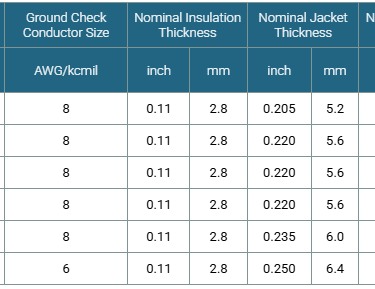
Power Conductors
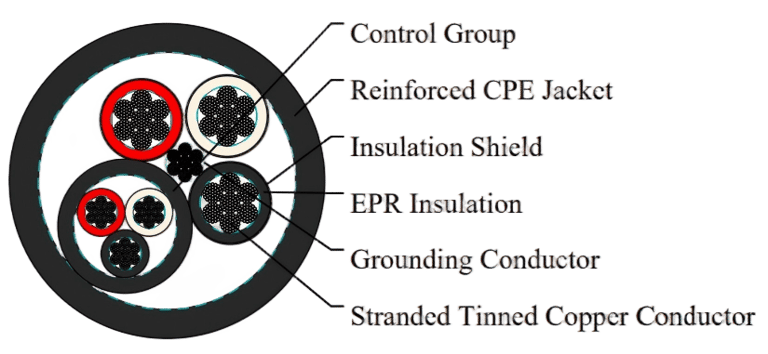
The power conductor system utilizes stranded annealed tinned copper construction, providing the flexibility necessary for portable cable applications while maintaining excellent electrical conductivity. The tinning process protects copper strands from oxidation and corrosion in moisture-laden underground environments, extending service life and maintaining electrical performance.
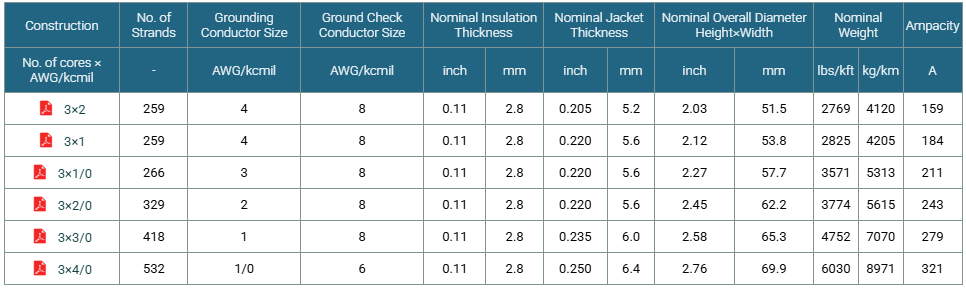
The three-conductor round configuration balances current carrying capacity with mechanical flexibility. This design allows for efficient power transmission while enabling the cable to bend and flex during equipment movement without compromising structural integrity. Each conductor is sized appropriately for the 5kV voltage class and anticipated load requirements of longwall shearer equipment.
Insulation System
Ethylene Propylene Rubber (EPR) insulation provides superior electrical and thermal performance characteristics essential for mining applications. EPR offers excellent dielectric strength suitable for 5kV applications, maintaining insulation resistance even under elevated temperatures and humidity conditions typical of underground mining operations.
The insulation system maintains thermal performance up to a maximum operating temperature of +90°C, providing adequate margin for continuous heavy-load operation. EPR's inherent flexibility remains consistent across wide temperature ranges, preventing insulation cracking or degradation during cable flexing in cold mine environments.
Insulation Shield
A tinned copper and textile braid shielding system surrounds each insulated conductor, providing critical electromagnetic interference protection and establishing a low-impedance grounding path. This shielding configuration ensures safe dissipation of capacitive charging currents and provides fault protection by enabling rapid detection of insulation failures.
The shielding system also contributes to uniform electrical stress distribution across the insulation surface, preventing localized electrical concentrations that could lead to premature insulation breakdown. This design element is particularly important in mining environments where cables may contact grounded equipment or conductive rock surfaces.
Control Group
The integrated three-conductor control group enables monitoring and control functions essential for modern mining equipment automation. These tinned copper control conductors feature EPR insulation and are protected by a thermosetting jacket, isolating them from mechanical stresses that affect power conductors.
Color-coded insulation—black, white, and red—facilitates proper circuit identification during installation and maintenance. This control group architecture allows the single cable to serve both power delivery and equipment control functions, simplifying cable management in confined underground spaces.
Grounding Conductor
A centrally located grounding conductor provides equipment safety grounding and fault current return path. The central positioning within the cable structure ensures symmetric construction and optimal mechanical balance. Tinned copper material specification ensures low-resistance grounding connections essential for personnel safety and rapid circuit protection activation.
Outer Jacket
The reinforced extra-heavy-duty Chlorinated Polyethylene (CPE) outer jacket represents the cable's primary defense against mechanical damage and environmental degradation. CPE provides exceptional abrasion resistance, essential when cables are dragged across rough mine floors or over equipment during deployment and retrieval operations.
The black CPE jacket resists oils, chemicals, and moisture prevalent in mining environments while maintaining flexibility across temperature extremes. This jacket material also demonstrates superior flame resistance properties, an essential safety characteristic for underground mining applications where fire prevention is critical.
Mechanical and Thermal Properties
The cable's mechanical design incorporates a minimum bending radius of 6 times the outer diameter (6×OD), ensuring that installation and operation do not impose excessive stress on internal components. Adhering to this bending radius limitation prevents conductor damage, insulation cracking, and shield disruption that could compromise electrical performance or safety.
With a maximum conductor operating temperature of +90°C, the cable accommodates heavy continuous loads while maintaining thermal margins that prevent insulation degradation. This temperature rating reflects EPR's superior thermal stability compared to alternative insulation materials, enabling reliable operation even during peak demand periods.
Flexibility and durability in harsh mining environments result from the careful selection and integration of materials throughout the cable structure. The stranded conductor design, EPR insulation elasticity, and CPE jacket reinforcement work synergistically to create a cable that withstands repeated flexing, impact, and abrasion encountered during normal mining operations.
Application-Specific Design Features
Longwall shearer operations represent one of the most demanding applications for portable power cables. These massive cutting machines traverse coal faces while connected to power sources via trailing cables that must accommodate continuous movement, bending, and tension. The SHD-PCG cable design specifically addresses these requirements through its round construction, which resists twisting and maintains consistent electrical properties during equipment repositioning.
Heavy-duty portable power cable mobility is enhanced by the cable's balanced construction and optimized weight-to-performance ratio. Underground mining environment compatibility extends beyond mechanical durability to include resistance to moisture infiltration, chemical exposure from cutting fluids and coal dust, and the mechanical stress imposed by rockfall or equipment contact.
The cable's resistance to these environmental factors ensures reliable power delivery throughout extended service periods, minimizing downtime for cable replacement and reducing safety risks associated with cable failures in underground locations.
Available Options and Customizations
While CPE represents the standard jacket material, alternative outer jacket options include CSP (Chlorosulfonated Polyethylene), PCP (Polychloroprene), NBR (Nitrile Butadiene Rubber), and PVC (Polyvinyl Chloride). Each alternative offers specific performance advantages for particular mining conditions or regulatory requirements.
Two-layer jacket construction with reinforcing fiber provides enhanced mechanical protection for extreme-duty applications where cable abuse is unavoidable. This construction incorporates a fabric reinforcement layer between inner and outer jacket materials, dramatically increasing tear and cut resistance.
Custom jacket solutions address specific mining conditions such as extreme chemical exposure, unusual temperature ranges, or specific regulatory requirements for international mining operations. Specialty insulation and shielding options enable optimization for particular voltage classes or electromagnetic environment requirements.
Common Cable Challenges and Solutions
Question: How can I prevent premature cable failure due to excessive bending?
Always respect the minimum bending radius of 6×OD during installation and operation. Use cable guide systems or sheaves that maintain this radius, particularly at equipment connection points where stress concentrations occur. Implement proper cable handling training for personnel to prevent kinking during deployment.
Question: What causes insulation degradation in mining cables?
Insulation degradation typically results from thermal overload, mechanical damage, or chemical attack. Ensure cables are properly sized for actual load requirements, protecting against sustained overload conditions. Regular inspection for jacket damage prevents moisture ingress that accelerates insulation deterioration. The EPR insulation in SHD-PCG cables provides superior chemical resistance, but avoiding prolonged contact with aggressive chemicals extends service life.
Question: How do I identify shield grounding problems?
Inadequate shield grounding manifests as electromagnetic interference affecting control circuits, elevated touch voltages on equipment, or reduced fault detection sensitivity. Verify that shield terminations maintain low-resistance connections to equipment grounding systems. Periodic testing of ground continuity ensures shield integrity throughout the cable length.
Performance Benefits and Operational Advantages
Enhanced safety features for underground mining include the comprehensive shielding system that enables rapid fault detection and the robust grounding conductor that ensures personnel protection. The cable's flame-resistant materials minimize fire propagation risk, critical in confined underground spaces with limited evacuation routes.
Reliable power transmission in mobile applications results from the cable's construction tolerating the mechanical stresses inherent to portable equipment operation. Extended service life in abrasive environments reflects the CPE jacket's exceptional wear resistance and the tinned copper conductors' corrosion resistance.
Cost-effectiveness for longwall shearer operations emerges not just from the cable's purchase price but from reduced downtime, lower replacement frequency, and enhanced operational safety that prevents costly incidents and production interruptions.
Conclusion
The Type SHD-PCG three-conductor round portable power cable 5kV represents a purpose-engineered solution for demanding mining applications. Its combination of EPR insulation, comprehensive shielding, robust CPE jacket, and integrated control conductors addresses the multifaceted challenges of underground mobile equipment power delivery.
For heavy-duty mining operations requiring reliable, safe, and durable electrical infrastructure, the SHD-PCG cable offers proven performance backed by recognized industry standards compliance. As mining operations continue advancing toward increased automation and electrification, portable power cables incorporating these design principles will remain essential components of productive, safe underground mining operations.
How to Reach Us
Get in Touch
SiteMap
Product Catalogue
Festoon Cable
Shore Power Cable


Scan to add us on WeChat