
Type SHD Three-Conductor Flat Portable Power Cable 2kV: Complete Industrial Mining Solution
Type SHD 2kV flat portable power cable with three conductors, tinned copper shielding, and reinforced CPE jacket. Designed for continuous miners with grounding conductors. ICEA/NEMA certified. Durable, flexible mining power cables for industrial applications.
hongjing.Wang@Feichun
1/13/20267 min read
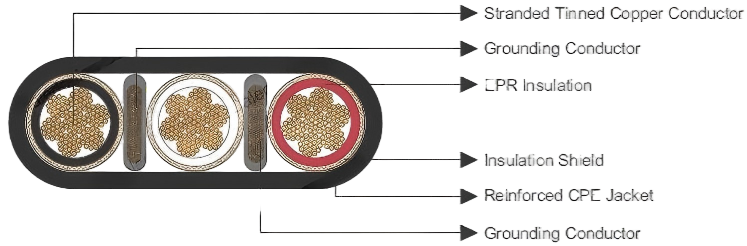
Mining operations demand power distribution solutions that can withstand harsh underground environments while maintaining reliable performance. The Type SHD three-conductor flat portable power cable represents a specialized engineering solution designed specifically for continuous miners and heavy-duty mining equipment operating at 2000V (2kV). This comprehensive guide explores the construction, applications, and technical advantages of these industrial mining cables.
Understanding SHD Cable Design and Core Applications
The SHD flat portable power cable features a unique three-conductor flat configuration that distinguishes it from conventional round cables. This design choice isn't merely aesthetic—it provides crucial functional advantages in mining environments where space constraints and equipment mobility are paramount concerns.
Continuous miners, the primary application for these cables, require power solutions that can endure constant movement, bending, and exposure to abrasive materials. The flat profile allows the cable to lay naturally along equipment surfaces and navigate tight spaces more effectively than round alternatives. This configuration reduces the risk of cable damage from pinching or crushing forces common in underground operations.
Beyond continuous miners, these three-conductor mining cable applications extend to shuttle cars, roof bolters, and various portable mining equipment. The flat design facilitates easier cable management on mobile machinery, where cables must follow complex routing paths while maintaining electrical integrity. Industrial grounding applications also benefit from the cable's comprehensive shielding system, which provides multiple layers of protection against electrical faults.
The portable power cable for mining equipment must deliver consistent performance across varying operational conditions. Temperature fluctuations, moisture exposure, and mechanical stress from dragging across rough surfaces all challenge cable durability. The SHD cable's construction addresses these factors through carefully selected materials and robust engineering.
Standards Compliance and Industry Certifications
Compliance with ICEA S-75-381 specifications ensures that SHD cables meet rigorous performance benchmarks established by the Insulated Cable Engineers Association. This standard defines construction requirements, electrical characteristics, and testing protocols specifically for mining cables. Mining operations relying on ICEA-certified cables benefit from documented performance capabilities and consistent manufacturing quality.
NEMA WC 58 compliance further validates the cable's suitability for mining applications. The National Electrical Manufacturers Association establishes dimensional standards and material specifications that ensure interoperability and safety. These ASTM B 172 and ASTM B 33 standards govern the copper wire and tinned copper components respectively, guaranteeing material quality and conductivity.
For operations extending into Canadian jurisdictions, CAN/CSA C22.2 No. 96 certification demonstrates compliance with Canadian mining cable standards. This international recognition allows the same cable design to serve mining operations across North American borders without requiring separate product specifications.
Safety certifications and regulatory compliance aren't bureaucratic obstacles—they represent validated engineering solutions that protect personnel and equipment. Mining cable standards evolve through industry experience, incorporating lessons learned from field failures and advancing technology. Selecting ICEA NEMA certified power cables ensures access to this accumulated knowledge.
Advanced Cable Construction and Material Engineering
Stranded Tinned Copper Conductor Technology
The foundation of any power cable lies in its conductor material. The SHD cable employs stranded annealed tinned copper construction, combining several beneficial properties. Stranding provides flexibility essential for cables subjected to repeated bending cycles. Solid conductors would quickly develop fatigue fractures under the flexing demands of mining equipment.
Tinned copper conductor cable offers superior corrosion resistance compared to bare copper. The tin coating prevents oxidation that would otherwise increase resistance and generate heat. In mining environments where moisture and chemical exposure are constant concerns, this tinned copper shielding cable configuration extends service life significantly.
Annealing the copper strands optimizes their flexibility while maintaining conductivity. This heat treatment process relieves internal stresses created during wire drawing, allowing the strands to flex without work hardening. The result is a tinned copper three-conductor cable for mining equipment that maintains mechanical properties through thousands of bending cycles.
Ethylene Propylene Rubber Insulation Properties
The EPR insulation mining cable system provides exceptional electrical and thermal performance. Ethylene Propylene Rubber excels in high-temperature applications, maintaining its insulating properties at the cable's maximum conductor operating temperature of +90°C. This temperature rating exceeds many alternative insulation materials, providing a safety margin during peak load conditions.
EPR's chemical resistance protects against common mining contaminants including oils, solvents, and mild acids. The insulation won't degrade when exposed to hydraulic fluids or lubricants that frequently contact mining cables. This chemical stability ensures long-term electrical integrity even in contaminated environments.
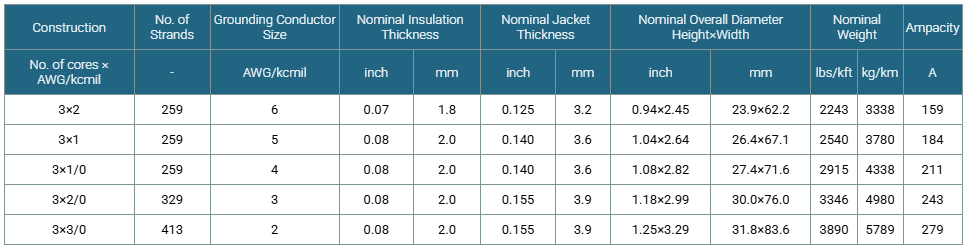
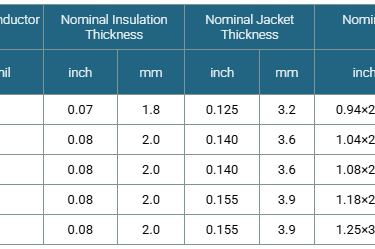
The insulation thickness in these 2kV power cable specs provides adequate dielectric strength while maintaining cable flexibility. Engineers balance insulation thickness against overall cable diameter, ensuring the minimum bending radius of 6×OD (outer diameter) remains practical for mining equipment installations.
Comprehensive Shielding System
The tinned copper/textile braid insulation shield serves multiple functions. Metallic shielding provides electromagnetic interference (EMI) protection, preventing electrical noise from affecting sensitive mining equipment controls. Modern mining operations increasingly rely on electronic monitoring systems that require clean power and minimal electrical interference.
This conducting extrusion grounding conductor creates a low-impedance path for fault currents. In the event of insulation failure, the grounding system rapidly conducts fault current, triggering protective devices before personnel contact energized components. The multi-layer protection benefits extend beyond simple ground continuity—they provide redundancy in the safety system.
Reinforced Extra-Heavy-Duty Jacket Engineering
The reinforced CPE jacket cable represents the cable's primary mechanical protection. Chlorinated Polyethylene combines excellent abrasion resistance with flexibility across a wide temperature range. The black jacket formulation includes UV stabilizers, allowing the cable to withstand both underground and surface applications without degradation.
Extra-heavy-duty reinforcement incorporates additional material thickness and optional fiber reinforcement layers. This two-layer jacket with reinforcing fiber option creates a robust barrier against mechanical damage from dragging, crushing, and impact forces. Mining environments subject cables to abuse that would quickly destroy lighter-duty constructions.
Alternative Jacket Materials and Customization Options
While CPE serves as the standard jacket material, alternative configurations address specific operational requirements. CSP (Chlorosulfonated Polyethylene) jackets provide enhanced ozone resistance and improved flame retardancy. Operations in areas with elevated ozone exposure or stringent fire safety requirements may specify CSP alternatives.
PCP (Polychloroprene) offers superior resistance to weathering and maintains flexibility at lower temperatures. Mining operations in cold climates benefit from PCP's low-temperature performance characteristics. NBR (Nitrile Rubber) jackets excel in oil resistance, making them ideal for applications where frequent hydraulic fluid exposure occurs.
PVC (Polyvinyl Chloride) represents a cost-effective alternative for less demanding applications. While not as robust as CPE in mining environments, PVC provides adequate performance for certain above-ground installations or temporary power distribution.
Custom cable options extend beyond jacket materials. Conductor sizes, insulation thicknesses, and shield configurations can be tailored to specific mining operations. This flexibility allows engineers to optimize cable performance for particular equipment or environmental conditions.
Technical Performance Specifications
The cable's minimum bending radius of 6×OD establishes safe installation practices. Exceeding this limit risks conductor damage, insulation cracking, and premature failure. For a cable with a 50mm outer diameter, the minimum bending radius would be 300mm. Installation crews must ensure adequate space for proper cable routing.
The maximum conductor temperature of +90°C reflects the EPR insulation's thermal capabilities. During peak loading, conductor temperature rises due to resistive heating. The 90-degree operating temperature rating ensures the insulation maintains its properties even during temporary overload conditions. This temperature margin provides operational flexibility without compromising safety.
The 2kV voltage rating accommodates standard mining equipment power requirements. This voltage level balances transmission efficiency with insulation requirements, providing optimal performance for medium-voltage mining applications. The three-conductor flat configuration consolidates phase conductors and grounding into a compact profile, simplifying cable management on mobile equipment.
Common Cable Issues and Troubleshooting Solutions
Problem: Premature Jacket Abrasion
Question: Why does the cable jacket show excessive wear in certain areas?
Solution: Examine cable routing for sharp edges or prolonged contact with abrasive surfaces. Install protective conduit or cable sleeves in high-wear areas. Ensure the cable isn't being dragged unnecessarily—consider cable management systems that support the cable along its length. The reinforced extra-heavy-duty portable power cables mining industry standard should withstand normal abrasion, but concentrated wear points require additional protection.
Problem: Flexibility Loss in Cold Environments
Question: The cable becomes stiff and difficult to handle in cold conditions. Is this normal?
Solution: All jacket materials experience some stiffness at low temperatures. If operations regularly occur below 0°C, consider specifying PCP jacket alternatives during ordering. Store cables in heated areas before deployment in cold environments when possible. Allow cables to acclimate to ambient temperature before subjecting them to severe bending.
Problem: Ground Continuity Concerns
Question: How do I verify the grounding conductor maintains proper continuity?
Solution: Perform regular continuity testing using appropriate instruments. The conducting extrusion grounding conductor mining cable design provides redundant ground paths, but physical damage can compromise this protection. Test resistance between the grounding conductor and each phase conductor's shield. Readings should indicate low resistance (typically less than 1 ohm for standard lengths). Elevated resistance suggests shield damage requiring cable replacement.
Problem: Connector Overheating
Question: Cable connectors show signs of heat damage despite proper termination procedures.
Solution: Verify that connector ratings match the cable's current capacity. Undersized connectors create resistance that generates heat. Ensure termination hardware achieves proper contact pressure—loose connections increase resistance dramatically. Clean all contact surfaces before termination to remove oxidation or contamination. Consider periodic infrared thermal scanning to identify developing hot spots before failure occurs.
Installation and Maintenance Best Practices
Proper installation procedures begin with careful cable handling during transportation and storage. Avoid dropping cable reels or allowing them to impact hard surfaces. Store cables in dry locations away from direct sunlight, even though the UV-resistant jacket provides some protection.
During installation, respect bending radius requirements throughout the cable path. Use cable supports at appropriate intervals to prevent excessive weight from stressing the cable. When routing cables through confined spaces, ensure adequate clearance prevents pinching or crushing.
Visual inspection procedures should occur on regular schedules. Examine the jacket for cuts, abrasions, or deformation indicating mechanical damage. Check connector housings for cracks or moisture intrusion. Document inspection findings to track cable condition trends over time.
Preventive maintenance schedules should include periodic electrical testing. Insulation resistance testing verifies the EPR insulation maintains adequate dielectric strength. Ground continuity testing confirms the shielding system remains intact. These proactive measures identify developing problems before they cause equipment failures or safety hazards.
Conclusion
The Type SHD three-conductor flat portable power cable 2kV represents specialized engineering tailored to mining's demanding requirements. Through careful material selection, robust construction, and compliance with industry standards, these industrial mining power cables deliver reliable performance in harsh environments. Understanding the cable's design features, proper application, and maintenance requirements ensures optimal service life and operational safety. Whether powering continuous miners, shuttle cars, or other heavy mining equipment, these durable mining cables provide the foundation for productive, safe mining operations.
How to Reach Us
Get in Touch
SiteMap
Product Catalogue
Festoon Cable
Shore Power Cable


Scan to add us on WeChat