
Type W Five-Conductor Round Portable Power Cable 2kV for Mining Equipment
Type W five-conductor round portable power cable 2kV with stranded tinned copper conductors, EPR insulation and heavy-duty CPE jacket for continuous miners, drills, cutters, loading machines and AC shuttle cars.
hongjing.Wang@Feichun
1/7/202611 min read
Introduction
Mining operations demand electrical infrastructure that can withstand the harshest conditions imaginable. Underground tunnels, surface excavation sites, and mobile equipment environments expose power cables to constant mechanical stress, abrasive materials, chemical contaminants, and extreme temperature variations. The Type W five-conductor round portable power cable 2kV has been specifically engineered to meet these challenging requirements, providing reliable power transmission for mobile mining equipment and heavy-duty industrial applications.
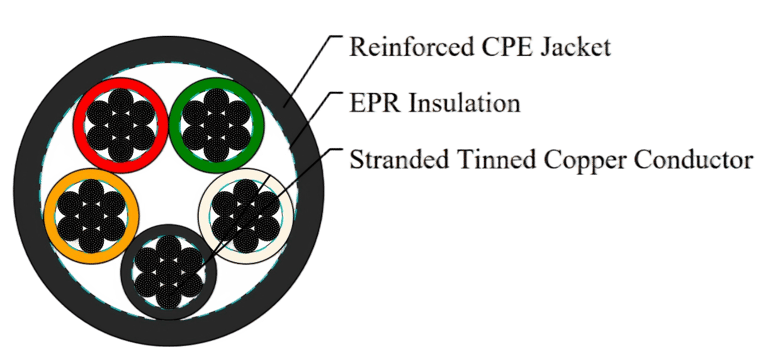
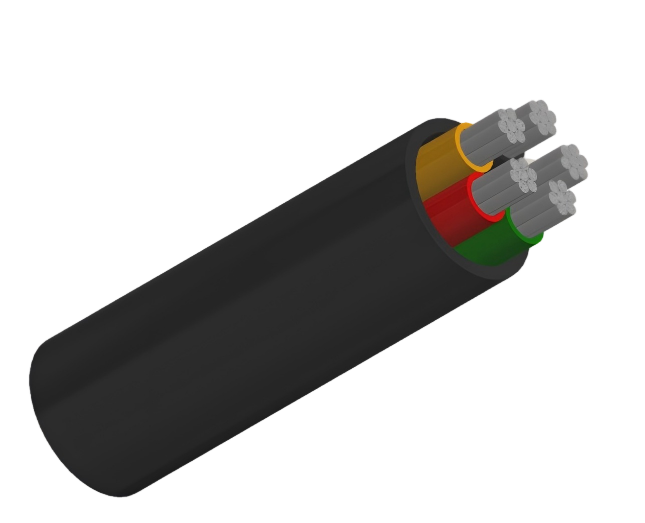
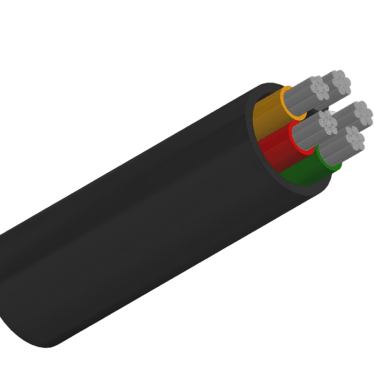
This specialized mining cable combines stranded annealed tinned copper conductors with ethylene propylene rubber (EPR) insulation and a reinforced chlorinated polyethylene (CPE) jacket to deliver exceptional performance in continuous service. Rated for 2000 volts operation with a maximum conductor temperature of 90°C, this cable construction offers the perfect balance of electrical efficiency, mechanical durability, and operational flexibility required by modern mining operations.
Compliance with rigorous industry standards including ICEA S-75-381, NEMA WC 58, and CAN/CSA C22.2 No. 96 ensures that this portable power cable meets the safety and performance benchmarks established for mining and similar demanding applications. Whether powering continuous miners deep underground, supplying electricity to mobile drilling rigs, or connecting AC shuttle cars in coal mines, this five-conductor configuration provides the robust power distribution solution that mining professionals rely upon.
Key Features and Benefits
The design philosophy behind this mining portable power cable centers on delivering uncompromising performance where failure is not an option. The 2kV voltage rating provides adequate electrical capacity for demanding mining environments while maintaining safe operating margins. The five-conductor round construction ensures balanced power distribution across all phases, reducing the risk of electrical imbalances that could damage sensitive equipment or create safety hazards.
Stranded annealed tinned copper conductors form the electrical backbone of this cable, offering superior flexibility compared to solid conductors while maintaining excellent conductivity. The tinning process applies a thin layer of tin to the copper surface, significantly improving resistance to corrosion and oxidation—critical properties in the moist, chemically aggressive environments common in mining operations. This construction allows the cable to withstand repeated bending cycles without conductor breakage, a essential characteristic for cables attached to mobile equipment.
EPR insulation provides exceptional dielectric strength, ensuring reliable electrical isolation at the 2kV operating voltage while demonstrating excellent thermal stability across the operating temperature range. This insulation material maintains its electrical properties even when exposed to moisture, oils, and many industrial chemicals encountered in mining environments.
The reinforced heavy-duty CPE jacket serves as the cable's first line of defense against mechanical damage. For cables with outside diameters exceeding 2.0 inches, an extra-heavy-duty jacket construction provides additional protection. This black outer jacket offers outstanding resistance to abrasion, impact, tearing, and puncture—the types of mechanical stress that frequently damage cables in mining applications. The CPE material also demonstrates excellent resistance to oils, greases, acids, alkalies, and weathering, extending cable service life even under continuous exposure to harsh conditions.
With a maximum conductor operating temperature of 90°C, this cable maintains safe, reliable operation during continuous service, providing adequate thermal margin for typical mining equipment load profiles. The minimum bending radius specification of six times the cable outside diameter (6×OD) ensures that the cable can be routed around equipment and through confined spaces without damaging the conductors, insulation, or jacket.
Applications
Continuous Miners
Continuous miners represent one of the most demanding applications for portable power cables in underground mining. These massive machines cut directly into coal seams or ore bodies, generating enormous quantities of dust and debris while constantly moving through the mine. The Type W five-conductor round portable power cable supplies the substantial electrical power required to operate cutting heads, conveyor systems, and hydraulic pumps while trailing behind the machine through abrasive conditions. The cable's flexibility allows it to follow the miner's movements without binding, while the reinforced jacket protects against the sharp rock fragments and constant dragging that would quickly destroy lesser cables.
Drills and Drilling Rigs
Both underground and surface drilling operations require flexible power connections that can accommodate the frequent repositioning of drilling equipment. Whether boring blast holes in a hard rock mine, creating pilot holes for shaft excavation, or performing exploratory drilling in tunneling projects, drill rigs demand reliable electrical supply. This five-conductor cable construction provides the power distribution needed for electric drive motors, hydraulic systems, and control circuits while maintaining flexibility during equipment setup and operation.
Cutters and Cutting Machines
Mechanical cutting equipment used in mining and tunneling operations places extraordinary demands on trailing cables. Roadheaders, tunnel boring machines, and other cutting equipment operate in confined spaces filled with rock dust, water spray, and sharp debris. The combination of EPR insulation and heavy-duty CPE jacket protects the cable's electrical integrity while the five-conductor configuration ensures balanced power delivery to three-phase drive motors and auxiliary systems.
Loading Machines and Haulage Systems
Load-haul-dump (LHD) machines, scooptrams, and conveyor belt systems require portable power connections that can survive repeated flexing, dragging across rough surfaces, and exposure to spilled materials. The 2kV mining cable withstands these conditions while maintaining electrical continuity, reducing downtime caused by cable failures. The round construction simplifies cable handling and reduces the tendency to twist during reeling operations.
AC Shuttle Cars
In underground coal mining, AC shuttle cars transport coal from the continuous miner to the conveyor system or loading point. These vehicles move continuously back and forth, dragging their power cable across the mine floor with each trip. The cable must flex repeatedly at the connection point while resisting abrasion from floor contact and impact from falling debris. This application exemplifies why the reinforced jacket construction and flexible conductor design are essential features for mining portable power cables.
Temporary Power Distribution
Mining operations frequently require temporary power installations for new workings, maintenance areas, or exploration projects. This portable power cable serves effectively for these applications, providing safe 2kV power distribution that can be relocated as mining progresses. The cable's durability ensures it survives the handling involved in temporary installations while maintaining electrical safety.
Applications Without Bare Grounding Requirements
The five-conductor configuration includes a grounding conductor with the same insulation as the phase conductors, making this cable suitable for applications where bare grounding conductors are not required or desired. This construction provides enhanced safety in wet conditions and reduces the risk of electrical faults caused by ground conductor damage.
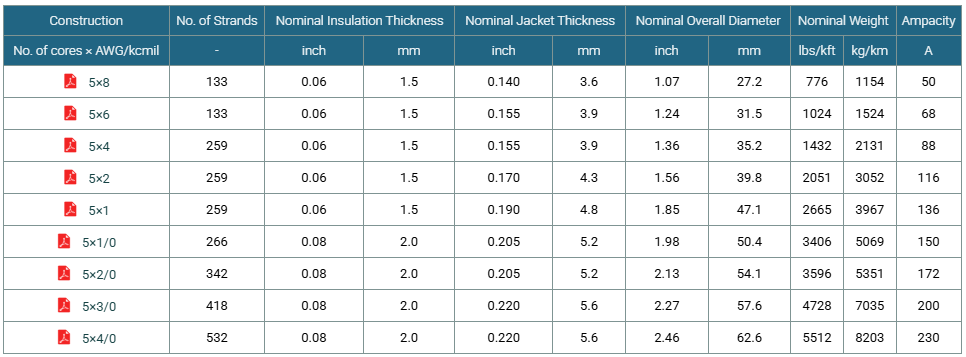
Construction Details
Conductors
The conductor assembly utilizes stranded annealed tinned copper following ASTM B 172 specifications for rope-lay stranded conductors and ASTM B 33 requirements for soft or annealed tinned copper wire. The stranding process divides the total conductor cross-section into multiple fine wires arranged in concentric layers, dramatically improving flexibility compared to solid conductors of equivalent ampacity.
Annealing softens the copper through controlled heating and cooling, further enhancing flexibility—a critical property for cables subjected to repeated bending during service on mobile equipment. The tin coating serves multiple purposes: it prevents oxidation of the copper surface, improves resistance to sulfur-bearing compounds found in some mining environments, and facilitates soldered connections when required.
The high flexibility achieved through stranded construction allows the cable to withstand the continuous flexing experienced at equipment connection points and reeling drums without conductor fatigue failure. This construction also provides excellent vibration resistance, preventing work hardening that could lead to conductor breakage in solid conductor designs.
Insulation
Each conductor receives individual insulation using ethylene propylene rubber (EPR), a thermoset compound engineered for high dielectric strength and long-term electrical reliability. EPR insulation maintains consistent electrical properties across a wide temperature range, from the cold conditions sometimes encountered in deep underground workings to the elevated temperatures generated by high current loads.
The material's excellent resistance to moisture prevents electrical tracking and ensures stable insulation resistance even in wet mining environments. EPR also demonstrates good chemical resistance to the oils, coolants, and hydraulic fluids commonly present in mining equipment areas. Unlike some insulation materials, EPR does not significantly degrade when exposed to ozone, an important characteristic for long cable service life.
The insulation thickness is carefully engineered to provide reliable electrical isolation at the 2kV operating voltage while maintaining sufficient flexibility for portable cable applications. This balance between electrical performance and mechanical properties distinguishes mining cables from more rigid industrial cable constructions.
Jacket
The outer jacket construction employs reinforced heavy-duty chlorinated polyethylene (CPE), with extra-heavy-duty CPE specified when the cable outside diameter exceeds 2.0 inches. This black jacket provides the cable's primary mechanical protection against the abrasive, impact, and tearing forces encountered in mining service.
CPE offers an exceptional combination of mechanical strength and chemical resistance. The material maintains its protective properties when exposed to mineral oils, hydraulic fluids, cutting oils, greases, dilute acids, and alkaline solutions—virtually all the chemicals commonly encountered in mining operations. Unlike natural rubber compounds, CPE demonstrates excellent resistance to ozone degradation and weathering, extending cable life in both underground and surface applications.
For enhanced protection, the jacket may incorporate reinforcing fiber between two CPE layers, creating a composite structure with superior tear resistance. This construction significantly improves the cable's ability to survive sharp rock fragments and mechanical abuse without jacket penetration.
The black color simplifies cable identification in mining environments and reduces visible surface soiling, though custom color stripes or identification markings can be applied when project specifications require enhanced visual identification of specific circuits or voltage levels.
Standards and Compliance
Adherence to recognized industry standards provides assurance that this Type W portable power cable meets established performance and safety benchmarks. ICEA S-75-381 and NEMA WC 58 specify requirements for portable and power feeder cables used in mines and similar applications, covering conductor construction, insulation properties, jacket performance, and testing protocols.
ASTM B 172 establishes specifications for rope-lay-stranded copper conductors, ensuring that conductor construction meets minimum requirements for strand count, lay length, and mechanical properties. ASTM B 33 covers soft or annealed tinned copper wire, specifying the tin coating thickness and copper properties required for reliable long-term performance.
CAN/CSA C22.2 No. 96 compliance indicates that the cable meets Canadian requirements for mining and industrial applications, facilitating use in Canadian mining operations and providing assurance of performance for operations that follow Canadian electrical standards.
These standards address not only the cable's as-manufactured properties but also performance under simulated service conditions, including tests for insulation resistance, dielectric strength, cold bend performance, flame resistance, and jacket properties after environmental exposure.
Mechanical and Thermal Properties
The minimum bending radius specification of six times the cable outside diameter establishes safe handling limits during installation and operation. Exceeding this bending limit risks damaging conductors, stressing insulation, or cracking the jacket, potentially leading to premature cable failure. This relatively generous bending radius requirement reflects the cable's optimization for portable service rather than fixed installation in cable trays or conduits.
The maximum conductor operating temperature of 90°C provides adequate thermal capacity for continuous service at rated current while maintaining margin below temperatures that would degrade insulation properties over time. This temperature rating assumes proper cable support, adequate ventilation, and current loading within the cable's ampacity specifications.
High mechanical strength characterizes this cable construction, enabling it to withstand the dragging forces, reeling stresses, and frequent movement inherent in mining applications. The combination of flexible conductors, resilient insulation, and reinforced jacket creates a cable structure that absorbs mechanical shock and vibration without electrical or structural failure.
Mining operations subject cables to mechanical stresses rarely encountered in commercial or industrial facilities. Equipment movement generates continuous flexing cycles, floor contact causes abrasive wear, and falling debris creates impact loads. The mining portable power cable construction addresses all these mechanical challenges while maintaining electrical integrity.
Common Cable Issues and Solutions
Question: Why do mining cables fail prematurely at equipment connection points?
Answer: Connection point failures typically result from excessive bending or inadequate strain relief. When a cable connects to moving equipment, the attachment point becomes a high-stress area subjected to repeated flexing. If the cable bends sharply at this point—violating the minimum 6×OD bending radius—conductor strands progressively break from fatigue, eventually causing circuit failure.
Installing proper strain relief devices distributes bending stress over a longer cable section, preventing concentration at a single point. Cable slings or support springs maintain the recommended bending radius even as equipment moves. Regular inspection of connection areas allows identification of wear before complete failure occurs.
Question: How can we prevent jacket damage from abrasion in our operation?
Answer: Abrasion protection requires multiple approaches. First, specify extra-heavy-duty jacket construction for severe applications—the additional thickness significantly extends abrasion life. Second, minimize floor contact by using cable handlers, reels, or support systems that lift the cable off abrasive surfaces. Third, eliminate sharp edges or obstacles that concentrate abrasive forces on small cable areas.
For extreme conditions, consider additional mechanical protection such as cable sleeves or protective conduits in high-wear zones. However, avoid protection methods that restrict cable flexibility or trap moisture against the jacket, as these create new failure mechanisms.
Question: What causes insulation resistance to decrease in our mining cables?
Answer: Insulation resistance degradation usually stems from moisture infiltration through jacket damage. When abrasion, cuts, or impact damage penetrates the jacket, moisture reaches the insulation surface, gradually reducing resistance to ground. In severe cases, tracking paths develop that can lead to ground faults.
Preventing jacket damage through proper handling and routing provides the primary defense. Regular insulation resistance testing identifies cables with compromised jackets before ground faults occur, allowing preventive replacement. Maintaining cables above minimum specified bending radii prevents stress cracking that could admit moisture.
Question: Can this cable be used for equipment operating outdoors in extreme cold?
Answer: While this cable construction demonstrates good low-temperature performance, extreme cold operation requires verification that temperatures remain above the cable's minimum rated temperature. EPR insulation and CPE jacket both maintain flexibility at temperatures well below freezing, but very cold conditions can reduce flexibility and increase the force required for cable handling.
For equipment operating in extreme cold environments, allowing cables to warm gradually before manipulation reduces the risk of jacket cracking. Storage in heated areas when not in use extends cable life. If specific cold temperature performance is critical, consult technical specifications for the exact cable construction to verify cold bend ratings meet application requirements.
Installation Recommendations
Proper installation practices significantly influence cable service life and reliability. Always observe the minimum bending radius of 6×OD during installation, routing, and operation. Plan cable routes to avoid sharp corners, edges, or obstacles that could concentrate mechanical stress. Use cable guides, rollers, or support systems to maintain proper bending radii at direction changes.
Avoid routing cables where they will be crushed by equipment, struck by materials, or subjected to repetitive impact. When cables must cross traffic areas, provide adequate mechanical protection such as cable bridges or protective channels. However, ensure protection systems do not create tight bends or restrict the cable's natural movement during equipment operation.
Select terminations and connectors specifically designed for Type W portable power cables, ensuring they provide adequate mechanical support and maintain proper electrical contact. Follow manufacturer recommendations for connector installation, paying particular attention to strain relief requirements. Improper connector installation creates stress concentration points where cable failures commonly initiate.
Comply with all applicable safety regulations, electrical codes, and site-specific requirements for mining installations. Verify that cable ampacity matches equipment electrical loads with appropriate safety margins. Implement proper grounding practices and ground fault protection systems as required by applicable codes and regulations.
Maintenance and Safety
Establish regular inspection schedules examining cables for jacket abrasion, cuts, cracks, or other visible damage. Pay particular attention to high-stress areas including equipment connection points, locations where cables contact floors or structures, and sections subject to repeated flexing. Early identification of jacket damage allows repair or replacement before electrical failures occur.
Inspect for signs of overheating including discolored jacket material, soft or melted areas, or unusual odors. Overheating indicates excessive current loading, poor connections, or insulation degradation—all conditions requiring immediate investigation and correction. Check conductor connections periodically for tightness and proper contact resistance.
Replace cables showing significant wear, insulation damage, or conductor exposure. Attempting to extend the service life of damaged cables through temporary repairs creates serious safety risks and often leads to more extensive equipment damage when the cable ultimately fails. Maintaining adequate spare cable inventory enables prompt replacement of worn cables without disrupting operations.
Document cable maintenance activities, test results, and replacement decisions to establish service life patterns and identify systematic issues that may require changes to cable specifications, routing methods, or handling procedures. This information proves valuable when evaluating cable performance and planning future purchases.
Why Choose This Type W Five-Conductor Cable
The combination of stranded tinned copper conductors, EPR insulation, and reinforced CPE jacket represents a proven formula optimized specifically for mobile mining equipment and heavy-duty applications. This construction has demonstrated reliable performance across thousands of mining operations worldwide, establishing a track record of durability in the most demanding conditions.
Compliance with international standards including ICEA S-75-381, NEMA WC 58, and CAN/CSA C22.2 No. 96 provides assurance that the cable meets established benchmarks for electrical performance, mechanical strength, and safety. These standards reflect decades of industry experience and comprehensive testing programs, giving users confidence in cable reliability.
Long service life and reduced downtime deliver tangible economic benefits in demanding mining environments where cable failures disrupt production and create safety hazards. The initial investment in quality portable power cables pays dividends through extended service intervals, fewer emergency replacements, and improved operational continuity. When power distribution reliability directly impacts production capacity and worker safety, selecting cables engineered specifically for mining applications represents sound business practice and responsible safety management.
How to Reach Us
Get in Touch
SiteMap
Product Catalogue
Festoon Cable
Shore Power Cable


Scan to add us on WeChat