Type W Two-Conductor Flat Portable Power Cable 2kV for Mining Applications
Type W two-conductor flat portable power cable 2kV for DC mining equipment. EPR insulation, tinned copper conductors, heavy-duty CPE jacket. ICEA/NEMA complian
hongjing.Wang@Feichun
11/11/202510 min read
Introduction to Type W Flat Portable Power Cable 2kV
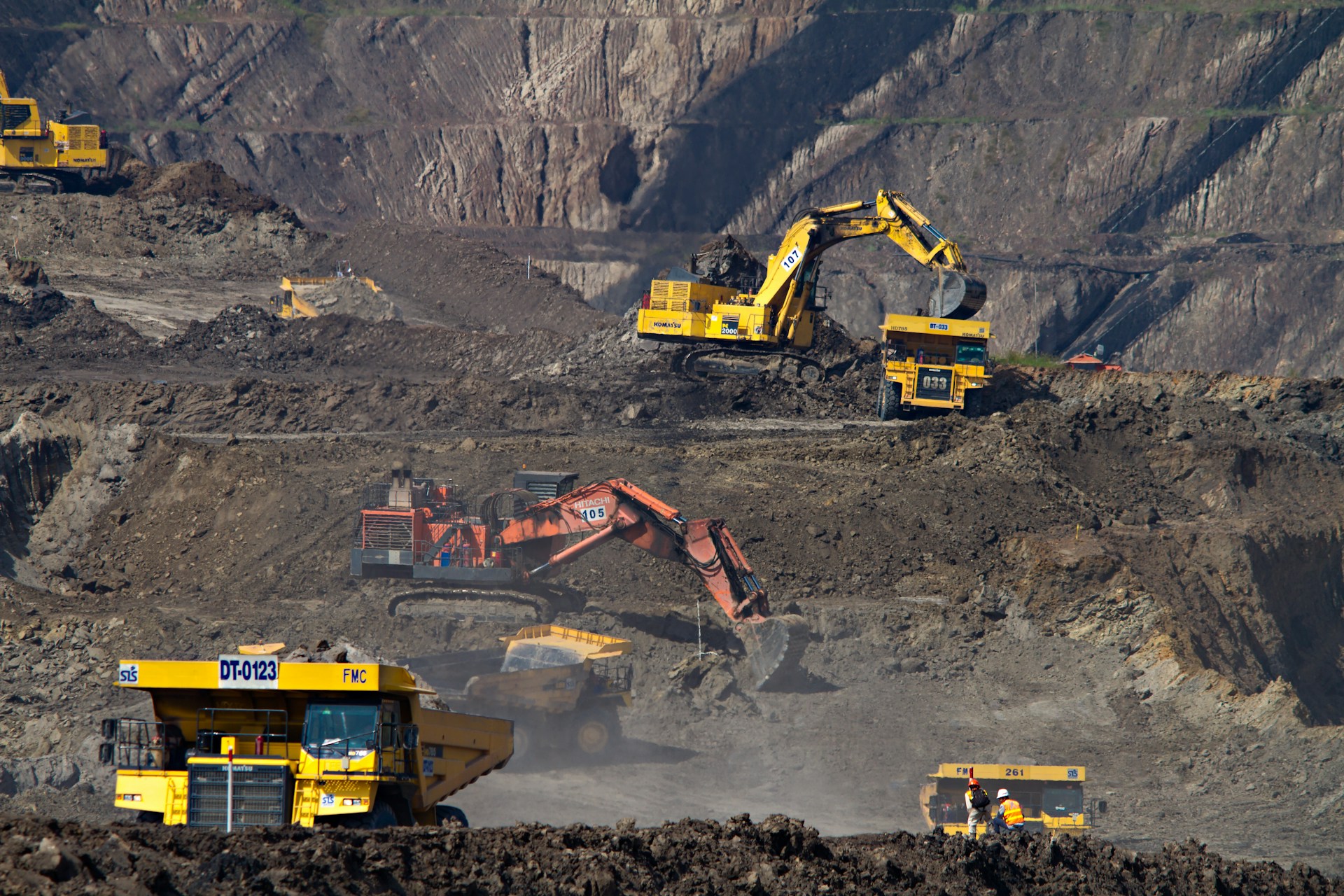
In the demanding environment of underground mining operations, reliable power distribution is not just a convenience—it's a critical safety and operational necessity. The Type W two-conductor flat portable power cable 2kV represents a specialized solution engineered specifically for DC mining equipment, including shuttle cars, drills, cutting machines, and loading equipment. This heavy-duty power cable combines robust construction with flexible portability, meeting the rigorous demands of continuous mining operations while maintaining compliance with international safety standards.
The mining power cable industry has evolved significantly to address the unique challenges posed by underground environments. Type W power cable designation indicates a portable cord specifically designed for extra-hard usage in applications where flexibility, durability, and electrical performance are paramount. The flat parallel configuration of this two-conductor power cable offers distinct advantages over traditional round cable designs, particularly in terms of handling efficiency, storage optimization, and reduced tangling during deployment and retrieval operations.
Technical Specifications and Construction
Conductor Design and Materials
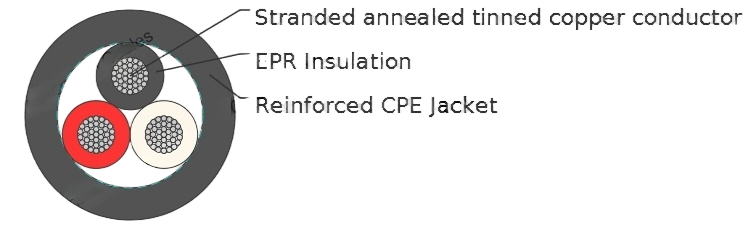
The foundation of any reliable DC mining cable lies in its conductor construction. Type W flat portable power cables utilize stranded annealed tinned copper conductors, a design choice that delivers multiple performance benefits. The stranding process involves multiple fine copper wires twisted together, providing exceptional flexibility while maintaining excellent current-carrying capacity. This construction allows the cable to withstand repeated bending and flexing without conductor breakage—a critical requirement for portable mining equipment power supply.
The tinning process, where copper conductors are coated with a thin layer of tin, provides superior corrosion resistance compared to bare copper alternatives. In mining environments where moisture, chemical exposure, and varying temperatures are commonplace, tinned copper conductor mining cable offers extended service life and maintains consistent electrical performance. The tin coating also facilitates easier termination and improves contact reliability at connection points, reducing maintenance requirements and minimizing potential failure points.
Insulation System: EPR Technology
Ethylene Propylene Rubber (EPR) insulation forms the primary electrical barrier in these cables, chosen specifically for its outstanding performance characteristics in harsh industrial environments. EPR insulated mining power cable specifications emphasize the material's exceptional dielectric strength, which ensures reliable operation at the 2kV voltage rating while providing a significant safety margin.
EPR insulation exhibits remarkable flexibility across a wide temperature range, typically from -50°C to +105°C, maintaining its mechanical and electrical properties even under extreme conditions. This temperature resistance proves invaluable in mining operations where ambient temperatures can fluctuate significantly. The material's inherent resistance to moisture, ozone, and various chemicals commonly encountered in mining environments—including oils, coolants, and cleaning agents—ensures consistent performance and longevity.
Additionally, EPR's resistance to weathering and UV degradation makes it suitable for applications where cables may be temporarily exposed to surface conditions during transport or maintenance. The insulation's elastomeric properties allow it to recover from compression and mechanical stress, contributing to the cable's overall durability and extended operational life.
Reinforcement Structure
Between the insulation layer and the outer jacket, Type W cables incorporate synthetic yarn reinforcement—a critical component often overlooked in discussions of cable construction. This reinforcement serves multiple purposes: it provides mechanical strength to resist pulling forces during cable handling, adds an additional layer of protection against abrasion and mechanical damage, and helps maintain the cable's structural integrity under stress.
The cable reinforcement yarn also acts as a barrier against moisture migration along the cable length, a phenomenon known as "wicking." In underground mining environments where water infiltration is common, this feature helps prevent electrical failures that could result from moisture reaching conductor terminations.
Heavy-Duty Chlorinated Polyethylene Cable Jacket
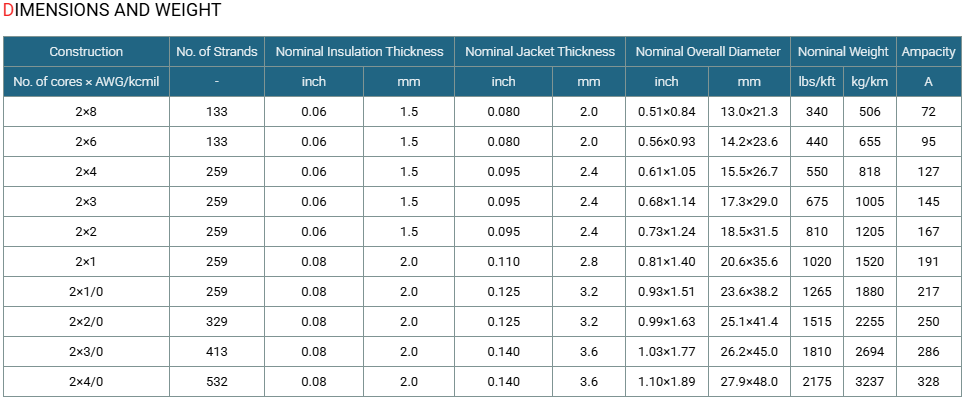
The outermost layer of protection comes from a heavy-duty chlorinated polyethylene (CPE) jacket, available in both heavy-duty and extra-heavy-duty configurations depending on the specific application requirements and cable outside diameter. For cables with an overall diameter exceeding 2.0 inches, extra-heavy-duty jackets are standard, providing enhanced protection against the severe mechanical abuse typical in mining operations.
CPE offers exceptional resistance to abrasion, cutting, tearing, and impact—all critical properties for portable equipment power cables that are frequently dragged across rough surfaces, subjected to crushing forces from mobile equipment, and exposed to sharp rock edges. The material's resistance to oils, greases, and most chemicals ensures that incidental spills or contact with mining equipment fluids won't compromise cable integrity.
The black color coding of the CPE jacket serves practical purposes beyond aesthetics. Black compounds typically include carbon black, which provides UV resistance for occasional outdoor exposure and helps dissipate static charges. The dark color also makes it easier to identify wear patterns and surface damage during routine inspections.
Standards Compliance and Quality Assurance
Adherence to industry standards ensures that Type W flat portable mining power cables meet rigorous safety and performance requirements. The primary governing standards include ICEA S-75-381 mining power cable specifications, which define construction requirements, testing protocols, and performance criteria for portable power cables used in mining applications. NEMA WC 58 provides complementary specifications ensuring consistency across manufacturers.
Material standards are equally important: ASTM B 172 governs the tinned copper wire specifications, ensuring proper tinning thickness and coverage, while ASTM B 33 defines the requirements for the copper conductors themselves, including conductivity levels, stranding configurations, and mechanical properties.
For operations in Canada or equipment certified to Canadian standards, compliance with CAN/CSA C22.2 No. 96 is essential. This standard addresses portable power cables for use with mobile equipment, providing specific requirements for construction, testing, and marking.
Application Scenarios in Mining Operations
DC Shuttle Car Power Cable 2kV Applications
DC shuttle cars represent one of the primary applications for flat portable power cables in underground mining. These vehicles transport coal or ore from the continuous miner to conveyor systems or loading points, requiring reliable, flexible power delivery throughout their range of motion. The DC shuttle car power cable 2kV must withstand constant dragging across mine floors, resistance to pinching by shuttle car wheels or track systems, and frequent coiling and uncoiling during operation.
The flat parallel cables for DC mining equipment offer distinct advantages in shuttle car applications. The flat profile reduces the likelihood of the cable rolling under the shuttle car's wheels, minimizing crushing damage. The configuration also facilitates easier handling by operators who must manage hundreds of feet of cable during shift operations. The two-conductor design provides adequate power delivery for DC motors while minimizing cable weight and bulk—critical factors when operators must manually handle and reposition cables multiple times during a shift.
Mining Drill Power Cable Requirements
Portable power cable for mining drills faces unique challenges related to the equipment's operational characteristics. Mining drills generate significant vibration during operation, require frequent repositioning, and often operate in confined spaces with limited cable routing options. The EPR insulation's flexibility and resilience to repeated flexing ensure reliable performance despite the mechanical stress imposed by drilling vibrations.
The flat configuration of these cables provides benefits in drill applications by allowing the cable to lay flat against tunnel walls or floors, reducing trip hazards and minimizing interference with other mining operations. The tinned copper conductors maintain low resistance connections even when subjected to vibration, ensuring consistent power delivery to drill motors and preventing performance degradation that could result from poor electrical connections.
Cutting and Loading Machine Applications
Heavy-duty power cable requirements for cutting and loading machines are among the most demanding in mining operations. These machines combine significant power consumption with continuous movement, creating a challenging environment for power cables. The equipment's weight and cutting forces can easily damage improperly specified cables, while the need for frequent repositioning demands exceptional flexibility.
Type W cables designed for these applications feature reinforced construction that resists the crushing forces these machines can inadvertently apply to cables. The heavy-duty CPE jacket withstands abrasion from coal, rock, and metal surfaces, while the EPR insulation maintains its electrical properties despite exposure to cutting fluids, hydraulic oils, and other chemicals common around this equipment.
Design Advantages for Mining Environments
The flat parallel configuration delivers multiple operational benefits beyond basic electrical performance. Space-saving installation becomes crucial in confined underground mining environments where cable routing options are limited. Flat cables can be positioned along tunnel walls, under equipment, or in narrow channels where round cables would be impractical. This configuration also reduces the effective height profile of cable installations, minimizing interference with mobile equipment traffic.
Storage efficiency represents another significant advantage. Flat cables coil more compactly and with less tendency to form kinks or memory loops compared to round cables of equivalent current-carrying capacity. During shift changes or equipment repositioning, operators can more quickly and easily manage flat cables, reducing downtime and improving overall operational efficiency.
The two-conductor design optimizes the cable for DC power distribution applications common in mining operations. Unlike three-phase AC systems that require three or four conductors, DC shuttle cars and many mining drills operate on two-conductor power systems, making the flat two-conductor configuration ideal. This design reduces unnecessary cable weight and bulk while providing exactly the conductors needed for the application.


Common Cable Problems and Solutions
Problem: Premature Jacket Wear and Cracking
Issue: Operators frequently report excessive wear on the outer jacket, particularly in high-traffic areas where the cable is repeatedly dragged across rough surfaces or subjected to crushing forces from mobile equipment.
Solution: This typically indicates either inadequate jacket specification for the application or improper cable handling practices. Ensure that extra-heavy-duty jacket options are specified for high-abrasion environments. Implement cable handling training emphasizing proper dragging techniques that distribute wear evenly across the cable length. Consider installing cable guides or protectors in areas where cables must cross high-traffic paths or where sharp edges pose particular hazards. Regular inspection protocols should identify wear patterns early, allowing for cable rotation or replacement before jacket failure exposes insulation layers.
Problem: Insulation Failure Due to Water Infiltration
Issue: Electrical failures occur after water penetrates the cable system, particularly at termination points or where mechanical damage has compromised the jacket integrity.
Solution: While EPR insulation provides excellent moisture resistance, water can migrate along the cable if the jacket is breached. Implement rigorous termination practices using approved sealing methods and heat-shrink or tape systems designed for mining applications. For temporary repairs in the field, use self-amalgamating tape and overwrap with friction tape to create a moisture-tight seal. Establish inspection procedures that specifically check for jacket damage, particularly after cable pinch or crush incidents. Consider installing cable drainage loops at low points to prevent water accumulation along cable runs.
Problem: Conductor Breakage from Repeated Flexing
Issue: The cable experiences conductor failure, often manifesting as intermittent power loss or complete circuit interruption, particularly near termination points or in areas of repeated bending.
Solution: This problem typically results from exceeding the cable's minimum bend radius during installation or operation. Consult manufacturer specifications for minimum bend radius—generally 12 times the cable's overall diameter for Type W cables—and ensure all cable routing respects this limitation. Install bend protectors or cable boots at termination points to prevent sharp bending at stress concentration points. If conductor breakage occurs frequently in specific cable sections, evaluate whether the application demands a more flexible cable construction or whether cable routing can be improved to reduce bending stress.
Problem: Electrical Noise or Voltage Drop Issues
Issue: Equipment experiences performance degradation, manifested as reduced motor speed, erratic operation, or increased heating, despite apparently intact cable systems.
Solution: This typically indicates excessive voltage drop due to inadequate conductor sizing, poor termination connections, or conductor damage. Verify that cable conductor size is appropriate for the actual current draw and cable length. Even if the cable was correctly specified initially, verify that equipment modifications haven't increased current requirements. Check all termination points for proper torque, clean connections, and absence of corrosion. The tinned copper conductors should resist corrosion, but connection hardware may corrode in harsh mining environments. Use contact cleaner and appropriate corrosion inhibitors during termination maintenance. Consider using larger conductor sizes for applications involving long cable runs or high starting currents.
Problem: Cable Overheating During Operation
Issue: The cable becomes excessively hot during normal equipment operation, posing safety risks and potentially degrading insulation properties over time.
Solution: Overheating typically results from one of three causes: excessive current draw, inadequate conductor sizing, or restricted heat dissipation. First, verify that equipment current draw matches cable ampacity ratings. Mining equipment that has been modified or is operating under abnormal conditions may draw more current than originally specified. Second, confirm that the cable conductor size is appropriate for both the steady-state current and starting currents of connected equipment. Finally, ensure that cables are not tightly bundled or covered in ways that prevent natural cooling. Type W cables are designed for portable applications with natural convection cooling; covering cables with insulating materials or tightly bundling multiple cables can cause overheating even when individual cables are not overloaded.


Installation and Maintenance Best Practices
Proper cable handling begins with understanding the mechanical limitations of the cable construction. Despite the robust design of Type W flat portable power cables, they are not indestructible. Train operators to avoid driving over cables with heavy equipment, to lift rather than drag cables when possible, and to inspect cables before each use for signs of damage.
Temperature operating ranges should be respected. While EPR insulation performs well across a broad temperature spectrum, extreme cold can temporarily reduce flexibility, making cables more susceptible to damage during handling. In cold environments, allow cables to acclimate gradually or warm them slightly before coiling or uncoiling to prevent insulation cracking.
Storage practices significantly impact cable longevity. Cables should be coiled loosely, respecting minimum bend radius requirements, and stored in areas protected from direct sunlight, extreme temperatures, and chemical exposure. Hanging cables on appropriately sized cable reels prevents the cable weight from creating pressure points that could damage insulation or conductors over time.
Regular inspection protocols should include visual examination of the entire cable length for jacket damage, unusual flattening or deformation, and signs of overheating. Electrical testing at scheduled intervals can identify insulation degradation or conductor damage before failures occur. Megger testing of insulation resistance provides quantitative data on insulation condition, allowing proactive replacement before failure disrupts operations.
Conclusion
The Type W two-conductor flat portable power cable 2kV represents a specialized engineering solution optimized for the demanding requirements of DC mining equipment operations. Its combination of tinned copper conductors, EPR insulation, synthetic yarn reinforcement, and heavy-duty CPE jacket provides the durability, flexibility, and electrical performance necessary for reliable operation in harsh underground mining environments.
Understanding the cable's construction, proper application, and maintenance requirements ensures maximum service life and operational reliability. When properly specified, installed, and maintained, these cables deliver years of dependable service, supporting safe and efficient mining operations. The investment in quality Type W cables, combined with appropriate handling practices and regular maintenance, proves economically sound by minimizing downtime, reducing replacement costs, and enhancing workplace safety.
For mining operations seeking to optimize their portable power distribution systems, selecting ICEA S-75-381 compliant Type W flat portable power cables from reputable manufacturers ensures compliance with industry standards while providing the performance characteristics necessary for demanding mining applications. Whether powering shuttle cars, drills, or loading equipment, these cables represent the industrial-grade solution that modern mining operations require.
How to Reach Us
Get in Touch
SiteMap
Product Catalogue
Festoon Cable
Shore Power Cable


Scan to add us on WeChat