
Type W Two-Conductor Round Portable Power Cable 2kV – Heavy-Duty Industrial Series
Looking for durable 2kV Type W Cable? Our 2-conductor round portable power cable offers extreme flexibility and abrasion resistance with a reinforced CPE jacket. Perfect for heavy-duty general use where grounding conductors aren't needed. View full specs, bending radius, and custom options here.
hongjing.Wang@Feichun
1/5/20269 min read
Product Overview
The Type W two-conductor portable power cable represents a premium-grade electrical solution engineered specifically for demanding industrial environments operating at voltages up to 2000 Volts. This robust cable design addresses a critical need in modern industrial operations: reliable power transmission in applications where a separate bare grounding conductor is neither required nor desired by system specifications.
Unlike standard three-conductor configurations, this 2-conductor design offers a streamlined solution for specialized power distribution scenarios. The cable excels in mining operations, industrial automation systems, mobile heavy machinery, and temporary power distribution networks where direct equipment grounding through alternative means satisfies safety requirements. Its construction philosophy prioritizes flexibility without compromising durability, making it an indispensable component for operations demanding both mechanical resilience and electrical reliability.
The 2kV rating provides substantial safety margins beyond conventional 600V cables, offering engineers additional protection against voltage transients and system anomalies common in harsh industrial settings. This voltage headroom proves particularly valuable in mining environments where electrical systems face constant exposure to moisture, dust, and mechanical stress.
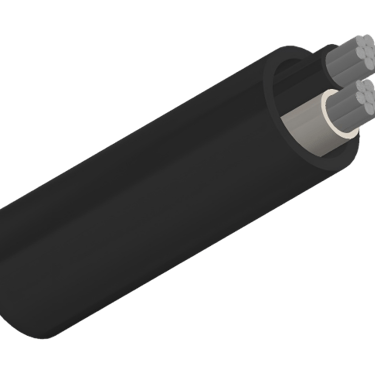
Construction & Material Specifications
Conductor Design
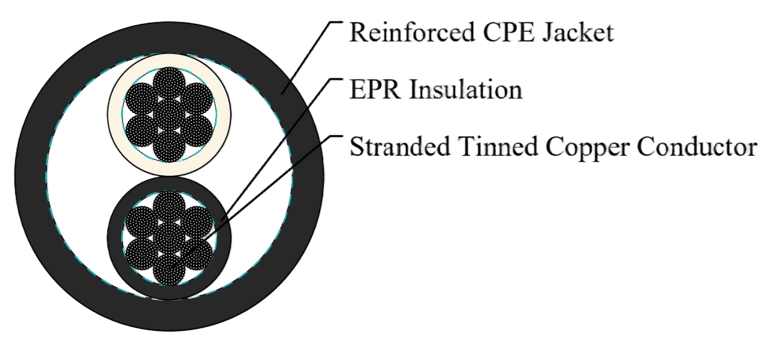
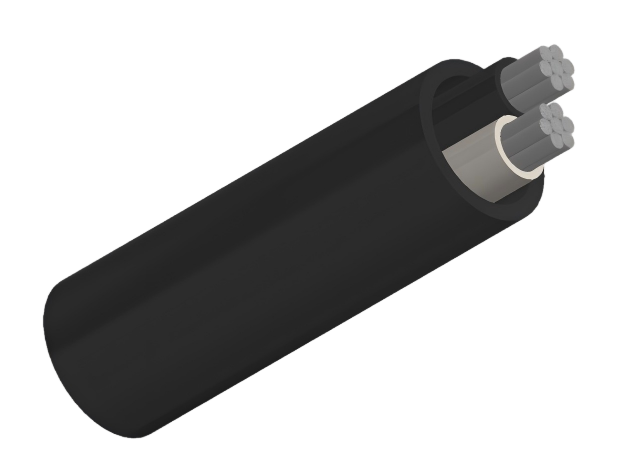
At the core of this Type W cable lies stranded annealed tinned copper conductors manufactured to rigorous industry standards. The stranding configuration provides exceptional flexibility, allowing the cable to withstand repeated bending cycles without conductor fatigue or breakage. Tinning the copper strands creates a protective barrier against corrosion, particularly crucial in environments with high humidity, chemical exposure, or coastal conditions where salt air accelerates oxidation.
The annealing process softens the copper, enhancing its flexibility while maintaining excellent electrical conductivity. This combination ensures the cable delivers consistent power transmission efficiency throughout its operational lifespan. The stranded construction typically follows Class K flexibility standards, providing the mechanical properties necessary for portable applications involving frequent repositioning or coiling.
Insulation System
Each conductor receives individual insulation using Ethylene Propylene Rubber (EPR), a synthetic elastomer renowned for its superior electrical and thermal properties. EPR insulation offers several critical advantages over alternative materials. Its high dielectric strength effectively contains electrical fields within the conductor, preventing voltage breakdown even under stress conditions. The material exhibits exceptional resistance to heat, maintaining integrity at conductor temperatures reaching +90°C without degradation.
EPR's moisture immunity stands as another defining characteristic. Unlike hygroscopic insulation materials that absorb water and lose dielectric properties, EPR remains impervious to moisture penetration. This quality proves essential in mining applications where cables frequently encounter wet conditions, standing water, or high-humidity atmospheres. The insulation also resists ozone degradation and maintains flexibility across a broad temperature spectrum, functioning reliably from -40°C to +90°C.
Jacket Protection
The cable's outermost layer consists of reinforced Chlorinated Polyethylene (CPE) jacket material, engineered to withstand the mechanical and environmental challenges inherent to industrial applications. CPE provides outstanding resistance to abrasion, oils, acids, and ultraviolet radiation, protecting the internal components from external damage sources.
The jacket thickness follows industry-established guidelines based on cable diameter. Cables exceeding 2.0 inches in overall diameter (OD) receive extra-heavy-duty jackets, incorporating additional material thickness to maximize impact resistance and crush protection. This graduated approach ensures optimal protection without unnecessarily increasing cable weight and rigidity on smaller diameter constructions.
The black CPE formulation serves dual purposes: the color provides easy identification while the carbon black additive enhances UV resistance for cables used in outdoor or semi-outdoor applications. The jacket's flexibility complements the overall cable design, maintaining pliability even in cold environments where some jacket materials become brittle and prone to cracking.
Mechanical & Thermal Performance
Temperature Capabilities
The cable's thermal performance envelope spans from -40°C ambient storage to +90°C maximum conductor operating temperature. This range accommodates extreme environmental conditions while ensuring safe continuous operation under full load. The conductor temperature rating accounts for both ambient heat and self-heating from current flow, providing engineers with clear parameters for ampacity calculations.
In high-temperature environments such as furnace areas, foundries, or confined spaces with limited ventilation, the +90°C rating offers substantial operational headroom. The EPR insulation maintains its physical and electrical properties throughout this temperature range without softening, hardening, or losing dielectric strength.
Flexibility Characteristics
One of the defining features of this portable power cable is its mechanical flexibility. The minimum bending radius specification of 6 times the overall diameter (6 × OD) represents a relatively tight bend capability compared to rigid or semi-rigid cable constructions. This flexibility proves critical in several operational contexts.
For mobile equipment applications, the cable must navigate around obstacles, through cable carriers, and onto reeling mechanisms without sustaining damage. A tighter bending radius enables more compact installations, reduces the physical space required for cable routing, and minimizes strain on termination points. Equipment such as shuttle cars, continuous miners, and mobile cranes benefits significantly from this flexibility, as these machines require frequent repositioning with cable in tow.
The flexible construction also extends cable service life by reducing mechanical stress during handling and operation. Cables subjected to repeated bending within their specified radius maintain insulation integrity and conductor continuity far longer than those forced into excessively tight bends that exceed design limitations.
Durability and Environmental Resistance
The CPE jacket formulation resists degradation from multiple environmental factors simultaneously. Oil resistance protects against hydraulic fluid spills, lubricants, and petroleum-based contaminants common in industrial settings. Acid resistance proves valuable in chemical processing facilities, battery charging areas, and locations where cleaning agents or process chemicals contact the cable surface.
Abrasion resistance extends cable life in applications involving dragging across rough surfaces, contact with sharp edges, or rubbing against equipment frames during operation. The reinforced jacket construction distributes mechanical forces across a larger area, preventing localized wear points that could compromise cable integrity. Sunlight resistance through UV stabilization prevents jacket degradation in outdoor storage, temporary installations, or equipment operating in open-pit mining environments.
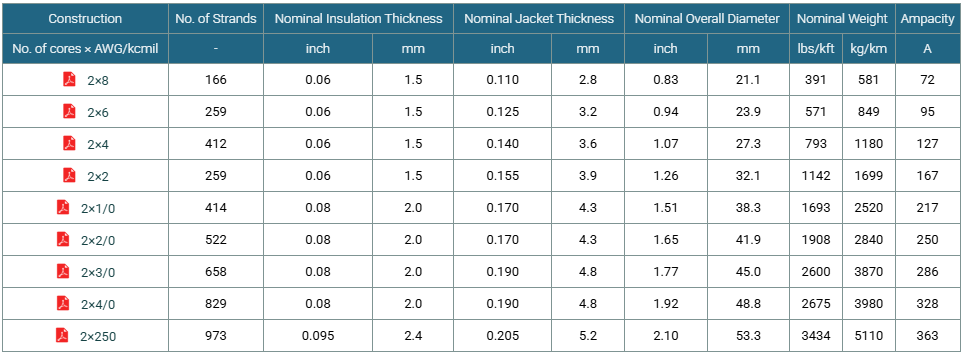
Customization & Jacket Options
Alternative Jacket Materials
While CPE serves as the standard jacket material, alternative compounds address specialized environmental requirements. Chlorosulfonated Polyethylene (CSP) offers enhanced chemical resistance and superior weathering characteristics, suitable for applications involving more aggressive chemical exposure or prolonged outdoor service.
Polychloroprene (PCP), commonly known by the trade name Neoprene, provides excellent flame resistance and maintains flexibility across temperature extremes. This material choice suits applications where fire safety concerns outweigh other considerations or where cable routing passes through areas with elevated fire risk.
Nitrile Butadiene Rubber (NBR) delivers superior oil and fuel resistance compared to standard compounds. Operations involving continuous exposure to petroleum products, cutting fluids, or hydraulic systems benefit from NBR's impermeability to these substances. PVC jackets offer a cost-effective alternative for less demanding applications, though with reduced flexibility and environmental resistance compared to elastomeric compounds.
Reinforcement Upgrade Options
For extreme mechanical stress applications, a two-layer jacket construction incorporates reinforcing fiber mesh between inner and outer jacket layers. This reinforcement dramatically increases tensile strength, tear resistance, and crush protection. The fiber mesh distributes tensile loads during cable pulling or when subjected to dragging forces, preventing jacket separation from the insulation system.
Reeling drum applications particularly benefit from this reinforcement. Cables wound onto power reels experience significant tensile stress during payout and retrieval cycles. The mesh reinforcement prevents elongation and maintains jacket integrity through thousands of reeling operations. Mining equipment that drags cables across rough mine floors, over rails, or through water similarly requires this enhanced protection level to achieve acceptable service life.
Applications and Usage Cases
Mobile Mining Equipment
Underground mining operations present some of the most challenging environments for electrical cables. Type W cable 2kV specifications make it particularly suitable for powering shuttle cars that transport ore from mining faces to conveyor systems. These vehicles frequently reverse direction, requiring cables to accommodate tight bends and constant flexing. The flexible mining power cable construction withstands this demanding duty cycle while maintaining electrical safety in damp, dusty conditions.
Continuous mining machines and rotary drills require substantial power delivery in confined spaces where cable routing options are limited. The round portable power cable construction fits through smaller openings and around obstacles more easily than flat or shielded designs. Dewatering pumps positioned in active working areas need reliable power supply despite frequent repositioning as mining advances, making portable cable designs essential.
Industrial Power Applications
Shore power connections for mobile equipment utilize these cables to deliver electricity from fixed distribution points to cranes, excavators, and material handlers. The 2-conductor configuration without ground proves appropriate when equipment frames connect directly to earth through structural means or when system design incorporates alternative grounding methods.
Overhead cranes and hoists in manufacturing facilities employ festoon systems or reeling drums to manage power cables during equipment movement. The cable's flexibility and durability accommodate the constant motion while its voltage rating handles the power requirements of large electric motors. Container handling equipment at ports and intermodal facilities faces similar demands, with cables experiencing continuous flexing while exposed to outdoor weather conditions.
Temporary Distribution Systems
Construction sites, outdoor events, and emergency power scenarios frequently require temporary electrical distribution. Generator connections using 2-conductor cable without ground serve specific load types including DC power systems, single-phase isolation transformers, or equipment with independent grounding provisions. The heavy-duty construction tolerates rough handling during setup and breakdown while the CPE jacket resists damage from site debris and weather exposure.
Film and television production requiring portable power distribution employ these cables for lighting systems and equipment. The cables must safely deliver substantial current while remaining manageable for frequent repositioning as production setups change throughout the day. Industrial maintenance operations use portable cables when equipment requires temporary power during repair, testing, or commissioning activities.


Why Choose Type W 2kV Cable?
Safety and Reliability Advantages
The 2000-volt rating provides critical safety margins over standard 600V rated cables. In systems operating at 480V or lower, this voltage headroom protects against transient overvoltages, voltage spikes from motor starting, and abnormal system conditions. The additional insulation thickness required for the higher voltage rating also increases mechanical protection and dielectric reliability.
Electrical safety in industrial environments depends on cable integrity under fault conditions. The robust construction contains arc faults and prevents insulation breakdown that could create shock hazards or ignition sources. Regulatory compliance becomes straightforward when cable voltage ratings substantially exceed system operating voltages, simplifying approval processes and inspection requirements.
Longevity and Life-Cycle Value
Tinned copper conductors resist corrosion that gradually increases electrical resistance and generates heat in untreated copper. In environments with moisture, chemicals, or salt exposure, this corrosion protection extends cable service life significantly. The initial cost premium for tinned conductors typically represents a small fraction of replacement costs should premature failure occur.
The reinforced jacket prevents tears, cuts, and abrasion damage that compromise cable integrity. Repair or replacement of damaged cables involves substantial direct costs for materials and labor, plus indirect costs from equipment downtime and production losses. Selecting appropriately robust cables initially minimizes these lifecycle costs, delivering superior total cost of ownership compared to lighter-duty alternatives requiring frequent replacement.
Common Cable Issues and Solutions
Problem: Premature Jacket Cracking
Question: Why do some portable power cables develop jacket cracks after relatively short service periods?
Answer: Jacket cracking typically results from exceeding minimum bending radius specifications, exposure to incompatible chemicals, or UV degradation in direct sunlight. Ensure cable routing maintains the 6 × OD minimum bend radius and avoid sharp edges at support points. For installations with chemical exposure, specify alternative jacket materials with appropriate resistance. Outdoor applications may require CSP jackets with enhanced UV stabilization rather than standard CPE formulations.
Problem: Conductor Overheating
Question: What causes conductors to overheat even when loads appear within rated capacity?
Answer: Overheating often stems from poor connections at termination points, undersized conductors for the actual current draw, or inadequate ventilation in cable trays. Verify all terminations are tight and properly torqued. Calculate actual ampacity considering ambient temperature, cable bundling, and duty cycle. In enclosed spaces, ensure adequate airflow prevents heat accumulation. Continuous duty applications require more conservative ampacity calculations than intermittent loads.
Problem: Moisture Ingress at Terminations
Question: How can moisture entering cable ends be prevented in wet environments?
Answer: While EPR insulated CPE jacket cable provides excellent moisture resistance along its length, termination points require proper sealing. Use appropriate cable glands with compression seals that grip the jacket without crushing. Heat-shrink boots or cold-applied wraps create additional moisture barriers at connections. In submersible applications or extreme wet conditions, specify potting compounds or sealed connector systems that completely encapsulate terminations.
Problem: Reduced Flexibility in Cold Weather
Question: Why does cable become difficult to handle in cold temperatures despite its -40°C rating?
Answer: All elastomeric materials experience increased stiffness at lower temperatures, though they remain functional. The -40°C rating indicates the cable maintains electrical properties and won't crack, not that flexibility remains unchanged. For extreme cold applications, minimize bending during low-temperature periods and allow cables to warm slightly before reeling or repositioning when possible. NBR or specialized cold-weather jacket formulations offer improved low-temperature flexibility compared to standard compounds.
Request a Quote / Contact Engineering
Selecting the optimal cable configuration requires careful consideration of your specific application parameters. Custom lengths, alternative jacket materials, conductor sizing, and reinforcement options can be specified to match your operational requirements precisely. Our engineering team provides technical support for ampacity calculations, environmental compatibility assessment, and compliance verification.
For bulk pricing on large projects, expedited delivery schedules, or technical consultation regarding cable selection and installation practices, contact our sales engineering department. We maintain inventory of common configurations while offering custom manufacturing for specialized requirements with competitive lead times.
How to Reach Us
Get in Touch
SiteMap
Product Catalogue
Festoon Cable
Shore Power Cable


Scan to add us on WeChat