
What Information Is Needed to Quote Crane Cable? A Complete Buyer's Guide for Industrial, Port and Mining Applications
Learn exactly what information is required to quote crane cable accurately — the electrical, mechanical, environmental and installation parameters that matter for reeling cables, festoon systems, ship loaders, stacker reclaimers, container cranes and mining equipment.
hongjing.Wang@Feichun
6/4/202612 min read
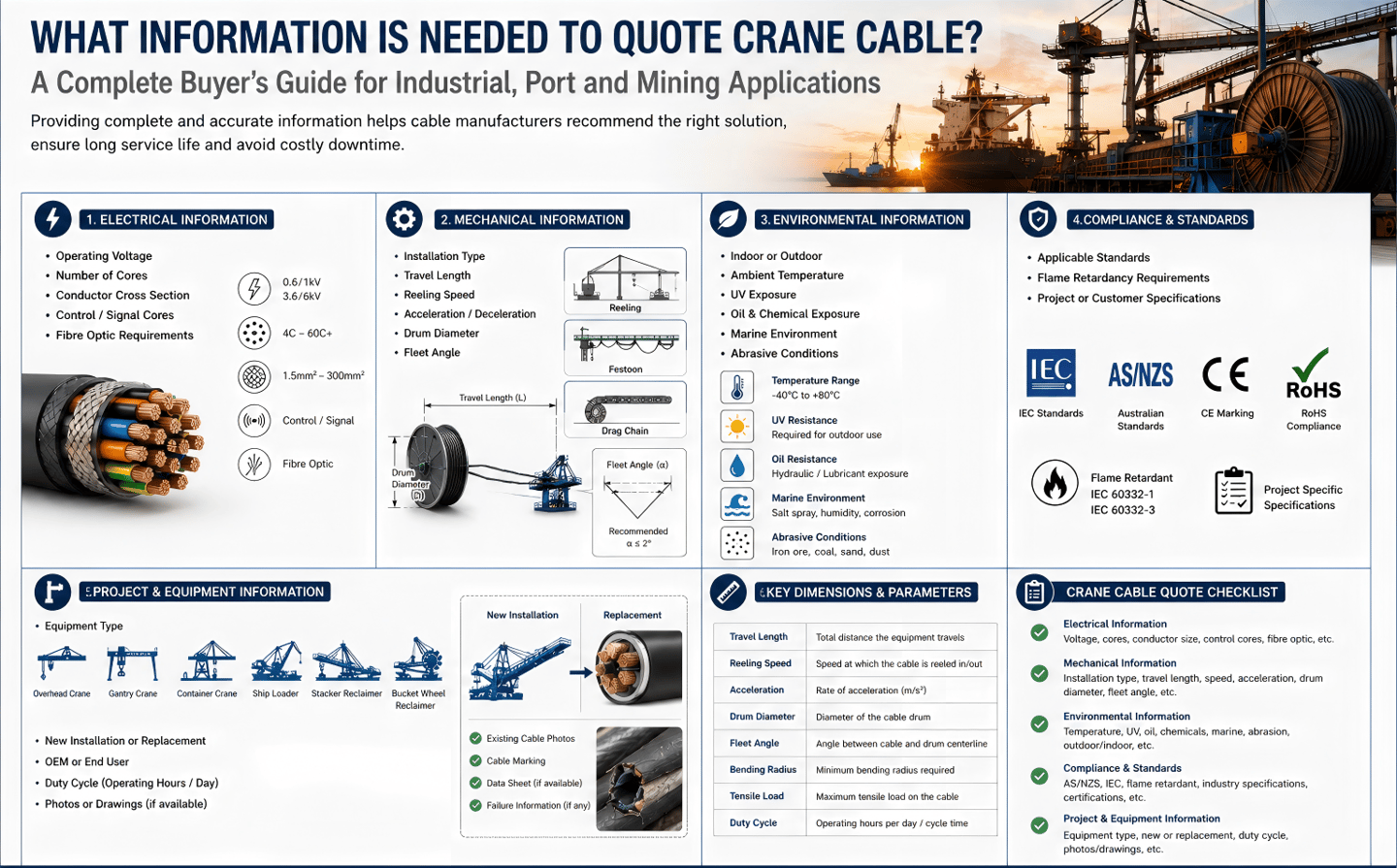
What Information Is Needed to Quote Crane Cable?
It happens most weeks. An email lands from a customer that reads, in full, something like: "Can you quote me a crane cable, 0.6/1kV, 4 core 35mm²? Need pricing today." It's a fair enquiry, and the person sending it usually assumes those two numbers are enough to put a price on the page. They almost never are.
Crane cable isn't a commodity you pull off a shelf. It's an application-specific engineered product, and the voltage and conductor size — the two things buyers reliably supply — are often the least important part of the selection. Get the rest wrong and you don't just pay too much or too little. You end up with a cable that cracks in the sun, fatigues on the drum, corrodes in the salt air, or simply doesn't fit the machine, and you discover all of that the hard way, mid-shift, with production stopped.
This guide walks through exactly what information a cable manufacturer actually needs to quote crane cable properly — electrical, mechanical, environmental, compliance and project details — and why each one matters. There's a checklist near the end you can copy straight into your next request for quotation, a worked example from a Western Australian ship loader, and a rundown of the mistakes that cost buyers the most. If you spend ten minutes gathering the right information before you send the enquiry, you'll get a better cable, a more accurate price, and far fewer surprises down the track.
Why Crane Cable Quotations Are Different from Standard Power Cables
When you specify building wire or a standard industrial power cable, the logic is largely electrical. You work out the load, size the conductor for current and voltage drop, choose an insulation rating, and you're most of the way there. The cable sits still in a conduit or on a tray for the rest of its life, so mechanical demands are minimal.
Crane cable flips that thinking on its head. With a moving cable, the mechanical duty usually dictates the design more than the electrical requirement does. Two cables can carry identical voltage and current and yet need completely different constructions, because one is reeling 100,000 times a year in 60°C heat and the other is flexing gently in a workshop. The same voltage does not mean the same cable — that single idea is the foundation of everything that follows.
A quick tour of the main crane types shows why a one-size answer never works.
Overhead cranes in a workshop or factory typically travel moderate distances and often use festoon systems, where the cable hangs in loops from a track. The duty is real but relatively gentle.
Container cranes are a different animal. They reel cable at high speed and run more or less continuously, so flex life and reeling performance dominate the design.
Ship loaders travel long distances along a wharf in a harsh marine environment, combining big mechanical demands with salt, UV and dust all at once.
Stacker reclaimers move in several directions at once — travelling, slewing, luffing — which puts complex, multi-axis stress through the cable.
Bucket wheel reclaimers and excavators sit at the extreme end, with very high mechanical loads in demanding mining applications where downtime is brutally expensive.
Each of these needs the cable matched to how it actually moves, which is why a good quotation starts with questions, not a part number.
Step 1 — The Electrical Information
Even though mechanics often rules, you still have to get the electrical basics right. These are the parameters most buyers already know to supply.
Operating Voltage
The rated voltage drives the insulation design and thickness. Common ratings run from low-voltage flexible cables at 300/500V and 450/750V, up through 0.6/1kV, and into medium voltage at 3.6/6kV, 6/10kV and beyond. As voltage climbs, the cable needs more sophisticated insulation and field control. Medium-voltage reeling cables, for instance, use semiconductive layers to manage the electrical field around the conductor — something a low-voltage cable never needs. Quoting the wrong voltage class doesn't just change the price; it changes the entire architecture of the cable.
Number of Cores
Crane cables frequently combine power and control in a single cable, and the core count tells the manufacturer a great deal. A simple 4-core might be pure power, while 12-, 24- or 36-core constructions usually carry a mix of power cores and smaller control cores. It's worth being clear about which cores are doing what, because power cores and control cores are sized and arranged differently.
Conductor Cross Section
The cross-section — anything from 1.5mm² and 4mm² for control duties up to 16mm², 35mm² and 95mm² for power — sets the current-carrying capacity. This needs to be matched to the actual load with appropriate derating for how the cable is installed and how hot the environment gets, which is exactly why ambient temperature (covered below) feeds back into this decision.
Control, Signal and Fibre Optic Requirements
Modern cranes are increasingly automated, and that changes what runs inside the cable. Worth asking yourself: Are dedicated control cores required? Is Ethernet communication needed? Is fibre optic communication part of the design? Is encoder feedback required for positioning? Automated cranes, port terminals and modern mining equipment often need data and signal elements integrated into the reeling cable. Some reeling cable families are built specifically to accommodate this — twisted shielded pairs or individually screened control elements can be incorporated, and fibre-optic variants exist as dedicated product lines — but the manufacturer can only design that in if you ask for it up front.
Step 2 — The Mechanical Information
This is the section that most often makes or breaks crane cable selection, and it's the section buyers most often skip. If you take nothing else from this guide, take the habit of supplying the mechanical detail.
Installation Type
The single most important mechanical question is how the cable moves, because each movement system calls for a fundamentally different cable family.
A reeling system winds the cable on and off a drum as the machine travels. This is the duty on ship loaders, container cranes and stacker reclaimers, and it demands a purpose-built heavy-duty reeling cable. The PROTOLON (N)TSCGEWOEU family is the classic choice here — a medium-voltage reeling cable engineered specifically for high travel speeds, dynamic tensile loads, repeated changes of direction and torsional stress.
A festoon system lets the cable hang in loops from a trolley track, gathering and spreading as the crane moves. This is common on overhead and workshop cranes, and it typically calls for a flat festoon cable designed to fold cleanly without twisting.
A drag chain system carries the cable in a guided chain, common on automated machinery and robotics. This needs a continuous-flex cable built for millions of small, controlled bends.
Tell the manufacturer which of these you have and you've already eliminated most of the wrong answers.
Travel Length
How far the machine travels — 30 metres, 100 metres, 250 metres, 500 metres — directly drives the tensile load the cable must withstand. A longer run means more cable hanging off the drum, more weight, and higher pulling forces, all of which influence conductor support, sheath strength and the overall construction. A cable that's perfect at 30 metres may be badly under-specified at 380.
Reeling Speed
Speed matters enormously. There's a world of difference between a cable reeling at 30 m/min and one running at 120 or 180 m/min. High-speed systems generate higher dynamic forces and demand specialised constructions with reinforcing braids and carefully engineered flexibility. As a reference point, the PROTOLON (N)TSCGEWOEU is rated for gantry reeling with no speed restriction up to 240 m/min, beyond which the manufacturer asks to be consulted — which tells you that speed is a genuine design boundary, not a footnote.
Acceleration and Deceleration
It isn't just top speed that loads a cable — it's how hard the machine starts and stops. Acceleration figures of 0.2, 0.5 or 1.0 m/s² produce very different peak forces. Rapid acceleration creates dynamic tensile spikes that can exceed the steady-state load considerably, and a quality reeling cable is rated separately for dynamic tensile force precisely because of this.
Drum and Roller Diameter
The diameter of the reeling drum and any guide rollers sets the minimum bending radius the cable will experience. Bend a cable tighter than it's designed for and you dramatically shorten its fatigue life. Supplying drum and roller diameters lets the manufacturer confirm the cable's minimum bending radius is compatible with the machine, rather than discovering a mismatch after installation.
Fleet Angle
Here's the parameter almost nobody mentions, and it's one of the most common hidden causes of premature reeling cable failure. The fleet angle is the angle between the cable and a line perpendicular to the drum as the cable winds on — in plain terms, how far off "straight on" the cable approaches the reel. If that angle is too large, the cable scrubs sideways against the drum flange and against itself as it spools, twisting and abrading with every wind. Over time that produces exactly the kind of torsional wear and sheath damage that kills a cable well before its expected life. Keeping the fleet angle within recommended limits — and telling the manufacturer what yours is — is one of the cheapest reliability wins available, and it's routinely overlooked.
Step 3 — The Environmental Information
Where the cable lives is as important as how it moves. Australia, in particular, throws conditions at cables that European catalogue ratings don't always anticipate.
Indoor or Outdoor
The first question is simply indoor or outdoor, because outdoor installation means sustained UV exposure. UV breaks down the wrong kind of sheath compound over months and years, causing fading, chalking, hardening and eventually surface cracking. A cable destined for the open air needs a sheath specifically rated for unrestricted outdoor use against ozone, UV and moisture — the PROTOLON (N)TSCGEWOEU, for example, uses a high-grade rubber outer sheath rated exactly that way.
Ambient Temperature
Temperature range drives both conductor sizing and material selection. An indoor factory might sit at a comfortable 0°C to 40°C. An Australian mining site can swing from −20°C on a winter dawn to +60°C surface temperature in summer sun. A Middle East port terminal can see surface temperatures past 70°C. Heat ages insulation, stiffens sheaths and raises conductor resistance, while extreme cold makes rubber brittle. Supplying the real ambient range — not just a nominal figure — lets the manufacturer pick a cable with adequate headroom. A quality reeling cable rated for a 90°C conductor temperature and an ambient range spanning deep negatives to +80°C exists precisely so it can cope with these swings.
Oil and Chemical Exposure
Many crane environments involve oil and chemicals, and these attack the wrong jacket material. Worth asking: Is there hydraulic oil exposure? Diesel? Chemical cleaning agents? The answers steer the choice of sheath compound, since a jacket that shrugs off oil is formulated differently from a general-purpose one. Reeling cables intended for industrial use are typically specified with defined oil resistance to recognised test standards for this reason.
Marine Environment
Ports, ship loaders and offshore terminals sit in salt-laden air, and salt is hard on the metal inside a cable far more than the rubber outside. The defence is tinned copper conductors, where each copper strand is coated in tin to resist the corrosion that bare copper suffers in a marine setting. If your installation is anywhere near the coast, say so — it's the difference between specifying tinned and untinned conductors, and that choice determines whether the cable lasts years or months.
Abrasive Conditions
Bulk materials handling means abrasive dust — iron ore, coal, cement, quarry material — settling on reels and rollers and grinding away at the sheath every time the cable moves. This calls for a genuinely abrasion-resistant outer sheath. Heavy-duty reeling cables address this with tough rubber compounds and, in the case of the PROTOLON design, a double-layer "sandwich" sheath with a reinforcing braid bonded between the layers to resist tearing and abrasion. Tell the manufacturer what material you're handling so the right sheath gets specified.
Step 4 — Compliance and Standards
Standards aren't paperwork for its own sake — they determine whether your cable is even permitted on the project.
For Australian projects, you'll commonly need to satisfy AS/NZS standards and, on mine sites, specific mining specifications that can be quite prescriptive about cable construction and testing. For international projects, the relevant frameworks are usually IEC standards, the German DIN VDE standards that underpin many reeling cable designs, and CE requirements. Many established reeling cables are built to a DIN VDE base specification, which gives a recognised engineering pedigree.
Flame retardancy deserves its own mention. Depending on the installation, you may need single-wire flame propagation performance to IEC 60332-1, or the more demanding bunched-cable performance to IEC 60332-3 where multiple cables run together and fire spread is a greater risk. Knowing which applies — and whether low-smoke or halogen-free properties are also required — shapes the cable significantly, so it belongs in the enquiry.
Step 5 — Project and Equipment Information
The final layer is context, and it's surprisingly valuable.
Equipment Type
Simply naming the machine — Ship Loader, Container Crane, STS crane, RTG crane, RMG crane, Stacker Reclaimer, Bucket Wheel Excavator, Gantry Crane — gives the manufacturer an enormous head start. Experienced cable engineers have seen each of these applications many times and can immediately narrow the design space, flag likely pitfalls and recommend a proven construction before you've even finished listing parameters.
New Installation or Replacement
Whether this is a new project, an upgrade, or an emergency replacement changes the conversation. New projects allow time for proper engineering and optimisation. Upgrades need the new cable to work within existing mechanical constraints. Emergency replacements are about getting a compatible, reliable cable as fast as possible — and being upfront that it's urgent helps the supplier prioritise and propose realistic lead times.
Existing Cable Information
If you're replacing a cable, the existing one is a goldmine of information. The existing cable model, its datasheet, the nameplate details, installation photos and — especially — failure photos can dramatically accelerate the engineering evaluation. A photo of where and how a cable failed often tells an engineer more than a paragraph of description, because it reveals whether the killer was fatigue, abrasion, crushing, heat or corrosion, and that points straight at what the replacement needs to do better.
The Crane Cable Quotation Checklist
Before you send your next request for quotation, gather the following. The more of it you can supply, the more accurate the recommendation and the price will be.
On the electrical side: operating voltage, number of cores, conductor cross-section, any control core requirements, and any fibre optic or data requirements.
On the mechanical side: installation type (reeling, festoon or drag chain), travel length, reeling speed, acceleration and deceleration, drum and roller diameter, and fleet angle.
For environmental conditions: indoor or outdoor installation, ambient temperature range, UV exposure, oil resistance requirements, chemical resistance requirements, marine exposure, and abrasive material exposure.
For compliance: the applicable standards, any project-specific specifications, and fire performance requirements.
And for project context: equipment type, whether it's a new installation or a replacement, the existing cable model if there is one, and photos of the installation or any failure.
A Real Example: Quoting a Ship Loader Cable in Western Australia
Consider a fairly typical enquiry. The project is a ship loader at an iron ore export terminal in Western Australia, operating at 0.6/1kV. The initial enquiry contained two pieces of information: the voltage, and the conductor size. On paper, you could quote a flexible cable against that and move on.
But a proper engineering review asked the questions this guide has been building toward, and the picture changed completely. The cable travels 380 metres along the wharf. It reels at 120 m/min. It's installed outdoors under intense UV. It sits in a salt spray environment. And it's permanently contaminated with abrasive iron ore dust.
Against that real duty, a standard flexible cable is plainly unsuitable. It would crack under UV within a season, corrode at the conductors in the salt air, abrade on the dusty drum, and fatigue under the relentless reeling cycles long before anyone expected to replace it. What the application actually called for was a heavy-duty reeling cable engineered for exactly these stresses — a PROTOLON (N)TSCGEWOEU, with its tinned copper conductors for the salt, its UV-rated rubber outer sheath, its abrasion-resistant sandwich construction, and its design rating for high-speed reeling well above the 120 m/min the loader runs at.
The takeaway is simple and it's the whole point of this article: proper cable selection depends on complete application data, not voltage alone. The two numbers in the original enquiry would have produced a cheap quote and an expensive failure.
The Mistakes Buyers Make Most Often
A handful of errors come up again and again, and all of them are avoidable.
The first and most common is providing only voltage and conductor size — the very situation this guide opened with. It feels like enough information, and it never is.
The second is leaving out travel length, which means the manufacturer can't assess tensile load and may under-specify the construction for a long run.
The third is ignoring reeling speed, when speed is one of the strongest drivers of whether a specialised construction is needed.
The fourth is not mentioning a marine or mining environment, which leads straight to untinned conductors corroding in salt air or unprotected sheaths shredding in abrasive dust.
The fifth is the overarching assumption behind all the others: believing that any flexible cable is suitable for a crane application. Flexibility on its own is not the same as engineered reeling, festoon or continuous-flex performance, and treating them as interchangeable is how cables end up failing early.
Conclusion
Quoting crane cable accurately takes far more than a voltage and a conductor size. The electrical parameters set the baseline, but it's the mechanical duty — how the cable moves, how far, how fast, around what diameter, at what fleet angle — that usually determines the design, with the environment and the compliance requirements shaping it further. Leave those out and even a well-meaning quote is little better than a guess.
Supplying complete project details is the single most effective thing a buyer can do, and it pays back directly: more accurate quotations, longer cable service life, less downtime, lower maintenance costs and more reliable operation overall. Whether you're planning a new installation or staring down an urgent replacement, the smart move is to gather the full picture using the checklist above and bring it to a crane cable specialist early. The conversation that starts with complete information is the one that ends with the right cable.
How to Reach Us
Get in Touch
SiteMap
Product Catalogue
Festoon Cable
Shore Power Cable




Scan to add us on WeChat