

What Is a Fiber Optic Cable? Fiber Optic Cable Types, Applications, and How to Choose the Right Fiber Optic Cable
Discover what a fiber optic cable is, key fiber optic cable types, where fiber optic cables are used, and how to choose the right fiber optic cable based on structure, core type, CPR fire rating, sheath material, armor, and data transmission speed.
hongjing.Wang@Feichun
1/22/202611 min read
Fiber optic technology has revolutionized data transmission by using light pulses traveling through ultra-thin glass or plastic fibers to carry information. Unlike traditional copper cables, fiber optic cables deliver exceptional advantages: significantly higher transmission speeds, vastly greater bandwidth capacity, and complete immunity to electromagnetic interference. These characteristics have made fiber optic cables the preferred choice for modern telecommunications infrastructure, enterprise networks, and data centers worldwide.
What Is a Fiber Optic Cable?
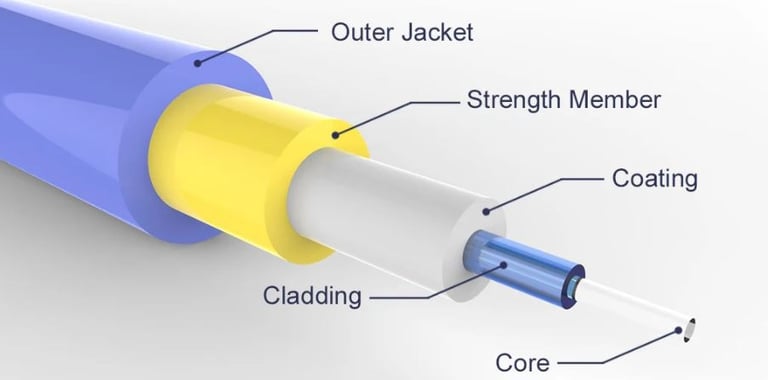
A fiber optic cable is a high-speed data transmission medium that uses light signals to carry information across long distances with minimal signal degradation. The fundamental structure consists of several precisely engineered layers working together to protect and guide light signals.
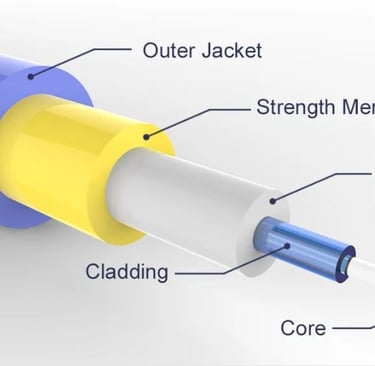
At the core lies an extremely thin strand of glass or plastic fiber, typically measuring between 8 and 125 micrometers in diameter—thinner than a human hair. Surrounding this core is the cladding layer, which has a lower refractive index than the core material. This difference in refractive indices creates the conditions for total internal reflection, causing light signals to bounce along the fiber core at extraordinarily high speeds with minimal attenuation.
Additional protective layers include a buffer coating that shields the delicate fiber from moisture and physical stress, strength members such as aramid yarn that provide tensile support during installation, and an outer jacket made from materials like PVC, PE, or LSOH compounds that protect against environmental hazards.
The principle of total internal reflection is what makes fiber optic cables so effective. When light enters the fiber core at the correct angle, it reflects off the boundary between the core and cladding repeatedly, traveling the entire length of the fiber without escaping. This enables high-bandwidth, low-loss transmission over distances that would be impossible with electrical signals in copper cables.
Comparing Fiber Optic Cables with Copper Cables
When evaluating singlemode vs multimode fiber optic cable performance against traditional copper alternatives, fiber demonstrates clear superiority across multiple dimensions:
Speed and Bandwidth: Fiber optic cables support data rates from 10 Gbps to 100 Gbps and beyond, while copper cables struggle to maintain 10 Gbps even over short distances. The inherent bandwidth capacity of fiber far exceeds copper, providing headroom for future network upgrades without cable replacement.
Transmission Distance: Copper cables experience significant signal attenuation, limiting high-speed transmission to approximately 100 meters. Fiber optic cables, particularly singlemode varieties, can transmit signals for many kilometers without requiring amplification or regeneration.
EMI Immunity: Because fiber uses light rather than electrical signals, it remains completely unaffected by electromagnetic interference from nearby power lines, motors, or radio frequency sources—a critical advantage in industrial environments.
Security: Light signals confined within fiber cores don't radiate electromagnetic emissions that can be intercepted, making fiber inherently more secure than copper for sensitive communications.
Physical Characteristics: Fiber cables are significantly thinner and lighter than equivalent copper cables, simplifying installation in crowded cable trays and reducing structural load requirements.
Cable Construction: Single Loose Tube vs Multi Loose Tube
Understanding fiber optic cable types and applications requires familiarity with two primary construction methods:
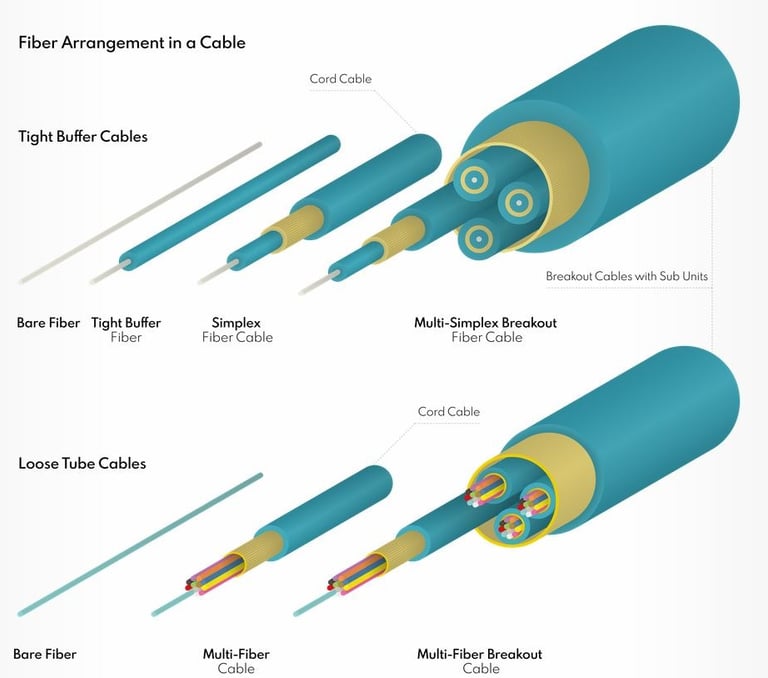
Single loose tube fiber optic cables house all optical fibers within one protective buffer tube filled with water-blocking gel or powder. This straightforward design suits:
Low to medium fiber counts (typically 2-12 fibers)
Indoor building distribution systems
Short outdoor runs between adjacent buildings
Cost-sensitive projects with modest capacity requirements
Multi loose tube fiber optic cables arrange multiple buffer tubes around a central strength member, with each tube containing a subset of the total fiber count. This modular construction offers:
High fiber counts (24 to 288 fibers or more)
Better organization for large-scale networks
Easier identification through color-coded buffer tubes
Superior protection for long-distance outdoor installations
Greater flexibility for future network expansion
The choice between these constructions significantly impacts installation efficiency and long-term network scalability. While single-tube designs cost less initially, multi-tube cables provide better fiber management in complex deployments.
Performance-to-Price and Long-Term Cost Advantages
Although fiber optic cables typically have higher upfront costs per meter than copper alternatives, total cost of ownership calculations often favor fiber for extensive network deployments:
Reduced active equipment requirements (fewer switches and repeaters needed)
Lower power consumption for network operation
Minimal maintenance requirements over decades of service
Future-proof bandwidth capacity eliminates costly replacement cycles
Longer achievable distances reduce infrastructure complexity
For campus networks, metropolitan fiber deployments, and enterprise backbones, these factors combine to make fiber the most economical choice when evaluated over the network's expected 20-30 year lifespan.
Where Are Fiber Optic Cables Used?
Fiber optic cables have become essential infrastructure across diverse application scenarios, from global telecommunications to individual building installations.
Core Network and Telecommunications Applications
Internet Backbone and Metro Networks: The foundation of global internet connectivity relies on fiber optic cables linking cities, countries, and continents. These networks use high-capacity singlemode fiber optic cable designs (primarily G.652.D) to carry enormous data volumes across thousands of kilometers.
Data Centers and Server Interconnects: Modern hyperscale data centers depend on multimode fiber optic cable OM3, OM4, and increasingly OM5 variants to connect servers, storage arrays, and network switches. The 40 Gbps and 100 Gbps speeds these cables support enable the rapid data movement required for cloud computing, big data analytics, and artificial intelligence workloads.
FTTH (Fiber To The Home) Access Networks: Direct fiber connections to residential premises deliver gigabit internet speeds that copper infrastructure cannot match. These networks commonly deploy bend-insensitive G.657.A1 or G.657.A2 singlemode fibers that navigate tight corners in residential buildings without signal loss.
Industrial Automation and Control Systems: Manufacturing facilities increasingly rely on fiber's EMI immunity for reliable communication in electrically noisy environments filled with motors, welders, and high-voltage equipment.
Government Institutions and E-Government Networks: Secure, high-capacity fiber networks support public services, administrative systems, and inter-agency communication.
Military and Secure Communication Systems: The inherent security advantages of fiber—no electromagnetic emissions and difficulty of physical tapping—make it preferred for defense and intelligence applications.
In-Building Fiber Optic Cable Usage
The deployment of fiber within buildings has accelerated as network bandwidth demands grow:
LAN and Building Backbone Networks: Fiber increasingly replaces copper for both horizontal cabling to workstations and vertical risers between floors. This transition supports modern workplace requirements including high-definition video conferencing, cloud-based applications, and wireless access point backhaul.
Commercial Buildings and Critical Facilities: B2ca fiber optic cable for buildings has become standard in:
Office complexes requiring reliable high-speed connectivity
Shopping malls supporting point-of-sale systems, security cameras, and customer Wi-Fi
Hospitals where fiber enables medical imaging, electronic health records, and telemedicine
Hotels providing guests with high-quality internet access
Schools and universities supporting digital learning environments
These installations commonly specify halogen free low smoke fiber optic cable with B2ca CPR ratings to comply with European construction regulations. The LSOH jacket materials minimize toxic gas emission and smoke production during fires, protecting building occupants and emergency responders.
Outdoor and Special Installation Scenarios
Underground Installations: Armored fiber optic cable for underground installation protects against multiple hazards. Steel wire armor defends against rodent damage from rats, squirrels, and gophers that can sever unprotected cables. The armor also resists crushing forces from soil settlement, vehicle traffic above burial sites, and accidental damage from excavation equipment.
Common problems in underground fiber deployments include:
Problem: Water ingress causing fiber attenuation and eventual failure. Solution: Specify cables with water-blocking gel or powder, double-jacketed construction, and proper sealing at splice points and terminations.
Problem: Rodent damage requiring expensive emergency repairs. Solution: Deploy cables with heavy steel wire armor rated for direct burial applications, and consider installing in conduit for additional protection in high-risk areas.
Aerial Installations: ADSS fiber optic cable for aerial installation provides self-supporting designs for pole-to-pole or building-to-building spans. These cables incorporate aramid yarn strength members that support the cable's weight over spans exceeding 100 meters. The all-dielectric (non-metallic) construction eliminates electrical safety concerns when aerial routes pass near power lines.
Problem: Cable sag and stress from ice accumulation and wind loading. Solution: Proper span calculation during design, appropriate tensioning during installation, and selection of ADSS cables rated for local climate conditions.
Problem: UV degradation of cable jacket in sun exposure. Solution: Specify cables with UV-resistant PE outer jackets containing carbon black stabilizers.
How to Choose a Fiber Optic Cable
Selecting how to choose a fiber optic cable that meets your specific requirements involves evaluating cable structure, core (fiber) type, CPR classification, sheath material, armor design, and required data transmission speed. Each factor directly impacts installation success, long-term reliability, and regulatory compliance.
1. Cable Structure
Single-Tube Fiber Optic Cables consolidate all fibers in one buffer tube, offering:
Simpler construction with lower material costs
Smaller overall diameter for easier routing through tight spaces
Adequate performance for fiber counts up to 12
Ideal for indoor distribution and short outdoor connections
Multi-Tube Fiber Optic Cables distribute fibers across multiple color-coded buffer tubes:
Efficient organization for 24 to 288+ fiber installations
Each tube can serve different destinations, simplifying network management
Better mechanical protection through distributed stress
Preferred for campus backbones and metro networks
Indoor vs Outdoor Requirements: Indoor cables prioritize flexibility and fire safety, using smaller diameters and flame-retardant materials. Underground cables require armored construction, moisture barriers, and ruggedized jackets to survive burial environments.
2. Core Types: Multimode vs Singlemode Fiber Optic Cable
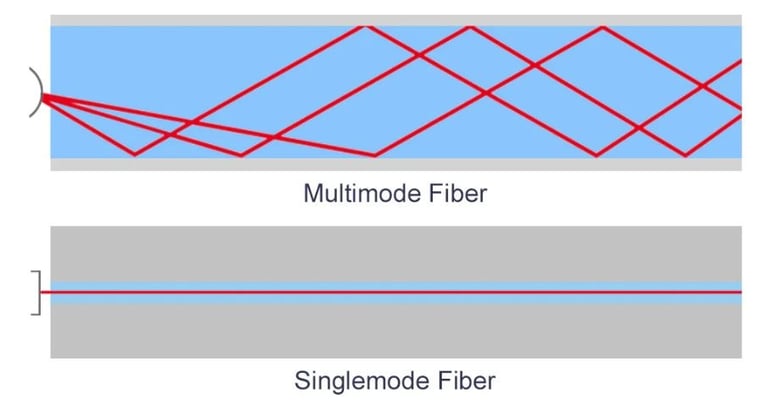
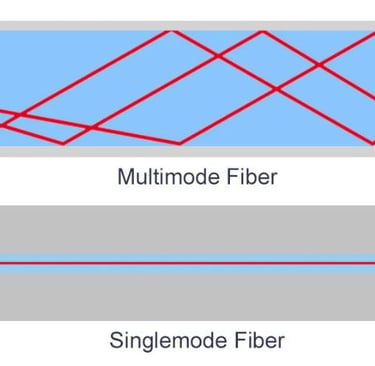
Multimode Fiber Optic Cable features a larger core (50 or 62.5 micrometers) allowing multiple light modes to propagate simultaneously. This design works with less expensive LED or VCSEL light sources and excels in short-range applications.
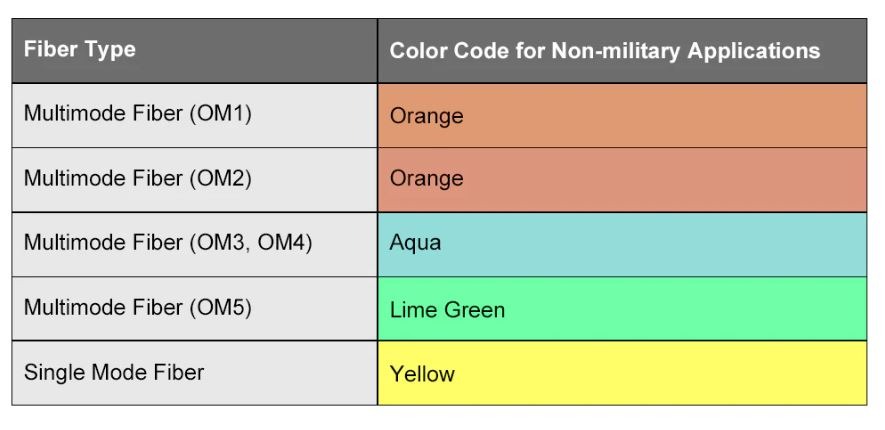
OM1: The original multimode standard with 62.5/125 µm core diameter operates at 850 nm wavelength. While suitable for shorter distances up to approximately 300 meters at 1 Gbps, OM1 represents legacy technology being replaced in new installations.
OM2: Improved performance with 50/125 µm core supports longer distances than OM1, reaching approximately 500 meters at 1 Gbps. However, OM2 also represents older technology with limited deployment in modern networks.
OM3: Laser-optimized multimode fiber specifically designed for VCSEL sources supports 10 Gbps transmission over typical data center distances around 300 meters. OM3 represents the minimum specification for contemporary high-speed installations.
OM4: Enhanced manufacturing processes reduce attenuation, enabling 10 Gbps over approximately 550 meters. OM4 also supports 40 Gbps over 150 meters and 100 Gbps over 100 meters, making it the current standard for enterprise data centers.
OM5: Wideband multimode fiber optimized for shortwave wavelength division multiplexing (SWDM) operates across 850-950 nm range. Designed for efficient 40 Gbps and 100 Gbps transmission, OM5 represents the latest advancement for future-proof data center installations.
Singlemode Fiber Optic Cable has a much smaller core (approximately 9 micrometers) permitting only one light mode. This enables very low attenuation and extremely long transmission distances.
G.652.D: The standard singlemode fiber type deployed worldwide in telecom infrastructure and backbone networks. Operating at 1310 nm and 1550 nm wavelengths, G.652.D provides excellent balance between performance and cost for most long-distance applications.
G.655 (NZDSF – Non-Zero Dispersion Shifted Fiber): Specifically engineered for long-distance DWDM systems, G.655 minimizes non-linear optical effects that can degrade signals over ultra-long spans. This specialized fiber serves submarine cables and terrestrial long-haul networks requiring maximum capacity.
G.657.A1: Bend-insensitive singlemode fiber fully compatible with G.652.D specifications withstands tighter bending radii (down to 10 mm radius) without significant signal loss. Common in FTTH installations where fibers must navigate tight corners in residential and commercial buildings.
G.657.A2: Ultra-flexible, highly bend-insensitive fiber tolerates even tighter bends (down to 7.5 mm radius), ideal for tight routing in wall outlets and in-building terminations. While G.657.A2 commands higher prices due to advanced manufacturing requirements, it reduces installation time and complexity in confined spaces.
3. CPR Classification for Fiber Optic Cables
The Construction Product Regulation (CPR) establishes harmonized fire performance standards for cables installed in EU construction works. CPR classifies cables according to flame spread, heat release, smoke production, flaming droplets, and smoke acidity.
B2ca Fiber Optic Cables achieve the highest performance level for conventional cables:
Very limited flame spread and low heat release
Very low smoke production and opacity
No flaming droplets or particles
Low acidity and toxicity of combustion gases
Required in evacuation routes, public buildings, and high-occupancy areas
Cca Cables provide medium fire performance with moderate flame spread resistance and limited smoke production, acceptable for general building installations where regulations permit.
Dca Cables meet lower fire performance standards with higher smoke production, representing the minimum acceptable level for many non-critical building areas.
In commercial buildings, hospitals, schools, and public facilities, B2ca fiber optic cables with halogen-free, low smoke sheaths protect occupants during fire emergencies by maintaining visibility for evacuation and reducing toxic gas exposure.
4. Sheath Material Selection
PVC (Polyvinyl Chloride): Economical general-purpose material offering good mechanical protection but producing toxic hydrogen chloride gas and dense smoke when burning. Suitable where fire regulations don't mandate low-smoke materials.
PE (Polyethylene): Excellent moisture and UV resistance makes PE the preferred choice for outdoor fiber optic cables. Black PE formulations include carbon black for enhanced UV protection in aerial and exposed installations.
LSOH/LSZH (Low Smoke Zero Halogen): Halogen-free compounds producing minimal smoke and no corrosive gases when burning. Essential for enclosed spaces with high human occupancy and required for B2ca CPR classifications. Standard in data centers, hospitals, transportation infrastructure, and public buildings.
PUR (Polyurethane): Exceptional oil and chemical resistance with high abrasion tolerance for harsh industrial environments. Used in specialized applications including robotic systems and moving machinery.
5. Cable Armor and Mechanical Protection
Fiber optic cable armor provides critical protection in harsh environments facing physical threats from rodents, excavation equipment, crushing forces, or installation tension.
Steel Wire Armor (SWA): Galvanized steel wires helically wound around the cable core provide exceptional mechanical strength and crush resistance. Excellent protection against rodent damage makes SWA ideal for direct burial installations.
Steel Wire Braid (SWB): Braided steel wires offer more flexibility than helical winding while maintaining good mechanical protection, suitable for confined spaces with some cable movement.
Corrugated Steel Tape: Spiral-applied steel tape combines strong mechanical protection with rodent resistance at lighter weight than steel wire armor.
Galvanized Steel Tape: Flat steel tape provides compact armor where space is limited, common in ducts and conduits.
Non-Metallic Armor (Aramid Yarn): High-strength aramid fibers provide tensile strength without electrical conductivity. Used in ADSS fiber optic cable for aerial installation, especially near power lines where metallic armor would create safety hazards.


What Is the Data Transmission Speed of Fiber Optic Cables?
Fiber optic cable data transmission speed significantly exceeds copper alternatives while maintaining immunity to electromagnetic interference. Typical performance ranges include:
Singlemode fiber optic cables (such as G.652.D) support:
10 Gbps transmission over 40-80 kilometers without amplification
40 Gbps transmission exceeding 10 kilometers for carrier networks
100 Gbps transmission reaching 40+ kilometers with advanced modulation
Multimode fiber optic cables (OM3, OM4) commonly deliver:
40 Gbps over approximately 150 meters for data center connections
100 Gbps over 100-150 meters for rack-to-rack links
Actual link speed depends on fiber cable quality, optical transceivers, connectors, splicing quality, and overall link design. High-grade fiber optic cables can significantly underperform if paired with low-quality active components or poor installation practices.
Common Problem: Newly installed fiber link fails to achieve rated speed. Solution: Verify all connectors are clean and properly seated, confirm transceiver compatibility with fiber type, test for excessive bending losses, and measure total link loss budget.
Conclusion: Selecting the Right Fiber Optic Cable for Your Network
Choosing the appropriate fiber optic cable requires balancing cable structure, core type (singlemode vs multimode), CPR fire class, sheath material, armor, and required data rate and distance. Base your selection on:
Environment: Indoor installations need flexible, fire-rated cables; outdoor deployments require weatherproof, armored protection; underground routes demand heavy armor; aerial spans need self-supporting designs.
Building Regulations and CPR Requirements: Verify local fire safety codes and specify B2ca cables for occupied buildings.
Network Architecture: Backbone networks need singlemode fiber for distance; data centers benefit from multimode's cost-effectiveness; FTTH installations require bend-insensitive fiber.
Budget vs Long-Term Performance: Initial savings from lower-grade fiber may limit future upgrades. Invest in higher specifications for scalability.
Plan fiber optic cable choice with future bandwidth needs and regulatory compliance in mind to ensure reliable, high-performance connectivity throughout the installation's service life.
How to Reach Us
Get in Touch
SiteMap
Product Catalogue
Festoon Cable
Shore Power Cable




Scan to add us on WeChat