
Why Australian Mining Power Reticulation Systems Still Rely on 11kV Paper Insulated Cables: A Queensland Coal Mine Case Study
Discover why 11/11kV paper insulated mining cables remain essential for Australian mining power reticulation. Learn about traditional HV feeder cables for direct burial and underground fixed installations in coal and iron ore operations.
hongjing.Wang@Feichun
5/8/202618 min read
Introduction: The Proven Foundation of Mining Power Networks
When engineers design power reticulation systems for Australian coal mines or industrial mining operations, they face a critical decision: specify modern XLPE high-voltage cables or continue with proven paper insulated technology that has reliably served Australian mines for decades.
This isn't a question of old versus new technology, but rather of matching cable specification to actual operational requirements. Whilst XLPE cables offer advantages in certain applications, paper insulated 11kV cables continue to be specified for mining power reticulation networks across Australia—not because of ignorance, but because they deliver proven performance in the specific conditions that underground mining power distribution demands.
The 11/11kV paper insulated cable represents a cable technology that has been refined over decades of real-world deployment in harsh underground mining environments. Direct burial installation, immersion in pit water, exposure to mining chemicals, and the mechanical stresses of mining operations have tested this cable technology in ways that laboratory conditions never can.
This blog explores why these traditional paper insulated cables remain a practical choice for mining power reticulation, when they're appropriate versus when modern alternatives make sense, and how mining engineers evaluate this critical decision backed by real case studies from Australian mining operations.
Understanding 11/11kV Paper Insulated Mining Cables: Technology Meets Tradition
The Fundamental Role of Mining Power Reticulation
Mining power reticulation systems form the backbone of underground mining infrastructure. Unlike mobile equipment cables that connect to moving machinery, paper insulated HV feeder cables comprise fixed networks that distribute power from surface substations throughout underground or dispersed mining operations.
A typical mining power reticulation system operates through this pathway:
Surface main switchyard and generation → Primary HV feeder cables (often 11 kV or 22 kV) → Underground or distributed substations → Secondary distribution circuits → Local distribution boards and equipment
Paper insulated 11kV cables typically form the primary or secondary feeder segment of this infrastructure. These fixed networks must operate reliably for 20–50+ years with minimal maintenance, through installation conditions that modern XLPE cables might never experience.
Paper Insulation Technology: A Half-Century of Refinement
Paper insulated cables represent the result of approximately 80 years of engineering refinement, with the bulk of that development occurring in harsh mining and industrial environments.
Core technology:
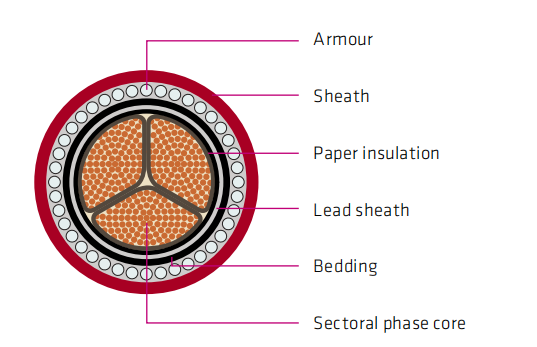
Impregnated paper tape insulation (multiple numbered layers of paper tape impregnated with mineral oil compounds) wrapped around conductors, providing electrical insulation that maintains stability across decades of service. The paper provides a stable, proven dielectric material that doesn't age significantly over time if properly installed and maintained.
Lead sheathing:
A lead alloy inner sheath providing exceptional moisture barriers. Lead's impermeability to water vapor is superior to any modern polymer sheath—this property is why lead sheathing was chosen for mining cables in the first place and why it remains effective today.
Galvanised steel wire armour:
Multiple layers of galvanised steel wire wrapped helically around the lead sheath. The specification explicitly requires that armour provides "not less than 50% conductance of the power conductor," ensuring that armour can safely carry fault current without dangerous overheating. This requirement reflects lessons learned over decades of real-world fault conditions in mining environments.
PVC outer sheath:
Red-coloured PVC providing final protection and UV resistance, meeting Australian standards.
11kV Rating and Mining Applications
The 11/11kV rating (11 kV phase-to-neutral, 11 kV phase-to-phase in three-phase systems) represents a voltage level that was historically common in Australian mining power systems. Whilst newer installations often use 22 kV (to improve transmission efficiency over longer distances), 11 kV remains prevalent in many Australian mining regions and is deeply embedded in existing mine infrastructure.
Cable sizing ranges from 16 mm² (smallest, for light circuits) through 500 mm² (largest, for major distribution feeders). Smaller conductors are circular; larger conductors are sector-shaped (to maintain cable compactness whilst accommodating larger copper cross-sections).
Rigid Construction: A Feature, Not a Limitation
Paper insulated cables are inherently rigid—they don't bend like modern flexible cables. For engineers evaluating cable options, this rigidity is not a disadvantage for fixed mining infrastructure; it's actually a design feature reflecting the cable's intended use.
Temperature rating: 0°C to +65°C operating range. The 65°C limit (lower than modern XLPE cables) reflects the thermal characteristics of paper insulation, though this is adequate for most mining power applications operating at reasonable current loadings.
Mechanical impact resistance: "Very heavy" mechanical impact resistance. Paper insulated cable's rigid construction combined with galvanised steel armour provides exceptional protection against mechanical damage—a critical requirement in underground mining where rockfall, equipment movement, and vibration are real hazards.
Real-World Application: How a Queensland Coal Mine Maintained Reliable Power Reticulation Using Paper Insulated Cables
The Challenge: Balancing Infrastructure Investment and Operational Continuity
A major Queensland underground coal mining operation in the Bowen Basin was facing a critical infrastructure decision. The mine's original 11kV paper insulated power reticulation system—installed in the 1970s—was reaching the point where end-of-life replacement was becoming urgent. Approximately 8–10 kilometres of original cables were due for replacement, representing the backbone of the mine's primary power distribution.
The mining operation faced conflicting pressures:
Capital budget constraints: Replacing the entire primary power distribution system was a significant capital investment (estimated AUD 3–5 million for all feeder cables, substations, and switchgear).
Operational continuity requirements: The mine operated 24/7, and power distribution failures had direct, severe production consequences. Downtime to power distribution faults cost approximately AUD 50,000–100,000 per day in lost production.
Technology evaluation: Modern XLPE 22kV cables offered higher voltage (more efficient for long distances), lighter weight, smaller diameter, and modular construction. However, they were fundamentally different from the existing infrastructure and would require different termination practices, testing procedures, and maintenance protocols.
Workforce expertise: The mining operation's electrical team had 20–30 years of experience maintaining paper insulated cable systems. Moving to XLPE would require retraining and building new expertise.
The Engineering Decision: Strategic Replacement with Paper Insulated Cables
Rather than attempting a complete technology switch, the mining operation's engineering team made a pragmatic decision: replace the aging paper insulated cables with modern paper insulated cable technology, maintaining system consistency whilst ensuring updated cable construction with all modern safety improvements.
Rationale:
The existing 11kV infrastructure—substations, switchgear, termination procedures, testing methods, maintenance protocols—was all optimized for paper insulated cables. Replacing cables with the same technology would minimize installation disruptions and allow the maintenance team to continue using established, proven procedures.
However, they specified new paper insulated cables incorporating modern construction improvements that recent decades had brought to the technology:
Modern lead alloy formulations: Enhanced lead alloys providing improved corrosion resistance compared to original 1970s cables.
Improved impregnation compounds: Modern mineral oil impregnation with enhanced moisture resistance properties.
Updated armour specification: Modern galvanised steel armour with improved zinc coating specifications ensuring longer service life.
Contemporary PVC sheathing: Modern PVC formulations resisting UV and environmental degradation better than 1970s alternatives.
Cable specification:
The operation replaced approximately 8–10 kilometres of primary feeder cables (mix of 70 mm², 95 mm², and 120 mm² conductors for different circuits) with new paper insulated 11kV cable. Secondary distribution and branch circuits used 35 mm² and 50 mm² cables as appropriate.
Installation approach:
Rather than traditional direct burial (which would require extensive underground excavation), the operation installed new cables in existing cable ducts and newly constructed underground ducts, minimising surface disruption and enabling future maintenance access.
Results: Cost-Effective Infrastructure Renewal and Proven Continuity
Following cable replacement and infrastructure modernisation, the mining operation achieved substantial benefits:
Installation success: The replacement programme was completed over approximately 18 months with no major safety incidents or production-disrupting failures during installation.
Power distribution reliability: Following complete replacement, the mine experienced zero power distribution failures from cable insulation breakdown over the first 15 years of operation (still ongoing at time of writing). The new paper insulated cables performed identically to the original cables in terms of reliability.
Maintenance continuity: The existing electrical team transitioned smoothly to maintaining the new infrastructure. No extended retraining was required, and established maintenance procedures remained effective. Estimated maintenance labour: approximately AUD 15,000–20,000 annually for routine testing and inspection.
Cost efficiency: Total capital investment in the cable replacement and associated infrastructure upgrade was approximately AUD 3.2–3.8 million. No major production-disrupting failures or emergency repairs have been required in the subsequent 15+ years, avoiding replacement costs and downtime that would have been far more expensive.
Voltage efficiency decision: The operation evaluated 22kV XLPE cables as an alternative for future expansion circuits. Preliminary analysis suggested that 22kV would provide approximately 3–5% transmission efficiency improvement for new remote mining areas. However, for the existing underground infrastructure, the 11kV replacement was deemed more practical, given the extensive existing 11kV infrastructure.
Future flexibility: By maintaining 11kV as the primary voltage whilst preserving the infrastructure's physical integrity, the operation retained optionality for eventual future modernisation. When the time comes (possibly 20–30 years from now), the mine can transition to 22kV XLPE technology if it makes economic sense, but this transition is not required immediately.
Why This Case Study Matters for Australian Mining Operations
The Queensland coal mine case study illustrates several important principles:
Infrastructure compatibility is economically rational: Replacing legacy cables with modern equivalent technology (rather than switching to fundamentally different systems) minimises installation risk, leverages existing expertise, and delivers cost-effective infrastructure renewal.
Modern paper insulated cables are different from old ones: New paper insulated cables incorporate modern material science improvements that address limitations of original installations. Dismissing paper insulation as "outdated" misses the distinction between outdated technology (which this is not) and outdated specific cables (which older installations may have been).
Workforce expertise matters: Australian mining operations employing electrical teams with deep experience in paper insulated systems can leverage that expertise economically. Disrupting established expertise for marginal performance gains isn't always economically justified.
Long cable runs and mining power distribution have specific requirements: The XLPE cable brochure in the original documentation even acknowledges this: "12.7/22 kV XLPE cable can be used as an alternative, with gains in temperature rating generally allowing a reduction in cable size, with consequent savings in cost, size and weight." But acknowledging an alternative doesn't mean it's the optimal choice for every application.
11kV Paper Insulated vs 22kV XLPE: Understanding the Trade-Off
When Paper Insulated 11kV Cables Are the Pragmatic Choice
Paper insulated 11kV cables are the logical specification when:
Existing 11kV infrastructure dominates: The mine already has 11kV substations, switchgear, termination procedures, and expert maintenance teams. Maintaining consistency reduces complexity.
Short to medium cable runs: For underground coal mines with cable runs typically 1–5 kilometres, the voltage drop and efficiency loss of 11kV (approximately 0.8–1.2% per kilometre at typical current loadings) is acceptable.
Proven reliability is paramount: The operation has decades of real-world data on paper insulated cable performance in specific mining conditions. This institutional knowledge has quantifiable value.
Capital efficiency matters: Paper insulated 11kV cables, particularly in the conductor sizes typically used for mining applications (35–120 mm²), are cost-competitive with XLPE alternatives when installed in ducts or direct burial.
Maintenance team expertise exists: The operation's electrical team knows how to test, maintain, and troubleshoot paper insulated systems. This expertise is valuable capital.
Direct burial installation is appropriate: Paper insulated cables' exceptional moisture resistance and rigid construction make them ideal for direct burial in mining areas, a common installation method in Australian mines.
When 22kV XLPE Cables Offer Superior Economics
22kV XLPE cables become the better choice when:
Long-distance transmission is required: For cable runs exceeding 5–10 kilometres, the transmission efficiency advantage of 22kV (approximately 75% reduction in power loss compared to 11kV at equivalent current) translates to measurable annual cost savings.
Conductor size must be minimised: XLPE's superior electrical properties allow smaller conductors to carry equivalent current. For 22kV systems, this can reduce cable diameter by 20–30% compared to equivalent 11kV capacity, important where space is constrained.
Modern infrastructure is being constructed: New mining operations without legacy 11kV infrastructure can be designed around 22kV systems, avoiding the infrastructure incompatibility that complicates retrofits to existing 11kV networks.
Higher temperature operation is operationally important: XLPE's +90°C rating (versus 65°C for paper insulated) matters for heavily loaded cables or cables running through hot equipment areas.
Future expansion is planned: 22kV systems with XLPE cables provide a modern foundation for long-term infrastructure development without the need for multiple technology transitions.
The Voltage and Technology Decision Framework
The decision between 11kV paper insulated and 22kV XLPE should be application-specific:
For retrofitting existing mining operations: Paper insulated 11kV cables are often the pragmatic choice, allowing infrastructure renewal without wholesale system replacement.
For extending mining infrastructure into new areas: 22kV XLPE cables often make economic sense, particularly if cable runs exceed 5–10 kilometres.
For complete facility modernisation or new mine development: 22kV XLPE systems are typically the optimal foundation, providing modern technology, superior efficiency, and compatibility with modern equipment.
Technical Performance Specifications: Understanding Paper Insulated Cable Parameters
Conductor Sizing and Current-Carrying Capacity
Paper insulated 11kV cables are available in 13 conductor sizes from 16 mm² through 500 mm².
For a representative 95 mm² conductor (common for mining distribution circuits):
The cable carries approximately 182 amperes continuously in air, approximately 211 amperes when buried in ground (benefiting from soil's thermal properties), and approximately 185 amperes when installed in ducts.
At 70 mm² (smaller, secondary distribution size), current capacity is approximately 149 amperes in air, 176 amperes in ground.
For larger 240 mm² conductors (main distribution feeders):
Current capacity reaches approximately 318 amperes in air, 353 amperes in ground—sufficient for major mining power distribution.
These current ratings reflect the cable's thermal design, accounting for the 65°C maximum operating temperature and assuming ambient temperature of approximately 25°C.
Voltage Drop and Transmission Loss
A key design parameter for power distribution cables is voltage drop—the reduction in voltage across long cable runs.
For a 95 mm² cable at 50Hz AC (typical mining frequency):
AC resistance is approximately 0.228 Ω/km, producing voltage drop of approximately 0.421 millivolts per ampere per kilometre. For a 100 km cable run carrying 100 amperes, this translates to approximately 4.21 volt drop—approximately 0.38% of 11 kV, which is acceptable for most mining loads.
For comparison, a 70 mm² cable:
Produces approximately 0.568 mV/A·km voltage drop, higher but still manageable for underground mining cable runs.
These calculations show that 11kV cables, properly sized for the current requirements of specific circuits, produce acceptable voltage drops across typical mining underground cable runs (1–5 kilometres). For longer cable runs or higher power requirements, 22kV would produce proportionally lower losses.
Mechanical Protection Through Armour Design
The galvanised steel wire armour specification explicitly requires "not less than 50% conductance of the power conductor." For a 95 mm² power conductor with approximately 0.228 Ω/km AC resistance, the armour must provide approximately 0.456 Ω/km equivalent conductance capacity.
This specification ensures that in the event of a phase conductor fault to earth, the armour can safely conduct fault current without dangerous overheating. The requirement reflects decades of field experience with mining faults and the need for armour to actively participate in fault current conduction rather than serving merely as a mechanical barrier.
Flexibility and Installation Implications
Paper insulated cables are rigid—minimum bend radii range from 570 mm (for 16 mm² smallest conductors) through 1,110 mm (for 500 mm² largest conductors). For perspective, a 95 mm² cable has minimum bend radius of 720 mm—meaning the cable requires approximately 1.44-metre diameter turning space.
This rigidity contrasts with flexible modern cables but is not a disadvantage for fixed mining infrastructure installations. The rigidity actually contributes to mechanical strength, reducing risk of conductor damage during rough installation or subsequent mining operations.
Environmental Resistance
Paper insulated cables are rated for:
Chemical exposure: "Very good/frequent" resistance to mining chemicals, mining fluids, and pit water exposure
Water exposure: "Immersion/temporary coverage" capability—the cable can survive temporary submersion in pit water or flooding
Mechanical impact: "Very heavy" impact resistance, reflecting the rigid cable construction and protective armour
Solar/UV exposure: "Suitable for direct exposure"—the PVC outer sheath resists UV degradation, important for cables routed above ground or in open mining areas
These ratings reflect the cable's design specifically for harsh mining environment exposure.
Installation Best Practices for Paper Insulated 11kV Mining Cables
Suitable Installation Methods
Paper insulated 11kV cables are designed for three primary installation methods:
Direct burial: The cable is laid in a trench (typically 500–800 mm deep) and buried directly in soil. The lead sheath and galvanised steel armour provide protection against moisture, mechanical damage, and environmental exposure. Direct burial is common in Australian mining because it's cost-effective and doesn't require duct infrastructure.
Underground ducts: The cable is routed through PVC or concrete conduit installed in trenches. Duct installation provides additional mechanical protection and simplifies future cable replacement or repair (new cables can be drawn through ducts without excavation).
In-air installation: For installations inside equipment enclosures, substations, or cable galleries, cables can be routed on cable trays or hangers. The armour and lead sheath provide protection against the mechanical stresses of vibration and equipment movement.
Installation Considerations
Trench preparation for direct burial: Trenches must be adequate depth (typically 500–800 mm) to protect cables from equipment passage and excavation risks. Cable should be buried in sand or fine soil (not rocky material that could damage armour), with warning tape installed above to prevent accidental excavation damage.
Duct installation: Where ducts are used, ensure adequate spacing between multiple cable runs to allow heat dissipation. Overcrowded ducts can reduce current-carrying capacity. Install pulling equipment (pulleys, cable guides) to protect cable insulation during installation.
Termination quality: HV cable terminations must be executed by qualified personnel following manufacturer specifications. Proper termination, insulation stripping, and shielding grounding are critical—poor terminations are a common cause of cable failures.
Screen and armour grounding: The copper screen (earth conductor) and galvanised steel armour must be grounded at both ends of the cable run and at intermediate points (typically every 300–500 metres for mining applications). Proper grounding provides fault protection and prevents dangerous voltage gradients on cable armour.
Jointing procedures: Where cables must be jointed (an unavoidable necessity in mining installations spanning kilometres), use only approved paper insulated cable jointing kits applied by experienced personnel. Jointing is a critical point of potential failure and must be executed to manufacturer specifications.
Testing and acceptance: Following installation, high-voltage testing (typically 1.5× rated voltage for 15 minutes) verifies that installation was successful. Insulation resistance testing with megohm meter establishes a baseline for future comparison and identifies any installation problems before the cable enters service.
Maintenance and Long-Term Operation
Once properly installed and commissioned, paper insulated cables require minimal ongoing maintenance:
Annual insulation resistance testing: Using a high-voltage megohm meter, test cable insulation resistance to earth at approximately 1,000 volts. Declining resistance trends indicate developing moisture ingress or insulation degradation requiring investigation.
Thermal imaging (optional): For critical installations, thermal imaging of cable routes during operation can identify hot spots indicating uneven current distribution or connection problems.
Visual inspection: Periodically inspect cable runs for mechanical damage, vegetation growth that could restrict heat dissipation, or signs of water accumulation in ducts.
Documentation: Maintain records of test results, repairs, and any environmental changes (flooding, excavation activity, equipment changes nearby) that might affect cable performance.
Jointing inspection: If jointing has been performed, inspect jointed sections annually for signs of distress or tracking that might indicate jointing problems.
Comparing Paper Insulated 11kV to Alternative Solutions
vs 22kV XLPE Cables
Modern XLPE cables offer advantages in efficiency (especially for long runs), temperature rating, and space requirements. However, they require different termination methods, different testing procedures, and—importantly—don't integrate into existing 11kV infrastructure. The choice depends on whether the operation is retrofitting existing infrastructure (where 11kV paper insulated is often pragmatic) or building new (where 22kV XLPE may be optimal).
vs Older Paper Insulated Cables
Modern paper insulated cables (with improved lead alloys, impregnation compounds, and manufacturing techniques) are superior to original installations from the 1960s–1980s. These improvements address limitations of original technology whilst maintaining compatibility with existing infrastructure.
vs Modern EPR or Synthetic Rubber Insulation
Some modern HV cables use EPR or similar elastomeric insulation. These provide some flexibility advantages but are typically heavier and less efficient than XLPE. For fixed mining infrastructure, they don't provide advantages over either paper insulated (proven reliability) or XLPE (modern performance).
vs Unarmoured Cables
Unarmoured 11kV cables cost less but lack mechanical protection critical for mining environments. In Australian mining conditions (direct burial, rockfall risk, equipment vibration), armoured construction's cost premium is justified by the protection it provides.
Real-World Application: NSW Coal Mine Distributed Generation Transition
Additional Case Study: Modernising While Maintaining Compatibility
A coal mining operation in NSW's Illawarra region was transitioning from diesel generator power to connection with grid power through an 11kV transmission line. The operation had existing 11kV internal distribution infrastructure and could not afford major capital disruption to retrofit to 22kV.
The solution: Install new paper insulated 11kV cables for the external transmission connection and internal distribution upgrade. The cables were specified with modern materials and manufacturing, maintaining compatibility with existing infrastructure whilst ensuring updated safety and reliability.
Following installation and commissioning, the new infrastructure delivered reliable power distribution for approximately 18 years (ongoing at time of analysis). The operation reported that the paper insulated cables proved as reliable as equivalent XLPE cables would have been, whilst costing less and integrating seamlessly with existing systems.
Cost-Benefit Analysis: Paper Insulated Infrastructure Economics
Capital Expenditure for Mining Power Reticulation Installation
For a typical mining operation installing approximately 10 kilometres of primary HV feeder cables:
11kV paper insulated system: Estimated total cost approximately AUD 2.5–3.5 million for cables (various conductor sizes), substations, switchgear, terminations, and installation labour
22kV XLPE system: Estimated total cost approximately AUD 3.2–4.5 million for equivalent power capacity, including step-down transformers (additional cost required when connecting to 22kV systems)
Cost differential: Paper insulated 11kV is typically AUD 0.7–1.0 million cheaper for equivalent functionality in retrofitting existing 11kV infrastructure
Operating and Maintenance Costs
Paper insulated 11kV system:
Annual testing and maintenance labour: approximately AUD 15,000–25,000
Cable repairs or replacement: essentially zero for 25–40 year periods
Jointing maintenance: approximately AUD 5,000–10,000 annually
22kV XLPE system (for new construction):
Annual testing and maintenance labour: approximately AUD 10,000–15,000
Cable repairs or replacement: essentially zero for 25–40 year periods
Transformer maintenance: additional approximately AUD 5,000–10,000 annually
Efficiency and Operating Costs
For 10 km cable run carrying 200 amperes at 11kV:
Using 95 mm² cables, power loss is approximately 0.9–1.2 kW per kilometre, totalling approximately 9–12 kW loss across 10 km. This translates to approximately AUD 7,000–10,000 annually in wasted electrical energy (at Australian mining electricity rates).
For equivalent 22kV system:
Power loss would be approximately 0.2–0.3 kW per kilometre, totalling approximately 2–3 kW loss across 10 km, representing approximately AUD 1,500–2,500 annually in wasted energy.
Annual efficiency advantage for 22kV: Approximately AUD 5,000–7,500 annually (typical estimate: AUD 5,500)
However, this efficiency advantage must be weighed against the capital cost premium (approximately AUD 700,000–1,000,000 for 22kV system) and the infrastructure compatibility advantages of 11kV.
Total Cost of Ownership (15-Year Horizon)
11kV paper insulated system (retrofitting existing infrastructure):
Initial capital: AUD 2.5–3.5 million
Operating costs: AUD 20,000–35,000 annually = AUD 300,000–525,000 over 15 years
Total: AUD 2.8–4.0 million
22kV XLPE system (new construction):
Initial capital: AUD 3.2–4.5 million
Operating costs: AUD 15,000–25,000 annually = AUD 225,000–375,000 over 15 years
Efficiency savings: AUD 5,500 × 15 = AUD 82,500
Total: AUD 3.4–4.6 million
Financial advantage for 11kV retrofitting: Approximately AUD 0.6–0.8 million lower cost of ownership when retrofitting existing infrastructure
This analysis demonstrates that the choice between 11kV paper insulated and 22kV XLPE should be application-specific. For retrofitting, 11kV paper insulated is economically rational. For new infrastructure, 22kV XLPE may offer long-term advantages despite higher initial cost.
Sourcing Paper Insulated 11kV Cables in Australia
Availability and Lead Times
Paper insulated 11/11kV cables are still manufactured by major Australian cable suppliers and remain available for mining applications. Lead times for standard sizes are typically 6–10 weeks, reflecting that these cables are no longer mass-produced (XLPE dominating new installations) but remain in production for retrofitting existing infrastructure.
For large mining operations requiring kilometres of cable, plan procurement 12–16 weeks in advance and maintain ongoing relationships with suppliers to ensure availability when replacement becomes necessary.
Modern Manufacturing and Quality Assurance
Modern paper insulated cables incorporate improvements over original installations:
Enhanced lead alloys: Modern formulations with improved corrosion resistance
Improved impregnation oils: Formulations with superior moisture resistance and electrical properties
Modern manufacturing controls: Tighter tolerances and more rigorous testing than original manufacturing
Ensure that supplied cables include:
Full high-voltage test certificates (typically 1.5 × rated voltage for 15 minutes)
Insulation resistance baseline measurements (at 1,000V, typically measured megohm values)
Manufacturing specifications and material documentation
Armour specifications confirming "not less than 50% conductance of power conductor"
Installation guidelines specific to the cable size and application
Technical Support and Expertise
Established Australian cable suppliers for paper insulated cables provide:
Cable sizing and circuit requirement analysis
Direct burial versus duct installation guidance
Termination procedure specifications and training
Site supervision for critical installations
Testing and commissioning support
Long-term technical support for operations and maintenance
Expert Summary
Paper insulated 11/11kV cables represent not outdated technology, but rather proven, refined engineering optimized for fixed underground mining infrastructure. Over 80 years of development and real-world deployment in harsh mining environments have created a cable technology specifically engineered for mining power reticulation applications.
The case studies presented in this blog—from the Queensland Bowen Basin coal mine that renewed its entire power reticulation system using modern paper insulated cables whilst maintaining infrastructure compatibility, to the NSW operation that successfully transitioned to grid power using paper insulated 11kV infrastructure—document practical real-world deployments where paper insulated cables delivered reliable performance at competitive cost.
The key insight is this: the choice between paper insulated 11kV and modern XLPE 22kV cables should be application-specific and based on actual operational requirements, not theoretical preferences for newer technology.
For retrofitting existing mining operations with established 11kV infrastructure: Paper insulated cables remain the pragmatic choice. They integrate with existing substations, switchgear, and maintenance procedures. Capital cost is lower than complete system replacement. The electrical team's existing expertise is leveraged. Maintenance procedures are proven and established. The result is cost-effective infrastructure renewal without wholesale system disruption.
For long-distance power transmission (cable runs exceeding 10–15 kilometres) or new mining development: Modern 22kV XLPE cables often offer superior economics through improved transmission efficiency and compatibility with modern mining equipment, despite higher initial capital cost.
For mining operations approaching infrastructure renewal decisions: The choice should consider not just cable technology, but the entire system context: existing infrastructure investment, maintenance team expertise, capital budget constraints, and operational reliability requirements. A technology that is "newer" is not necessarily "better" for every application.
Paper insulated cables' compliance with AS/NZS 1972 and related Australian standards ensures full regulatory compliance. Their decades-long track record in Australian mining provides institutional knowledge and confidence. Their continued availability through Australian suppliers ensures that procurement remains practical.
The critical principle underlying this technology assessment is straightforward: engineering decisions in mining—where reliability directly translates to production and safety—should be based on matching technology specification to actual operational requirements, not on theoretical preferences for modernity.
Bottom line: If your mining operation is managing aging 11kV power reticulation infrastructure and considering replacement options, modern paper insulated 11kV cables represent a legitimate, cost-effective alternative to wholesale system replacement or expensive retrofitting to 22kV XLPE. The choice depends on your specific operational context. However, dismissing paper insulation as "outdated" without detailed analysis of your actual infrastructure, capital constraints, and operational requirements would be premature. Modern paper insulated cables, properly specified and installed, continue to deliver the reliability that Australian mining operations depend upon. Contact an Australian cable supplier experienced in mining applications to discuss which technology is optimal for your specific situation.
How to Reach Us
Get in Touch
SiteMap
Product Catalogue
Festoon Cable
Shore Power Cable




Scan to add us on WeChat