

Why Choose the Type 245 1.1-6.6 kV Flexible Mining Cable for Longwall Shearers, Continuous Miners & Peripheral Longwall Equipment?
Explore the advantages of the Type 245 1.1-6.6 kV flexible mining cable for use in longwall shearers, continuous miners and peripheral longwall equipment. Learn about its construction, 3 central pilot conductors for earth-continuity monitoring, AS/NZS standard compliance, and why this highly flexible trailing cable is ideal for demanding mining environments.
hongjing.Wang@Feichun
11/5/202513 min read
Introduction
Underground mining operations present some of the most demanding conditions for electrical infrastructure. Deep beneath the surface, mining equipment operates in environments characterized by constant moisture, abrasive coal and rock dust, extreme mechanical stress, and the ever-present risk of electrical faults that could endanger personnel and disrupt production. In these harsh settings, the selection of appropriate power cables becomes a critical decision that directly impacts operational safety, equipment reliability, and mining productivity.
The Type 245 1.1-6.6 kV flexible mining cable represents a specialized solution engineered specifically for the rigorous demands of underground coal mining applications. This cable system is designed to deliver reliable power transmission to mobile mining machinery while withstanding the continuous flexing, dragging, and mechanical abuse inherent in longwall and continuous mining operations. What distinguishes this cable from conventional industrial power cables is its exceptional flexibility combined with an integrated safety feature: three central pilot conductors dedicated to earth-continuity monitoring, providing real-time verification that protective earth connections remain intact throughout the cable's service life.
For mining operations utilizing longwall shearers, continuous miners, and peripheral longwall equipment, the Type 245 flexible mining cable offers a proven combination of mechanical durability, electrical safety, and operational flexibility that addresses the unique challenges of underground coal extraction.
Application Context
Modern underground coal mining relies heavily on three primary categories of mobile equipment, each presenting distinct challenges for electrical power delivery. Longwall shearers traverse back and forth across coal faces that may extend 300 meters or more, cutting coal with rotating drums while trailing power cables that must flex thousands of times daily. Continuous miners operate in development headings and room-and-pillar sections, advancing into the coal seam while their trailing cables navigate tight curves around corners and through restricted spaces. Peripheral longwall equipment includes armored face conveyors, stage loaders, crusher units, hydraulic pumps, and haulage systems that collectively support the coal extraction process.
Each of these equipment types subjects its power cables to severe mechanical stress. Longwall shearer cables experience repetitive flexing as the machine oscillates along the face, combined with tensile loading from cable handlers and the weight of hundreds of meters of cable suspended in catenary configurations. The cable surface encounters abrasion from contact with the armored face conveyor structure and exposure to falling coal and rock. Continuous miner cables endure similar flexing stresses but face additional challenges from tighter bend radii in confined development headings and frequent repositioning as the machine advances.
The Type 245 cable addresses these operational realities through a construction philosophy that prioritizes flexibility without compromising on electrical integrity or mechanical protection. Unlike rigid cables designed for fixed installations, this flexible mining cable for longwall shearer and continuous miner applications incorporates design elements specifically intended to survive dynamic loading, repetitive flexing, and harsh environmental exposure. The cable's construction enables it to bend to tight radii without damaging conductors or insulation, recover from compression and impact events, and maintain electrical performance despite the accumulation of surface wear that inevitably occurs in underground mining service.
Voltage Range and Standards
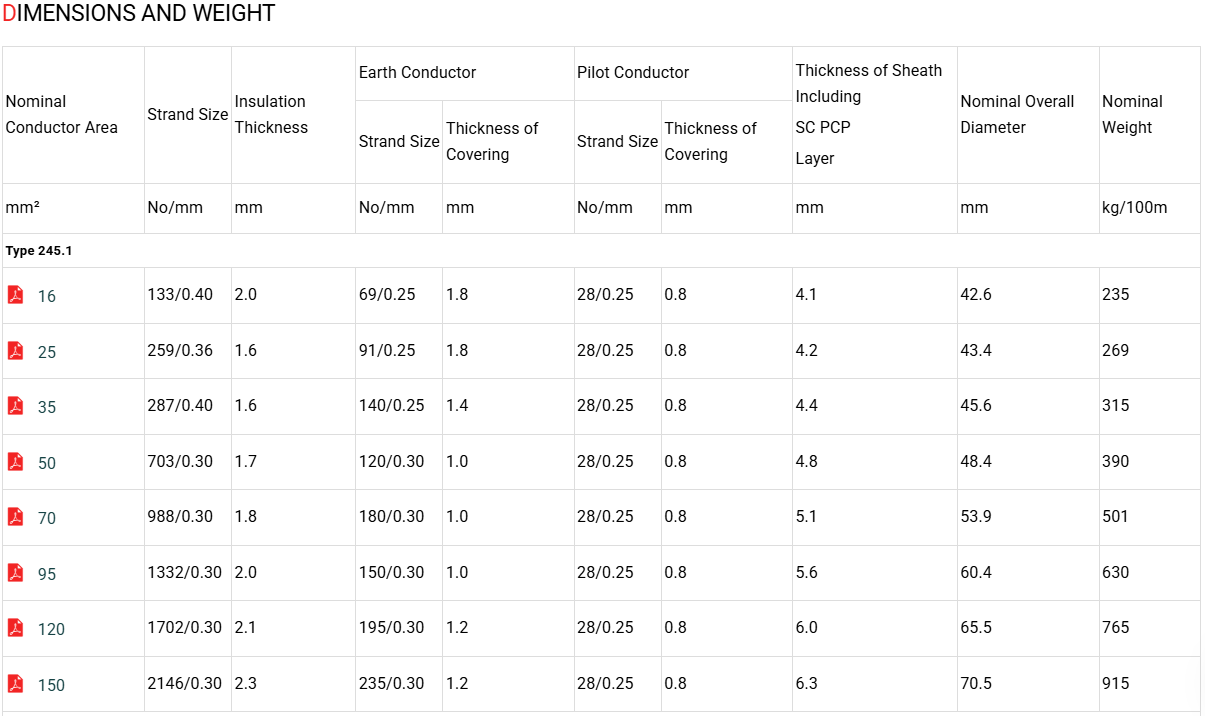
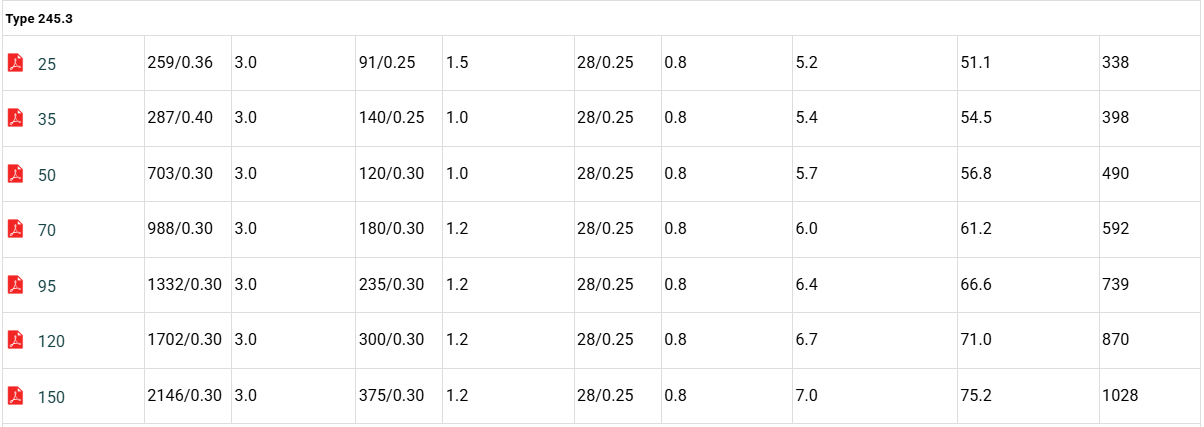
The Type 245 mining cable 1.1-6.6 kV is manufactured in three distinct voltage grades to accommodate different mining system architectures. Type 245.1 cables are rated for 1.1 kV applications, typically serving auxiliary equipment and lower-voltage distribution circuits. Type 245.3 cables operate at 3.3 kV, the most common voltage level for Australian underground coal mining mobile equipment. Type 245.6 cables serve 6.6 kV systems, often utilized for higher-power longwall shearers and larger continuous miners where increased voltage enables the transmission of greater power levels through conductors of manageable size.
This voltage stratification reflects the practical realities of mining electrical systems. Operating voltage selection involves balancing multiple factors including equipment power requirements, permissible cable conductor sizes, the length of cable trails, voltage drop considerations, and the available supply infrastructure. Higher voltages enable the delivery of greater power through smaller conductors, reducing cable weight and improving flexibility. However, higher voltages also demand more robust insulation systems and increased clearances, considerations that influence cable diameter and handling characteristics.
Critical to the Type 245 cable's acceptance in Australian and international mining operations is its compliance with AS/NZS standards governing mining cable construction and performance. These standards establish rigorous requirements for conductor construction, insulation materials, screening layers, sheathing compounds, and performance testing that cables must satisfy before approval for underground coal mining service. Compliance verification includes testing for flexibility, flame resistance, mechanical strength, electrical properties, and environmental durability under conditions that simulate actual mining service.
The importance of standard compliance extends beyond mere regulatory conformance. Mining operations depend on cables that perform reliably under extreme conditions where failure can result in production stoppages, equipment damage, and personnel safety hazards. AS/NZS standards embody decades of accumulated experience regarding what construction techniques and materials provide adequate performance in underground coal mining environments. Cables meeting these standards have demonstrated through extensive testing that they possess the necessary characteristics to survive and function in conditions that would quickly destroy cables designed for less demanding applications.

Construction and Technical Design
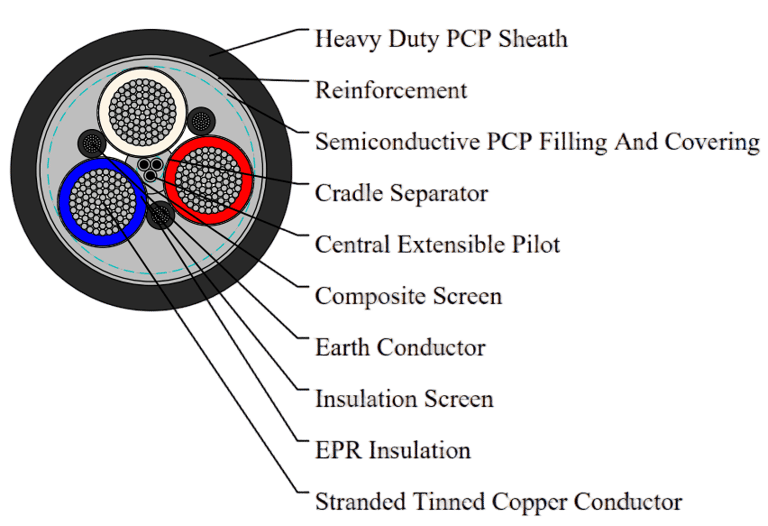
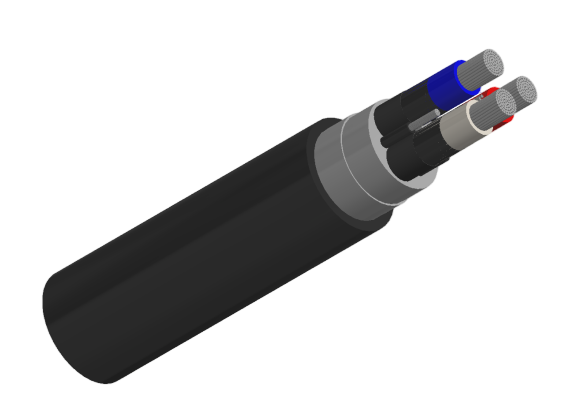
The Type 245 1.1-6.6 kV flexible mining cable achieves its performance characteristics through a carefully engineered multi-layer construction, with each component serving specific electrical or mechanical functions. Understanding this construction helps explain why the cable performs effectively in demanding mining applications.
At the cable's core are flexible tinned copper conductors constructed from multiple strands of fine copper wire. The fine stranding provides the flexibility necessary for repetitive bending without work-hardening and eventual conductor breakage. Tinning the copper strands with a thin coating of tin-lead alloy serves multiple purposes: it facilitates conductor manufacture by allowing strands to slide past each other during cable flexing, provides corrosion resistance in moist underground environments, and enhances the quality of compression connections at cable terminations.
Each conductor is insulated with ethylene propylene rubber (EPR), an elastomeric insulation material selected for its combination of electrical properties, thermal performance, and flexibility. EPR provides excellent dielectric strength, maintaining insulation integrity at the specified operating voltage while accommodating the temperature rise associated with conductor current loading. The material's elastomeric nature allows it to flex repeatedly without developing the cracks and fissures that would occur in thermoplastic insulation materials, preserving insulation integrity throughout years of cable flexing service.
Surrounding each insulated conductor is a semi-conductive screening layer. These screens serve crucial electrical functions by establishing uniform electrical stress distribution at conductor and insulation interfaces, eliminating air voids where partial discharge could occur, and providing a defined earthed surface that contains the electrical field within the insulation. In mining cables subjected to mechanical abuse, these screens also help maintain electrical integrity when insulation surfaces experience compression or deformation during cable flexing and handling.
A defining feature of the Type 245 cable is its three central pilot conductors positioned at the cable's geometric center. These small-gauge conductors serve earth-continuity monitoring and control circuit functions. Earth-continuity monitoring systems pass a small test current through these pilot conductors and the cable's earth system, continuously verifying that protective earth connections remain intact. Any interruption in earth continuity immediately triggers protective relaying, de-energizing the cable before fault conditions can create hazards. This monitoring function addresses one of the most critical safety concerns in underground mining: ensuring that equipment frames remain reliably earthed so that insulation faults result in protective device operation rather than dangerous frame potentials.
Interstitial earth conductors are positioned in the spaces between power conductors, forming a comprehensive earth system that surrounds and protects the power conductors. These earth conductors serve multiple purposes: they provide low-impedance earth return paths for fault currents, contribute to mechanical cable symmetry that improves flexibility and reduces twisting tendencies, and offer supplementary mechanical protection to the power conductors and insulation system.
The complete conductor assembly is enclosed within a heavy-duty polychloroprene (PCP) outer sheath. Polychloroprene offers an excellent combination of properties for mining cable service: good mechanical strength and abrasion resistance, flexibility across a wide temperature range, resistance to oils and chemicals encountered underground, flame resistance, and durability in moist environments. The sheath thickness is substantial enough to provide meaningful mechanical protection while remaining flexible enough not to compromise the cable's overall flexibility characteristics.
This multi-layer construction, when properly manufactured, produces a continuous miner trailing cable or longwall shearer cable that balances the often-competing requirements of flexibility, electrical integrity, and mechanical durability. Each construction element contributes to the cable's ability to deliver reliable electrical service in environments that would quickly destroy cables of lesser construction quality.
Key Benefits in Mining Operations
The Type 245 cable's construction translates into multiple operational benefits that directly impact mining productivity, safety, and cost-effectiveness. These advantages become particularly evident when compared to less specialized cable constructions or when assessing total cost of ownership rather than merely initial purchase price.
Exceptional flexibility stands as perhaps the most immediately apparent benefit. Longwall shearers may traverse the coal face 40 to 60 times per day, with each traverse subjecting the trailing cable to a complete flexing cycle. Over months and years of service, this accumulates to hundreds of thousands of flex cycles. The Type 245 cable's fine-stranded conductors and elastomeric insulation survive this repetitive flexing without the conductor breakage and insulation cracking that would occur in less flexible constructions. This flexibility also facilitates cable handling during installation and repositioning, reducing the physical effort required by mining personnel and minimizing the risk of cable damage during handling operations.
Enhanced safety through integrated earth-continuity monitoring represents a critical advantage in underground coal mining environments where explosive atmospheres may exist and where water and conductive dust create conditions conducive to electrical faults. The three central pilot conductors enable continuous verification that protective earth circuits remain functional, ensuring that any insulation failure results in immediate circuit de-energization rather than creating dangerous potential differences on equipment frames. This monitoring capability provides a crucial additional layer of protection beyond that offered by conventional overcurrent protective devices.
Resistance to impact, abrasion, and harsh environmental conditions directly affects cable service life in mining applications. Coal and rock falling onto cables, cables dragged across rough floor surfaces, cables compressed between equipment and mine structures, and cables exposed to water, mud, and corrosive mine atmospheres all contribute to gradual cable degradation. The Type 245 cable's robust PCP sheath and comprehensive internal construction provide meaningful resistance to these degrading influences, extending the interval between cable replacements and reducing the frequency of cable-related production interruptions.
The broad voltage range of 1.1 kV, 3.3 kV, and 6.6 kV variants enables mining operations to apply Type 245 cables across their entire mobile equipment fleet, standardizing on a proven cable type rather than managing multiple different cable specifications for different equipment types. This standardization simplifies spare parts inventory, reduces procurement complexity, and ensures that maintenance personnel develop deep familiarity with a single cable type rather than managing multiple different constructions.
Perhaps most significantly from a business perspective, the Type 245 cable's reliable performance translates into reduced downtime and lower maintenance costs. Cable failures on longwall shearers or continuous miners result in immediate production cessation, with downtime costs in underground coal mines potentially reaching thousands of dollars per hour. A cable that provides extended service life without premature failures delivers value far beyond its initial purchase price, contributing to more consistent production performance and reducing the frequency of costly unplanned maintenance interventions.
Choosing the Right Variant
Selecting the appropriate Type 245 cable variant requires careful consideration of multiple factors related to the specific equipment application and mining system characteristics. While all variants share the same basic construction philosophy and flexibility characteristics, the voltage rating and associated insulation thickness differences create distinct performance envelopes that should be matched to application requirements.
The primary selection criterion is system operating voltage. Equipment rated for 1.1 kV operation requires Type 245.1 cable, 3.3 kV equipment utilizes Type 245.3 cable, and 6.6 kV systems demand Type 245.6 cable. Operating a cable at voltages exceeding its rating compromises electrical safety and violates regulatory requirements, while significantly over-specifying voltage rating results in unnecessarily large and inflexible cables that complicate handling and installation.
Conductor size selection depends on the equipment's power requirements, the length of the cable trail, and permissible voltage drop limits. Higher current loads demand larger conductor cross-sections to maintain conductor temperatures within acceptable limits and to minimize resistive losses. Longer cable trails exacerbate voltage drop concerns, potentially requiring conductor upsizing to maintain adequate voltage at the equipment terminals. Mining electrical standards typically specify maximum permissible voltage drop values that must be satisfied through appropriate conductor sizing.
Installation layout considerations influence cable selection decisions. Longwall shearer cables that must traverse long coal faces while suspended from cable handlers face different challenges than continuous miner cables that negotiate tight turns in development roadways. Cable routes with minimal bend radius restrictions may accommodate slightly less flexible constructions, while applications involving severe bending or frequent repositioning demand maximum flexibility. The frequency and severity of cable movement during normal operations should inform cable selection, with more dynamic applications benefiting from the most flexible available constructions.
Physical space constraints at equipment connection points may limit the maximum permissible cable diameter, particularly for continuous miners operating in restricted-height coal seams where equipment dimensions are minimized. The relationship between voltage rating and cable diameter should be considered when specifying cables for space-constrained applications, recognizing that higher-voltage variants incorporate thicker insulation and typically result in larger overall cable diameters.
Correct specification of cable characteristics ensures optimal cable service life and operational reliability. Under-specified cables may fail prematurely, creating safety hazards and production interruptions. Over-specified cables impose unnecessary costs and may introduce handling difficulties due to excessive size and weight. Working with experienced mining electrical engineers and referencing manufacturer technical data helps ensure that cable specifications appropriately match application requirements.
Real-World Application Scenarios
Examining specific mining applications illustrates how the Type 245 flexible mining cable's characteristics address practical operational challenges. These scenarios demonstrate the cable's versatility across different mining equipment types and operating conditions.
Consider a longwall shearer operation in a mine extracting a 3-meter-thick coal seam with a face length of 280 meters. The shearer, powered through a Type 245.3 cable rated at 3.3 kV, traverses the face approximately 50 times per day, with each traverse lasting 30 to 45 minutes. The trailing cable, which may total 400 meters in length when accounting for catenary loops and cable handler routing, experiences continuous flexing at multiple points: at the cable handler support points, at the cable entry point to the shearer, and at intermediate points where the cable negotiates obstacles or equipment structures.
In this application, the peripheral longwall equipment cable must survive not only the repetitive flexing cycles but also environmental exposure to coal dust, water sprays from dust suppression systems, and occasional impacts from falling coal. The cable's EPR insulation maintains its flexibility and electrical integrity despite these conditions, while the PCP sheath provides the abrasion resistance necessary to survive daily contact with coal face structures. The three central pilot conductors enable continuous earth-continuity monitoring, ensuring that any developing earth circuit degradation triggers immediate protective action. Best practices in this application include regular cable inspections focusing on areas of maximum flexing, periodic megger testing to assess insulation condition, and earth-continuity system functional testing to verify monitoring circuit integrity.
A continuous miner application presents different challenges. Operating in a development heading advancing into the coal seam, the miner's power supply cable must navigate 90-degree turns at roadway intersections while accommodating frequent machine repositioning as mining advances. The cable route may include sections where the cable rests on the mine floor, sections suspended from roof support structures, and sections routed around installed equipment such as ventilation ductubes or roof bolting machines.
The Type 245 cable's flexibility enables it to negotiate these tight bend radii without conductor damage, while its robust construction survives the abrasion from being dragged across floor surfaces during miner repositioning. Installation best practices include using cable support stands or rollers at fixed positions to minimize floor contact, avoiding sharp-edged obstacles that could damage the cable sheath, and implementing systematic cable rotation practices where cables are periodically reversed end-for-end to distribute wear more evenly.
Peripheral longwall systems utilizing cables for conveyor drives, hydraulic power packs, water pumps, and haulage equipment benefit from the Type 245 cable's standardized construction and proven reliability. These applications may involve less frequent cable movement than shearer or continuous miner applications, but often include exposure to water, mud, and continuous vibration from operating equipment. The cable's construction provides adequate durability for these service conditions while maintaining the flexibility necessary for initial installation through restricted access routes and for periodic equipment repositioning.
Across all these applications, proper cable maintenance practices significantly extend service life. Regular visual inspections identify developing problems before they progress to cable failure. Maintaining adequate cable support to minimize excessive tensile loading prevents conductor stretching and connection point stress. Keeping cable routes clear of sharp obstacles and maintaining proper cable handling procedures during equipment moves minimize mechanical damage. Periodic electrical testing of insulation resistance and earth-continuity circuit function provides early warning of developing electrical deterioration.
Conclusion
The Type 245 1.1-6.6 kV flexible mining cable represents a mature, proven solution for powering mobile underground mining equipment in demanding coal mining environments. Its carefully engineered construction balances the often-competing requirements of exceptional flexibility, robust mechanical protection, reliable electrical performance, and integrated safety monitoring capabilities. For applications involving longwall shearers, continuous miners, and peripheral longwall equipment, this cable type delivers the specific performance characteristics required for long-term reliable operation in conditions that would quickly destroy cables of lesser construction quality.
The cable's key differentiators—fine-stranded tinned copper conductors, EPR insulation, comprehensive screening systems, three central pilot conductors for earth-continuity monitoring, interstitial earth conductors, and heavy-duty PCP sheathing—combine to create a flexible mining cable for longwall shearer and continuous miner trailing cable applications that survives years of repetitive flexing, mechanical abuse, and environmental exposure while maintaining electrical integrity and safety functions.
Mining engineers, electrical designers, and equipment specifiers should carefully evaluate the Type 245 cable when designing new mining systems or developing equipment replacement programs. The cable's proven performance in Australian and international underground coal mining operations, combined with its compliance with AS/NZS standards and availability in voltage ratings from 1.1 kV through 6.6 kV, makes it suitable for virtually any mobile underground mining equipment application.
In an industry where equipment reliability directly impacts production performance and where electrical safety remains paramount, the selection of appropriate power cables constitutes a critical decision. The Type 245 flexible mining cable offers the combination of durability, safety, and operational flexibility required for modern underground mining systems operating in harsh and dynamic conditions. Mining operations seeking to optimize equipment reliability, minimize downtime, and enhance electrical safety should consider this cable type as a foundational element of their electrical infrastructure.
For detailed technical specifications and application guidance, mining professionals can reference comprehensive product information available through specialized mining cable suppliers. The investment in properly specified, high-quality flexible mining cables delivers returns through extended service life, reduced maintenance requirements, improved safety performance, and more reliable production operations—benefits that far exceed the initial cable procurement cost.
How to Reach Us
Get in Touch
SiteMap
Product Catalogue
Festoon Cable
Shore Power Cable




Scan to add us on WeChat