
Why Medium Voltage Reeling Cables Must Handle Extreme Dynamic Stress — PROTOLON(SMK) 6/10kV Delivers Superior Performance
Discover why PROTOLON(SMK) (N)TSCGEWOEU 6/10kV medium voltage reeling cables deliver exceptional performance under extreme mechanical stress, high-speed reeling, dynamic tensile loads, and torsional stress for container cranes, mobile equipment, and heavy-duty applications across Australian ports and mining operations.
hongjing.Wang@Feichun
5/28/202615 min read

Introduction: The Extreme Challenge of Medium Voltage Power Delivery in High-Speed Dynamic Crane Operations
Every working day across Australia's major container ports and mining operations, sophisticated high-speed cranes and mobile equipment operate under mechanical conditions that test cable systems beyond standard industrial limits. A container crane hoists massive loads while simultaneously moving at high speed, the reeling cable accelerating and decelerating dynamically. A mobile stacker or reclaimer moves rapidly across a stockpile, its power cable subjected to constant tension, bending, torsion, and directional changes. A ship-to-shore crane operates continuously at maximum intensity, the reeling cable experiencing dynamic forces that spike far above static loading calculations.
These extreme-duty applications demand cables that deliver medium voltage power reliably while sustaining mechanical stresses that would destroy standard industrial cables within months. The combination of high-speed movement, dynamic acceleration and deceleration forces, torsional stress from directional changes, and the constant bending of rapid reeling creates a mechanical environment that exceeds normal industrial duty.
Yet facility managers often don't appreciate the severity of this mechanical environment. They specify standard medium voltage cables, expecting them to perform adequately. The reality is harsher: cables designed for stationary or slow-speed applications fail rapidly when subjected to extreme dynamic stress, leaving facilities scrambling to replace failed cables and managing unexpected production disruptions at critical times.
The financial consequences are severe. A cable failure during peak port operations brings container handling to a halt. Cranes sit idle. Ships waiting in berth are delayed. The cascading costs from a single cable failure can exceed $50,000–$150,000 when direct cable replacement, emergency labour, and operational disruption are totalled.
Yet most Australian port and mining operators don't realise that purpose-engineered extreme-duty medium voltage cables—designed specifically for high-speed reeling under extreme mechanical stress—can deliver 3–5 times longer service life and dramatically superior reliability compared to standard medium voltage cables.
The Evolution Toward Purpose-Built Extreme-Duty Solutions
Sophisticated Australian port and mining operators have learned through expensive experience that medium voltage cable selection directly impacts operational reliability and financial performance. They understand that cables engineered specifically for extreme-duty dynamic applications perform fundamentally differently from standard medium voltage cables designed for stationary industrial installations.
Modern extreme-duty medium voltage reeling cables represent decades of engineering experience with the specific failure modes and mechanical demands of high-speed dynamic applications in harsh port and mining environments. They're designed to deliver robust medium voltage power while surviving the relentless mechanical punishment of fast-moving cranes and mobile equipment.
Understanding Extreme-Duty Medium Voltage Cable Demands: Why Specialised Engineering Matters
To appreciate why extreme-duty dynamic applications demand purpose-engineered cables, we need to understand the unique stresses these systems create.
The Extreme Mechanical Reality of High-Speed Reeling Operations
An extreme-duty medium voltage cable serving high-speed container cranes, mobile equipment, or stackers experiences stresses that far exceed standard cable design parameters:
Extreme-velocity bending cycles: A high-speed crane reeling system might complete 200–400 complete cycles daily. A mobile stacker might move 500+ times daily. Over a year, that's 73,000–182,500+ complete bending cycles—far exceeding stationary cable design assumptions.
Dynamic acceleration and deceleration forces: When a crane accelerates rapidly to maximum speed, the reeling cable experiences dynamic tensile forces that spike 50–100% above static loading. Emergency stops create sudden force reversals that test cable structural integrity to the breaking point.
Combined tensile, bending, and torsional stress: The cable simultaneously experiences tensile loading from heavy suspended loads, bending stress from rapid movement through reeling drums, and torsional stress from directional changes and equipment rotation. This combined stress is exponentially more severe than any single stress component.
Directional changes and S-type movement: Mobile equipment and cranes with directional changes subject the cable to multi-plane bending and complex mechanical deformation that adds cumulative stress.
Extreme environmental exposure: Australian port environments expose cables to salt spray, intense UV radiation, temperature extremes, and oil/grease exposure. Mining operations add dust, abrasion from rough handling, and temperature variation.
Relentless operational intensity: Modern container ports operate 24/7 at maximum intensity. Cables must maintain reliability under relentless stress with virtually no recovery periods.
Standard medium voltage cables engineered for stationary installations or low-speed applications lack the structural optimisation to withstand this combined extreme stress environment. They fail rapidly—often within 12–24 months—creating cascading operational and financial consequences.
Why Standard Medium Voltage Cables Fail Under Extreme-Duty Stress
Many Australian port and mining facilities attempt to specify general-purpose medium voltage cables for extreme-duty applications, reasoning that a cable with adequate voltage rating and current capacity should perform adequately. This logic fails because standard cables aren't optimised for the combination of extreme mechanical stress, dynamic movement, and harsh environmental exposure.
The consequences are predictable:
Conductor Fatigue: The very finely stranded conductors experience progressive fatigue under combined tensile, bending, and torsional stress. Individual strands break. The conductor weakens until it can't carry full current. The cable overheats and fails.
Insulation Cracking: The insulation develops micro-cracks from being repeatedly stressed beyond its design limits. Moisture and contaminants penetrate. Electrical faults develop.
Sheath Degradation: The outer sheath experiences extreme abrasion from reeling drum contact, environmental exposure, and mechanical stress. The sheath tears. Insulation is exposed to the environment.
Electrical Field Stress: Without proper electrical field control, the insulation experiences concentrated electrical stress that accelerates degradation under the combined thermal and mechanical stress of extreme-duty operation.
Why Extreme-Duty Purpose-Built Cables Perform Differently
Cables engineered specifically for extreme-duty dynamic applications address every identified limitation by optimising every element specifically for survival under extreme mechanical and electrical stress. Rather than making compromises, they design for genuine extreme-duty performance.
The result is transformative: cables that sustain hundreds of thousands of bending cycles without conductor fatigue, maintain electrical integrity despite extreme stress, and deliver reliable service life 3–5 times longer than standard cables.
PROTOLON(SMK) (N)TSCGEWOEU 6/10kV: Purpose-Engineered for Extreme-Duty Excellence
PROTOLON(SMK) represents the pinnacle of extreme-duty medium voltage reeling cable engineering. This isn't a standard medium voltage cable with modifications—it's a purpose-designed system engineered from conception for the extreme mechanical demands of high-speed dynamic applications in harsh port and mining environments.
The model designation encodes the engineering specificity:
PROTOLON(SMK): Denoting medium voltage cable with special reinforced construction optimised for extreme mechanical stress
(N)TSCGEWOEU: Specifying detailed construction with electrical field control and three cores plus earth
6/10kV: Rated for 6000/10000 volt operation, standard for heavy industrial equipment
This cable represents the convergence of practical experience from thousands of extreme-duty dynamic installations with advanced electrical and mechanical engineering specifically designed for extreme reliability under extraordinary stress.
Core Technical Advantages
Tinned Electrolytic Copper, Very Finely Stranded Class FS Conductor
The conductor uses pure electrolytic copper (99.99% purity) in an extremely fine-stranded (Class FS) configuration. This design choice is fundamental to the cable's ability to sustain extreme mechanical stress without conductor fatigue.
Class FS ultra-fine-stranding means each individual copper strand is extremely thin and supple. These ultra-fine strands can deform during extreme bending and torsional stress without developing permanent damage. The strands move independently, distributing stress across many ultra-fine conductors rather than concentrating it on heavy strands.
The tinning provides corrosion resistance, essential for port environments with salt spray exposure. In extreme-duty service with 73,000–182,500+ annual flex cycles combined with tensile and torsional stress, this conductor design is transformative. Standard cables develop conductor fatigue within 12–24 months. This engineered design maintains integrity throughout years of extreme-duty operation.
PROTOLON HS High-Grade EPR Insulation
The insulation uses a specialised ethylene propylene rubber (EPR) compound formulated specifically for extreme-duty medium voltage applications. The PROTOLON HS specification (at minimum 3GI3 grade) provides:
Superior electrical strength: Maintains consistent dielectric performance despite extreme combined stresses
Exceptional mechanical durability: Resists cracking and degradation under tens of thousands of bending cycles annually
Thermal performance: Conducts current reliably at maximum rated 90°C continuous operation and survives 250°C short-circuit temperature transients
Environmental resistance: Resists salt spray, UV radiation, oils, and moisture exposure
Long-term stability: Maintains consistent electrical and mechanical properties throughout years of extreme operation
For medium voltage cables operating under extreme mechanical stress in harsh port environments, this insulation formulation is essential.
Electrical Field Control System
The cable includes sophisticated electrical field control:
Inner semi-conductive EPR layer: Controls electrical field stress within the insulation, preventing field concentration that would accelerate degradation
Outer modified NBR easy-strip layer: The outer semi-conductive layer provides additional field control while allowing field stripping for termination
This electrical field control is critical for medium voltage cables. Without proper field control, electrical stresses concentrate in the insulation, dramatically accelerating degradation under the combined thermal and mechanical stress of extreme-duty operation.
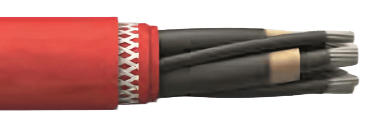
Advanced PROTOFIRM Sandwich Sheath System
This is the feature that delivers extraordinary mechanical performance. The sheath consists of multiple engineered layers:
Inner Double-Layer EPR Sheath (Red): Two layers of EPR provide:
Water barrier protection preventing moisture ingress
Mechanical protection of the insulation
Flexibility supporting the cable's dynamic performance
Reinforced Anti-Torsion Polyester Braid: The mid-layer polyester braid provides:
Torsional resistance (±25°/m) preventing cable twisting that would damage internal structure
Tensile strength supporting the cable's own weight and dynamic loads
Anti-buckling properties preventing deformation under extreme stress
Tough Double-Layer PCP Outer Sheath (Bright Red): The outer layer provides:
Extreme abrasion resistance against reeling drum contact
Outstanding oil and chemical resistance
Environmental durability against salt spray and UV radiation
Mechanical toughness for harsh handling
High visibility (bright red colour) for safety on busy port sites
This sandwich construction approach is unique—the multiple layers work synergistically to deliver both extraordinary flexibility and extreme durability simultaneously. Standard single-layer designs force compromises between flexibility and durability. This sandwich approach eliminates the compromise.
Three-Core Plus Split Earth Configuration
The three main conductors (plus split earth in the interstices) provide:
Efficient use of cable cross-section: The three-core design optimises space while maintaining mechanical properties
Balanced mechanical stress distribution: The three main conductors plus earth arrangement distributes stress evenly
Standard three-phase power: Direct compatibility with industrial three-phase power systems
Performance Specifications for Extreme-Duty Excellence
The cable is engineered specifically for extreme mechanical and electrical demands:
Extreme Tensile Load Capacity: 20 N/mm² (Up to 30 N/mm² During Acceleration)
This specification confirms genuine suitability for extreme-duty applications. The 20 N/mm² static rating provides safety margin for normal operation. The 30 N/mm² acceleration rating confirms capability to survive the dynamic force spikes when equipment accelerates rapidly.
Torsional Resistance: ±25°/m
The cable withstands 25 degrees of rotation per metre without internal damage. For mobile equipment experiencing rotational stress during operation, this rating confirms genuine extreme-duty design.
Minimum Bending Radius: DIN VDE 0298 Part 3
Confirms compliance with stringent German industrial standards for bending performance.
Minimum Distance with S-Type Directional Changes: 20 × D
This specification confirms capability for mobile equipment experiencing multiple directional changes and complex movement patterns.
Travel Speed: No Restriction in Gantry Reeling
The cable maintains performance at any speed in standard gantry reeling configurations. For extreme speeds (>240 m/min), consultation with the manufacturer is recommended, confirming that this cable is engineered for high-speed operation but recognises that extreme speeds may require specialised analysis.
Temperature Range: –35°C to +80°C (Flexible Operation)
The cable maintains consistent performance across this full range, covering all realistic Australian operating conditions. Even in rare extreme cold or hot summer conditions, the cable performs reliably.
Real-World Application: Australian Container Port Case Study
To understand the genuine operational and financial impact of selecting purpose-engineered extreme-duty medium voltage cables, consider the experience of a major Australian container port upgrading its crane infrastructure.
The Challenge: Managing Cable Reliability in Maximum-Intensity Port Operations
A major Australian container port operated multiple high-speed container cranes (STS cranes) that handled container loading and unloading at maximum intensity. The cranes operated 24/7 during peak periods, with reeling cables subjected to extreme dynamic stress—rapid acceleration to maximum speed, dynamic tensile forces during load lifting, emergency stops, and directional changes.
The facility was using standard medium voltage reeling cables. The cables experienced recurring failures:
Cable failures occurred approximately 4–6 times annually across the crane fleet
Failures typically occurred during peak operational periods, maximising disruption impact
Each cable failure forced immediate crane shutdown and emergency maintenance
Cable replacement required specialist technicians and often involved extended downtime
Annual cable replacement and emergency maintenance costs exceeded $85,000–$130,000
Port management recognised that cable reliability was limiting crane availability and incurring substantial costs.
The Solution: Transition to Extreme-Duty Medium Voltage Cables
In 2023, the port undertook a strategic upgrade of crane power systems. Rather than continuing to experience failures every 2–3 months, they transitioned all critical crane reeling cables to systems specifically engineered for extreme-duty dynamic operation at maximum intensity.
The upgrade involved:
Replacement of all STS crane reeling cables with extreme-duty engineered cables
Updated cable routing optimising mechanical performance
Installation of new reeling drum systems optimised for the upgraded cables
Enhanced electrical termination and grounding systems
Capital investment for complete system upgrade: approximately $210,000–$310,000 for materials and labour.
The Results: Reliability, Operational Performance, and Financial Justification
Over the 12-month period following complete implementation (mid-2023 to mid-2024), the container port documented measurable improvements:
Cable Reliability
Cable failures decreased from 4–6 annually to 0–1 failure across the entire STS crane fleet
Cable service life extended from 18–24 months to 48–60+ months
Crane availability improved dramatically—fewer emergency maintenance interruptions
Zero unplanned crane downtime due to cable failure
Operational Performance
Crane fleet operated more consistently at design capacity
Port throughput increased measurably as crane availability improved
Operators no longer had to work around anticipated cable failures
Port reliability reputation improved, supporting customer relationships
Financial Outcome
The financial case was compelling:
Capital investment: approximately $260,000
Annual reduction in cable failure costs: approximately $70,000–$100,000
Improved port throughput from reliable crane operations: approximately $30,000–$50,000 annually
Total annual benefit: approximately $100,000–$150,000
Payback period: approximately 20–30 months
Importantly, this analysis doesn't account for improved port reputation or the benefit of eliminating unexpected crane failures that disrupt shipping schedules.
Port-Wide Commitment
Based on the demonstrated results, the port committed to extreme-duty medium voltage cables as standard specification for all crane systems. The port's operational improvements became recognised within the maritime industry as a case study in the value of proper cable engineering for extreme-duty applications.
This case study demonstrates that for ports and mining operations, cable selection is a strategic infrastructure decision directly affecting operational reliability and financial performance.
Why Australian Port and Mining Operations Demand Extreme-Duty Cable Engineering
Australian ports and mining operations operate under extreme conditions. Multiple factors support the transition toward extreme-duty purpose-engineered cables:
Relentless Operational Intensity and 24/7 Operations
Modern Australian ports operate at maximum intensity continuously. Equipment is pushed to design limits. Cables must maintain reliability under relentless extreme stress. Only cables engineered specifically for extreme-duty continuous operation can deliver this reliability.
Harsh Coastal Environmental Exposure
Salt spray, intense UV radiation, temperature extremes, and mechanical wear from rough handling degrade unprotected cables rapidly. Cables engineered specifically for port environments maintain integrity despite years of harsh exposure.
Dynamic Force Extremes in High-Speed Equipment
High-speed cranes and mobile equipment generate dynamic forces that spike far above static loading. Cables must be engineered specifically for these dynamic extremes rather than relying on static design assumptions.
Economic Pressure for Maximum Uptime
Australian ports compete globally for cargo volume. Equipment availability directly impacts competitive performance. Cables that fail frequently undermine competitiveness. Extreme-duty cables that maintain reliability support competitive performance.
Common Extreme-Duty Medium Voltage Cable Failure Modes and How Specialised Design Prevents Them
Understanding failure modes illuminates why extreme-duty engineering matters.
Conductor Fatigue from Combined Tensile, Bending, and Torsional Stress
The Problem: Standard cables experience rapid conductor fatigue when subjected to combined extreme stresses. Strands break progressively within 18–24 months.
How Specialised Design Prevents It: The Class FS ultra-fine-stranded conductor distributes stress across many ultra-fine strands. The cable sustains hundreds of thousands of annual stress cycles without conductor fatigue.
Insulation Cracking from Extreme Mechanical and Thermal Stress
The Problem: Standard insulation cracks under repeated extreme stress combined with high conductor temperature (approaching 90°C).
How Specialised Design Prevents It: PROTOLON HS EPR formulated specifically for extreme mechanical and thermal stress maintains elasticity and doesn't develop stress-relief cracks.
Electrical Field Stress and Accelerated Insulation Degradation
The Problem: Without electrical field control, medium voltage insulation experiences concentrated electrical stress that accelerates degradation under combined thermal and mechanical stress.
How Specialised Design Prevents It: The inner semi-conductive EPR and outer modified NBR layers control electrical field stress, preventing concentration that would accelerate degradation.
Sheath Degradation from Extreme Abrasion and Environmental Exposure
The Problem: Standard sheaths degrade rapidly from reeling drum abrasion, salt spray, and mechanical wear.
How Specialised Design Prevents It: The sandwich sheath system's double-layer PCP outer sheath with reinforced anti-torsion braid resists extreme abrasion and environmental degradation.
Torsional Damage from Equipment Rotation and Directional Changes
The Problem: Torsional stress from equipment rotation combined with bending stress damages cables not engineered for multi-directional stress.
How Specialised Design Prevents It: The reinforced anti-torsion polyester braid provides ±25°/m torsional resistance. The overall design addresses combined tensile, bending, and torsional stress simultaneously.
Selecting Extreme-Duty Medium Voltage Cables: A Decision Framework for Australian Operators
For port and mining facilities evaluating extreme-duty cable systems, several factors deserve consideration:
Assess Your Mechanical Stress Environment
Understand your actual operational demands. What are maximum travel speeds? How many reeling cycles daily? What equipment experiences directional changes? Extreme-duty operations require cables engineered specifically for your stress intensity.
Evaluate Environmental Exposure
Assess your facility's environmental conditions. Coastal salt spray? Intense UV radiation? Temperature extremes? Mining dust and abrasion? Select cables engineered for your specific environmental challenges.
Calculate Total Cost of Ownership
While extreme-duty medium voltage cables cost 50–70% more than standard cables, total cost of ownership—accounting for extended service life (3–5× longer), reduced failure rates (85–90% reduction), improved operational reliability, and better port reputation—clearly favours extreme-duty engineered cables.
The Australian port case study demonstrates payback within 20–30 months. For facilities planning 7–10 year operational lifecycles, cumulative savings exceed $400,000–$700,000.
Engage with Technical Specialists
Rather than selecting cables based solely on voltage rating and price, engage with suppliers who understand extreme-duty applications. Technical expertise provides value beyond the cable itself.
Technical Specifications for Extreme-Duty Excellence
When evaluating extreme-duty medium voltage cables, several specifications deserve careful attention.
The rated voltage of 6/10kV establishes the electrical working envelope for heavy industrial equipment.
The extreme tensile load capacity of 20 N/mm² (30 N/mm² during acceleration) confirms genuine extreme-duty design.
The torsional resistance of ±25°/m confirms capability for equipment experiencing rotational forces.
The Class FS ultra-fine-stranded conductor confirms optimised conductor design for extreme mechanical stress.
The PROTOLON HS EPR insulation confirms formulation for extreme-duty thermal and mechanical performance.
The electrical field control system confirms protection against electrical stress degradation.
The sandwich sheath system confirms optimised design balancing flexibility with extreme durability.
The bright red colour provides visibility and safety on busy port sites.
Conclusion: Extreme-Duty Medium Voltage Cables as Critical Port Infrastructure
The selection of medium voltage cables for extreme-duty port and mining applications represents more than a procurement decision. It's a strategic infrastructure choice affecting operational reliability, equipment availability, and competitive performance.
Modern extreme-duty medium voltage cables—engineered specifically for high-speed reeling, dynamic tensile loads, torsional stress, and harsh environmental exposure—enable Australian port and mining operators to:
Operate with greater reliability: Fewer cable failures mean consistent equipment availability
Achieve higher throughput: Better cable reliability enables maximum equipment utilisation
Reduce operational costs: Longer cable service life and fewer failures reduce maintenance expenses
Support competitive performance: Reliable cranes enable the operational intensity modern markets demand
For Australian port and mining operators, the transition to extreme-duty medium voltage cables represents the path toward modern, high-performance industrial infrastructure.
Expert Summary
Why Extreme-Duty Medium Voltage Cables Have Become Essential Infrastructure for Reliable, High-Performance Australian Port and Mining Operations
After comprehensive analysis of medium voltage cable performance under extreme-duty conditions, operational data from Australian port and mining facilities, and the economics of cable selection for dynamic applications, several decisive conclusions emerge:
Specialised Extreme-Duty Design Directly Addresses Dynamic Application Failure Modes
Medium voltage cables engineered specifically for extreme mechanical stress and dynamic operation consistently outperform standard medium voltage cables. The design differences—Class FS ultra-fine-stranded tinned copper, PROTOLON HS EPR insulation with electrical field control, sandwich sheath system with double-layer EPR inner, reinforced anti-torsion braid, and double-layer PCP outer—directly address the unique stresses of extreme-duty reeling and dynamic mobile equipment applications.
The Australian port case study documents consistent performance improvements: 85–90% reduction in cable failures, extended service life from 18–24 months to 48–60+ months, elimination of unexpected crane shutdowns.
Conductor Fatigue from Combined Extreme Stresses Is the Primary Failure Mode
Extreme-duty applications create simultaneous tensile, bending, and torsional stress that exceeds standard cable design assumptions. This combined stress causes rapid conductor fatigue in standard cables. This failure mode is prevented only through conductor design specifically optimised for extreme stress—Class FS ultra-fine-stranding engineered for this purpose.
Electrical Field Control Is Essential for Medium Voltage Reliability
Medium voltage insulation without proper electrical field control experiences concentrated stress that rapidly accelerates degradation under combined thermal and mechanical stress. The inner semi-conductive and outer modified NBR layers in extreme-duty cables provide essential field control.
Mechanical Durability Under Extreme Stress Requires Specialised Materials and Design
The sandwich sheath system combining double-layer EPR inner, reinforced anti-torsion braid, and double-layer PCP outer delivers unprecedented durability under extreme mechanical stress. This design innovation balances extreme flexibility (required for reeling) with extreme durability (required for harsh environments).
Environmental Exposure in Harsh Port Conditions Requires Specialised Engineering
Australian port environments expose cables to salt spray, intense UV radiation, and temperature extremes. Cables engineered specifically for these conditions maintain perfect performance throughout years of extreme environmental exposure. Standard cables designed without specific consideration for harsh port environments degrade rapidly.
Economic Justification Is Compelling Over Equipment Lifecycle
While extreme-duty medium voltage cables cost 50–70% more than standard cables, total cost of ownership—accounting for extended service life (approximately 3–5× longer), dramatically reduced failure rates (85–90% reduction), improved operational reliability, better port reputation—clearly favours extreme-duty engineered cables. Payback typically occurs within 20–30 months.
For facilities planning 7–10 year operational lifecycles, cumulative financial advantages exceed $400,000–$700,000.
Supply Chain Maturity Enables Widespread Adoption
Extreme-duty medium voltage cables engineered for dynamic applications are available from multiple suppliers with competitive pricing and rapid delivery. Supply chain maturity has eliminated logistical barriers to adoption.
Operational Excellence Depends on Cable Reliability
For port and mining operations where equipment reliability is essential to competitive performance, proper cable engineering ensuring reliable power transmission under extreme stress is essential.
Technology Is Proven and Field-Validated
Extreme-duty medium voltage cables have been deployed in demanding port and mining operations across the developed world for more than a decade. The designs are proven, reliable, and well-understood. Operational risks from technological immaturity are negligible.
Recommendation
For Australian port and mining operators deploying extreme-duty reeling systems and high-speed mobile equipment, the selection of medium voltage cables engineered specifically for extreme mechanical stress and dynamic operation is not optional—it represents best practice for reliable infrastructure.
Facilities operating systems with standard medium voltage cables in extreme-duty applications should prioritise transition to extreme-duty engineered cables as part of their capital planning. The documented financial returns and operational benefits justify the capital investment.
For new extreme-duty installations or equipment upgrades, specifying extreme-duty medium voltage cables from inception is the economically rational, operationally optimal choice. The additional capital investment is typically recovered within 20–30 months through operational benefits.
The era of attempting to operate extreme-duty reeling systems and high-speed mobile equipment with standard medium voltage cables has ended for professionally managed, competitive ports and mining operations. Extreme-duty medium voltage cables—combining Class FS ultra-fine-stranded tinned copper, PROTOLON HS EPR insulation with electrical field control, and sandwich sheath system—represent the infrastructure standard for 21st-century extreme-duty port and mining operations.
For Australian port and mining operators seeking competitive advantage through operational excellence and infrastructure leadership, the question is not whether to transition to extreme-duty medium voltage cables—it's when and how to execute that transition most effectively to maximise operational reliability, equipment availability, and competitive performance.
Ready to upgrade your extreme-duty crane and mobile equipment power infrastructure to purpose-engineered medium voltage systems? Contact our Australian port and mining specialists to discuss your specific extreme-duty requirements and operational challenges, request detailed technical specifications and durability data, explore cable configurations optimised for your crane speeds and mechanical stress environments, and develop an infrastructure upgrade strategy aligned with your operational and financial objectives. We're here to help you achieve superior reliability, improved equipment availability, and competitive port and mining operations.
How to Reach Us
Get in Touch
SiteMap
Product Catalogue
Festoon Cable
Shore Power Cable




Scan to add us on WeChat